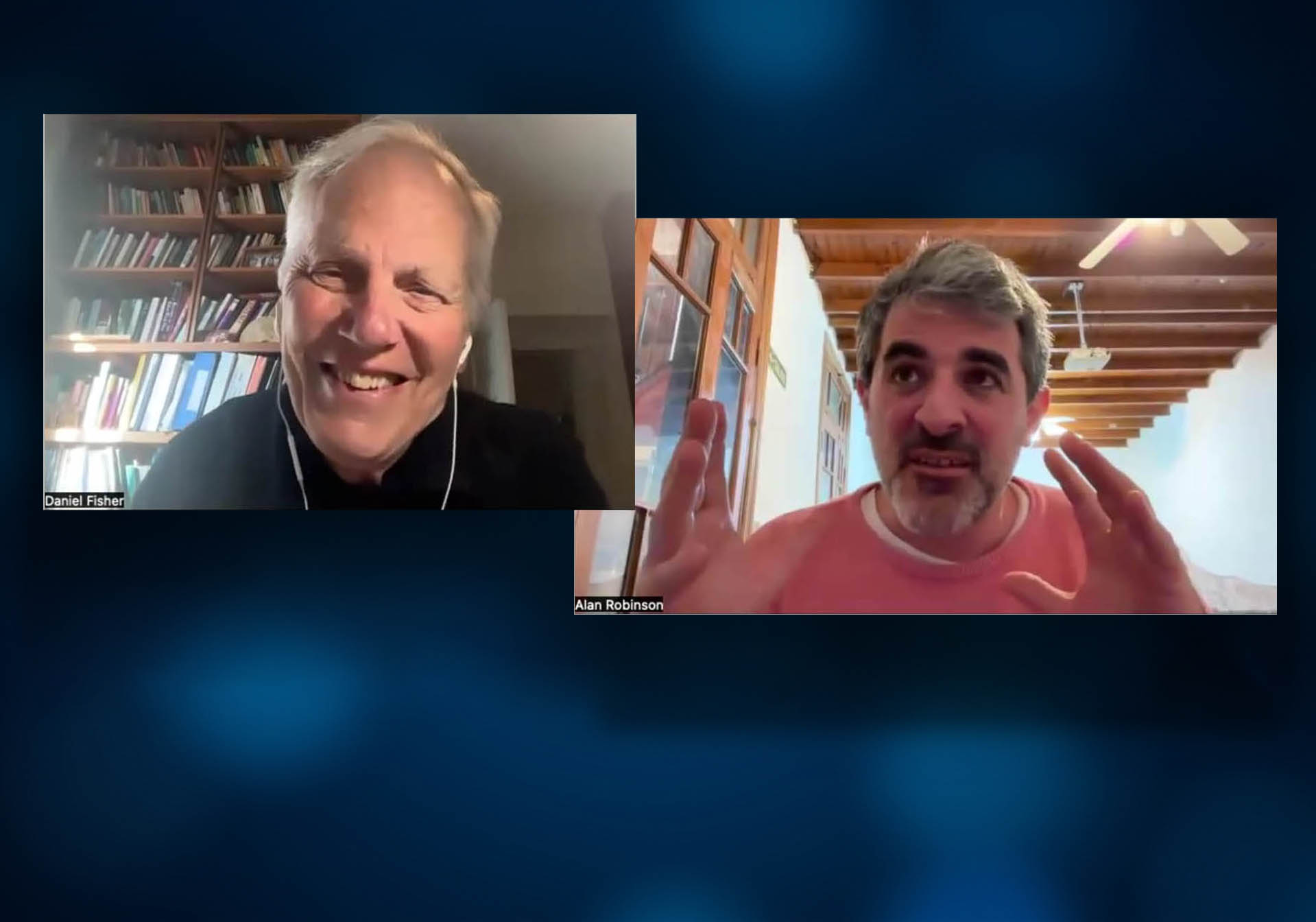
Editor’s Note: This Mad in the World report features an interview with eCPR founder Dr. Daniel Fisher, interviewed by Locura en Argentina founder Alan Robinson.
Dr. Daniel Fisher is an international pioneer in the mental health recovery movement who helped transform psychiatric care by demonstrating that full recovery from severe mental health conditions is possible. After personally overcoming a diagnosis of schizophrenia, he earned his medical degree from Harvard Medical School to reform the mental health system from within as a psychiatrist. A former member of the White House Commission on Mental Health and co-developer of Emotional CPR (eCPR), Dr. Fisher’s work has shifted international policy toward human connection and peer-led empowerment rather than forced treatment and lifelong institutionalization. He is also the author of Heartbeats of Hope: The Empowerment Way to Recover Your Life, which is being translated into Spanish.
Alan Robinson: Welcome, Dr. Daniel Fisher. In the early 1970s and 1980s, the Mental Patients Liberation Front (MPLF) was rooted in radical resistance. What was your first interaction with them like, and how did working with them shape your vision for peer-run alternatives?
Daniel Fisher: I first learned about the Mental Patients Liberation Front by reading a radical mental health newsletter called Madness Network News, which was published by a group in San Francisco starting in the early 1970s. At the time, I was completing my medical school training and discovered that the MPLF was located in Boston. When choosing where to do my psychiatric residency, I specifically sought a Harvard teaching hospital in Boston because the MPLF was there—not primarily because of Harvard itself. I instinctively felt that my best education would come from people with lived experience in the mental health system.
Prior to that, I had been hospitalized three times—twice before medical school and once during. Those experiences taught me that the mental health system desperately needed major reform, as the treatment was barbaric. I believed I could change the system from within by becoming a psychiatrist.
In 1976, I wrote to the MPLF asking to join. They sent back a postcard stating I could join as an ex-patient, but not as a psychiatrist. When I arrived in Boston and began my residency on an inpatient unit, a couple of hospitalized clients whispered to me that they knew who I was, as I had to keep my history quiet due to the severe stigma attached to a schizophrenia diagnosis. Eventually, they formed a group called “Friends of MPLF” for professionals with lived experience. Through that group, I met Judy Chamberlin, author of On Our Own, who became my lifelong mentor starting in 1976.
Later, another member blurted out to her psychiatrist—who happened to be Dr. Lee Mock, the head of my psychiatry department—that I was in the group. When I approached Dr. Mock, he called my lived experience a “great asset,” though he advised keeping it secret from other psychiatrists who would not understand.
Robinson: How did you handle the potential confusion or conflict of being both a former patient on one hand and a practicing doctor on the other?
Fisher: Bridging those two worlds has been a lifelong task. Initially, I coped by leading two separate lives and keeping my lived experience secret for three years, sharing it only with the head of the department. Over time, I earned the trust of survivor advocates. Judy Chamberlin used to joke that I was one of only three psychiatrists in the U.S. whom advocates accepted—the other two being Peter Breggin, author of Toxic Psychiatry, and Peter Stastny.
I waited until I finished my three-year residency before publicly disclosing my history. At the end of my residency, I was invited onto a television talk show, People Are Talking, to debate forced treatment. I invited my former supervisor to debate me. Right before we walked onto the stage, I told him I was going to reveal my past hospitalization. He sarcastically responded, “It’s very fashionable these days to have been hospitalized”.
Robinson: Both you and Dr. Pat Deegan received diagnoses of schizophrenia, were told you would never recover, and went on to earn doctorates. Did you feel living proof that the system’s prognosis was completely wrong?
Fisher: Yes, absolutely. Pat Deegan, who earned her doctorate in psychology, co-founded the National Empowerment Center (NEC) with Judy Chamberlin and me.
When giving talks to psychiatric audiences, many psychiatrists remained deeply skeptical about recovery. One psychiatrist told me after a talk, “You couldn’t possibly have had schizophrenia, because your presentation made sense”. The assumption was that people simply do not recover from schizophrenia.
Years ago, a friend attending a graduate-level abnormal psychology course at Boston University challenged her professor when he told the class that people never recover from schizophrenia. She mentioned that a friend of hers—a psychiatrist—had recovered. When the professor claimed I must have been misdiagnosed, they went through the DSM-III criteria item by item, confirming I met every single criterion, including catatonia, mutism, and being out of work and social functioning for over six months. Facing this evidence, the professor shifted his response to: “Well, if he met the criteria, he must still be sick—he’s just a case of a disabled psychiatrist”. It shows how deeply entrenched the belief in non-recovery was.
At the National Empowerment Center, we developed six core criteria for recovery. The primary criterion is that neighbors and community members would not suspect your psychiatric history—that you can pass as another member of the community, make your own decisions, build an independent support network outside the mental health system, and feel capable of running your own life. Whether someone takes medication or not is not the determinant of recovery, as many people lead full, meaningful lives while taking medication.
Robinson: In the 1980s, figures like Leonard Roy Frank and Howie the Harp were central to the radical ex-patient movement. How were you received when entering those spaces, and how did collaborating with leaders like Howie influence your approach to peer support?
Fisher: Howie the Harp was initially skeptical, but having Judy Chamberlin vouch for me gave me credibility. Leaders like Howie inspired me tremendously. As a shy person who disliked public speaking, their courage encouraged me to find my voice. Howie was a burly man who used a cane, and at the start of meetings he would lift his cane and shout, “I’m raising Cain!”. Their fearlessness was incredible.
They recognized that because of my credentials, I could enter settings and reach audiences they could not access. In 1984, a rehabilitation specialist informed me of a Medical Director opening at a community mental health center. I stated I would only apply if I could openly disclose my lived experience. They agreed, which allowed me to hire other professionals with lived experience. However, working within the traditional system remained stressful because its primary orientation was control, making mutual support groups among staff essential.
Robinson: Judy Chamberlin famously attributed her recovery to being a non-compliant patient. How did working with her influence how you practiced psychiatry, and how did you navigate these radical perspectives alongside federal funding at the National Empowerment Center?
Fisher: Judy and I shared a deep outrage and passion for reform. At the National Empowerment Center, we received 70% to 80% of our funding from the federal government, which meant we constantly had to push the boundaries while navigating what the government would accept. When Judy wrote an article titled Confessions of a Non-Compliant Patient for our newsletter, we debated how funders would react, but they ultimately accepted it.
However, in 2010, when we invited author Robert Whitaker (Anatomy of an Epidemic) to keynote the national Alternatives conference, federal funders initially objected. After a massive email campaign sent directly to the White House during the Obama administration, federal officials permitted Whitaker to speak on the condition that another psychiatrist, Dr. Mark Ragins, present a critique. Navigating these dynamics is a tightrope walk where you push for radical change while assessing how much pushback the organization can sustain.
Robinson: You were appointed to the President’s New Freedom Commission on Mental Health in 2002. How did that policy battle unfold, and how did you ensure recovery became a central focus?
Fisher: When I was appointed as a commissioner in 2002, there was significant debate within the movement about whether I should join or if it would result in co-optation.
At our very first meeting, broadcast on C-SPAN, I declared in my opening statement that recovery must be the central theme of the commission. At the time, other commissioners were focused on clinical remission at best. When a group of fellow advocates sitting in the audience stood up and applauded my speech, an official sitting next to me asked what was happening, as he had never seen applause at a government meeting. I told him, “This is a movement. Millions of us are watching”.
I fought to expand the public testimony time from 15 minutes to 45 minutes at our monthly meetings across the country, bringing in local advocates to share their stories with passion. By the end of the year, recovery was adopted into the official mission statement of the White House Commission report: “We envision a future where everyone with a mental illness will recover”. That report became a landmark document used globally to legitimize recovery.
Afterward, activist Sally Zinman and I recognized the need to train emerging leaders. Together with Judy Chamberlin, we created the “Pioneer Voice” training based on the “P’s of Empowerment”—including Peer support, Purpose, and transforming anger into Passion.
Robinson: You and Laurie Ahern co-developed the PACE curriculum. How did you translate survivor movement principles into practical, real-world alternatives to traditional psychiatric care?
Fisher: Laurie Ahern, a journalist and advocate with lived experience, joined the Empowerment Center and pointed out that full recovery was a well-kept secret that needed to be broadly communicated. We obtained federal funding to conduct a qualitative study interviewing peers to define the core principles of recovery, identifying 13 key principles. This formed the basis of PACE (Personal Assistance and Community Existential).
PACE was also a critique of PACT (Program of Assertive Community Treatment). While PACT aimed to support people in the community, it often resulted in trans-institutionalization, where individuals remained trapped within a closed loop of continuous system supports without a path to true independence.
True alternatives are voluntary, home-like peer-run respites. The first peer-run respite was created in 1995 by Shery Mead in New Hampshire. Today, there are around 50 peer-run respites across the United States, providing intensive, non-coercive support operated entirely by people with lived experience.
Robinson: Looking back on your journey as a historical pioneer in this movement, what is your message for the future?
Fisher: The mental health system will not give up its power without a struggle. While I am not an abolitionist—because removing the mental health system without alternatives would leave prison as the only option—we must continuously organize laterally across the globe to demand our rights and demonstrate our capabilities.
Furthermore, as society turns increasingly toward artificial intelligence, we will see its limitations. AI lacks a heart; it cannot feed people’s dreams or replace genuine human connection. This technological shift highlights the urgent need to return to the root of our shared humanity—which is precisely what our movement represents.