As I sit here in my—as I like to call it—Oasis in the Desert, looking out my window at the morning clouds gloriously dancing to the tune the songbirds sing every morning is simply a treasure. I can smile at the sun and sway with the wind as it tickles my senses. I enjoy this morning view as I sip a cup of sweet herbal tea and take in the rays of light.
There was a time when such treasures were absent in my mind. I was living with undeniable pain that I could not explain, except in my poetry.

It’s my heart that aches the most.
The feeling of nerves tearing and bones slowly breaking.
Flares of fire running through my veins.
The words that everyone took as metaphorical were literal words of agony from trauma that started decades earlier. It would take over half a century to discover the root cause of the autoimmune conditions that developed, the near dementia scares. At one point, I was having severe neurological attacks where I lost control of my limbs entirely, making them feel as though they were being tossed around like a rag doll. I picked three alcoholic husbands and stayed in abusive relationships. Little did I know that all of this was coming from the same place: unprocessed trauma.
It took me by surprise too. I had been making decisions about who I chose to be my mate based on what I thought was normal from what I experienced as a child. I had suffered sexual abuse more than once, starting when I was only 7 at the hands of a friend’s oldest brother, then an uncle who was visiting, with the worst culprit being my own father. What does a horrific experience like that do to the mind of an innocent child? Nobody was ever prosecuted, my therapy was abruptly stopped, and nothing was done. Left without justice or support, I was left to navigate the aftermath entirely on my own. This meant those early patterns quietly and unknowingly dictated my choices for years.
Decades later, the trauma manifested itself as depression. The connection wasn’t obvious because nobody asked the core question: What happened in your childhood?
So many individuals struggle with trauma that they cannot even name, for we are told, even by medical professionals, that we must focus on our future and that going backward is not in their school of thought. However, trauma is the poisonous seed that grows weeds of unnecessary pain that need to be destroyed at the root.
I walked with pride for so many years, challenging the status quo despite what had happened. I buried it without realizing that everything always comes back if not properly addressed. The pain of betrayal is doubly sharp when there’s unprocessed trauma in the background. It is unfortunate that the questions that could have shaped my treatment were not asked.
I always did things differently, even as early as 6 years old when I was selected to teach a kindergartener English, showing a precocious initiative and drive to bridge gaps long before I understood what systemic obstacles even were. I remember thinking that it was important for my student, Alicia, to learn hopscotch as that would make it easier for her to integrate with the other children. I was an ESL assistant from third to sixth grade. Selling shiny rocks door-to-door for ice-cream money at age 6, writing formal letters in Spanish to my grandfather at age 8. At just 14 years old, I served as the inventory buyer for our family shoe store. I was entrusted to travel on buying trips with an adult and curate the shoes for our inventory.
Learning the mechanics of commerce, spatial merchandising and inventory selection at such a young age taught me how to analyze systems, spot value, and exercise practical strategy long before I ever had to apply those skills to my own survival. At 15, that same drive led me to approach my high school principal with a proposal to redesign the school uniform. I saw how the existing uniforms lacked functionality and aesthetic timelessness, so I designed an updated, structurally timeless uniform that my school adopted. I was already practicing the art of seeing what needed change, organizing a solution, and taking decisive action.
I dared not dwell on the horror of the abuse I had experienced, not realizing that my body would keep score. At that stage, blocking the pain was pure survival. I hadn’t yet allowed my mind to acknowledge the true scope of what had happened — confronting it all at once would have destroyed me, so I compartmentalized just to stay standing.
And then… I fell. It was not only a romance gone wrong that was the trigger; rather, it was the simultaneous collapse of my entire foundation. In the span of a single moment, I discovered that the person I loved was leading a double life, my ex-husband stopped paying for child support just months after I had bought my first home, and the job where I had established myself as a superstar was suddenly pulled out from under me. That triple blow — the profound betrayal, the financial abandonment, and the sudden loss of my professional footing — acted as the ultimate shock to my system, setting off a breakdown. The feelings of profound abandonment shattered the vault where I had locked away my childhood pain. The old trauma and all the new betrayals collided.
My nervous system went into severe distress. Instead of looking at the wreckage of abandonment and betrayal in my mind, medicine handed me a prescription.
Decades later, the disconnect was stark when a physician completely failed to address or even inquire about how that severe trauma could have served as the direct trigger for the physical and neurological breakdown that followed. By ignoring the root cause, they treated the symptoms in isolation, missing the underlying truth of what my mind and body were carrying. Instead, I was fed Zoloft to tame the depression that developed.

At first, something magical happened: I started writing poetry—not just writing but ‘downloading’ it. The poems didn’t require typical brainstorming or drafting; they arrived fully formed, as if my mind was simply acting as a receiver for raw, structured truth. I wasn’t tortured trying to find the words; they were spilling out of my brain onto whatever I could write on. My brain had shifted into an uninterrupted intuitive flow state.
I was excitedly sharing my newfound thrill with writing with a neurologist that I happened to be seeing for headaches. His astonishing response was the beginning of the end of my autonomy: “Only two kinds of people can write like that: Genius or Manic Bipolar.”
When I asked him to elaborate on the difference, he couldn’t. He did not ask me anything about my past, or what trauma could possibly be buried so deep that my system was failing. He completely missed the mechanism: the compounding trauma had already left my system in a state of acute crisis, and the introduction of Zoloft acted as a severe chemical trigger. By altering my brain chemistry without ever investigating the foundational shock my body was carrying, the medication pushed an already overwhelmed system over the edge into full neurological collapse, while the doctors simply looked on, blind to the connection between what had happened to me as a child and how my brain was reacting.
I don’t necessarily blame him for making that assumption without knowing the full weight of my past; after all, he was operating within a system trained to treat symptoms in isolation. He was a neurologist making psychiatric assumptions. Dangerous territory. That blind spot is precisely why I am writing this: because an assumption was made, a life-altering label was assigned, and the real story, the root trauma never addressed.
That moment with a multitude of doctors was the gateway into a two-decade labyrinth of polypharmacy. When one drug created new symptoms, another was added to quiet them. Nobody paused to consider how an environment of safety might calm an inflamed nervous system. The answer was there all along, but instead I stayed in an environment that kept re-triggering my trauma.
Medical literature now confirms what my joints and limbs already knew: individuals carrying unprocessed trauma face up to a triple risk of developing autoimmune conditions. The body does indeed keep score, turning unaddressed terror into physical fire, while standard medicine hands out pills instead of looking at the spark. When a body is kept under siege, trapped in an abusive environment, the nervous system absorbs the shock. Under extreme unyielding stress, the brain and body essentially short-circuit.
The medical literature refers to functional neurological disorders and somatic manifestations where physical motor control collapses not because of localized joint or bone defects, but because the central nervous system is overwhelmed. The ‘fractures’ weren’t just physical; they were the structural failure of a system trying to endure the unendurable. The proof of a body keeping score when the mind is forced to lock horror away just to survive.
As Patient Zero of my own recovery, I have documented proof of when these fractures manifested in my body, emerging during another devastating period when I was struggling with the acute grief of losing my brother while desperately trying to escape an environment where my trauma was constantly being re-triggered. It was coincidentally around the time that COVID struck when everything became evident. I could not remember simple tasks or hold down a job anymore. When everything collapsed and the neurological symptoms took over, I was suffering from severe vertigo, falling unexpectedly, and struggling with cognitive deficits so stark that doctors thought I should be monitored for early onset dementia. They ran tests and couldn’t figure out what was causing it, blind to the fact that my nervous system was physically breaking down under unrelenting stress.
The answer was never to be found in a pill bottle or another diagnosis. The true medicine I finally discovered was creating a safe environment; a physical and emotional sanctuary where my nervous system could finally step out of survival mode and into peace.
For decades my body and mind had been bracing against invisible threats, re-triggering old wounds every time my external world mirrored the chaos of my past. Once I removed myself from the toxic environments, drew hard boundaries, and established genuine safety, my mind and body were finally able to stop fighting and begin repairing themselves. Then came the return of my cognitive skills, the improved eyesight, the clarity in my mind and the pure happiness of being in a safe dimension that was not going to disappear.
Rebuilding from the ground up required listening to what my nervous system needed rather than relying on clinical labels. It meant stepping away from medications that masked or worsened the collapse, anchoring myself and channeling the raw emotional weight through my poetry and art rather than letting it calcify.
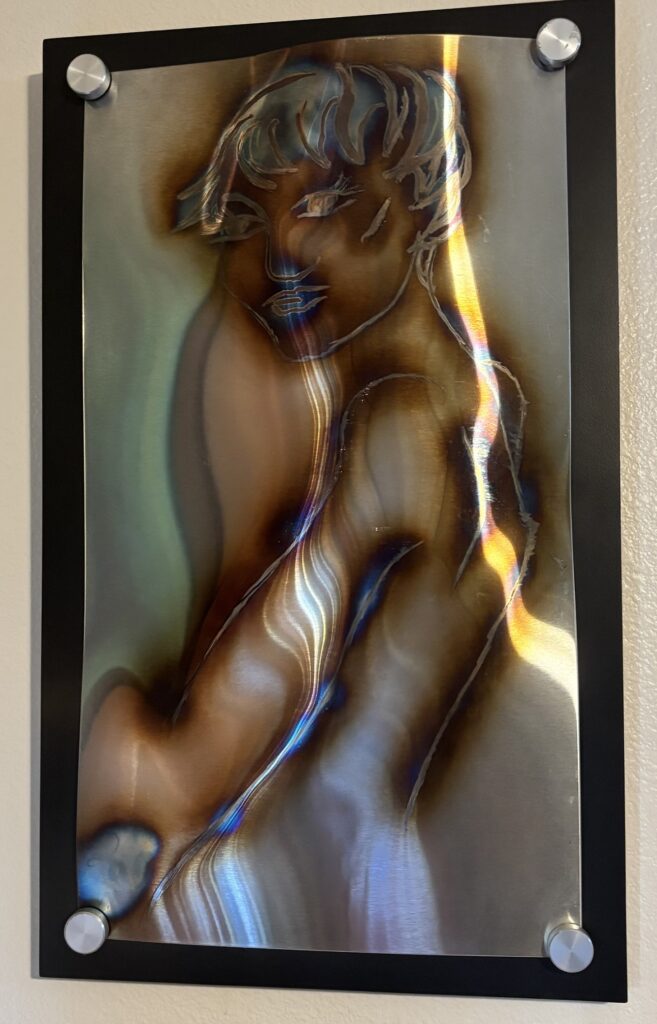
I chose to work with fire, developing a chemical thermal process to create art with fire on titanium and stainless-steel sheets. My work is an exploration of precision and controlled energy — rather than allowing heat to spread unpredictably, my process isolates and contains sharp, deliberate lines, turning raw industrial metal into a canvas of shifting light, color, and form that capture the tension between fragility and strength, giving physical permanence to the unseen emotional shifts of the human spirit. Applying fire directly to metal is an act of reclamation, taking a destructive element and using it to create a healing work of art where I can get lost in the moment, leaving all else behind. Anytime I am creating art or writing, it takes me to another world where trauma is absent; where I don’t ponder on the negative, I escape it entirely.
Recognizing alternative forms of treatment absent of mind-altering chemicals, including proven modalities like EMDR, has also brought a new light to my story. I can now dive into those dimensions of terror without getting lost there. Instead, I go there for artistic inspiration. Reclaiming my life demanded tough, uncompromising choices, drawing a hard line of tolerance for what I will allow, and refusing to ever accept less than absolute peace again.
As I sit here today in my Oasis in the Desert, watching the morning clouds dance and listening to the songbirds, I know the weeds have been destroyed at the root. My soul was never lost; it was simply waiting for a safe place to land.