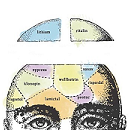
In the Greek Eleusinian mysteries, Persephone was the maiden abducted by Hades. She became the ineffable queen of the underworld whose name must not be spoken. One archaic root of her name, phónos, means “murder.” Her abduction was also her death. Yet in the ancient Mediterranean world, pilgrims traveled to Eleusis seeking an epiphany of her that might inspire hope for the soul’s return.
Two and a half decades ago, in the crisis of my first psychotic collapse, I met Persephone.
The seeds of that encounter were prefigured by the memory of a woman—for whom I had no right to feel anything beyond the measure of our brief encounter. Just a few meetings and conversations around my hometown of East Northport, Long Island, after college. Something she said struck me, about going to nursing school because “that is the only thing I am any good at.” An intuition of a saintly meaning in her words, which would otherwise have seemed banal. Then I went away to film school in Los Angeles. I was twenty-three.
Can we live our stories forward into the unknown and recover them in the afterlife of memory—like a dying person gathering his tales? After my psychic collapse, five years later, I would write of this underestimated encounter with the woman whose name I shall encipher here as N: “In all possible worlds, I met her. In all possible worlds, I lost her. Madness is but a door to the underworld, or perhaps the casting of a spell…”
Time is a metronome counting off.
One. The disaster. Unnamable loss.
Two. It is a hole, deep and dark.
Three. The tomb is the womb.
With whom was the encounter? Perhaps I was mad from this beginning, mad beyond measure. Then, all was forgotten for a while.
* * *
Fast forward a few years to life after film school, and to the night my mind shattered. Lived forward, the collapse felt like fragmented images constellating in a vortex of dark revelation. In hindsight, I see it was the beginning of katabasis—a descent into the underworld.
Signs of a deeply poetic nature began to speak to me: a flock of birds streaming through the tenements; a star-shaped leaf drifting on a torrent of rainwater; colors too intense to belong to the ordinary world. Then a young woman was murdered in my hometown.
At the time, I was working with the editorial staff on a documentary about Psycho, Gus Van Sant’s remake of Hitchcock’s film. Each evening, I watched the team rework the famous shower scene of a woman stabbed to death. In the blur of these signs, the murdered woman merged with the memory of the woman I once knew, whom I became convinced was in mortal danger.
Persephone was the maiden abducted by death. But one underworld myth weaves together with all the others, constellating together the ring of a laurel crown. I wrote in my diary of Orpheus, who lost his bride to Hades. By poetic metonymy, I became Orpheus. And Orpheus must descend to rescue her, even if his story is doomed.
So at 2 a.m., I called this woman’s house three times. She no longer lived there, but my desperate calls alarmed her parents. When her mother told me nothing was wrong, I realized I was quite mad. That moment precipitated my first psychotic free-fall—an abduction by underworld forces.
Writing for several days and nights, sleepless, in spiraling doodles on reams of notebook pages. Writing in many voices and “to the voices” —by whom I designate thoughts with an invasive agency so vivid that they did not belong to me. Writing myself to the gates of Hades. As the myth requires, Orpheus must fail. This is the brink where thoughts vanish into black. Nothing more to write. Except that the memory of this woman is a grave.
The ways we name this black can kill us. In the absence of an imaginal language, I could only imagine for myself compulsive flashes of my own death, by my own hand.
For three years I went in and out of hospitals, oscillating every few months between mania and suicidal depression. I underwent the standard regimen of medications, cognitive behavioral therapy and even a touch of Jungian therapy. One doctor advised, “Do not listen to the voices!” Yet I yearned for them—the dreams, the poetic signs, the strange illuminations where the streets shed their names, memories felt like inscriptions from a civilization that never quite existed, and people were shades in an underworld.
Another counselor advised, perhaps a little closer to the mark, “That woman was your anima” —the Jungian term for the feminine aspect of a man’s psyche, so easily projected onto actual women. Still, to my mind, that implied that the memory of the woman and her grave was merely a personally generated fantasy. I wished to testify otherwise.
* * *
Persephone is the first divine Name that came to me. Here is how this name first flashed forth from the abysmal waters.
I had been having nightmares, or perhaps nightmare was calling out to me. A terrifying milieu of chaotic, fearful impressions. Then one night, there was something—something in the dark with me—I could not see. It sat next to me: a woman in a black veil. Behind her rose a black mosque in a pitch-black void.
A saint
in a black mosque
nurses me
I awoke. My raised hand felt numb where she had held it to her tears.
I began a dream diary. I conducted this practice as if I were praying to that mysterious source and following its signs. Let me call this the divine dark. Here, darkness does not connote evil, but alterity (the state of being “other”) and unfathomability. It is a mystery radically other than me, and beyond me.
Another night, this darkness showed me a vision that changed the course of my madness:
I hear a man’s voice, strangely familiar as my own. He is singing a distant lullaby.
I rise in my sleep, ascending above the roofs of sleeping lovers and their children, above moonlit clouds. I look north.
Through the air hundreds of miles away, past nimbus and fell of drizzle, beyond tunneling winds, beyond that darkness: N. must be sleeping. If I sleep enough, perhaps I’ll see her.
What survives when the beloved is no longer possible, given to another in marriage, and their shared destiny of children?
It is my shade.
What makes a man singular? Beyond wealth, beyond fame, beyond excellence itself, if he were given a taste of love, he would surely spend his life’s remainder to find again–
– the dark Beloved in his heart, by which he might be healed of his hatred for all the world and God. She cannot die!
Persephone, the dark queen whose memory must never die. No longer the woman I met, but a deeper metaphysical image of descent, metamorphosis and return. To use Simone Weil’s term, this descent “de-creates” me. I am undone and unwound. Only through this unmaking is my return to life possible.
Giorgio Agamben, in The Unspeakable Maiden, wrote of Persephone as a principle of dark liminality—a Korē (the Greek word for “maiden”) suspended between life and death. Yet to my sensibility, Persephone belongs less to the threshold than to the nexus between death, de creation, and re-created life. Here I follow Carl Kerényi, who argued against Jung’s anima theory:
The Demeter-Kore myth is far too feminine to have been merely the result of an anima-projection. [The anima] is in the highest sense femme à homme, whereas Demeter-Kore exists on a plane of mother-daughter experience which is alien to the man and shuts him out.” (Carl Kerenyi, Eleusis: Archetypal Image of Mother and daughter)
Persephone is not a divine child archetype, nor the anima Jung imagined, but a matriarchal religious mystery bound to feminine destruction and creation.
From these origins I made a wager: to give a place to the “voices,” the dreams, the poetic signs in everyday life; to follow the “gods”—these theophanies I will never fathom or contain. The deeper mystery of Night I call the Black Virgin: a matrix of divine feminine names, of which Persephone was the first.
Over the next twenty-five years I was hospitalized only twice—and not at all in the last fifteen. In my travels since, I learned to walk with Her mysteries along the narrow tether between the ordinary social world and the soul’s nocturnal realm. I avoided support groups for bipolar depression, where the clinical catechism—Did you take your meds? Are you thinking of taking your own life?—too often foreclosed the visionary dimensions of her path. Instead, I embarked on a lifelong odyssey, in turns comic and heartbreaking, seeking comradeship across cultures and religions. I found rich resources for articulating divine darkness in Islamic mysticism, Taiwanese Buddhism, and the Black Madonnas of Afro-Caribbean and Hispanic Catholic traditions; as well as in friendships with colleagues, prisoners and civil rights activists. The Black Virgin became my guide into deeper shadow work—with my family’s traumas and deaths, and with the historical abjection and dispossession of others.
* * *
I began to write a book, first in confessional sketches. Then I curated them into a kind of palimpsest, preserving the original mad visions and my travels since then, lived forward. The inset text in italics within this story are excerpts from that book (Questions for Werewolves, Running Wild Press 2026). Yet there may be a third afterlife of memory in which I, like any person of lived experience, attempt to weave deeply felt visions into a more general, hospitable frame.
Recently, clinicians have spoken of madness and mysticism: the re-enchantment of psychology. Mysticism may be characterized in terms of intuitions of emptiness, nonduality, oneness or the infinite (e.g. Wouter Kusters, Ken Wilber); or else in terms of archetypal myths (e.g. Carl Jung, James Hillman). I wish to stake my own views, as a manifesto.
Mystical love and divine truth are not oriented toward any single person or esoteric idea. They are not affects, internal objects, or epistemes. They cannot be articulated in a conceptually satisfying way, even negatively. I believe instead in true images—not fantasies or allegories, but modes of contact with a transcendent mystery that always vanishes beyond its forms. I am skeptical of angelologies of light—too much light—which inflate the ego and foreclose shadow work. Katabasis draws us deeper into unseen matter. We descend again and again, de-creating ourselves to better love the Beloved and to cultivate compassion for the abject and dispossessed.
I am equally skeptical of reducing such images to a list of Jungian archetypes or systematic magical pantheons. Myths offer a second, imaginal language that helps us spiral beyond the flatlands of concept and system, but their narratives should not be conflated with the primal, poetic experiences—the primary process as psychoanalysts call it—that engender them. Kerényi himself held that mythical narratives are epiphenomenal to visionary experience itself, grounded in sensuous intuition and cultic practice, which glimpses divine secrets that remain unspeakable in the realm of ideas.
Nor do I accept Wilber’s claim that myth belongs to an immature, pre-personal stage of spiritual intelligence—a familiar esoteric denigration of animist and indigenous ways of knowing. Let me speak mythopoetically once more: Persephone is one name for a matriarchal mystery. Two of her epithets—She who presides over the underworld, She who rules the labyrinth—name the structure of descent:
Some griefs are so mysteriously deep that the soul must cross the threshold to Persephone before it can return. The underworld is a labyrinth. Metamorphic intuition may come like a golden thread—from the Mistress of the Labyrinth herself, perhaps—to guide the soul back. Hands and heart later weave these traces into a new form of life, somewhere in the indistinction between madness and sanity. By such names and their epithets, flashed in abysmal night, we know more deeply the divine dark, its unknowability, its merciful and transcendent love.
The Black Virgin is the soul’s bright darkness. She is the void that destroys and conceives meaning, the night that protects, the fire of yearning that liberates memory into both forgetting and deeper remembering. She is the mistress of shadow work. Persephone is one of her names. She commences the soul’s return to a new form of life.
“We created you in the highest of stature, and drove you into the lowest of the low.” (The Qur’an)











True images are the form, not beyond them. You can’t be Orpheus and Persephone at the same time. Why re-descend, and why throw away Ariadne’s golden thread only to ask for it again and again? There’s literally nothing down there in the labyrinth. The Sisyphean practice of deconstruction is meaningless and unfruitful.
The Christian God is the only God who provides reason and meaning to the ascent and descent. Put away childish toys and dwell on the surface, satisfied that there’s nothing more to discover in the dark.
Report comment
Persephone is a part of you. She seems to be a guide. Perhaps she’s trying to lead you to your personal hell, which is both a healing place and the place inside of you you fear most…
Report comment
Thank you, Jean-Phillipe, for such encouraging words. For myself, I would say Persephone is a divine name that has guided me on underworld journeys, which can be terrifying and healing, as you say.
It is very suggestive that you used the term ‘hell’ instead of ‘underworld’. Such underworld journeys can certainly be hellish; and all the more reason we need guides. But I also believe that they need not be so. I might cite Simone Weil, who wrote in a philosophical, mystical and Catholic milieu (Gravity and Grace). For her, “de-creation” is an unforming of the self, so as to better meet the divine. I weave that notion into my interpretation of Persephone’s mysteries. Perhaps the soul needs to un-form (as a kind of death) so as to better heal and re-form again, thus returning to this life (or next life) again as from winter into spring.
I imagine we are weaving kin threads of the same mystery. THank you again.
Report comment