

Earlier this year, a bill was proposed in the U.S. state of Connecticut to end forced shock treatment. To put it mildly, the bill restored my hope.
Electroshock treatment, eventually re-branded as electroconvulsive therapy (or “ECT,” for short), was first used to treat a patient diagnosed with schizophrenia in 1938. The procedure, which involves applying a voltage to a person’s head to induce a seizure, was soon applied to people with diagnoses such as major depressive disorder and bipolar disorder.
To date, there is still no consensus on the mechanism of action of how the repeated induction of seizures could improve one’s mental health.
Still, the American Psychiatric Association currently promotes electroshock treatment as an effective treatment for major depressive disorder, stating “substantial improvement in approximately 80 percent of patients.”
Yet there have only been 11 randomized controlled trials of electroshock for depression; none were double-blind, all were conducted before 1985, and more than half of them found electroshock didn’t even outperform a sham (placebo) treatment.
Electroshock treatment poses concerning risks of harm to both the brain and body, including permanent memory loss, cognitive deficits, and heart problems that can be fatal.
Worse, most patients are not informed about these potential harms, or the risk is dismissed as “minor.” As with psychiatric drugs, governments around the world have put in place laws intended to protect patients from psychiatrists at healthcare facilities who wish to perform electroshock treatment against patients’ will. Such laws are typically limited in their scope, allowing for forced electroshock when the decision is made by a psychiatrist that the patient’s mental state prevents them from being able to give informed consent. However, there are exceptions. Multiple U.S. states simply have no laws about electroshock on the books, and so allow it without any oversight. These states include Arizona, Georgia, Maryland, New Mexico, Rhode Island, and West Virginia.
Sadly, laws allowing forced electroshock to be performed on patients were only put in place after years of incessant patient abuse without regulation, rendering them better described as “laws preventing forced electroshock” so as to definitively describe the default condition in most states is to allow forced psychiatric treatments unless it is explicitly prohibited. Doing so would properly honor the accomplishment of activists passing the original 1971 law in Connecticut that abolished forced electroshock without the written consent of the patient.
Since 1971, protections have diminished, with Connecticut’s law now allowing for forced electroshock to be performed on an individual for a period of 45 days following the approval of a probate court judge (see C.G.S. § 17a-543(c)). The process is put in motion by the submission to the court of a form containing the signed approval of two physicians and the head of the requesting hospital.
Once the petition form is submitted, Connecticut law allows the hospital to begin performing the forced shock treatments. Though the patient may request a hearing to object, the patient’s request does not grant an automatic stay on the forced shock taking place… which means that they can forcibly shock a patient while the patient is waiting for their legal hearing.
The Clown, the Data, the Graph, and the Maps: How Forced Shock Treatment was Resurrected in Connecticut
Since my first encounter with involuntary psychiatric treatment in Hartford, Connecticut back in 2008, I dreamt of a world free from all forms of forced mental health services. My later introduction to the psychiatric survivor movement in 2017 brought awareness of an effort born in the early 1970s that, at least, delivered the legal changes to state laws around the U.S. that still give us the right to a legal hearing prior to being involuntarily drugged and/or electroshocked. To me, the existence of these hearings represented a tangible artifact of progress toward an ultimate end. The impossible was possible.
In comparison, my personal efforts to realize the fantasy have largely fallen flat, at times seeming only to further perpetuate the negative stereotypes of a labelled person. And, admittedly, the ambitious dream—of one day witnessing the finale to forced psychiatry without ever even imagining that the first act could be the conclusion to forced shock in the very state I was born—was a naïve one, which eventually seemed to have left me forever hopeless in the absence of any evidence of victorious progress.
Learning that my own home state of Connecticut was considering abolishing forced electroshock was a wake up from the child-like dream world turned nightmare, and into a reality where the first act was already underway.
Hope seemed to return.
Sadly, the deadline for the bill to be put out for public testimony uneventfully rolled by, quickly leaving me wondering whether the bill itself had been nothing more than a dream.
As one does, I reported to clown duty at Hartford’s Bushnell Park, where I spoke with many Connecticut residents about the state’s forced electroshock laws. After convincing people that it was, in fact, really legal to perform electroshock treatment on someone against their will, most responded with some version of “well, just because it’s legal doesn’t mean they actually do that to people.” Without having a law that I could point to (C.G.S. § 17a-543(c)) or being able to tell them I’m an electroshock survivor myself (I’m not), I didn’t really have the answer people deserved.
In search of hard data, I began writing to the probate courts and found my answer surprisingly quickly from the State of Connecticut Office of the Probate Court Administrator, which provided the district-by-district data showing just how many petitions were filed by mental health facilities in Connecticut requesting permission from the probate courts to perform forced electroshock on people from 2012 to present.
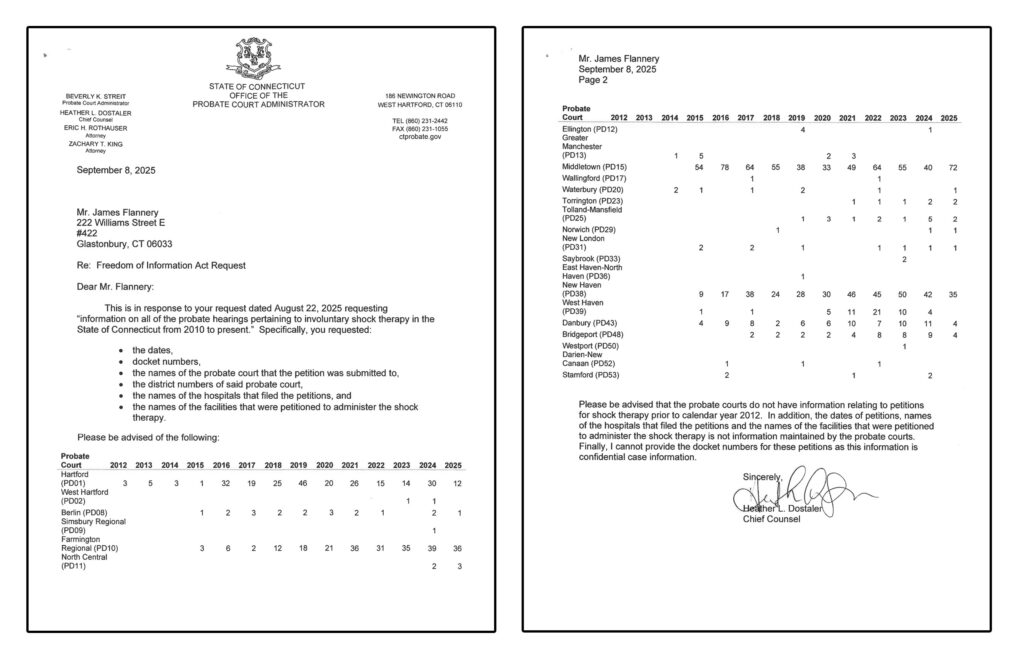
The heartbreak of seeing the unexpected increase found in the 2015 data for the first time was only made worse by the uncomforting realization that every district of the 24-row data table contained within it a story of a mental health facility and (at least) two physicians making the decision to bring back forced electroshock treatment.
Without further preface, the state-wide data graph showing the number of forced electroshock petitions filed to probate courts by mental health facilities throughout Connecticut from 2012 to 2024:
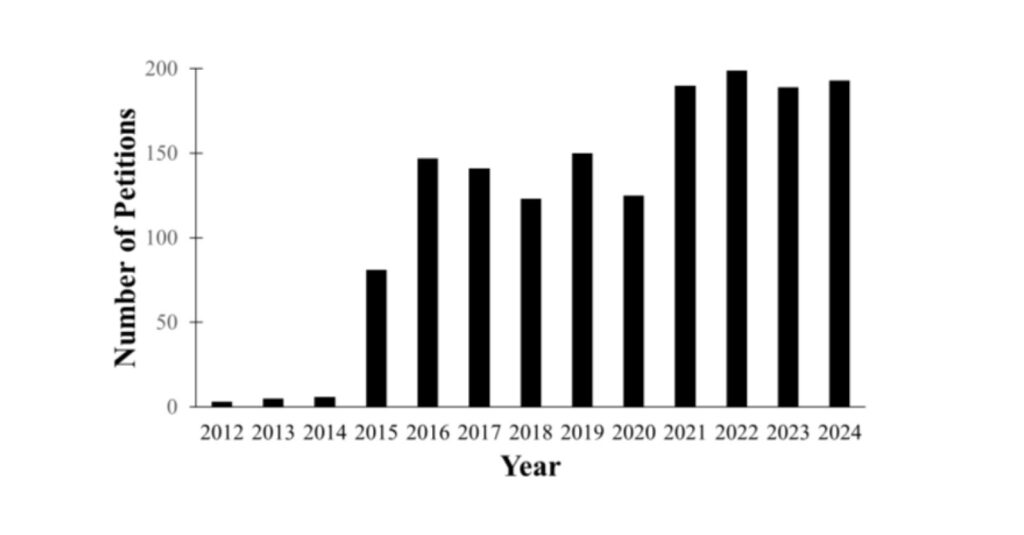
The graph clearly shows an explosive state-wide increase beginning in 2015, but what caused it? To understand, one has to look at the data on a district-by-district basis and even on a geographical basis, hence the timelapse map of the data by probate district:
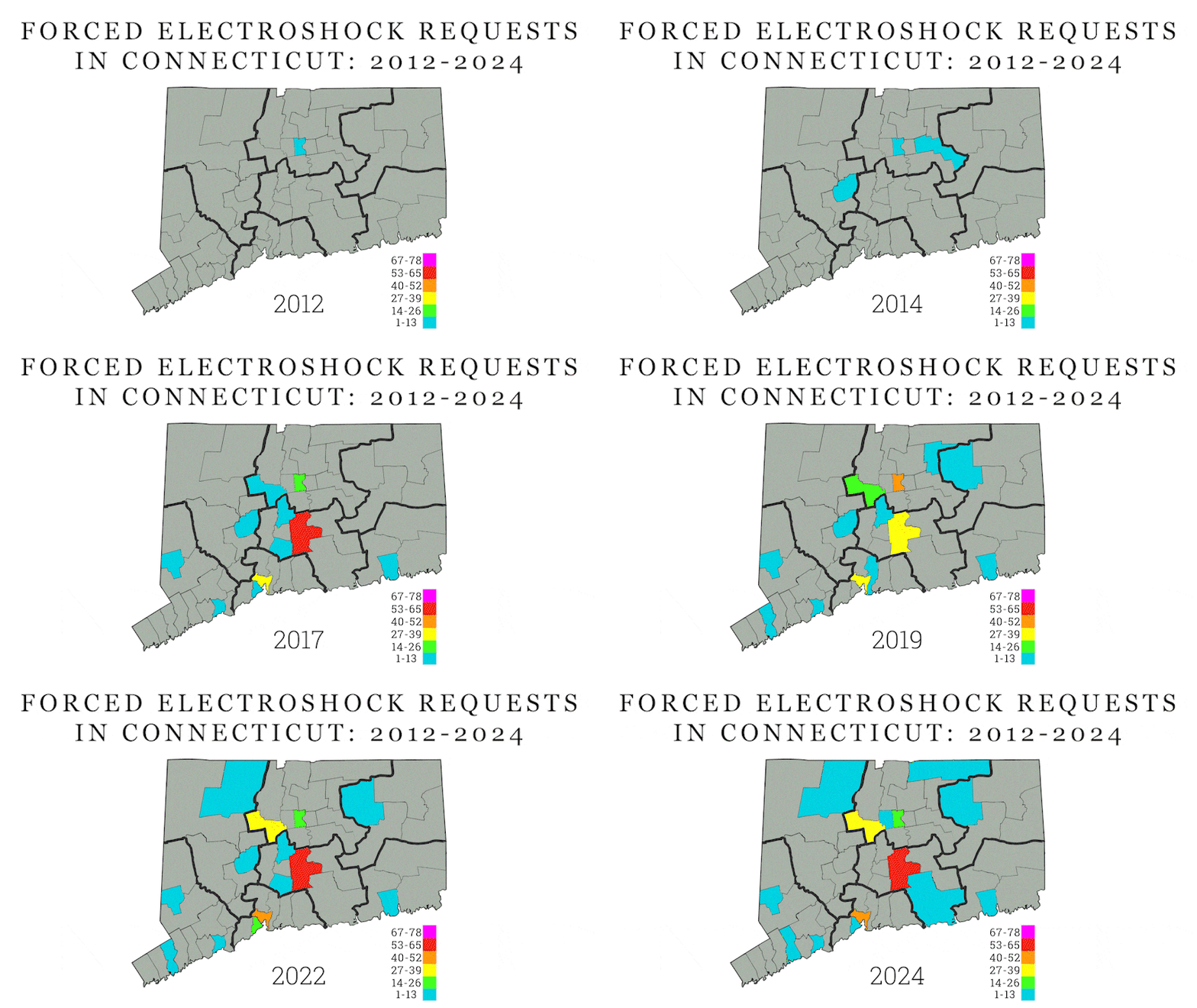
What we see just before and after the 2015 increase, unfortunately, appears to be nothing more than the spread of Connecticut gossip; we’re watching the decision to use forced electroshock be born in Hartford, circle around to its neighbors in Manchester and Waterbury, hop on over to Middletown, and then head down to New Haven and as far as Stamford.
This is seen more clearly with a version of the map animation that highlights the earliest data from 2012-2016.
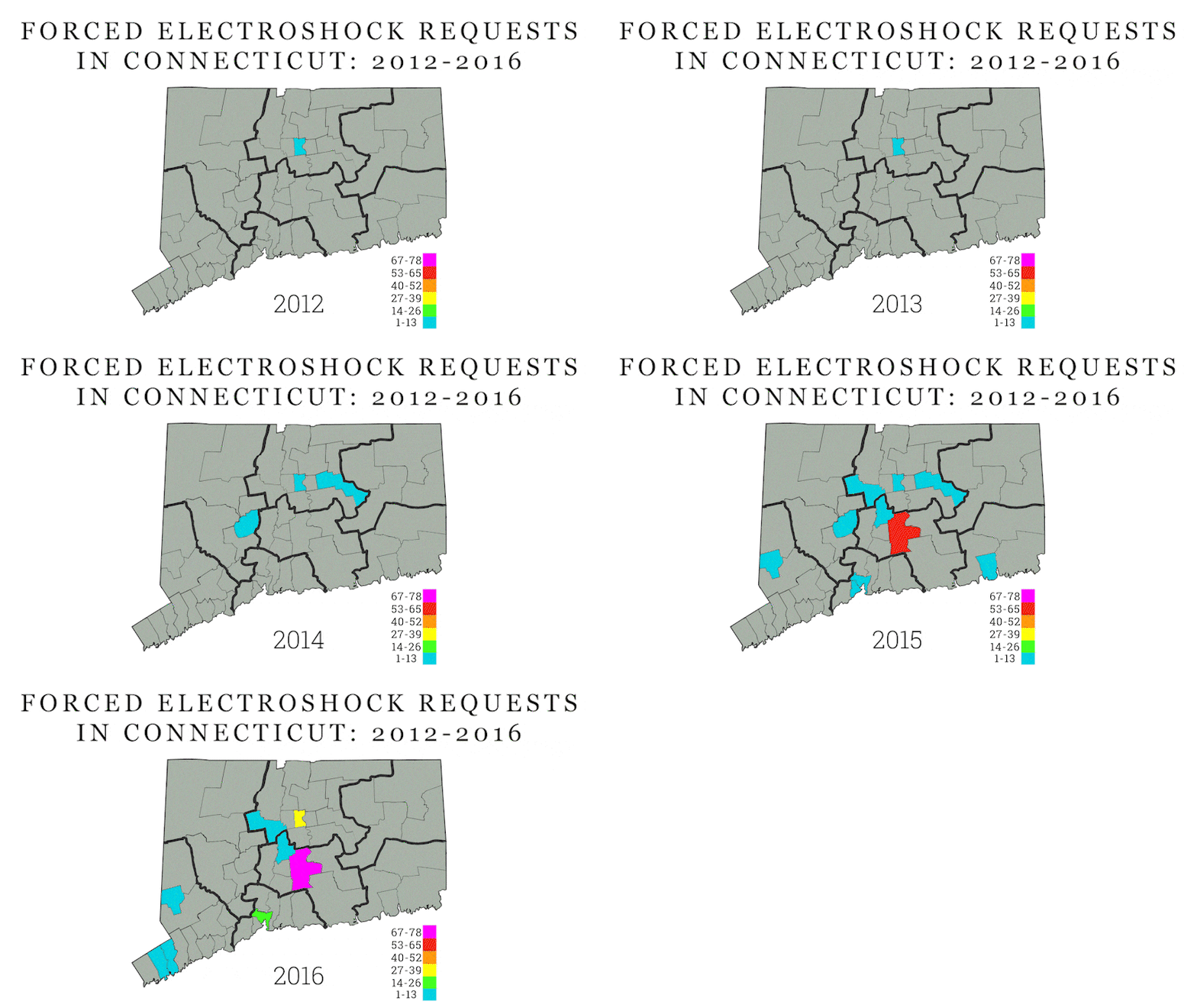
To put it bluntly: the return to forced shock is simply growing by word of mouth and what we are seeing here is not the result of a law being changed or under-reporting, but instead is just geographical.
And, to put it dreadfully: it appears that in almost any part of the state where one might now go to find a mental health facility in Connecticut, they may be at risk of forced electroshock treatment.
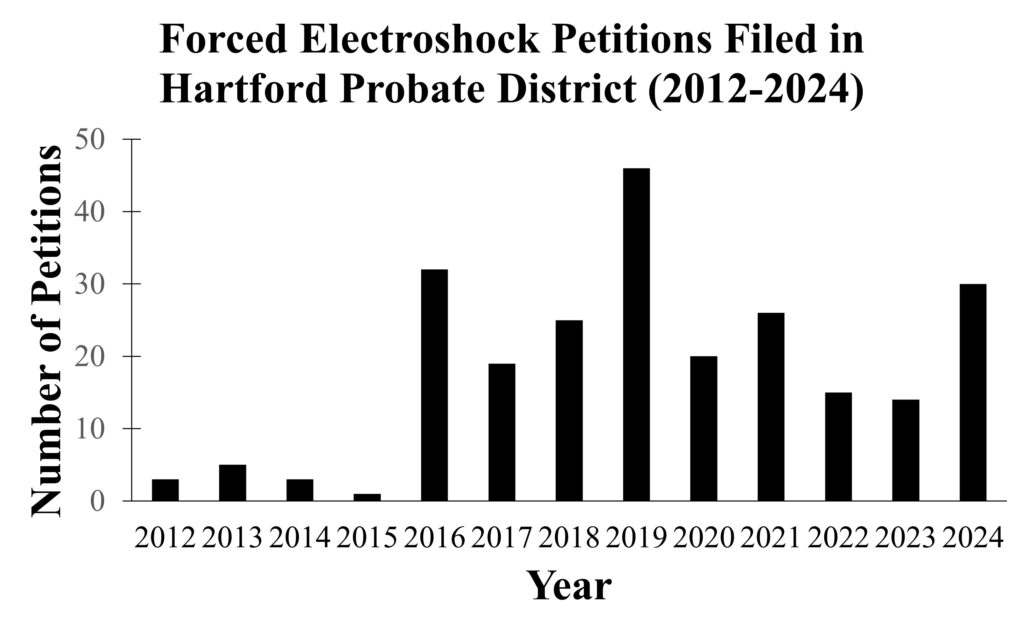
This was not the case in 2012 when only Hartford Probate District received forced electroshock requests.
And it sure was not the case in 1971 after the first law protecting individuals from forced electroshock was passed in Connecticut.
I’m sorry, it just doesn’t look good at all.
And I don’t think anything short of a Million Clown March is going to succeed in fighting this thing.
But I can at least address questions pertaining to this data and hopefully my (admittedly limited) knowledge of Connecticut can provide a worthwhile additional insight.
UNDERSTANDING CONNECTICUT’S FORCED SHOCK DATA
Why the huge increase in forced electroshock petitions in 2015 (and the continued growth since then)?
Identifying the cause of the increase is the most important (and upsetting) aspect of this analysis. I’ve been unable to explain away the increase through under-reporting, legal changes, or a mental health epidemic, which leaves us with a potentially lethal wound from Occam’s Razor: that the simplest explanation for the growth of forced electroshock throughout Connecticut is simply through the spread of the belief that it is worth the risk.
Do these probate requests represent actual forced shock?
A forced electroshock petition that is approved by a Connecticut probate judge grants the healthcare facility the right to perform forced electroshock on the patient for up to 45 days (see C.G.S. § 17a-543(c)). During this time, a patient can expect to receive two to three electroshock treatments per week.
Connecticut law also allows for forced electroshock to begin immediately after the filing of the probate court request—before the legal hearing where the probate judges allows or denies the forced electroshock procedure—which means that every single petition filed can represent an individual being electroshocked against their will (see C.G.S. § 45a-186(i)).
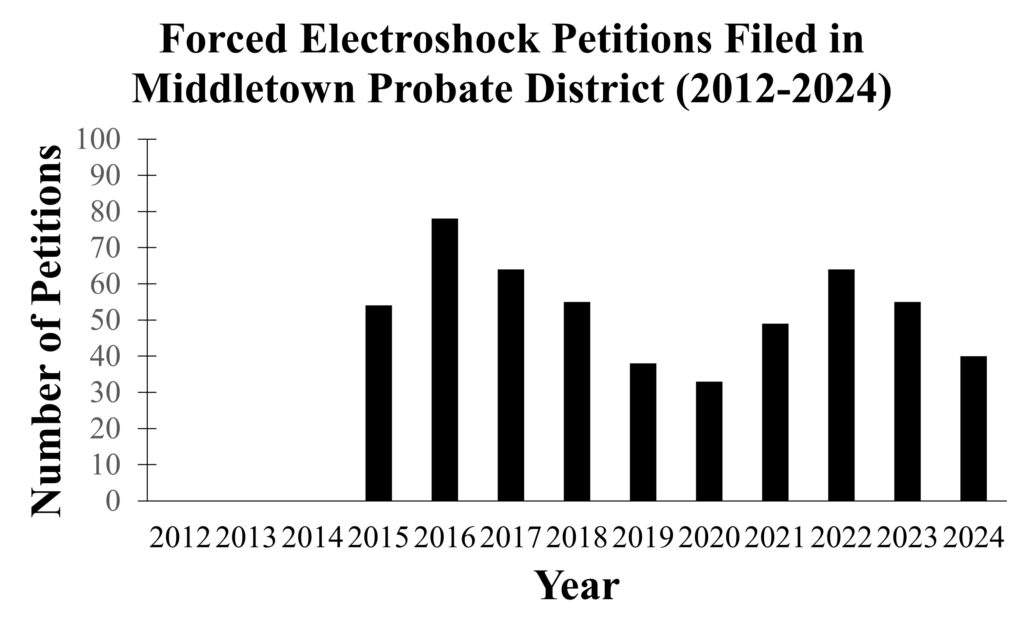
That being said, the petition grants a 45-day window to perform forced electroshock, after which the hospital can continuously file additional 45-day requests. This means that a single person could have up to eight forced electroshock petitions filed against them in a single year. (This could go on for years, with one patient from Connecticut Valley Hospital in Middletown receiving over 500 forced shock treatments in a five-year period from 2015-2019).
Now would be a good time to show you the graph of the data for Middletown District, Connecticut’s number one forced shock offender:
Which specific mental health facilities filed the requests?
The State of Connecticut Office of the Probate Court Administrator wrote that the “…names of the hospitals that filed the petitions and the names of the facilities that were petitioned to administer the shock therapy is not information maintained by the probate courts.”
The data provided only states which probate districts the facilities requesting forced shock reside in—not the names of the facilities—however, Connecticut state law does not allow for forced outpatient electroshock treatment, only inpatient, which means we can extrapolate information from the data about the specific facilities in some cases.
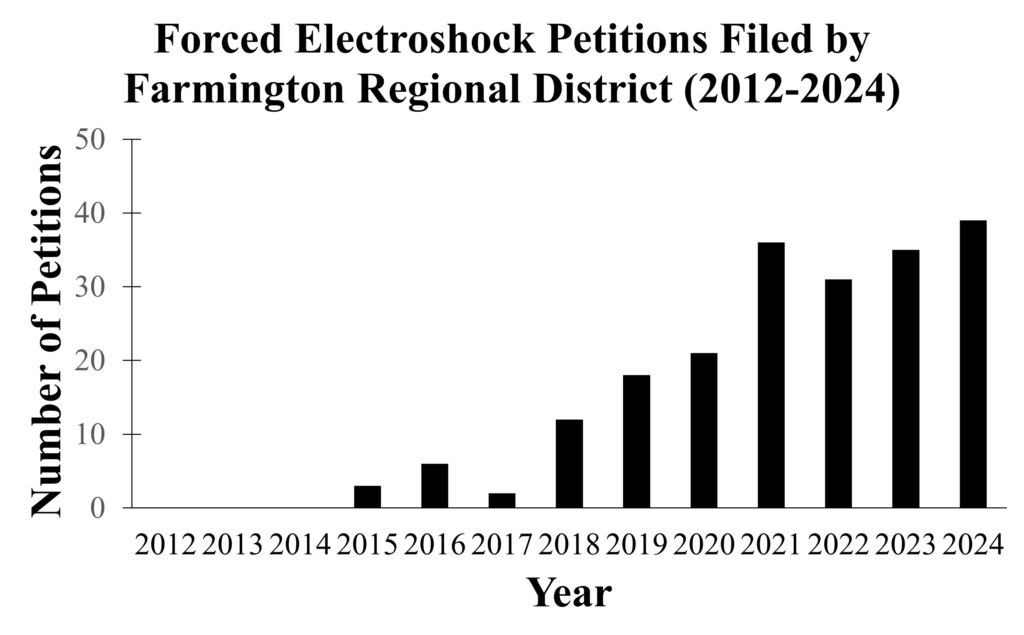
For example, Farmington Regional Probate District, which encompasses Farmington, Burlington, and Plainville, is a district within which only one inpatient psychiatric unit exists: the 3rd floor of the Connecticut Tower at UCONN Health Center.
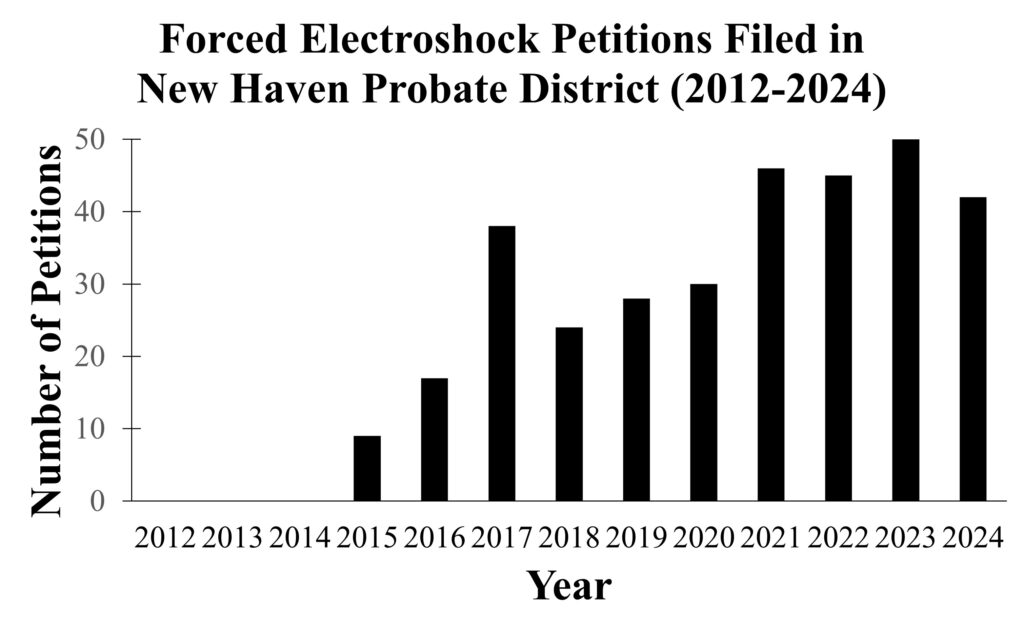
A counter-example, where the specific facilities cannot be extrapolated, is New Haven Probate District, which contains two inpatient psychiatry facilities: Yale New Haven Psychiatric Hospital and Connecticut Mental Health Center.
Can the increase in forced shock petitions be explained by under-reporting?
The State of Connecticut Office of the Probate Court Administrator wrote that “…the probate courts do not have information relating to petitions for shock therapy prior to calendar year 2012…” indicating that an administrative change occurred to how forced electroshock petition records are kept. This suggests that the increase we see over time in the data is due to under-reporting as different probate districts adopted a change.
If under-reporting were the sole explanation, however, then we would not expect to see such a large increase in Hartford, where evidence shows they were reporting forced electroshock petition data to the state prior to 2015. I would be remiss not to mention that Hartford Hospital’s Institute of Living has a parking space with a sign reserving it for electroshock patients behind the Donnelly Building, though I doubt an involuntary patient has had the opportunity to use it.
Why does the data only go back to 2012?
I’ve been unable to identify any law or policy that states why the State of Connecticut Office of the Probate Court Administrator began aggregating district records in 2012. Connecticut state law has, however, required probate court approval for forced electroshock since 1978 (the original 1971 law stated that there could be no forced shock at all without the patient’s consent).
Were any children forcibly shocked?
We don’t know. We know there are youth and adolescent units in some of the districts that made forced electroshock requests (including Hartford Hospital’s Institute of Living). We also know that the state reported no requests from Probate Districts 55-60, which include the six regional children’s probate courts.
Is the data not just an indication that there is a growing mental health epidemic in Connecticut?
From 2012 to 2024, there was a 6,333% increase in forced electroshock petitions filed in Connecticut. While it is easy to suggest that this increase was caused by a likewise 6,333% increase in the number of patients critically affected by mental health issues, that assumption seems short-sighted.
To put this to rest, we can look at the steepest single-year change where we saw a 1250% increase in forced electroshock petitions for 2015. Did something happen in 2015 that caused a 1250% increase in mental health issues in Connecticut? I might be crazy, but not crazy enough to believe that something happened in Connecticut in 2015 that was worse than the Sandy Hook Massacre in 2012 or the COVID-19 pandemic in 2020, only the latter of which might even be represented in the data.
In your assessment, how bad is it?
Real bad. The way I see it, looking at the number of districts receiving requests rather than the number of requests is the scariest part of all this. The district count may not get headlines or attract attention because it’s focusing on lines people scribbled on a map long ago rather than the people suffering at the hands of this forced procedure; however, it can be viewed as a map of where it is safe and unsafe to seek mental health treatment without risk of being involuntarily electroshocked.

For non-Connecticutions, the Connecticut River Valley that travels down the middle of the state and the coastal cities by the New York border are the state’s areas of highest population density, making them the primary places one would find a mental healthcare facility in Connecticut.
A recent population density map from the State of Connecticut Census may help to illustrate the relationship:

The overlap between population density and the districts that have received petitions for forced electroshock illustrates what appears to be a nearly complete spread of the decision of mental health facilities to allow electroshock to be forced on patients.
Since this began spreading from Hartford over a decade ago, we’ve now had 24 out of 60 probate districts receive requests for forced electroshock. As the State of Connecticut Office of the Probate Administrator did not provide names of the specific facilities requesting forced electroshock, we cannot know at this time which facilities do or do not exercise their ability to forcibly electroshock patients without the heads of hospitals or inpatient psychiatric units openly stating that their policy is to never request forced shock treatment.
I can at least say, as someone who was born and raised here, that you’ll have an easier time finding an inpatient psychiatric facility that is willing to forcibly electroshock you than one that refuses to—and it wasn’t always that way.
Further graphs and other information are available here for public access.



Jim
The world need more people like you……..thank you so much.
Report comment
I appreciate your positive words. Thank you.
Report comment
This is bad news; didn’t know it was going on.
I see a pattern connected to university medical facilities, but that could just be because most medical facilities there are run by universities.
In California we have Sutter (which is the bigger problem) and Kaiser, and many smaller health systems, in addition to university-run hospitals.
I also see a possible correlation to political contention, or the sense by elites that they are under attack (which they are).
The problem I have seen with this issue (electroshock) is that it is not done often enough to create a public uproar. This is even true of some obviously criminal activities like murder or rape. But those activities are already categorized as criminal. Electroshock isn’t. In California we are trying to change that.
In simplistic – but not untrue – terms, we have a problem with psychopathy on this planet. And electroshock is just one of their tools that they have been refusing to give up. I don’t think we can have a real breakthrough on this issue until we learn as a society to protect ourselves from psychopathy in all walks of life.
Report comment
I don’t use the terms of psychiatry to cushion myself from the actual topic of conversation. What we are talking about is evil. In other words, “I don’t think we can have a real breakthrough on this issue until we learn as a society to protect ourselves from evil in all walks of life.” Evil is what it is, isn’t it. Not a mental illness. It is a choice to hurt other people without justification which is a matter of character.
Report comment
Thanks, Larry, for sharing.
I want to respond to your remark about a pattern connected to university medical facilities.
You are correct that UCONN Health and Yale-New Haven have facilities in the probate districts listed in the data. I’m not certain that UCONN Health began performing forced electroshock as a result of anything at Yale-New Haven – but – that’s not to say it isn’t possible.
My inclination is to think that UCONN Health was following DMHAS since UCONN is a public university and all of the state-run facilities in Connecticut (run by DMHAS) are within districts where forced shock is happening (Middletown, Hartford, and Bridgeport).
[I should mention DMHAS also runs a 4-bed peer respite in New Britain which is within the probate districts listed on the list (Berlin District), but I honestly don’t suspect anyone at the peer respite would be getting forced shock… if they did, honestly, all hope is lost]
What I do see clear evidence of, as far as the universities go, is the fact that Yale has so many inpatient psychiatric facilities throughout the state that fall within districts listed in the data:
– Yale-New Haven Psychiatric Hospital in New Haven
– Lawrence Memorial in New London
– Bridgeport Hospital in Bridgeport
– West Haven VA (Yale runs the inpatient unit)
As far as I have found, that’s 100% of their Connecticut inpatient psych locations… The only other one (which 211.org says is run by Yale-NH, though I cannot confirm this myself) is Day Kimball Hospital in Putnum, CT.
That’s an awful lot of strikes against Yale-NH.
Report comment
I’m glad you are following this.
My life experiences have somewhat biased me against the “goodness” of universities, but university people keep popping up in these stories, so it’s quite possible someone at Yale is pushing this.
Report comment
I wonder if any nationwide sociological research has been conducted regarding the populations most affected by ECT and other forced psychiatric barbarities? Could these unfortunate victims be disproportionately members of the urban underclass, prison inmates, juveniles confined in detention facilities, or indigent elderly patients (especially females) in nursing homes?
Report comment
Some has been done. But it’s a bit difficult because not all facilities are willing to provide full reports.
From CCHR: “In the UK, Dr. John Read, a professor at the University of East London, obtained statistics through a Freedom of Information request that found 67% of patients who received ECT in 2019 were female. He further established that 36% underwent ECT without consent, which the United Nations defines as torture.”
Another paper is here: https://pubmed.ncbi.nlm.nih.gov/16567337/
Report comment
Only I know of who has info on this is Peter Breggins ….. I have a story of this harm I have yet to see reported and cannot find people to report on it
Report comment
Thanks, Joel, for asking such an important question. The short answer is: I honestly haven’t looked into this enough to give you information about nationwide statistics. I’m also not sure the CT Shock Data can give us firm answers, as many of the hospitals in the lower socioeconomic communities are utilized by their more affluent neighbors.
I did take notice that Stamford is particularly low in forced electroshock despite it being one of the largest cities in Connecticut – which is possibly a result of socioeconomics (being down by New York City indicates a likely wealth disparity compared to the other large cities like Bridgeport, Hartford, and New Haven).
Also important is Middletown Probate District, the leading offender of forced shock, which is home to Connecticut Valley Hospital and Whiting Forensic Hospital. These are the two largest state-run inpatient psychiatric facilities in Connecticut. (and Whiting is the only one that specifically houses people through the criminal justice system). Generally-speaking, if you are at a state-run facility like Connecticut Valley Hospital, it’s because you don’t have the money to be in a private facility (and frankly, anyone is going to become poor after an extended involuntary stay in an inpatient unit).
As for children, I can only state the inpatient mental health facilities I’ve found within the districts:
– Yale-New Haven Children’s Hospital in New Haven
– Turnbridge Adolescent Residential Treatment in Killingworth
– Albert J. Solnit Children’s Center – South Campus in Middletown (run by the Department of Children and Families)
– Institute of Living in Hartford (they have units specifically for children)
Of these four, only Turnbridge is alone in it’s probate district.
For nursing homes, I’ve found some inpatient psychiatric units for seniors specifically in:
– Masonicare Senior Behavioral Health Hospital in Wallingford
– Connecticut Behavioral Health Hospital in West Hartford
– Institute of Living in Hartford
Of those three, Masonicare and CBHH are alone in their probate districts.
Report comment
Jim, your comment about the low rate of ECT treatments in Stamford relative to the rates in less affluent communities in Connecticut is most revealing, and confirms my belief that income and social status disparities have a significant effect on the quality of care provided by mental health institutions, nursing homes, and other facilities.
This subject certainly calls for the attention of investigative journalists, sociologists, and independent researchers.
Report comment
Keep up your good work! best wishes, Peter Sterling
Report comment
Thank you, Peter.
Report comment
The next question is: Why is this allowed? From the testimony I’ve read, the psychiatric experts are stating that ECT is the gold standard of treatment for conditions such as schizophrenia and Major Depressive Disorder. I looked up this information and found many research articles which did, indeed, make statements of this kind, praising ECT as the frontline level of treatment. As with pharmaceutical products and TMS, I believe such outcomes in research studies to be the result of cherry picking and the manipulation of information as well as ignoring decades long reports of severe and damaging side effects. From you article, Jim, we now know the frequency with which ECT is applied to psychiatric patients. Now we need to expose the ideological flaws and fraudulent methods which are behind the use of ECT which are used to justify it as a treatment.
Report comment
Thank you, Elizabeth, and sorry for the delayed reply. I’m hoping that this data can be used to hold the individuals and facilities accountable who have filed requests for forced shock. Our movement ultimately ends up spending a lot of time talking to one another, which isn’t a bad thing, but we never really hear justification given by those who wielding the power to hurt us. It would be nice if the weight was on *them* to explain why they do this to us, rather than on us to explain why they should not (particularly when our voice is so easily dismissed).
Report comment
Jim, you say the following:
“The State of Connecticut Office of the Probate Court Administrator wrote that the “…names of the hospitals that filed the petitions and the names of the facilities that were petitioned to administer the shock therapy is not information maintained by the probate courts.”
I suspect this isn’t true and I’d suggest that you file a complaint with the FOI Commission to get this information. I could be wrong, of course, but I’d give it a try.
Report comment
I’ve filed a complaint at your suggestion, though, I am concerned it may be past their deadline to do so. I suppose I can always re-submit a request to the Probate Court to get a fresh date to complain from. (Speaking of which, it’s after Jan 1 now, so I might as well put in a request to get the full 2025 data at this point)
Report comment
Jim:
Appreciate all the work you do in this field.
Isn’t it possible that the FDA’s proposal in 2015 to de-classify the ECT devices from severe risk (Class II) to moderate risk (Class II) for some diagnoses spurred the dramatic rise in 2018 on those Connecticut charts for Farmington and New Haven, in particular, when the proposal was enacted? In other words, might it be that after that there were just that many more ECT sessions being delivered in CT, and consequently the number of enforced shock petitions also rose dramatically then?
Report comment
Robert – that just may be it.
I think I dismissed the possibility that the FDA’s reclassification proposal in 2015 would have an effect prior to the proposal being enacted in 2018.
That being said, the 2015 proposal was published in December 2015, which would not give much time for the number of forced shock requests that came in 2015. Are you aware of any announcements about this prior to the published December 2015 proposal?
If the proposal was known about prior to it’s publishing, then I would think it could have enticed psychiatrists and mental health facilities to take the risk.
That would mean we might see three different “phases” in the data:
– pre-2015,
– 2015-2018,
– and 2019-2024
Report comment
Sorry, the end of that comment was unfinished. Please ignore that part about the “phases” at the end.
Report comment
Rob Carr
10:23 AM (5 minutes ago)
Hi, Jim.
Yes, it’s mostly the Farmington and New Haven statistics that are coincident with the Class II reclassification.
My own guess –which is all it is, lacking evidence — is that even before December, 2015 the device manufacturers and the facilities delivering ECT were aware of the FDA reclassification proposal and were confident enough of its being put into effect to begin delivering more ECT. After all, the profits from it are staggering. (ECT: the Cash Cow for Hospital Psychiatric Units https://banelectroconvulsivetherapy.com/blog/).
By the way, do you know if there is any bill being submitted to the Connecticut legislature this session which would do more to protect patient rights by strengthening required Informed Consent application?
Report comment
It wouldn’t surprise me that much if they risked re-introducing electroshock across the state based solely on hearsay that the reclassification was going to happen. I just don’t know for sure. I’m hoping the hospitals will be compelled to provide an explanation when this story reaches a large enough audience.
The Cash Cow article was an interesting read. I’ve wondered about what kind of investment would have been needed to have been made to Connecticut Valley Hospital in Middletown Connecticut pre-2015 to prepare for the wave electroshock treatment they were planning to introduce. I imagine someone had to sign off on the equipment, and possibly even the renovations to setup a PACU and procedure room.
As for 2026 legislation, this year is a “short” session, running from Feb 4 to May 6, and short sessions are supposed to be reserved for budgetary matters… I’m not sure if the ever-increasing amount of electricity us residents are subsidizing for them to forcibly zap the fuck out of people is necessarily a part of that discussion.
Report comment
Regarding the investment for ECT delivery, three or four years ago the US government was paying $34-56 thousand for a “full feature” ECT device package from Sigma. Of course, our less-than-thrifty government also spent half a million dollars on a transgender monkey study recently. Today EBay lists the average price of a used ECT unit as a thousand bucks.
As you note, though, still cheap enough to raise our electricity bills every time some poor sod gets zapped.
Thanks for the legislature data.
Report comment
Hi Robert – sorry for going out of order on the comment-reply chain, but I ran into an issue making a rely to your latest comment so here we are. I wanted to check if you have a citation/reference for the remark about the govt purchasing the Sigma shock unit for $34-56 grand.
From what I can tell, the only manufacturers currently selling shock equipment are Somatics and Sigma (MECTA was spun out into Sigma at some point it seems). I’ve been able to get the service manual and instructions for use for the Thymatron, but not the Sigma…. I will check some eBay sellers and see about getting a copy tho.
Report comment
Hi, Jim.
I just Googled “cost of ECT devices” and AI provided me with the government purchase price. You’re right, I believe: only Thymatron and Sigma (once MECTA) manufacture these devices.
By the way, my personal email is [email protected]. It would be a more convenient and private way for us to communicate.
– Rob
Report comment