
Electroconvulsive Therapy (ECT), or electroshock as it is sometimes called in the USA, involves applying a sufficiently strong electric shock to the brain to induce a seizure. It is administered under general anesthesia, typically between six and 12 times, over several weeks.
Approximately a million people receive ECT annually (Leiknes et al., 2012), disproportionately women and older people, including about 2,500 here in England (Read et al., 2019a; Read et al., 2021).
ECT remains controversial (Funk et al., 2025; Read et al., 2019a). One meta-analysis reported views from ‘probably ineffective but certainly causes brain damage… through to those who think it is the most effective treatment in psychiatry and completely safe’ (UK ECT Review Group, 2003, p. 799).
Unsurprisingly, therefore, rates of use vary widely from country to country (Braithwaite et al., 2026; Leiknes et al., 2012). A recent review of European usage found, for instance that people in Sweden and Denmark are 11 times more likely than people in the UK, and 143 times more likely than people in Italy, to be given ECT.
Our own two audits of usage in England found 12-fold (Read et al., 2018) and 47-fold differences (Read et al., 2021) between the highest and lowest using regions.
The European review (Braithwaite et al., 2026) was authored by 20 ECT champions, including first author Dr Richard Braithwaite, Chair of the UK Royal College of Psychiatrists’ Committee on ECT. They collectively bemoaned the relatively low usage in English speaking countries, blaming a ‘campaign to discredit ECT’ and identifying, as the only examples of the campaign, our two reviews of the literature showing minimal evidence of efficacy and significant evidence of persistent adverse effects such as memory loss (Read & Bentall, 2010; Read et al., 2019b).
But I am not convinced that our research, or indeed any research demonstrating ECT’s inadequate efficacy and extensive risks, is actually what is going to reduce its use. The European reviewers were a perfect example of how ECT researchers respond to the large, and growing, body of research that does not conform with their personal opinions. They ignored most of it and denigrated the rest as a negative ‘campaign’. Other tactics used to dismiss the evidence is to label it ‘stigmatising’ or ‘antipsychiatry’, or to blame patients’ well-founded fears about ECT on a 50-year-old Jack Nicholson film.
So, I suggest that rather than continue to wait for the 4% of psychiatrists (mostly male) (Luccarelli et al., 2025; Morrison et al., 2026) who still think electricity is the answer to human distress, to abandon their extreme cognitive dissonance about research they don’t like, we should turn our attention to the legal system.
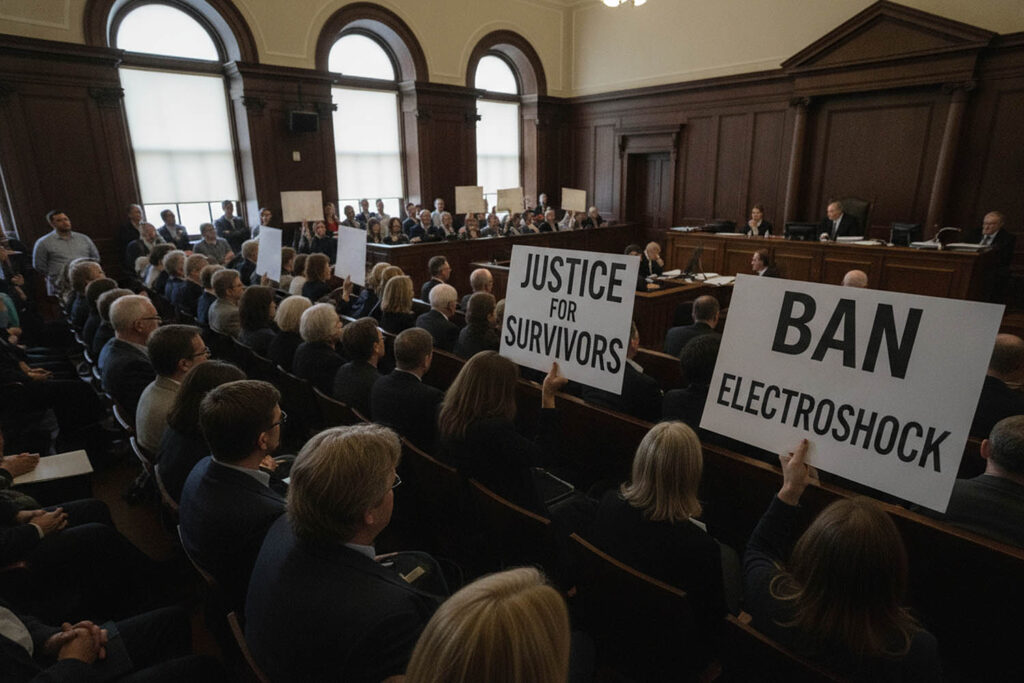
ECT in the Courts
South Carolina 2005
In 2005 a South Carolina woman won a jury verdict of more than $600,000 against a doctor after suffering devastating memory loss following ECT (Salters vs. Palmetto Health Alliance, Inc., et al., Case 03CP4004797, Richland County, South Carolina).
Litigation involving ECT has been ongoing in the United States for several years, but the litigation has largely focused on the manufacturers of ECT machines, rather than doctors, with plaintiffs claiming the companies failed to warn doctors of ECT’s risks, and, in turn, the doctors could not or were not obligated to warn patients.
The website of Wisner Baum, a Los Angeles legal firm involved in multiple ECT cases reports that “Dozens of lawsuits have been filed across the United States by survivors harmed by the MECTA Spectrum ECT machine and Somatics’ Thymatron machine.” (MECTA and Somatics are the only manufacturers of ECT devices in the United States.)
Dr Peter Breggin, the famous and relentless critic of unevidenced practice in psychiatry, was an Expert Witness in many of these lawsuits.
There were, in fact, so many lawsuits that MECTA filed for bankruptcy in late 2021 and no longer sells the Spectrum machine. But they immediately began marketing a new machine in 2020, the “Sigma” machine.’ It is unclear whether their new machine is substantially different from, or safer than, the discontinued one.
Florida 2023
The first case I was personally involved with, as an Expert Witness, was a case against Somatics. It went to jury trial in 2023, in U.S. District Court for the Middle District of Florida, Tampa Division. Plaintiff Jeffrey Thelen alleged in his lawsuit that Somatics failed to adequately warn about the known risks associated with its ECT machines, including brain damage, severe permanent memory loss, permanent neurocognitive injuries, and others. I provided a written summary of the ECT research on which I was cross-examined for over an hour in court. The jury in Jeffrey Thelen v. Somatics, LLC unanimously found Somatics guilty of failing to warn about the named risks when placing their ECT machine on the market.
It seems that a jury of ordinary people are more willing to listen to the research than the doctors giving the treatment. The Wisner Baum website reports:
Dr. Read reviewed all studies that have ever been conducted that compared ECT with “sham” ECT. This is the gold standard way to determine if a medical treatment works, it is widely accepted, and constitutes evidence-based medicine.
Only 11 such studies exist, all predating 1986. These studies would not pass muster today – they were of very poor quality.
“We can say there has never been a single study showing that ECT is better than sham ECT beyond the end of treatment, or (sic) ECT cannot be said to have any long-term benefits.”
With respect to brain damage, Dr. Read testified “several leading proponents [of ECT in earlier times] argued that ECT works because it reduces the intelligence or level of intellectual functioning of people. So they were arguing that some mental patients have too much intelligence, too much going on in their brains, and it needs to be reduced, and they believed that that was the therapeutic process.”
“[W]e have published a review of over a hundred studies to support this idea, is (sic) it’s similar to the original brain-damaging therapeutics idea, and we have, we believe, demonstrated that the effects on the brain that the ECT (sic) is very similar to the effects of what’s called a closed-brain injury … there’s changes in the brain that are documented after ECT, very similar to traumatic brain injury.”
With respect to permanent memory loss, Dr. Read testified “our analysis indicates that the range of a (sic) percentage of the people who get autobiographical memory loss is between 12 percent and 55 percent” and “[t]his is permanent memory loss.”
Other Expert Witnesses included Dr. Bennet Omalu, a neuropathologist and clinical professor of laboratory medicine and medical pathology at the University of California. He is famous for his work on the brain damage suffered by American football players. Professor Kenneth Castleman, another Expert Witness, worked with NASA for 15 years and has done research on the electrical mechanics of ECT and its impact on the human body and brain.
The Wisner Baum website also reports the verbatim transcript of the cross examination of Dr Richard Abrams, co-owner, with Dr. Conrad Swartz, of Somatics LLC.
Q. Let me ask you, as the manufacturer of the Somatics machine, have you or your company taken any efforts to conduct a clinical trial that you believe in your mind, would answer the question of whether ECT can cause either brain damage or permanent memory loss?
A. No.
Q. And Somatics has likewise never conducted any clinical trials to determine the safety and efficacy of its ECT machines, correct?
A. It has not. Correct.
Q. At any time to the present, has Somatics initiated any studies or tests with regard to this issue of long-term side effects associated with ECT?
A. No.
Q. Any reason why not?
A. That’s not our business.
Q. Up to this point in time, had you reached any conclusions as to how ECT was working in terms of its effectiveness?
A. No.
Q. Up to the present, do you have any understanding as to the mechanics of how ECT works?
A. I do not.
Q. …would you agree that that’s the general state of the industry still today, that the practitioners of ECT don’t have any understanding of how it works?
A. That’s correct.
Q. …do you have any understanding that anyone at Somatics has ever incorporated studies of traumatic brain injury with ECT in any way?
A. Certainly not.
Q. Do you know why?
A. There would be no reason to.
Q. Is that because you don’t believe that there could be a correlation between TBI, traumatic brain injury, and ECT?
A. Well, we’re not in the business of doing studies of traumatic brain injury. We sell Thymatrons.
Q. Has Somatics [ ] (sic) conducted any studies to determine whether any brain injury could be caused by ECT?
A. Somatics has never conducted any studies of any kind.
***
Co-owner Dr. Conrad Swartz wrote in an email “the goals of the warning statement we need to make [re permanent memory loss and brain damage] are one, to prevent lawsuits, and two, not alienate psychiatrists.”
Q. Do you see that doctor? (sic)
A. Yes.
Q. Do you agree with the statements made by Dr. Swartz? … (sic)
A. I would say those are accurate. I would agree with those.
California 2026
A more recent case, in the Superior Court for the State of California in the County of Sacramento, was settled out of court shortly before the scheduled trial date of May 11, 2026. I was, again, an expert witness, drawing on my research and published reviews about ECT.
The case is historic as it is the first time individual psychiatrists and a hospital have successfully been sued for damage caused by ECT in California, or for failure to inform about the risks involved.
The litigation in California was particularly challenging because, for decades, a legal loophole allowed ECT machine manufacturers and drug companies to argue that only a doctor’s testimony mattered and the patient’s testimony was irrelevant. In other words, when a doctor testified that he or she would have prescribed the procedure notwithstanding a warning, the case could be dismissed. In 2024, the California Supreme Court ruled to remove that loophole.
Wisner Baum, LLP, senior partner Bijan Esfandiari argued the case before the California Supreme Court, won and stated, “As a result of the California Supreme Court’s Himes decision, moving forward, pharmaceutical and device manufacturers who fail to warn of risks associated with their products can no longer avoid liability by misusing the learned intermediary doctrine. Today’s decision in Himes is not only a victory for consumers injured by defective pharmaceuticals and medical devices but is a victory for anyone who champions patient autonomy.”
Subsequently, in the recent case, two women who had received 11 and 31 electroshock treatments at the Sutter Center for Psychiatry in Sacramento, alleged that they had suffered, as a result of the treatments: “brain damage, neurocognitive injuries, permanent memory loss, impaired visual and verbal memory, significant decline in their ability to learn and recall information, a disruption and decline in the ability to encode new information, loss of executive function, additional physical, physiological, psychological and emotional injuries and economic harms.” (Herrera et al., v. Sutter Center for Psychiatry et al., Case No. 34-2020-00280488; Sacramento County, California).
The defendants were psychiatrists Theodore Goodman and Robert Blanco, and the Sutter Center for Psychiatry, where the treatments occurred. The allegations included: “common-law negligence, breach of fiduciary duty, fraud, medical malpractice, and battery” arising out of “serious and debilitating cognitive injuries.”
The plaintiffs alleged that defendants “negligently and intentionally concealed and failed to adequately disclose and warn about risks, including but not limited to, brain damage and permanent neurocognitive injuries associated with the ‘SpECTrum’ Electroconvulsive Therapy shock device” and “intentionally, recklessly and overtly misrepresented the safety and efficacy of the shock therapy device.”
They also alleged that Goodman and Blanco “recommended and administered ECT treatments without obtaining their informed consent and that they committed battery by performing shock treatment on Plaintiffs without obtaining their informed consent.” (Herrera et al., v. Sutter Center for Psychiatry et al., Case No. 34-2020-00280488; Sacramento County, California).
In a bizarre twist, the plaintiffs further alleged that “Negligently and in breach of his fiduciary duties,” Dr. Goodman “concealed from Plaintiffs that he had been convicted for a felony arising out of his practice of medicine (illegally selling body parts and organs of deceased veterans) and that he had previously had his medical license suspended by the California Medical Board as a result of his criminal and reprehensible conduct.” This speaks volumes about the state of a profession that would allow someone who had committed such crimes back into practice on the public.
Although the case was settled just before trial, the litigation against the doctors and hospital had proceeded because the plaintiffs had overcome the doctors’ and hospital’s strenuous attempts to dismiss the case.
Implications and Future Hopes Regarding ECT
Of course, I am not saying that research is not important. But it does seem it is more valuable in a court of law than in discussions with ECT psychiatrists. In the California case, for example, I was able to include, in my written testimony, the remarkable outcomes of the largest ever international survey of ECT patients and family members, that I conducted in 2024 with three ECT recipients and two other clinical psychologists (Harrop et al., 2026; Morrison et al., 2026; Read et al., 2025a, b, c; 2026, a,b,c)
It is to be hoped that legal cases like these, whether they go to trial or are settled at the last minute out of court, will encourage psychiatrists, at least in the USA, to think twice before administering such a potentially damaging treatment, however lucrative it may be, if only because of the risk of major financial penalties. I am currently involved in two other cases in Canada, and am aware of others elsewhere.
These cases might at least help ensure that patients and families are given better information about the risks in future, which, according to our audits of information leaflets in the UK (Harrop et al., 2021; Read et al., 2023) and our international survey, published in the Journal of Medical Ethics (Read et al., 2026a), is certainly not the case at the moment.
***
References
Braithwaite R, Amad A, Cattaneo CI, Di Pauli J, Finnegan M, Frias P, Gonçalves-Pinho M, Grözinger M, Järventausta K, Jørgensen A, Karttunen S, Kessler U, Nordanskog P, Obbels J, Oliveira-Maia AJ, Rhebergen D, Sienaert P, Tas FQ, Wilhelmy S, Kirov G. Use of electroconvulsive therapy in Nordic and western European countries. Eur Psychiatry. 2026 Jul 29:1-50. doi: 10.1192/j.eurpsy.2026.12238. Epub ahead of print. PMID: 42522846.
Funk, M., Drew, N., Pathare, S., Encalada, A., Mcgovern, P., Hancock, S., Read, J. (2025). Electroconvulsive therapy: reaffirming the case for caution, consent, and rights. Lancet Psychiatry, 12, 549-551.
Harrop, C., Read, J., Geekie, J., Renton, J. (2021). How accurate are ECT patient information leaflets provided by mental health services in England and the Royal College of Psychiatrists? An independent audit. Ethical Human Psychology and Psychiatry, 23, 5-24.
Harrop, C., Cunliffe, S., Hancock, S.P., Johnstone, L., Morrison, L., Read, J. (2026). An international survey of the relatives and friends of electroconvulsive therapy recipients. Psychology and Psychotherapy: Theory, Research and Practice. doi:10.1111/papt.70062
Leiknes, K., Jarosh-von Schweder, L., & Hoie, B. (2012). Contemporary use and practice of electroconvulsive therapy worldwide. Brain and Behavior, 2, 283-344.
Luccarelli, J., Hart, K., & McCoy, T. (2025). Gender representation in the ECT workforce in the United States from 2013 to 2021: A Medicare physician data analysis. Journal of ECT, 41, 27-30.
Morrison, L., Cunliffe, S., Hancock, S.P., Harrop, C., Johnstone, L., Read, J. (2026). Electroconvulsive therapy and women: An international survey. Health Care for Women International, 47, 631 – 659. doi:10.1080/07399332.2025.2568222
Read J, Cunliffe S, Jauhar S, et al. Should we stop using electroconvulsive therapy? Br Med J 2019a; 364: k5233.
Read, J., Kirsch, I., & Mcgrath, L. (2019b). Electroconvulsive therapy for depression: A review of the quality of ECT vs sham ECT trials and meta-analyses. Ethical Human Psychiatry and Psychology, 21, 64-103.
Read, J., Morrison, L., Harrop, P. (2023). An independent audit of Electroconvulsive Therapy patient information leaflets in Northern Ireland, Scotland and Wales. Psychology and Psychotherapy: Theory, Research and Practice, 96, 885-901.
Read, J., Harrop, C., Geekie, J., Renton, Cunliffe, S. (2021). A second independent audit of ECT in England: Usage, demographics, consent, and adherence to guidelines and legislation in 2019. Psychology and Psychotherapy: Theory, Research and Practice, 94, 603-619.
Read, J., Harrop, C., Geekie, J., Renton, J. (2018). An audit of ECT in England 2011-2015: Usage, demographics, and adherence to guidelines and legislation. Psychology and Psychotherapy: Theory, Research and Practice, 91, 263-277.
Read, J., Cunliffe, S., Hancock, S.P., Harrop, C., Johnstone, L., Morrison, L. (2025a). A survey of ECT recipients, family members and friends: Are the self-reported reasons for their problems being addressed? International Journal of Mental Health Nursing, 34, e70187
Read, J., Johnstone, L., Hancock, S.P., Harrop, C., Morrison, L., Cunliffe, S. (2025b). A survey of 1144 ECT recipients, family members and friends: Does ECT work? International Journal of Mental Health Nursing, https://doi.org/10.1111/inm.70109
Read, J., Hancock, S.P., Morrison, L., Johnstone, L., Harrop, C., Cunliffe, S. (2025c). A survey of 1144 ECT recipients, family members and friends: Incidence, severity and duration of memory deficits. Ethical Human Psychology and Psychiatry, 27, 87-116.
Read, J., Harrop, C., Morrison, L., Hancock, S.P., Johnstone, L., Cunliffe, S. (2026a). A large exploratory survey of ECT recipients, family members and friends: What information do they recall being given? Journal of Medical Ethics, 52, 77-84.
Read, J., Cunliffe, S., Hancock, S.P., Harrop, C., Johnstone, L., Morrison, L. (2026b). The adverse effects of electroconvulsive therapy beyond memory loss: An international survey of recipients and relatives. International Journal of Mental Health, 55, 112-132.
Read, J., Cunliffe, S., Hancock, S.P., Harrop, C., Johnstone, L., Morrison, L. (2026c). The self-reported positive and negative effects of electroconvulsive therapy: an international survey. Journal of Affective Disorders Reports, 24, 101008.
UK ECT Review Group. (2003). Efficacy and safety of ECT in depressive disorders. Lancet 361, 799-808.












Psychiatry is pseudoscience.thomas szasz is explaining in her book.ECT is torture.peter breggin is explaining in her book. Pschiaytry is human right violation. Science of lie pscyhiatry.john read tell a right.ECT is torture
Report comment
Psychiatry is saying ,MR Brain who were made ECT is normal but MR Brain who were made schizophrenia is normal but psychiatry say disease even though MR Brain is normal.psychiatry is normal ECT who were made them for MR Brain is normal
Report comment
John, you are a legend.
Keep supporting court cases! I really hope there will be more and more of them, all over the world.
Report comment
“intentionally, recklessly and overtly misrepresented the safety and efficacy of the shock therapy device.” that is the impprtant bit.
They gave in because they thought they would loose.
Report comment
Dear John. Reminds of something, cannot think what a the moment. In any case, it’s the exact same procedure old Jack had to act his way through. At no time did you see his bones snap. So in actual fact all the modern rigemaroll with the “spier verslapper” or muscle relaxant is unnecessary. Just ms Ratchet holding his head including possibly a few numbskulls (or as the Sex Pistols would say “vacant”), and of course that odd look of knowing in her eyes, but look deeper, and you will see the fear, why, it’s easy, just a little physics knowledge would suffice. I have a special introductory test for anyone that thinks they know what they are talking about if they try to soften the reality of the real, more or less random shock wave of upwards of 1 amp coursing through their subjects memory circuits. And who knows what other Mhz waves are also there attempting to direct the 1 or 2 second shock. The physics and know-how necessary does not fit within the entire 8 or more years of doctor school. In fact very little does, apart from … the knee bone’s connected to the leg bone, the leg bones connected to the finger bone …
Report comment
I read the statement in the text above, “not alienate psychiatrists”. It’s a non-sensical statement. Say just about anyone that has slightly above average intelligence (remember material in a book) for a little longer, but lack overall determination (decision making capacity), and they are given a non-sensical job (give the go-ahead for possibly gruelling, but invisible to the naked eye, torture methods), I know what I would say to that. The old thumbs down in Emperor days.
Report comment
Dr. Goodman “concealed from Plaintiffs that he had been convicted for a felony arising out of his practice of medicine (illegally selling body parts and organs of deceased veterans) and that he had previously had his medical license suspended by the California Medical Board as a result of his criminal and reprehensible conduct.”
It’s just mind blowing.
Medical license suspended; why the heck wasn’t it totally removed ?
Report comment
The neurosurgeon who snorts cocain, gets a probationary period of 3 months, a professional development program to do, and the making of a promise to not use cocaine again. Back to work they go. Heavens forbid that such a person should lose their source of income, be left unable to support themselves and or their family.
No psychiatrist nor psychiatric interventions offered for this addiction problem, probably used to alleviate stress and distress.
Maybe ECT would work?
Report comment
I underwent ECT earlier this year for treatment-resistant depression, which was administered 50+ times over the course of 4 months. At no point did my outpatient psychiatrist or the psychiatrist administering the treatment advise me that extending treatment longer and longer would increase the detrimental side effects. Now, here I am, and I can honestly only remember 5% of my life prior to ECT.
Report comment
How did you get talked into having ECT?
How?
Report comment
Having directly seen the processes of medico influence and the aftermath of the procedure – ECT should be criminalised, unplugged, and sent for scrap metal.
To think that reputable practitioners use this barbaric electrification of the human brain, on the elderly who are supposedly treatment resistant, is a gross negligence against them. The elderly are vulnerable in many ways.
Especially so, that there is no research, and no evidence, that ECT is better than placebo!
Stop drugging the elderly in the first place, with medications and substances that are known to cause NEUROPSYCHIATRIC side effects, adverse effects, and BEHAVIORAL TOXICITY. Stop polypharmacy. Stop cascade prescribing for symptoms caused by side effects and adverse effects. Stop!
Ban the manufacturing of ECT machines.
Ban the manufacturing of Trans Magnetic Stimulation machines.
Ban the off-label use of any and all medications and substances.
Ban the use of anti-seizure, anti-epileptic drugs, medications, treatments for anything other than proven, evidenced seizures that such medications are to date approved for.
Ban all unnecessary interferences with the human brain that have no physical and identifiable appearance on investigation and examination. All ages, all genders, all demographics, all origins.
Ban the research, innovation, development, trials of all drugs, substances, medicines, medications, treatments, that are being designed to cross the BLOOD BRAIN BARRIER.
For those who think they are gods of some sort, and or think that they can defy, outsmart, out-do Mother Nature when it comes to the machinations of the human brain and its interwoven systems within the human body, you are treading where you should fear to tread.
ECT – is used as a threat in involuntary mental incarceration. Take the pills or else.
Report comment
if courts are judged as the place to defend or reject the scientific validity of a therapy trhen you are on the wrong track.
Report comment
ECT is not a permanent cure for clinical depression, bipolar disorder and should be used with caution in patients with a psychosis.
If ECT therapy is not beneficial it should be discontinued immediately by the psychiatrist.
Only if it’s beneficial the therapy must be followed up with a course of mood stabilizer medication for long term clinical assessment.
PS: In case of ,mood stabilizer treatment resistant disorders , and long term chronic psychotic disorders, continuation of ECT must be justified with caution due to adverse sinarios mentioned in this article.
Setting up the correct low pulse width, moderate pulse frequency and therapeutic duration (all can be adjusted via the ECT machine) for optimal outcomes is the sole responsibility of the clinical psychiatrist.
Report comment