Just because someone perceives you as dangerous does not make you dangerous. Sometimes it means you are the one in danger.
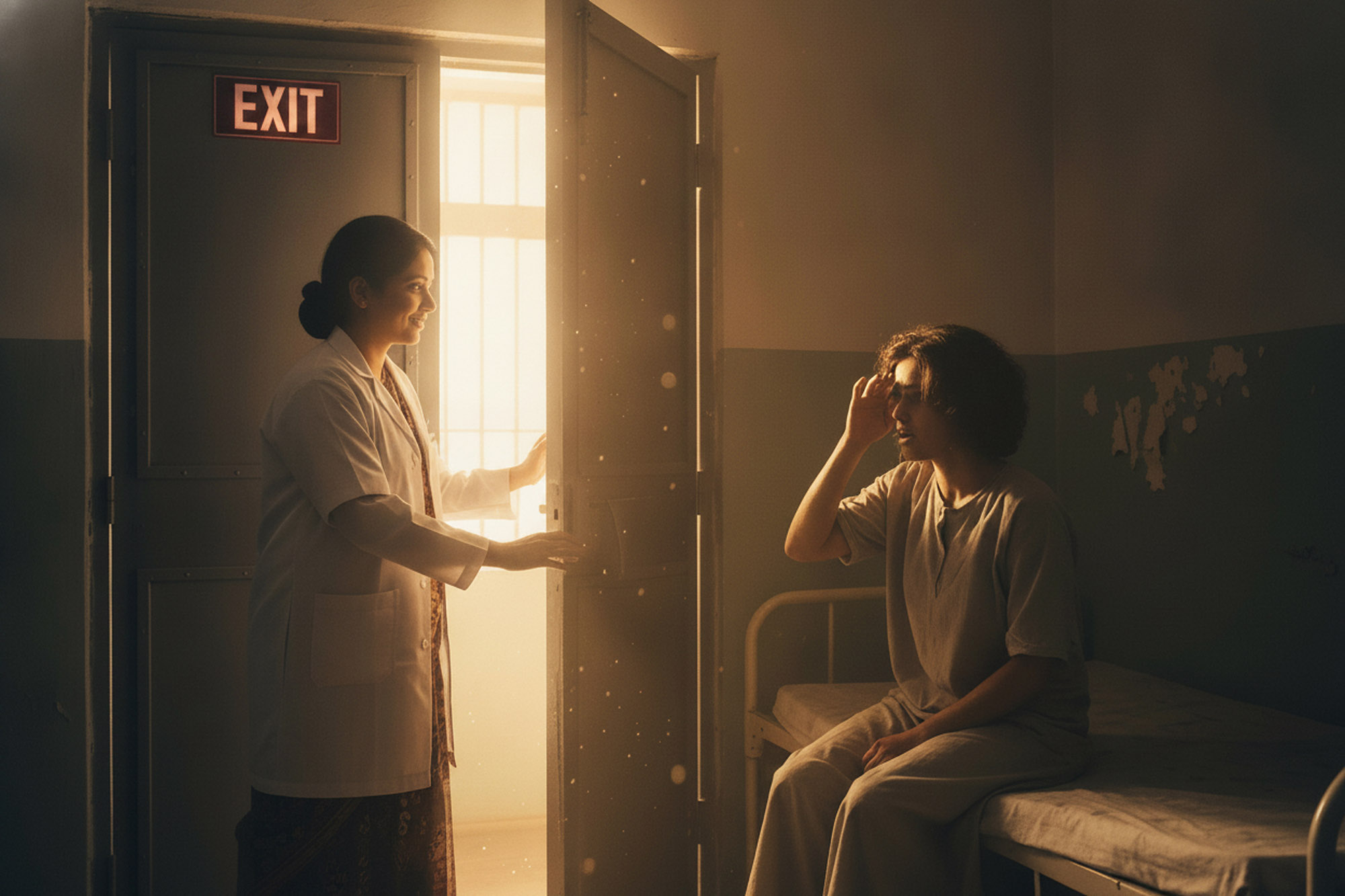
In 2003, I arrived at a locked inpatient facility after days without sleep, despite heavy medication. My nervous system was in overdrive from a profound sense of danger—one no cocktail of meds could soothe.
I was a first-year Harvard med student, 23 years old, watching my world disintegrate. Having reached the height of my capacity, I was now becoming a version of myself I did not recognize. I felt like I had fallen off a cliff.
I had already failed to complete one block and had barely gotten through this one. Earlier that day, I had mustered whatever was left in my depleted gas tank to take the exam—which I managed to pass—just to avoid another incomplete.
My identity as a med student was all I had left. Being fully disabled would have meant I had lost myself. For the daughter of Punjabi-Sikh immigrant parents who had invested their entire lives in my educational attainment, the stakes were imminently high.
My sense of terror was compounded by entering a locked psychiatric facility for the second time, something highly stigmatized in my parents’ Indian diaspora community.
But during that hospitalization intake, a clinician asked me whether I thought I could ever be violent toward someone. Looking around, seeing bars, witnessing violent takedowns of other individuals seeking help like me, a sea of white faces, I said what felt true: that if someone came for me, I would defend myself. This place they were admitting me to felt less like safety and more like assault. I was in absolute fight-or-flight mode—disoriented and trying to survive.
My answer—a statement of self-preservation from someone in crisis, in an institution, with no power—was documented as a threat. I was placed on violence precautions, despite never being violent a day in my life.
That designation moved me one step closer to restraint, seclusion, or forced medication if staff decided I had become “unsafe.” My fear had been reframed as dangerousness. It was dehumanizing and degrading, and it felt racialized. My brown skin had made me less of an endearing soul and more a threatening other. The harm of that distortion has stayed with me in a way that two and a half decades have not softened.
I would spend years discovering that what happened to me was not an exception. At a person’s lowest point, standard psychiatric interventions can take them lower still.
The Rupture
Six years later in 2009, I found myself on the other end of this equation as an intern on night float—the lone psychiatrist in the hospital overnight, responsible for every mental health issue that arose. You’re by yourself. It’s the middle of the night. You feel like you don’t have a clue.
I had entered residency carrying the shame of having once been the medical student who needed psychiatric hospitalization. Having gone from patient to provider, my fear had shifted from being forcibly tied down to making a mistake.
I was paged to the psychiatric emergency room and told to sign off on paperwork for someone who had already been physically and chemically restrained—injected with an antipsychotic. As a brand-new physician, I was being handed a pen and asked to sign on the dotted line. As if putting a needle into a person’s body to chemically immobilize them was an administrative task. No one acknowledged that what I was authorizing was violent. It was just what we did.
This was my introduction to the bureaucracy of seclusion and restraint. The restraint could happen before the doctor ever laid eyes on the patient. Then the resident psychiatrist—still in training, maybe only a few days out of medical school—was expected to authorize it after the fact.
The nurse who handed me the paperwork had over twenty years of experience—and made sure I knew it. I started asking questions, trying to understand rather than simply sign on the dotted line. But the more I asked, the more frustrated she and the other staff became. Eventually they stopped answering the clinical questions and started talking about their own safety instead—the locked facility, security standing nearby.
She told me it would have been cruel not to medicate the person. She wanted to make it clear to me that caring about the patient meant I wasn’t caring about my colleagues. That made me selfish.
No one taught me another way. I was taught to sign the paperwork. I was taught that questioning restraint meant questioning my colleagues—and that questioning my colleagues invited them to question my competence.
Six years earlier, I had been the one whose fear was called dangerous, whose humanity was distorted into a label. Now I was standing on the other side of that same distortion, being asked to perform it on someone else. This is the rupture: the break psychiatry installs between what you know to be true about a person’s humanity and what your training tells you to document.
In my own case, I had learned that Dr. Legha, the psychiatrist, had to be broken from Rupi the human being. The latter—the one who had been where the patients I was providing care for now were, had to be hidden away as part of my code of “professionalism.”
I signed the paperwork that night with a knot in my stomach. I would go on to sign it for eleven more years—and eventually, I am embarrassed to say, it became easier. I didn’t even connect in my head that I had been subject to the same confusing, distorted standards—that the wounds they caused (and ultimately, I wasn’t even tied down, and if I had been, God knows where I’d be) had stayed with me—and that it was wrong to do to others the thing I was terrified of being done to me. Medicine had already cracked that bone of humanity in two.
Even though I reported my history of mental illness responsibly and attended to my health diligently to stay well, the profession had taught me that this history was something to hide and to be ashamed of. Restraints, coercion, and force were things we did to other people. People less human than we were. People not like us—not like me.
So I followed the protocols perfectly. Hundreds of times. I deferred to the frontline nurses and staff who were left to do the dirty work of actually injecting and strapping people down—psychiatrists usually get to hide behind a glass fishbowl, observing and monitoring everyone directly or on cameras. They enter orders into computers. They sign paper forms. They do not do the injecting and strapping down.
Legal hold started. Check. Order for seclusion and restraints entered into the chart. Check. Required paperwork for the seclusion and restraints entered into the chart. Check. Note entered into the chart providing justification for the intervention. Check. Rinse and repeat.
What Haiti Laid Bare for Me
Four years later in 2013, I arrived in Haiti as part of my global mental health fellowship—carrying years of training I had never fully questioned.
Within days of arriving, I was asked to help develop a policy for the use of physical restraints at the hospital. The head of security showed me the equipment. I stood there holding straps, cuffs, fasteners—a modern version of shackles. Something about it—being handed this equipment and asked to use it again in the name of safety, in a former slave colony—felt obscene.
I was in the first Black republic in the world, founded by people who had overthrown slavery decades before emancipation in the United States. I could not stop thinking about 1804—the year enslaved people in Haiti overthrew their French oppressors and literally broke shackles. What on earth were we thinking, asking their descendants to accept new ones in the name of medical “care”?
But no such conversation was being had.
Being an outsider, in a country that was not my own, with a history I could not look away from—cracked something open in me. For the first time, I asked a question I had never been permitted to ask in residency: why are we claiming to seek safety in violence? And why are we exporting this model to other settings in the name of bringing the greatest good to those with the fewest resources?
Later in my experience, a young woman came to a clinic “agitated.” She was pregnant. She had an infected wound. She was given an injection of Haldol and sent home. No further medical evaluation took place.
She came back. It happened again.
The third time, she was septic. The infected wound had now seeded bacteria throughout her bloodstream. Her vitals were unstable. She was agitated, her body was in crisis—and the response was the same: more Haldol, this time IV, plus another sedative.
She coded and died on the table as they cut the baby out of her. Her family had spent everything they had on her medical care. Now she was dead, and there was a premature infant and no money to feed them.
I became involved in the case after she died. I want to be clear that no one person is to blame. Her death was the fallout of exporting this model abroad, a reminder of all that psychiatric coercion eclipses.
Haiti laid bare for me what happens when agitation stops being treated as a symptom and becomes the diagnosis itself. Stripped of the language we use to dignify it back home; this practice was no longer treatment or safety. It was force, compliance, and the path of least resistance. An option of convenience dressed up as a last resort. A way to silence distress rather than ask what was causing it, to avoid talking to people and instead to shut them up. And that it can be deadly.
Another Way
Seven years later and several months after George Floyd’s murder, I was working in a busy county hospital serving primarily Black and Brown people when a Black child from foster care was brought into the emergency room, already restrained.
By then, I had watched what restraint actually looked like more times than I can count. A person thrashing, screaming, sometimes four or five bodies pinning down one body—staff, and if that wasn’t enough, security guards too, all of them pushing down on a single person who was fighting for their life as they understood it. Pants pulled down so a needle could go into the buttocks in front of everyone because privacy was the first thing to go the moment someone was labeled dangerous. I had seen two large men throw a body to the ground with force, bones broken, pulses diminished under the weight of restraint.
There were holes in the story psychiatry told itself about these practices. I had begun to recognize how deeply racist, oppressive, and traumatizing these practices were.
2020 and the COVID-19 pandemic had made it undeniable for providers that racism was the public health crisis of our time. The lynching of George Floyd laid bare for me how we, too, as clinicians—as psychiatrists in particular—place our knees on people’s necks. We tie them up and hold them down so they cannot breathe. And once I saw it, I could not unsee it.
The child lifted their bound hands into the air and pleaded: “Please don’t give me a shot.” The gesture stopped me cold. Hands raised. Sounding eerily similar to the “hands on the wheel” directive Black people often instinctively follow when police pull them over. A child in a hospital already bound performing surrender before anyone had threatened them—because somewhere, he had already learned that this was what kept him alive. The mental health providers were no different from the cops.
That was the moment I decided I would never participate in this practice again. Haiti showed me what this practice really was. This child showed me who it was for.
The Repair
In 2021, after exiting all major mental health settings—county clinics, inpatient and emergency room settings, and beyond—I elected to start my own private practice committed to humane, person-centered care. I’ve continued to see people of all ages—and to do things in a different way. When it comes to crisis care in particular, I do everything I can to avoid sending people into settings where seclusion and restraints are possible.
It is no coincidence that this shift happened only after I exited those structures—settings that had pushed me to uphold my colleagues and the institution rather than the people receiving care. As I began renouncing the practices I refused to do to others—because I would not want them done to me—I began to reintegrate the 23-year-old version of myself, who had once been exactly where my patients now were. There was no longer an equation with two sides, and me standing on one of them. There was just a greater integration of myself as a whole human being. Once I was whole, the people in front of me became whole too.
The interventions I’d once administered were no longer things I did to people. They became a question I had to ask myself first: would I want this done to me, or to someone I love? The break that happened my intern year when I was paged to sign off on a violent intervention has slowly been restored.
Week after week, session after session, I watched the same pattern emerge in different bodies, different families, different diagnoses—but always the same underlying story.
A Black adolescent—mildly autistic, undiagnosed for years and labeled with oppositional defiant disorder—attending a majority-white public school. They had already been sent to the emergency room many times before—for suicidal ideation and for running away from their inhospitable school. In conversations with their teachers, one had described their father—a fierce advocate for his child—as “difficult” and “hostile.” Nothing about him was difficult or hostile—another reminder of how anti-Black racism distorts what it sees: a parent fighting for their child becomes a threat to be managed, the same way their child’s distress would later become “aggression” instead of what it actually was.
By then, they had already spent months moving through the mental health system, each new evaluation medicalizing their distress a little further. Then came a week when things fell apart. They were banging their head. Refusing to get out of bed. Refusing to go to school. In the past, this had meant the emergency room.
I was certain that if they went this time, they would be restrained. Their neurodivergence, hypersensitivity, and already-activated nervous system—the sights and sounds of an ER would only escalate them further, and their distress would be read as aggression. My intuition signaled that if they were tied down and injected, it would leave a wound they might carry for the rest of their life. By then, I had seen enough versions of this child before—Black children terrorized by the mental health system—to know that a single restraint could alter the entire trajectory of a life.
So I did everything I could to keep them home. I worked with their primary caretakers—their father and grandmother—around the clock. We tried medication adjustments. I told the child they had a choice—the ER, or home—but if they chose home, they had to work toward returning to school by Monday, and they had to talk to me for five to ten minutes every day. They agreed, and as I often do with kids, I rewarded their efforts with puppy playtime care of my two miniature dachshunds, Saint and Sachi. They went back to school the following week. I breathed a sigh of relief.
The other providers were not on board, nor did they seem to understand my logic and rationale.
Similar to what I had experienced with other providers, at our next team meeting, they insisted the safety plan going forward would be the ER or 911. One of them said he’d worked with the people at that ER—they were “good” and that we had to “follow the rules.” I had spent nearly fifteen years working inside facilities like that one. They hadn’t. And yet they felt certain enough to default to the standard recommendation—the same recommendation that, I believed, would leave a wound in a child they might carry for the rest of their life.
I never got to see how the rest of the story played out. But I knew what I was trying to keep them from. Those emergency rooms are not just points of care. They are gateways to restraints, to higher levels of care, residential treatment, a system that, once a child enters it, can become difficult to escape.
The Possibility
One of the most therapeutic things I say to a patient is also one of the simplest: We are not going to do that to you. We are not going to tie you down. We are not going to force medication into your body. We are going to understand what your distress is trying to tell us before we decide what it means. I have watched people’s shoulders drop, their breathing slow, and their terror give way to conversation. Crisis becomes less frightening when people no longer have to fear the treatment itself.
This approach involves an undoing of the usual one whereby psychiatry mistakes expressions of danger for evidence of dangerousness; the person whose nervous system is in overdrive is distorted into someone providers need protection from rather than someone they should be protecting. Restraints and seclusion inevitably follow. The very interventions meant to restore safety instead teach the nervous system that moments of greatest vulnerability are the moments when control can be taken away.
The consequences do not end when the restraints come off. People carry those experiences with them, often for years. They remember the hands that held them down, the horror of losing agency over their bodies. The next time they reach a crisis, they arrive not only with whatever suffering brought them there, but with the memory of psychiatric coercion itself—and the fear that it could happen again. Their fear is amplified, their bodies are more activated, and their distress is louder. Once again, those expressions of danger are mistaken for evidence of dangerousness. The cycle repeats, and the wounds compound.
I think often about the Black child whose care changed my own. My colleagues did not like what I had done. They wanted to restore the status quo—the ER, the restraints, the default—and in the meetings that followed, I felt myself pushed out of care for refusing to go along with it. Treatment team meetings and conversations with family were had without me.
I cannot undo the years I spent signing restraint paperwork myself. I cannot undo what happened to me as a patient. But I can refuse to keep doing it in the name of care, even when it costs me standing with the people I work alongside.
There is a lot we don’t learn, and don’t talk about, in psychiatric training about seclusion and restraint. One of the biggest: what it does to us. How it breaks something in the people doing it, and how we go on providing care in that broken form for years afterward, without ever naming what happened. That silence is a training problem. Residency taught me how to order a restraint. It never once asked what it would cost me to do it, or what I owed the people I did it to. That has to change.
Psychiatry residency also forcefully assimilated me to a code of professionalism that required me to separate Dr. Legha from Rupi, the human being who knew what it felt like to be frightened inside a locked psychiatric unit. I reject that code wholeheartedly. My experience as a patient is the therapeutic backbone of everything I do. Embracing my vulnerability and wholeness has deepened my oath. The 23-year-old on that locked unit and the doctor who signed paperwork for eleven years are, finally, sitting in the same room, asking the same question: would I want this done to me, or to someone I love? Now they get the same answer.
Details in this essay—including identifying characteristics, locations, and timelines—have been modified to protect the confidentiality of patients and colleagues. Certain cases draw on composite elements from multiple patients.



I keep telling myself “I’ll never read another psychiatric survivor story” (I’ve read hundreds) because they are just too painful. Then I saw this blog entry with an actual psychiatrist in the title as being another victim. Hmm….
This turned out to be a fabulous story – filled, yes with some pain, but also with tons of insight about the true oppressive nature of today’s medical model, and the complicit and harmful role of psychiatry within that model.
Rupinder, this was a great story, and so well written. It is heartening to hear there are true dissident psychiatrists completely breaking with their profession.
You might find my previous blog (2014) at MIA to be very interesting: “May the Force NEVER EVER Be with You: The Case for Abolition.” Here is the link: https://www.madinamerica.com/2014/10/may-force-never-ever-case-abolition/
Carry on! Richard
Report comment
Your article has stayed with me all these years Richard. Along with the info about benzos. Was it really that long ago? Wow.
In regards this article the only thing I wonder is what amends the ‘good’ doctor has made to those she harmed despite a claim of ignorance as a defense. Made it to the top of the hill over the bodies of others not so fortunate, and now looks out and realises that climbing over them was wrong. I guess at least she wasn’t arranging to have people ‘spiked’ with date rape drugs and planting a knife on them to ensure police used their weapons to force people into compliance. It looks like she actually speaks to people before calling them an “outpatient” and exercising powers not available under the law.
Report comment
I agree with you!
Report comment
Thank you for sharing your story and for being courageous enough to speak up for those who have no voice. With the stoke of a pen a life is destroyed, families ripped apart, and not once, does anyone take the time to ask, “what happened to you.” I wonder how many books, like Unshrunk, have to be written and stories told before this so-called mental health system uses their critical thinking skills.
Report comment
Well finally so good to see this and not an easy journey. When I was working there was one psychologist Fred Freese Phd who had a somewhat similar story though in the military and he in the end played the game talking up the need for medication and how nicotine and smoking helped. He was allowed to be on an adjunctive faculty position at the end of his career. Another psychiatric resident in the hospital worked at self disclosed as well and was as Fred was the subject of unkind gossip that just blew my mind and I was wrong in not speaking up . So my hands are stained as well. Thanks so much for this. Emergency Rooms and Departments took any soul work out of the medical healthcare framework from the beginning. And any social work staff that were initially present not there now as far as I can tell. It the area of trauma and also all the isms in our society needs a completely new set of tools and framework. Ellyn Saks used to right about this with her own life and then legal work. Redfield as well . I tried having been in all of the situations but never seemed to get a solid platform. The Gathering Place, Gigi’s Playhouse, and Gilda’s Clubs are all possible tools abd frameworks. The book Share the Care as well.
In my thinking one wants to catch human beings before the trauma escalates or even better allow humans and all species a healthy framework for life. And hard to do if chemicals of any kind involved. But prevention so that we all can have supportive frameworks on our journey in life. It also helps if we have equality in all areas because that crack and sometimes great divide hurts all of us . Take Care , Rupinder.
Report comment
Note on my own writing – ah the mispellings even with the edit check and my thought on chemical well i over reacted in that sense because we need iodine and others. I was thinking of neurotoxins just to be clear and sometimes in a severe crunch whatever works . but emphasis on a severe crunch.
Report comment
The consequences do not end when the restraints come off. People carry those experiences with them, often for years. They remember the hands that held them down, the horror of losing agency over their bodies. The next time they reach a crisis, they arrive not only with whatever suffering brought them there, but with the memory of psychiatric coercion itself—and the fear that it could happen again. Their fear is amplified, their bodies are more activated, and their distress is louder. Once again, those expressions of danger are mistaken for evidence of dangerousness. The cycle repeats, and the wounds compound.
crying
occ witchhunt
one of the best reads, content and form
such a difficult topic to write and read about
reading bruce levine talk about the fear that causes the Oppositional Defiant Disorder and you now about the racism, too, neither surprises but both together in my biased mind so cogent and clear . . . . stop hurting people for what you do not understand
and the comments ive read have been swell, worthwhile
i wish my psychiatric attacker jail at best which he deserves/ed for perjury on the clinical certificate
. . . . so the only way I should let my attackers off the hook (a major ask) is to ask them to come similarly clean as this essay
more, great, thanks
I hear the woman (?) overlooked
Report comment
Thank you so much for this honest and brave piece.
Report comment
This account speaks to my own experience of coercive control in psychiatry, and my attempts to integrate back into my life-before-my-breakdown. Thank you for writing this – you capture the framework of mainstream mental health care as it still stands (unfortunately) in 2026. I will NOT hide my identity. I’ve spoken publicly about what happened to me, and people should know who it’s already happened to – even if they aren’t practitioners in the field, like you.
Report comment
Forced psychiatric treatment is being abused for nefarious reasons. I know, because one of my former force treatment doctors was finally arrested for systemic abuse against many patients, and the associated financial crimes.
And I was eventually handed over the medical evidence of the nefarious motives.
Forced treatment really should be made illegal, “… absolute power corrupts absolutely.”
Report comment
who is nefarious. some extra planetary entitiy or a dollar bill?
Report comment
May 2024, suicidal ideation with no plan and no intent was quickly labeled “danger to self”, and I was hauled out of a dark forest where I was staying in my vehicle with my psychiatric service dog – by police. I am not brown, and I absolutely recognize that this makes me safer; I am known mentally ill though, and I am a known local anarchist. I do fear law enforcement…
I was hauled to the local 72 hour hold hellhole – and I was every bit as terrified; especially for my service dog. I worked hard to assert my rights as a disabled person with a medical device (service dog), and my rights were utterly ignored.
I ended up underneath 5 people, eventhough I never fought, I was never angry or demeaning, I simply said “No, I have rights”. They were going to show me how much my rights mattered to them… I still have flashbacks that lead directly into flashbacks about other trauma as well.
The charge nurse is still under investigation, I am actually hopeful that she will get something more than a smack on the wrist, but we will see…
I am diabetic, and still afraid to see a doctor… I need to do something about that, I know…
Anyways, we can’t continue like this. It is time all these hospitals and clinics are forced to invest in Trauma Informed Care training…. this horrific cruelty and caricature of “care” needs to be stopped.
Report comment
Bravo Doctor – I wish you would write a book that the World’s psychiatric residents could be assigned as a Mandatory Textbook. There’s a lot in your article that speaks to me. I’d like to mention a journal article written by a Law Professor at a University titled ‘Being Sane in Insane Places.’ The professor’s last name was Rosenhan. What’s appalling to me is that I read this in 1997, and from what I’ve heard when talking to other Diagnosed people is that the article is just as true now as it was then. Very sad, and what a waste. It was published in a Journal (I think in 1973) but the journal does not have the full and complete article as originally written. I read it in a Social Psychology class.
Report comment
While I appreciate some of this article, I am horrified that coercing an autistic adolescent back into school (an environment that they are clearly unable to cope with, and the likely source of their distress) under the threat of being sent to ER and all its attendant trauma is being upheld as as a humane and helpful approach. Horrified, but not one bit surprised. All of psychiatry seems fundamentally rooted in coercive control, no matter how forcefully or “gently” that is executed.
Report comment
Totally fair, and thank you for noticing it
Report comment
Our parent/s (and or others) are relieved from making decisions and providing care, by choosing the institutions and their workers to do the job. The responsibilities shift.
Coloured or not, these dramas play out for even the elite.
Always have full blood checks and baseline medical checks before being admitted to a mental facility. This criteria ought to be made mandatory (no exceptions).
If poverty is an issue, diet should be the medicine.
And so on.
Report comment