
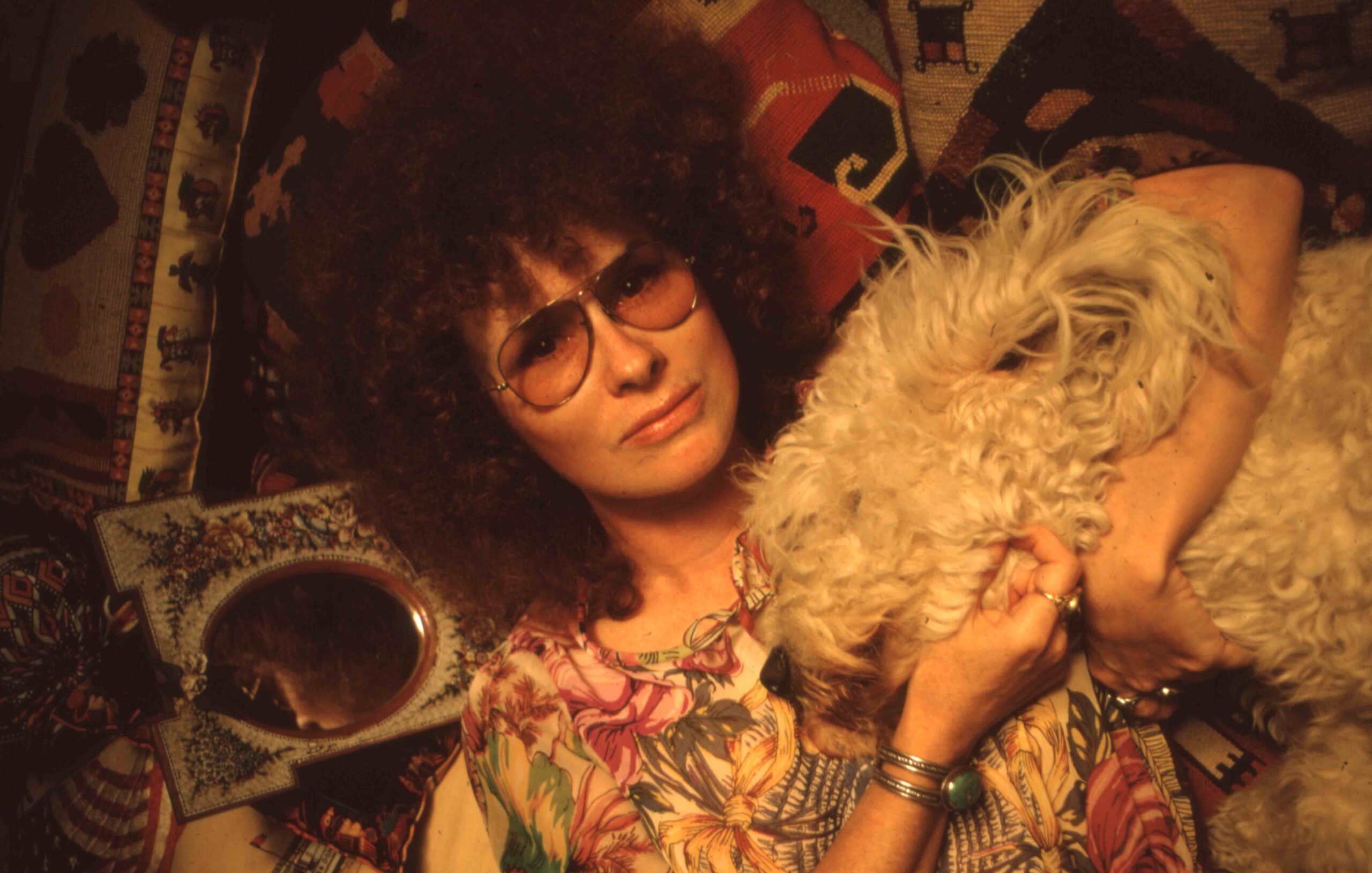
On October 17, 1974, neuroscientist Peter Sterling and musician Dory Previn sat down to record an interview. Peter had written to Dory after developing a deep interest in her work, particularly how she used her experiences of voice hearing and psychiatric treatment in her songwriting.
The recording of that conversation remained in Peter’s archive for more than fifty years. Now, the upcoming Mad in Norway International Film Festival, which will feature a showing of the film Dory Previn – On My Way to Where, gives us the chance to air this fascinating discussion.
Here, Peter Sterling explains why the work of Dory Previn became so important to him.
“I was a young assistant professor of what is now called “neuroscience” at the University of Pennsylvania when I read a review of her new releases in 1971: Reflections in a Mud Puddle and Mythical Kings and Iguanas. I bought the albums and listened to the songs repeatedly. They affected me deeply and led me to her earlier On My Way to Where, released in 1970.
For me there were two apparently distinct issues.
(i) I had discovered somewhat accidentally that “psychosurgery” — lobotomy, cingulotomy, amygdalotomy, and so on — had never been abandoned and in fact were still widely practiced — even in premier institutions such as Yale, Harvard, and Penn. Same for ECT. I was astonished and began to research these practices to learn if there was the slightest justification for physically damaging the brain in order to “relieve” mental suffering. As my reading of the medical literature advanced, I became convinced that these practices all constituted a gigantic atrocity and planned to write a book. I never managed the book but did publish a substantial article summarizing my understanding. I began to testify in court against lobotomy, ECT, and forced drugging of “mental patients”––and to write about that.
(ii) I was lecturing to Penn medical students about the parts of the brain concerned with emotional regulation and behavior, what was called the “limbic system”. Also, I was experiencing for the first time some depression, anxiety, and concern about my own sanity. So while I was wondering in general about the nature of sanity, I was also wondering specifically about my own.
I decided to present the classic neuroanatomy but also to try to convey the feelings of desire and madness. How better than to play to the class––150 medical students plus attending faculty––some of Dory Previn’s songs. I chose 2 songs per lecture and, anticipating the query, “Why are you wasting our time?”, I timed them. Two minutes each, so four minutes of a 60-minute lecture.
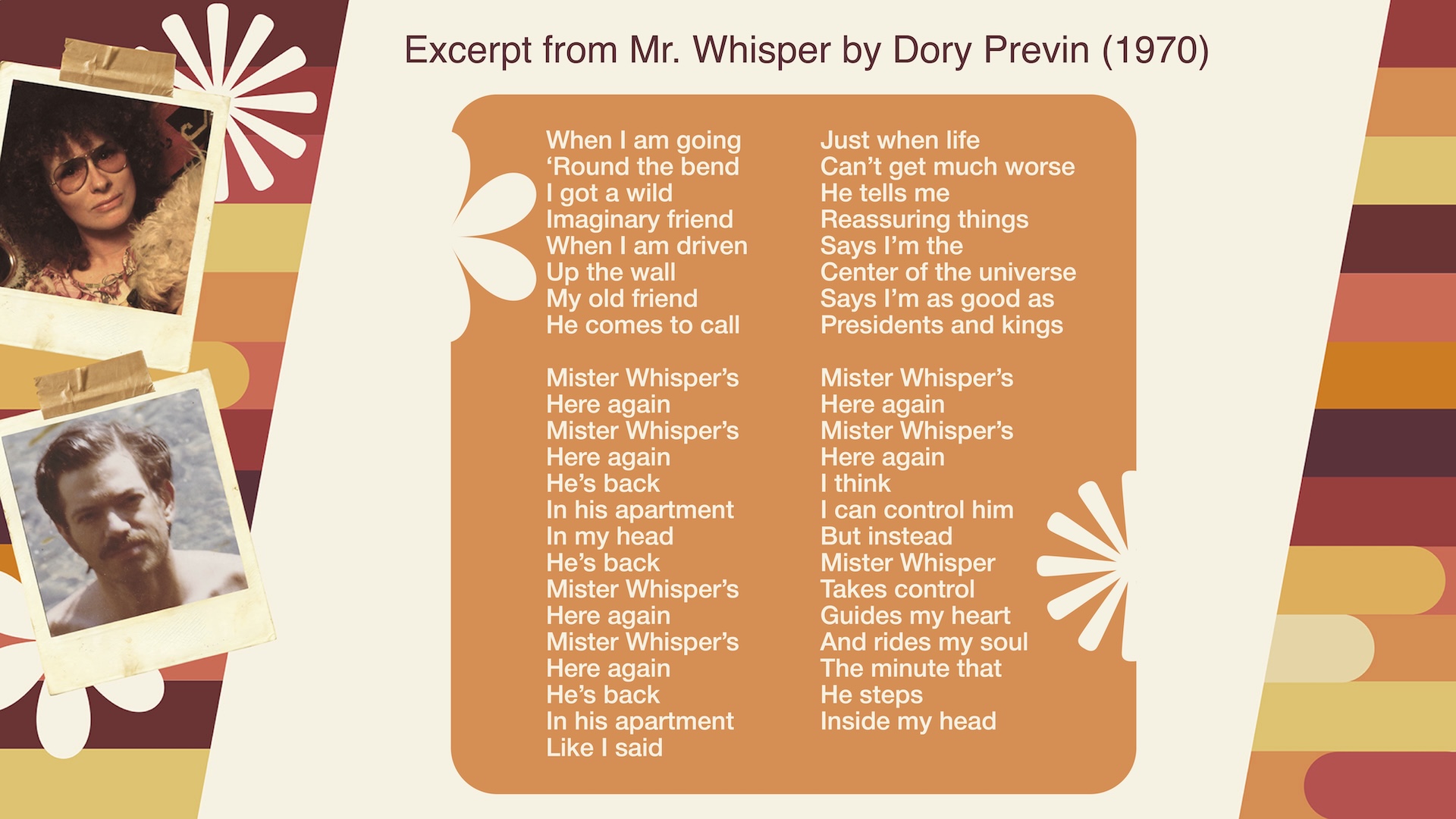
Among the songs I chose were Mythical Kings and Iguanas — which spoke to my own feelings of constraint by “higher cognitive” activities and my desperate desire to descend down, down, down to where the iguanas play. Another was Screaming and then On My Way to Where in which she sings, “…they shoot me with a bolt or two and drive me back to lonely sanity.” That seemed to comment on ECT and also that her reluctance to stay sane is that it was too lonely — whereas in the song Mr. Whisper, her imaginary friend, tells her “reassuring things…”
After a song faded and the tape clicked off, I’d be staring at the audience paralyzed with emotion, speechless. Some of the students, I estimate about one-third, shared my response. They got it — and later a number sent notes, or poems, or recalled those moments when, years later, I’d encounter them on the street. Another one-third of the students were indifferent and just wanted the lecture done. The final third were disturbed in a different way––angry and uncomfortable; several walked out, especially once they anticipated what was coming.
After two or three years of these presentations, the faculty asked me to stop the music. Of my seven colleagues in this “team taught” course, only one, a kindly country man from Tennessee, sort of did get it and defended my right to include this material. But, since I was course director, I felt bound to respond to the majority and so dropped Dory from the lectures. My daughter and son grew up with Dory Previn’s albums and understood their message. Last year at a family party for my 85th birthday, my son and grandson sang a brief medley from Mythical Kings. So in my family, Dory Previn’s influence now spans three generations.
In the late 1970s I also began to write about the brain–body connections and how society, via the brain, influences the body. Eventually I published What is Health? Allostasis and the Evolution of Human Design (2020). Dory Previn is not named in the book, but she is there on every page.”
Now, more than fifty years after that meeting, Peter is ready to hear her voice again—and to consider what her remarkable songs and words had to say. The following interview has never before been aired.
The transcript below has been edited for length and clarity. Listen to the audio of the interview here.
Peter Sterling: I’ve got to say before I ask my questions, this is for me like a cross between an interview and a religious experience.
Dory Previn: My goodness!
Sterling: I don’t think that I would have had the nerve to write you or to ask you some of the things I’m going to ask you if I didn’t really feel like I really shared some of the stuff that you sing about and clearly don’t share all of it. That’s what I want to ask you about.
I guess where I want to start is, I’ve been working on this book, gathering material for a couple of years, starting as psychosurgery which we were all taught that psychosurgery, lobotomies, a lot of that went out 20 years ago. I read up a lot on that. I see a lot of parallels between shock and drugs. In fact, it seems to me more and more that in terms of social problems and considering treatments as social problems, that drugs and shock are more important.
I guess I ought to start, by saying, I don’t know your biography, but I mean, from just from listening to your song, that’s all I know, suggests that you went through a period in which you were what people call crazy, and Mr. Whispers suggests that you had shock.
Previn: I had insulin shock, which is not the same. I had many, many years of tranquilizers, uppers and downers. But it was considered for a while that I might have shock therapy. I asked my doctor that I never be allowed to have it because I always felt that I wanted to remember, not to forget. If you are shocked, catapulted over a specific block in life, one day you’re going to have to go back and face it.
I mean, it’s just one way, and so you just keep being catapulted over and over and over, which I guess then becomes very diffused and dulled. It’s very terrifying. It’s the only part of the mental hospital outside the straps and the lock, which is really frightening to the other patients, because you can see what happens to the person.
But I do remember also that despite the fact of almost making a verbal contract with my doctor, that no matter how bad I got, would he please never use that because I always wanted to use my mind the best way possible. He always felt that I should also, so he didn’t want me to have shock therapy because he admired my mind, wanted to do his best to preserve it.
Nevertheless, I do remember there was one period in the hospital where I begged him to allow me to have shock. I’m, you know, eternally grateful he didn’t allow it because he must have known that I was just in a terrible state of despair that I asked for it. I was in what you call a spin. It’s a deep depression. You just keep going around and around. They shock you to get you out of that spin, you know. So, I asked for it, and I wasn’t allowed to have it, and I was always grateful for it.
Sterling: That really brings me to what’s a central difficult question. Psychiatrists and neurosurgeons will talk and say, “Look, people are in misery, intolerable pain”.
Previn: Yeah, intolerable.
Sterling: And we have to do something. It’s immoral not to do something. They say that people who are opposed to shock or surgery, any of the treatments they have to offer, are people who make something romantic out of it. You were beginning to say how you felt at the time.
Previn: In my case, I was lucky enough to have been pulled through with the help of drugs and other things of that sort, therapy. I think that there should be more romance in medicine, especially in the treatment of psychiatric problems because I think that everything the patient says, and I know this from experience, is rational in a created environment. In other words, the person cannot deal with life as it is. So you create another life.
Now, everything that is said, no matter how strange or how unrealistic it seems to come out, has a total reality to the person. So, one has to get through all that, work through it, define the architecture of that so-called fantasy state, understand what the person is saying, go through it to its limits, and you’ll eventually come out the other end. But if you, as the moment the person starts, which has been done with me also, the moment the person starts, you make the person quiescent, and you stop the memory, and you put the person out, but even though the pain is intolerable. I mean, that’s why not very many people come through mental illness. The pain is intolerable. But if you stop that imaginary reality, which very often is closer to the patient’s own real reality, you stop midway; you are only deterring it. It will come back. It’s not complete. The idea, which has absolute merit to the patient, is never brought forth, and then never understood by the doctor. Does that make sense?
Sterling: Yeah. But you said that the shock that you didn’t have and the drugs got you through it.
Previn: Well, I think that’s frame of mind. I think that’s state of mind of the patient. Again, I can speak very clearly about it from my point of view. I never took pills, or I mean, except in the very extreme state where I just was trying to get through the night, or just get through to the next five minutes, the next one minute. But I always had the idea that because I was as far into this state as I got, and had several breakdowns, had experienced it so many times. I never felt the pills were going to be the crutch that would keep me going for the rest of my life.
I always viewed them very specifically as a maintaining operation, that I would use pills and that the pills were being used on my part, whether on the doctor’s or the hospital’s or anything else, on my part to just get me through to the next point of light, so that then I could continue. It was just always in my mind keeping me going till I could scrape the bottom, till I could find out what it was that was making me this way, define it in myself.
Sterling: My understanding of a lot of patients is really doped up on enough Thorazine that it’s not so easy to keep fighting.
Previn: Yeah, well, that’s what I said. I said that sometimes when I was in a very extreme situation, the world stopped for me, and it was just a stopping action. Then it was just, as I said, just trying to get me through the next five minutes. But then when I would get out of those extreme periods, I always viewed the pills as being something, or shots, whatever; I’d taken pure Thorazine, shot form, everything. I always viewed it simply, though, as something to help me — to keep me going until I could better understand the situation.
Sterling: Did your doctor take you off Thorazine?
Previn: He would always lessen my medical dosage as soon as possible, even though I would get frightened. But then after I got out of the hospital, he always had me on my own program, because that was part of it. The moment I would need fewer pills, I would take fewer pills. It was always a means to an end, to a certain goal that I had, not as a way and means of getting through life. I was taking a normal dosage of Thorazine, and people just who are neurotic or are like taking three times 10 milligrams a day. I mean I was not fooling around. I was taking enormous dosages, plus Nembutal to get to sleep, plus Stelazine to keep something going. I never, ever thought that it was going to be my life always, never. I think that conviction is what kept me going. Insulin shock, it was in my case, merely to bring me up to a certain level, to bring me out of a very deep depression, so that then they could start treating me with everything else.
It was a shock to get me into a kind of false, slight false sense of euphoria. But it wasn’t even that; it was just bringing me up to, honestly, the normal level, just to a level where they could begin treating me with pills.
Sterling: I mean, I’m actually quite surprised at what you’re saying now, because what I hear, at least, in that is a regret and anger.
Previn: There’s a psychiatrist doctor named Dr. Leonard Zinman, who uses Mr. Whisper in lectures and things like that, and he was quoted in this article in Human Behavior, or The Psychologist. He said that the people who go into unreality are so lonely in the world that they go somewhere else, because everything’s checked out in the world. Because if there were anything left in the so-called reality world, they would stay there, you know.
They go into another world, literally, because they are so alien to this world. He said, and with going into another world like that, if one feels that all love in one’s life is canceled out, one invents a friend. And then he says, consider this lyric, and he plays it, and then he recites it. He said, if a person is convinced that no one in the world loves her, that she’s totally alienated and totally alien, and she invents a friend who tells her she’s as good as presidents and kings, and that everything is incredible and that she can do anything she sets her mind to do.
Then a doctor comes and says, “I’m now going to remove that friend from your existence”. That person is going to be very bitter, very sad, very lonely that the doctor could take that friend away, because that’s a valued friend. A friend to really have a friend who says you’re as good as presidents.
Consequently, there’s enormous ambivalence and enormous loneliness. You know, in the Faustian sense, I would make pacts with the voices; I would say, “I’ll do anything as long as you’ll just stay and not leave”, you know, because it’s too lonely back there, could you come back with me? Now I’m speaking to you in this way as though that is a reality, because as I said before, that anything anyone says in that state has a reality to the person.
Now, this last time that I had a breakdown, I determined that I would come back with whatever friend I made. So, I walk a very fine line now between what is the so-called outer world and what inhabitants exist in my so-called inner world. I found that while it’s very fearful, and everything in our contemporary society says, that’s not reality; you must not feel that way about inner friends, or as we call them, voices. Nevertheless, it’s my prerogative if I can cope with the world and do what I have to do and what I want to do, and still have a very vivid inner so-called imaginative world. That’s my concern.
I came back from this last episode that I had. I don’t take pills. I’ve been in activist therapy, as opposed to classical analysis, and I’m able to get through it now. Then I give as an example of a counterpart to what I experience in my own imaginary world, the so-called ally. The ally, to me, is no different from this so-called spirit friend that I feel and experience, and that I choose not to part company with. I’m sure it’s maybe a modern, maybe an existential version of God. Maybe it’s a physical human manifestation of what I would imagine my soul to be.
For a while, I was very, very frightened because I began to think, “Oh God, I hear this voice again”. I communicate this in a way with this inner friend, which I refused to have taken away from this last journey of pills or otherwise. I even quit analysis for a while because I didn’t want to talk about it, because I didn’t want to be robbed of it.
It was metamorphosing. This vision of the mind was beginning to have aspects of a fish, like a mermaid or something. I was going through my books, and I saw a book by Jung, Carl Jung, Psychology and Alchemy. I looked at that book, and I thought, oh God, I bought that about two or three years ago and I don’t remember ever going through this because I never read it. I took it, and I put it by my bedside, and I was still having these feelings of insecurity about my imaginary life circle.
One night I couldn’t sleep, and I opened the book, just opened it at random, and it said, it’s a title I’m paraphrasing, The Aspect of the Spirit in the Medical Studies of Paracelsus in the 14th Century. It haunted me, and I started reading it.
In the 14th century, Paracelsus wrote of a condition in which he described as arriving at the point where a person’s entire life, as it was heretofore up to a certain point, collapses. Every ounce of the structure of the foundation on which a person builds her life or his life collapses, and the person has nowhere to go, no way out. At that moment, he said, very often a person will conceive a vision of the mind. That vision of the mind very often takes other forms. Most often it’s female, but it will take combined forms, such as a fish or a salamander, which is an iguana. I had written the song Mythical Kings and Iguanas. I looked, and I thought, okay, all right and that happens to me all the time now.
Every time that I feel despondent or I feel I’m crazy, I’m going over the edge again, I am hearing this voice, I’m communicating in my inner life, not anyone from another planet or anything like that, just someone created inside and I begin to get frightened, a book falls off the shelf, or a phone call will come from a friend, or someone will say something, or I’ll see something in a sign or on television, anything. It would always reinforce this belief that I had. My next album, I wrote specifically a much more outer album, this last album, because I’m going to deal with it. Whether I can communicate it or not, I don’t know. Whether it will be received for what it is, I don’t know.
It’s no different from Tiny Tim. Remember when you were a kid in the funny papers, Tiny Tim was this big, but you could see him because he was in the funny papers. It’s no different from Harvey the Rabbit. Whatever gets you through the night, you know. If one creates a friend that looks like a rabbit or a fish or a person, does it matter?
Sterling: But it matters to psychiatrists who take that as evidence of something. I mean, in a way, you’re a special case because you’re not the average. Orders and orders of magnitude more articulate and in some incredible way, stronger than most of the people who are around now.
Previn: It was a coincidence. I was fortunate that I was a writer. I took a trip, took several trips, came back and wrote about it.
Sterling: Yeah. But what happens in most cases, they said, and people plead for the shock or plead for lobotomy. How do you feel about that in retrospect? I mean, you said very clearly how you felt about it at the time. In retrospect, how do you feel about it for your compatriots in madness?
Previn: As to whether they should have shock or not?
Sterling: Well, you know how much pain they’re in. You know what they’re asking for. As far as I can make out, the ultimate result of a chronic application of any of these things is just flattening everybody out.
Previn: See, this may sound very cold what I’m going to say, but survival of the fittest is a very, very strong component of this. I think we are going through a period now of evolution where I think that drugs have been a crash program to spirituality. I think that they have not been without a very positive contribution to our culture because in a culture where we were going totally down the road to technology and Freudian analysis or interpretations, we had to be stunned or stoned into recognizing that there’s more. It’s a hyped up recognition, but it presents the possibility to people who were so into materialism, so into technology, that it became a reality. It paved the way for writers like Castaneda.
Sterling: That’s true of LSD, marijuana, and so on.
Previn: The thing is that just as in the old days, as you know, a leg was cut off immediately if you had an ingrown toenail, I guess, they could cut your foot off. I mean, things have led to a certain degree of betterment in medicine, but I think that we are in this evolutionary state where we are making a leap.
Some of us are going to make it, and some of us are not. And just like in the sense of drug culture, some people made it. They went through it. They no longer are on drugs, but they remember that, and they are very attuned to the spiritual inner world now. There were also the casualties who didn’t make it, right?
I think in an evolutionary leap, there are going to be those people who will make it and those people who will not. So I think there are two villains. The person who asks and begs for the drug and continues to, where it just becomes, you know, a way and a means to living. And there’s the person who says, hey, no, there’s a better world out there somewhere.
What I’m saying is that it rests with the individual. The strong person, the person with the will to get through, will eventually say to the doctor, no more shock, no more pills. I’m going to make it on my own. I’m going to do it. Or keep cutting down my pills. Cut them down, cut them down, cut them down.
I was lucky, whether it was because my doctor had some kind of respect for my mind or felt that it was worth trying to take the effort. I don’t know. That’s not even fair either, if that was the reason, because I’m no better than anyone else. But I had twofold luck. I was absolutely determined to make it through, to find out. I never turned away. I always faced the demons and went in further and further and further and kept breaking myself over and over again, like bumping into a stone wall. But eventually something has to give. It can’t always be just the one person. You temper steel by breaking it, don’t you? It gets stronger and stronger.
I had that with myself, an absolutely unswervable will. I had a doctor who was willing to go through it. He said to me once, he said, “No, I’m not going to give you shock. I think we’ll do it the hard way”. So I’m grateful to him. Then when I went to the gestalt therapist, the first time when I began to get into the spiritual thing with him, he said, you know, don’t give me that spiritual bullshit. I won’t take that with you. I said, well, it’s a classic example of East meets West; I mean, you have a totally Western precept, and I’m looking for a Western precept with the possibility of an Eastern concept, and I want the two. So I’m going to leave. I left, and I went through a breakdown alone.
I have since gone back to my therapist after staying out for a year because I wanted to solidify this inner existence. When I went back to him, I started telling him that he had come around to my way of thinking. So that’s what I’m saying. I mean, if we evolve and if we move forward, I mean, I always hate seeing anyone go into the shock. But there’s nothing I can do about it. I mean, I don’t know what I would do if I were that patient. I don’t know. I would get angry sometimes with patients who would go into the shock because I thought, Jesus, do it, do it. But who knows, you know?
Sterling: Did you ever talk to other patients?
Previn: Not about shock, no. Not people who are determined to go because it rests with the individual. It’s the difference between wanting to sleep and wanting to be awake, and there’s some people who want to sleep through life. Where the pain is just so unbearable.
Sterling: Let me ask you, that sort of brings me to another question. You get the sense there of sort of a patient underground that is dealing with these offered physical treatments, drugs, shock, and trying to fend them off as best they can? Do you have a sense of the general attitude to it? I mean, you said that people were frightened about shock, but the same people underwent it anyway.
Previn: No, there was always a disquietude. It’s a microcosm, it’s a little universe, and people who were not going into shock, knowing a person was preparing for it, there was also a lot of restlessness. I mean, it was comparable to, I think, death row, when the woman goes to the electric chair or something, and there’s that kind of dynamic reaction among the group.
Kind of “There, but for the grace of God”, I don’t think I’m lucky enough; I don’t have to go. Oh, that person’s going. Oh, that person will deal with that depression now.
Or, I mean, there were a number of varied reactions, all subjective. I was always terrified of it, because I was always terrified of the possibility that at the end of the road, that was what awaited me.
But one time I read a sentence in RD Laing that I really think changed my mind. He said, “I am now referring to those people who decide to embark on a career of schizophrenia”. Those are incredible words. I realized then who decided, who made the decision, who went on the trip, and was it going to be my career? A lot of people in mental institutions, that’s their career; their sickness is their career. I didn’t want that to be my career.
Sterling: I mean, I guess one of the important questions in my mind is, you know, how does one make that transition from drugs to gestalt?
Previn: I think that’s all it is. I think it’s a will. It’s so enormous, and so simple. It’s the ultimately complex thing, and the ultimately simple way to do it. Let me say this, and this is very subtle. There is also a decision. I wrote one of the lyrics about it called broken soul. There is a decision to go through it, to accept it as a part of one’s existence, not be thrown by it, not be frightened by it.
That’s what I meant earlier when I said I walk a very precarious line, very tenuous, because I go into those periods, getting out of them, I’m always slightly aware of them, and I say, it’s okay, don’t panic, it’s all right, it’s maybe heightened awareness. I think that maybe fear of that, the thing is that some people believe that insanity is not insanity at all, but merely a state of heightened perception, and because of the fear, it begins to get all scrambled. But what you’re really doing is you’re opening the shutter of the eye just a millimeter more than usual, and the light blinds you. But we do see by selectivity, because we’re not capable yet of seeing all.
So consequently, we select what will keep us at this stage of evolution. Everyone says, well, if you open the shutter of awareness just a slight bit more, a millimeter, less than a millimeter, it can throw you. But it can also be very revealing. I think it’s worth it, some kind of heightened awareness, what it is here, why we’re here. The terrible thing that happens when you go into a state like that is you begin to see the patterns of the universe. They call it relating, and they call that introspection, and that it’s a sick way. I think it’s the real reality.
Sterling: I mean, I guess it goes around. What you’re saying now is that the terror and pain is worth it.
Previn: If you understood it to mean anything else, then I misled you. I’ve always felt it’s worth it. Knowing what I know about people who’ve had shock therapy, and knowing how you go, here’s your block, and you go up to here, and you don’t want to face it, and you don’t want to take pills to keep you relatively aware, but you can still go through it, right?
Face the pain, face the terror, go through the long dark night. So instead of all that, and instead of going back into a depression, you’re shocked over it. Now, what happens is if you are in a very, very responsible position, you are confronted with a new shock compounded by the hidden traumas that you didn’t face the last time. So that each new trauma that you face has the added weight of all those unfaced traumas, right?
So it becomes a cumulative, overwhelming thing, but I only have so much reserve. My mind is like a person with a weakened heart, a kidney, or a limb. If you break your knee 10 times, you have to be careful. You’re not going to take risks. It might get even stronger as a result, but you always have those little fractures there, and I feel that way about my mind. I take care of myself. Something like this, to make a tour like this, takes every last ounce of energy and reserved energy to do. I take as best care of myself as I can.
I would not want to be in a life of the unexpected all the time. I mean, all lives are filled with the unexpected, even if I never leave my home in Los Angeles every day, but I can only deal with that unexpected within my own surroundings. I’m sure that when this evolutionary leap is met, these things will be axiomatic anyway, because they are just things of the moment, trenchant things of evolution.
Sterling: You’re incredibly optimistic.
Previn: Well, if I weren’t, I’d be dead. I have to have some kind of optimism, and I think that each person’s life is a microcosm of the universe, and I think that that’s how we contribute. I’m with Buckminster Fuller in that one. Some contribute negativity, some contribute positivity, and I think the most negative people very often turn out to be the most positive, because it’s all been shit, and there must be a pony; it’s that old joke.
It’s a good joke. I don’t like jokes, but this is a very philosophical joke. The little boy was totally, totally an optimist, and the father wants to teach him a lesson in life, and so the father goes out and fills the boy’s bedroom with manure, and the boy opens the door. Now do you believe that the world’s full of shit? And the boy starts digging like mad. The father says, what are you digging for? He says, with all this manure, there must be a pony. And I think with all this shit, there must be something positive, because no one would get through it.
Sterling: Sure, but I mean, it gets, it’s a positive thing, because of your singing, and as I sit and read and watch the graphs of the consumption of Thorazine go up year after year.
Previn: I understand that, I agree with you, but it’s all percentages, and for every thousand, every million people who get through and just go down the drain on Thorazine, there are another billion who would go down the drain on alcohol, another billion who go down the drain on pot or whatever, LSD, they scramble their brains, and then there’s another million who like myself, used it to get through all the shit that was laid on them from another lifetime of precepts, you see?
There are survivors. I get back to that again. If I had not had drugs and Thorazine, maybe I would have gotten through. I don’t think I would have, and it helped me at a point in life when I couldn’t get through without pills, and I got through it, and then I threw them away like crutches, after I got strong. I can’t, in all honesty, because I look back on how they used to treat people like myself. Years ago, I would have been in Bedlam, or they would have given me warm baths all the time, to try and keep me quiescent, you know? So I’ve always been grateful for Thorazine. Not shock, I’ve always been terrified, but Thorazine and those pills, I’ve always been very grateful for them.
Now, what they’ve done to my body, whether I will die earlier because of having taken those thousands and thousands of pills, I don’t know. But I would have been dead earlier anyway. So it just gave me a little longer.



Wow, this is fabulous. Thank you so much.
Report comment
Thank you for sharing this, Peter. Incredible you kept it all these years. Interesting questions; fascinating responses. “It’s the ultimately complex thing, and the ultimately simple way to do it. Let me say this, and this is very subtle. There is also a decision. I wrote one of the lyrics about it called broken soul.”
Report comment