
A good soccer team coach makes all the members of the squad feel valued and that they have an important contribution to the team’s efforts. A less confident coach may have favorites and neglect other squad members. This will likely lead to disharmony in the squad and disaffected members may team up and be quite sabotaging to the aims of the coach. We think this is a great metaphor for understanding and managing different parts of ourselves and in particular we have found it a useful metaphor to support people who hear voices.
Why are we passionate about this?
We are psychologists who have been inspired by the hearing voices movement. I (Rufus) have worked with hearing voices groups since 2001. I fell in love with the values of the hearing voices movement because it saw people as experts of their own experience and voice hearing was meaningful. This resonated with my own experiences of being treated as psychotic for a year when I was 18, even though I did not hear voices. Nevertheless, I strongly believed the content of my psychosis/alternative realities were meaningfully related to my life, despite medical approaches which seemed to ignore this possibility (seeing it as a largely biological problem called schizophrenia). I (Kate) also been involved with supporting people who hear voices since 2009 and have been particularly inspired by the community development aspect of the hearing voices movement; where people are brought together to learn from each other and give each other confidence. I have been using the soccer team metaphor for understanding voices in my own clinical practice for many years, after Rufus introduced this to me. Trainees and therapists I have supervised have often asked for a reference paper for the soccer team!
What is the hearing voices movement?
The hearing voices movement started in the late eighties in Holland and soon after in England. It was a collaboration between people who heard voices and mental health workers. It brought voice hearers together in conferences and peer support groups to share experiences and ideas on how to better live with voices. There was an emphasis on shifting the power relationship between the voice hearer and their voice or voices; rather than trying to get rid of voices encouraging voice hearers and their supporters to respect and learn from voices but not to submit to them. This represented people learning to become the leaders of their own psyche. In the nineties, links were made between the hearing voices movement and a personal development approach technique called Voice Dialogue.
What is Voice Dialogue?
Voice Dialogue was developed as a self-development tool by psychologists Hal and Sidra Stone in the 1970s (Stone & Stone). The approach proposes that rather than having one distinct personality we tend to have a cluster of sub-personalities. Hal and Sidra stone suggested that if we can get to know better our different parts, from a position of awareness, we will have more choice in how we behave and reduce our level of inner conflict. There are similarities between Voice Dialogue and Internal Family Systems (IFS) which the reader may be more familiar with. Internal Family Systems has grown as a therapeutic approach over the last 20 years. However, whilst some IFS practitioners have begun working with voice hearing over the last ten years there is not much written on this (see Stephanie Mitchell 2025 for an interview with the founder of IFS Richard Schwartz where they reflect on dialoguing with voices). Compassion focused therapy also supports voice hearers to manage their voices through assertive dialogue from a place of grounded confident compassion (Heriot-Maitland and Longden 2022).
Voice Dialogue with voices/Talking with Voices
The Voice Dialogue approach has been adapted to use with voice hearing (see for example Corstens, Longden , & May, 2012). To distinguish it from general Voice Dialogue, Voice Dialogue with voices has also been termed the ‘Talking with Voices’ approach. It should be noted voice hearers negotiating with their own voices has been an established self help technique since the 1980s. And it was voice hearers like Ron Coleman and psychiatrists like Dirk Corstens and Marius Romme, in the late nineties, who first made links between the voice dialogue chair work and developing this technique to support voice hearers.
The Talking with Voices approach is beginning to be evaluated in research (e.g. Middleton, Cooke & May, 2022; Steel et all, 2019 & 2020; Longden at el 2021a, 2021b, 2022a, 2022b, 2023). It proposes that voices that are challenging (e.g appearing critical or domineering) can be seen as a representation of disowned or pushed-away aspects of self. Informed by Jungian ideas that uncomfortable, discouraged or unsafe parts may become pushed away, it suggests that the content of voice hearing is often related to disowned traits. As the experience of trauma is often related to aspects of self becoming disowned, it follows that the content of voices is also often related to trauma. This approach would suggest that voices are like symbolic representations of disowned selves, conceptually similar to framing voices as dissociative experiences (Moskowitz, A., & Corstens, D. (2007). A core technique in voice dialogue is to work with a facilitator to talk with the voices, with the aim of understanding and honoring these aspects, in non-destructive ways. This can be directly with the voice hearer speaking as if the voice, or indirectly, where the voice hearer speaks as themselves but informs the facilitator what the voice is saying. Facilitators may be therapists, but not necessarily, with the model having applicability in other contexts such as peer support networks (e.g. hearing voices groups) and existing in self-help formats (e.g. May & Svanholmer, 2017).
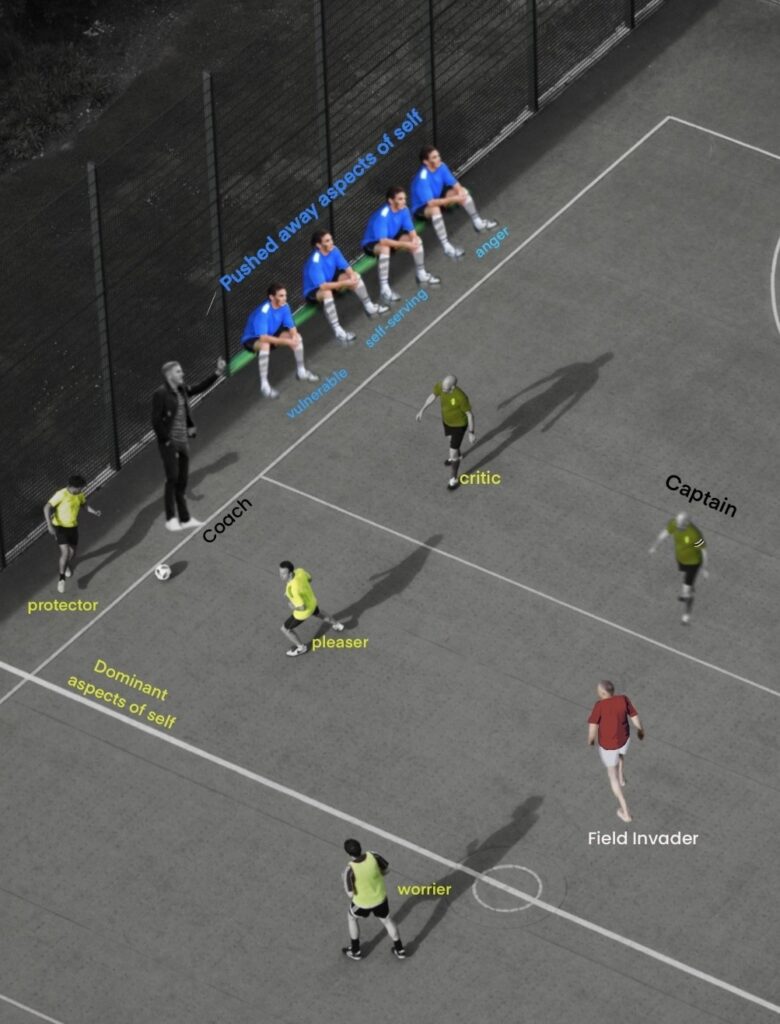
We outline a metaphor for introducing the theory of voice dialogue and voice hearing, using the analogy of a soccer team and a soccer team coach.

The team coach
The team coach, in voice dialogue theory, is called the ‘aware ego’. Rather like the coach of a soccer team, whose job it is to pay attention to all of the players (those on the field and on the bench), the aware ego is there to pay attention to and ‘manage’ all the aspects of self. This includes the dominant and disowned selves, and therefore also the voices. As with a good coach, the aware ego has to consider those selves that are louder/more dominant, but also those that are quieter and may struggle to be heard. The team coach position represents standing back and holding awareness of all the selves.
What can help this process is if the team coach gets to know the characteristics of all the squad members and builds a better relationship with characters, they are not so close to.
The protector/controller
An influential protective self in voice dialogue theory, is called the protector/controller. While in voice dialogue the protector/controller is an aspect of self, it can be seen as rather like a defensive captain in that its role is to oversee the selves and get the team to play safe. The captain might be seen as giving access to the other aspects of self/players, so often this is the part to approach first when considering dialogue with the selves. It is protective, so will often not want vulnerable selves to come to the fore. It is important to work alongside the protector/controller captain if you wish to be able to dialogue with all the selves.
The players on the field
The players on the field are the ‘dominant selves’—those selected to play (or in other words, those in conscious awareness). Dominant selves come about due to our upbringing/experiences, culture and characteristics like gender or race. They tend to be things that are regarded as socially acceptable in context and/or have served us well in the past. People may describe becoming quite ‘stuck’ in a particular aspect of self, and less able to observe or understand the other selves as you would if you were in the team coach position. The players on the field include aspects of self we may recognise as aspects of our personality even if we don’t feel too happy about them. In voice dialogue no selves are regarded as good or bad, though people may describe them as such when discussing their own experiences. We might ask people to identify the players on the field by asking them to describe traits they recognise within themselves or what someone who knew them well would say about them. It can be useful to do some initial dialogue work with dominant selves as part of socialising people to the model and to practice with selves that may feel more accessible and less threatening.
The players on the bench
The players on the bench are the ‘pushed away’ or disowned selves, which are also influenced by culture, our experiences and characteristics. They may be things that have been unsafe to express, or discouraged in cultural context. They may also be vulnerable or more child-like parts that tend to become more disowned into adulthood. People may not identify with these aspects as being like them at all, but should they come into conscious awareness, they would still be experienced as part of the team. An example of a question to identify the disowned selves might be to ask what qualities or traits someone finds annoying or difficult in other people. Just as dominant selves can be interviewed in dialogue work, so can the disowned selves. The team coach needs to be aware of the whole squad of players, including those on the bench. During dialogue work, we may ask people to start in the team coach position, move into the self we are dialoguing with (often switching chairs as well), and to then move back for reflections with the team coach.
Disaffected players/fans
Within the adaption of voice dialogue for hearing voices, we would conceptualise voice hearing as similar to disowned or dis-associated aspects of self. However, these are so pushed away that when they come back into conscious awareness, they are perceived as separate rather than part of the team of players. Voices often do have qualities similar to the person’s identified disowned selves, and may become pushed away for similar reasons. For example, as a response to trauma. We might think of voices as symbolic messengers, given their subconscious nature (rather like dreams, which most people feel familiar with in terms of the concept of subconscious communication). Part of the task of understanding voices is to formulate what these messages may mean and represent (as disowned parts). The idea that voices may convey a symbolic rather than literal meaning can be helpful to change relationships with voices (beliefs about voices have been found to be predictive of distress related to voice-hearing, e.g. Csipke and Kinderman, 2006). In voice dialogue we may talk with voices in a similar way to how we might talk with other aspects of self. For the soccer team metaphor, you might conceptualise voices as players who have been dropped from the team, and may no longer be in the squad, disrupting the team. For example, leaking stories to the press. Or if we consider the fanbase to also be part of the team community a voice could be a protester arriving on the field (unexpected, unwanted and disruptive to the team).
What if the person does not find it helpful to see voices as parts of themselves?
So far we have talked in terms of seeing voices as disowned parts of self. However, some people see their voices as spiritual or external in some other way. In Jungian psychology the unconscious is linked to the collective unconscious, a kind of psychic internet where cultural archetypes dwell. This offers a similar framework to what many cultures have termed the spirit world. Voices may say they are ancestors, djinns or ghosts and the person can find this a helpful framework. The soccer coach metaphor can still be helpful. It is about how you manage the different beings in your consciousness. Treating each character with respect and trying to build constructive relationships rather than ignore them or submit to them would still be a core feature of the work.
The limits of the metaphor
There are limits to the usefulness of this metaphor. So we would urge people not to take it too seriously. Soccer players can be bought or sold. Coaches can be fired. Protesters can be arrested and banned. Whereas in the psyche, our experience is both parts of self and voices are often around for a long time. So the emphasis is on trying to create social cohesion, like a well functioning soccer team that keeps its players and manager where good communication is prioritized.
Conclusion
The talking with voices, or voice dialogue with voices approach, suggests that voice hearing might be conceptualised as reflecting disowned or dissociated aspects of self, often occurring as a result of life events. We have used the soccer team metaphor to illustrate these principles when working with people who hear voices as a way of understanding this model. Through mapping out their voices and supporting voice hearers to talk constructively with their voices, voice hearers can consider their relationship to their voices. They can be supported to become better team managers of their different selves and voices. This provides scope for voice hearers to live with their voices in different, more positive ways.
***
References
Csipke, E., & Kinderman, P. (2006). A longitudinal investigation of beliefs about voices. Behavioural and Cognitive Psychotherapy, 34(3), 365-369.
Corstens, D., Longden, E., & May, R. (2012). Talking with voices: exploring what is expressed by the voices people hear. Psychosis, 4(2), 95-104.
Heriot-Maitland, C., & Longden, E. (2022). Relating to voices using Compassion Focused Therapy: A self-help companion. London: Routledge.
Longden, E., Corstens, D., Pyle, M., Emsley, R., Peters, S., Chauhan, N., Dehmahdi, N., & Morrison, A.P. (2021). Engaging dialogically with auditory hallucinations: Design, rationale and baseline sample characteristics of the Talking with Voices pilot trial. Psychosis: Psychological, Social and Integrative Approaches.
Longden, E., Corstens, D., Morrison, A.P., Larkin, A., Murphy, E., Holden, N., Steele, A., Branitsky, A., & Bowe, S. (2021). A treatment protocol to guide the delivery of dialogical engagement with auditory hallucinations: Experience from the Talking With Voices pilot trial. Psychology and Psychotherapy: Theory, Research and Practice.
Longden E., Corstens, D., et al (2022). A psychological intervention for engaging dialogically with auditory hallucinations (Talking With Voices): A single-site, randomised controlled feasibility trial. Schizophrenia Research 172-179.
Longden, E., Branitsky, A., Jones, W., & Peters, S. (2022). ‘It’s like having a core belief that’s able to speak back to you’:Therapist accounts of dialoguing with auditory hallucinations. Psycholog y and Psychotherapy: Theory, Research and Practice, 95(1), 295–312.
Longden, E., Branitsky, A et al (2023) When therapists talk to voices: Perspectives from service users who experience auditory verbal hallucinations. Psychol Psychother Theory Res Pract. 2023;00:1–15.
May, R., & Svanholmer, E. (2017). Self-help guide to dialoguing with voices. https:// openmindedonline.com/resources/self-help-guides/.
Middleton, K., Cooke, A., & May, R. (2022). “It allowed us to let our pain out”: perspectives from voice-hearers and their voices on the ‘talking with voices’ approach. Psychosis, 16(2), 131–143.
Mitchell, S. (2025) Youtube film – IFS and Psychosis; interview with Dick Schwartz https://www.youtube.com/watch?v=1X-m9h4SIf4
Moskowitz, A., & Corstens, D. (2007). Auditory hallucinations: psychotic symptom or dissociative experience? Journal of Psychological Trauma, 6, 35-63.
Steel, C., Schnackenberg, J., Perry, H., Longden, E., Greenfield, E., & Corstens, D. (2019). Making sense of voices: A case series. Psychosis, 11(1), 3-15.
Steel, C., Schnackenberg, J., Travers, Z., Longden, E., Greenfield, E., Meredith, L., … & Corstens, D. (2020). Voice hearers’ experiences of the making sense of voices approach in an NHS setting. Psychosis, 12(2), 106-114.
Stone, H., & Stone, S. (1999). Voice dialogue. Available as a PDF at voicedialogue.org













I love this metaphor Rufus and Kate, I too have been involved as a comrade (non voice hearer supporter, NHS Clinical psychologist) of the HVN and Intervoice since psychiatry began a begrudging acceptance that personal experience may have some validity!! I trained in Voice Dialogue with Eleanor, Ron and Dirk in a quirky golf club venue in Dundee in 2009 and continue to use voice dialogue, alongside other support (I and voice hearers I have worked alongside, believe successfully) The power of metaphor is central to most of my approach these days, which is along an Acceptance and Commitment lines. I find a combination of all of these aspects of help/ support dovetail and are useful depending upon individual context. However If we maintain the basic underpinning of the VH movement that “VH is a common human experience”, we will continue to see greater improvement in support offered to people struggling with hearing voices. As I approach retirement I reflect upon how voice hearers were supported(or not!) in the 1990’s and see big changes over the last 30yrs. Its slow progress and It’s never enough, but one of my young colleagues joining the ranks of comrades, (I’m handing the baton on!) reminded me that my contribution (and other colleagues MM and DS) have changed the narrative in Suffolk 30yrs later. A voice hearer in our EI team now is a voice hearer not psychotic! Thank you for your continued work in this area, and to all those who have been inspirational to us comrades. To yourself Rufus, Ron, Eleanor Rai and Pete Bullimore, you are a huge part of paradigm change and should be honoured for it Viva la Revolution! David Williams Clinical Psychologist, Sunny Suffolk England. P.S, small point, but it’s football not soccer
Report comment