
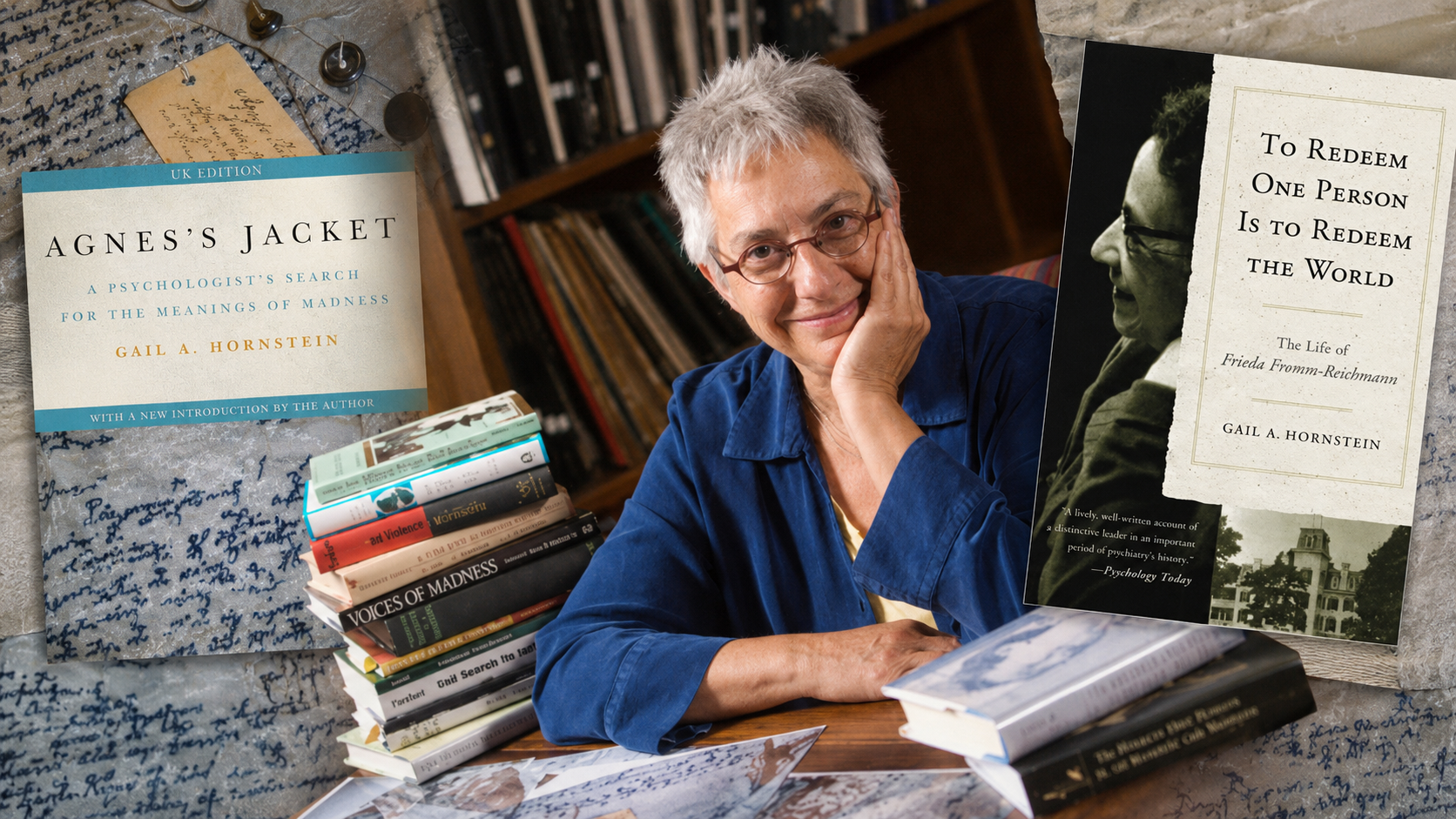
Gail Hornstein is Professor Emerita of Psychology at Mount Holyoke College. Across a long and influential career, her work has moved between psychology, psychoanalysis, history, qualitative research, and the study of first-person accounts of madness.
She is the author of To Redeem One Person Is to Redeem the World: The Life of Frieda Fromm-Reichmann, a biography of the pioneering psychiatrist and psychoanalyst best known for her intensive psychotherapeutic work with people diagnosed with schizophrenia and other psychoses. She is also the author of Agnes’s Jacket: A Psychologist’s Search for the Meanings of Madness, which explores what first-person narratives, asylum artifacts, patient memoirs, and the Hearing Voices Movement can teach us about the meanings of madness and the limits of conventional psychiatric explanation.
Dr. Hornstein is also the creator of the Bibliography of First-Person Narratives of Madness in English, which lists more than 1,000 books by people who have written about madness from their own experience. More recently, she has conducted extensive research on Hearing Voices Groups in the United States, examining how these groups work, the different functions they serve, and what members find useful about them.
In 2019, Gail spoke with Mad in America about first-person accounts of madness and global mental health. In this conversation, we will begin with Gail’s own intellectual formation and her early interest in psychological approaches that take subjective experience seriously. We will then turn to Frieda Fromm-Reichmann and the question of whether first-person accounts should be treated as clinical illustrations or as knowledge in their own right. From there, we will move into Agnes’s Jacket, the Hearing Voices Movement, and Gail’s recent research on what Hearing Voices Groups make possible for people who hear voices, have visions, or experience other extreme states.
The transcript below has been edited for length and clarity. Listen to the audio of the interview here.
Justin Karter: I’d love to start with your own path into this work. How did you become a psychologist interested in first-person experience?
Gail Hornstein: Well, I’ll say to start with, as someone who is schooled in and very committed to psychoanalytic approaches, that the reasons why any of us does anything in life always have complex meanings: unconscious and conscious, varied, changing, etc. When I was 14, I had a profound experience that has shaped my thinking about psychology throughout my life. My best friend took her own life. She too was 14. This was an utterly shocking, unexpected, unexplained action. It was something that seemed like it could never be understood by anyone.
I think there was something very profound about its effect on me, in addition to, of course, the sadness of her loss. To have someone who was sophisticated, extremely smart, an excellent student, a successful person in many respects, suddenly make this kind of choice, this horrible choice, and not to be able to talk about it with anyone. I had spoken with her the day before and had absolutely no idea that this was even remotely likely.
Among other things, this event made me appreciate the enormous complexity of human psychology and the extent to which certain aspects of it will forever remain unexplained and unknowable to us, regardless of what theoretical perspective or approach we might take to try to understand them.
I began reading accounts of people’s own experiences of madness during this period, I think in some kind of inchoate attempt to understand how this had happened. I read I Never Promised You a Rose Garden, which had come out just the previous year, and I read other books of that kind. Although my friend had certainly not been psychotic, there was something about these works that explored how it could be that people had experiences other people could not possibly understand. Of course, the people who wrote these books lived long enough to write about those experiences and to explore and understand them in their own terms. There was something about that that was very affecting to me.
Later on, I began to informally collect these books. I kept reading them, and I didn’t discard them. Then people learned of my interest and sent me more. I eventually ended up with a very large collection. But I think what was so important about them from the beginning was that they represented people’s urgent attempts to understand their own complicated, often inexplicable, often irrational-seeming psychology.
People talked about doing things yet not understanding why they were doing them. They talked about having horrifying feelings or thoughts, or ecstatic ones, that they couldn’t comprehend. There’s something about the intensity with which such works represent people’s desire to understand that was very moving to me, and remains very moving to me.
Karter: When you have this kind of inexplicable encounter, you’re trying to find some way into it, some way to understand it. These literary expositions, these memoirs, offer a way of imagining another person’s mind when it can be so hard, in the moment, to know what they were going through or what they might have been experiencing.
Hornstein: Yes. In the same period, I started to read Freud. I read Freud as a teenager in a series of paperback books that were published in the United States by New Directions. Who knows what I understood about what Freud was saying when I was 15. No doubt it’s different from what I would understand now. But similarly, what I appreciated about Freud was that he didn’t want to come to simple conclusions. I didn’t always agree with everything he said, to the extent that I even understood it, but I appreciated the depth of his exploration. I read, for example, Three Case Histories, where he spent dozens of pages trying to understand any one person’s actions. There’s something similarly very affecting to me about that.
I was a psychology major as an undergraduate at the University of Pittsburgh. This was when Skinnerian behaviorism was in its heyday. Skinner was still alive, and that was the dominant perspective in American psychology. The University of Pittsburgh’s department was an excellent one, but it was very shaped by that approach.
Karter: You’d been reading these literary memoirs and first-person accounts, and you were reading Freud. I see this with psychology undergraduates today. They’ve had some experience or encountered some literature that motivates them to study psychology because they want to understand people in a deep and complex way. Then they take Psychology 101 and think, “What is this?” It sounds like you had that experience too. The psychology you were being presented with didn’t scratch that itch. It didn’t approach the complexity, or the loss you had experienced, with much sophistication or nuance.
Hornstein: Yes, that’s true. But I loved school. I was a good student, and I persevered. Then it was time to go to graduate school. I made what I considered, then and still consider now, probably the single most important decision of my life: to attend Clark University for my PhD in psychology.
Many people know Clark because in 1909, G. Stanley Hall, Clark’s first president and a famous American psychologist who helped establish adolescence as a distinct stage of human development, organized the university’s twentieth-anniversary conference. Hall invited Freud and Jung to Clark, and Sándor Ferenczi traveled with Freud. For Freud, it was his first and only visit to the United States.
Parenthetically, it’s amazing to think back to this. Freud’s lectures were delivered extemporaneously and in German. The American audience was sophisticated enough to listen to these lectures in German, as was a reporter from the local newspaper, the Worcester Telegram, who covered them for the local community. I find that extremely impressive.
But be that as it may, the reason Hall invited Freud and Jung was that Clark thought about psychology differently from other departments in the United States. Of course, there weren’t very many departments in 1909. But by the 1970s, when I went to graduate school, Clark was still very distinctive in following Hall’s basic approach, which was to see psychology as a unified discipline.
Unlike other departments, there weren’t separate sections where the people in social psychology, developmental psychology, and clinical psychology might barely encounter one another. At Clark, because of this idea of the unity of psychology, we all studied together. If you wanted to be a therapist who did assessments, for example, you took additional assessment courses, but otherwise everybody studied together.
Similarly, the prevailing attitude was that psychology was a highly complex discipline that intersected with many other fields. We read philosophy of science. I personally studied, with the encouragement of my professors, phenomenology, phenomenological psychology, psychoanalysis, and ethnomethodology. We read books that people in other psychology programs simply wouldn’t have read. We read Foucault. We read Frieda Fromm-Reichmann. We read Sullivan. We read Goffman. We read Kenneth Burke on dramatism. We had a very, very broad understanding of the field, and that has shaped my thinking for the entire rest of my career.
Karter: In some ways, to come back to the original question, it’s almost surprising to have to ask: How did you become involved in a psychology that pays attention to subjective experience? It sounds like Clark was one of the few places that took first-person accounts and subjective experience seriously, and theorized from them, at a time when much of American psychology was focused on measurable behavior.
Hornstein: Yes. And I was lucky enough to do a postdoc at Berkeley in a program called Personality and Social Structure, which similarly shaped my two abiding interests for the rest of my career.
I studied grounded theory with Anselm Strauss and learned participant observation from Michael Burawoy. I studied with Arlie Hochschild, one of the leading figures in the sociology of emotions, and with psychologists interested in how social structures shaped internal psychological processes. I feel very, very lucky to have had those experiences.
Karter: This brings us to your first book, To Redeem One Person Is to Redeem the World, where you explored the life and thinking of Frieda Fromm-Reichmann. How did that book come about? Why Fromm-Reichmann? You mentioned her as one of the people you had read early on.
Hornstein: Yes. I had read her important book, Principles of Intensive Psychotherapy, as a graduate student. It was taught in a class by a professor who had enormous respect for her approach and her willingness to engage with people with psychotic diagnoses.
I came to write what became her biography in an interesting way. It didn’t start out as a biography, and for most of the 10 years I researched it, it wasn’t one.
By that time, I had become a serious student of the history of science and the history of medicine. I spent a year as a visiting fellow in a prominent history of science department, and I really appreciated the perspectives of colleagues in those fields. What I couldn’t understand was why, in the histories of psychiatry, psychotherapy with psychotic patients was never mentioned. And in histories of psychoanalysis, work with psychotic patients was similarly never mentioned, except to say that Freud thought it was impossible.
It was as if the work of people like Fromm-Reichmann, Sullivan, and Ferenczi didn’t exist. Ferenczi was eventually rediscovered in the history of psychoanalysis in a powerful way, but initially his work was really discredited. It was as if this very important approach, which I knew about and thought was significant, was simply being left out of history.
I was originally going to write a book called Models of Madness, in which I explored this lacuna in the history of psychiatry and psychoanalysis. But the more I talked about Frieda Fromm-Reichmann, and I gave many talks about this work, the more it seemed to people, myself included, and to my publisher, that focusing on her example was really the most powerful way to get these ideas across.
Because when I said to historians of medicine, “I’m writing about the history of psychotherapy with psychotic patients,” they would say, “Is there such a history? What is there to say? It didn’t happen.” Frieda really embodied this approach, and it became increasingly apparent that it was the way to tell the story.
Karter: For listeners who don’t know Frieda Fromm-Reichmann or her biography very well, could you put her in context for us? Who was she, and what was her connection to Erich Fromm and to the wider psychoanalytic and social-theoretical world of the time?
Hornstein: Frieda Fromm-Reichmann was born in 1889 in Germany. She was one of the first women physicians of her generation. She began studying medicine at the University of Königsberg in 1908, the year women were first permitted to matriculate fully at Prussian universities.
Although she became a psychoanalyst and certainly thought psychoanalytically, what I argue in my book is that her formative experience came during World War I, when she was a close associate and assistant to the neurologist Kurt Goldstein.
Goldstein ran a clinic for soldiers who had brain injuries. With trench warfare in World War I, these injuries were often highly idiosyncratic, depending on where shrapnel entered, its velocity, the number of fragments, and so on. The soldiers were all very different from one another depending on the nature of their injuries.
But Goldstein believed very strongly that the brain had the capacity to compensate and adapt after injury, ideas that anticipated what we would now discuss in terms of neuroplasticity. He searched in every one of these soldiers for the health that was left in them, not simply for the things they couldn’t do.
He was fascinated by how creative people with brain injuries could be in adapting to the effects of their injuries and arriving at new ways of doing things. I argue in my biography that this was the formative experience for Frieda Fromm-Reichmann. Later in her life, when she worked with people with psychotic diagnoses, she never thought about them as hopeless in the way that many psychiatrists and psychoanalysts did.
Because if people with shrapnel in their brains were not hopeless, how could people who had psychological trauma in their lives, from which they could potentially recover, be considered hopeless? She always had the attitude that it was the physician’s responsibility to figure out a creative way to connect to the health that remained in the person, however slim or significant that might be.
After her work with Goldstein, she trained as a psychoanalyst. She trained at the Berlin Psychoanalytic Institute, where Karl Abraham was a central figure and where there was much more interest in work with psychotic patients than there was among Freud and his colleagues in Vienna.
Frieda then ran a small clinic in her very large house in Heidelberg that combined her upbringing in Orthodox Judaism with her commitment to psychoanalysis. The place was jokingly called the Therapeutikum. During that period, she met Erich Fromm, who was working with colleagues in nearby Frankfurt. They married. They eventually divorced, but they remained very close friends and colleagues for the rest of her life. She died considerably before him.
She was forced to flee Germany in 1933 when the Nazis came to power. She found out she was on a list of people likely to be arrested, so she crossed the nearby border into France pretending simply to be going away for the weekend. She never went back.
Two years later, she was lucky enough to get a job at a tiny asylum in Rockville, Maryland, outside Washington, D.C., called Chestnut Lodge. She had never heard of it. She and Chestnut Lodge’s director, Dexter Bullard, then spent the next 22 years helping to turn the hospital into an internationally known center for the psychoanalytically oriented treatment of seriously distressed patients, especially people diagnosed with schizophrenia.
For most of those years, antipsychotic drugs didn’t yet exist. Many of these patients were very, very distressed, sometimes violent or very out of control. She was absolutely convinced, following Goldstein, that it was possible to find the health within such people and to bring them back to a successful and meaningful life.
Joanne Greenberg’s I Never Promised You a Rose Garden is a barely disguised portrayal of her treatment with Fromm-Reichmann during the heyday of that approach.
Karter: You mentioned I Never Promised You a Rose Garden. Could you talk about how Frieda’s work is portrayed in that first-person account? What was her method, and what was her model of madness that you found paradigmatic of this psychoanalytic approach to psychosis?
Hornstein: That book, as I say, is barely disguised, and it’s a very, very accurate portrayal of Frieda’s approach. I refer to her as Frieda here, as I do in my book, because that’s what absolutely everyone called her, including patients. She had a long name and a German accent, and it was easier to say Frieda. I say that with no disrespect for her, obviously. I’ve studied her for 30 years.
Her approach was very flexible. This, again, was influenced by Goldstein rather than Freud. She thought that rigid rules of psychoanalytic treatment, like lying on the couch, seeing someone for only 50 minutes, being a silent screen, and so on, just weren’t appropriate for work with very distressed people. It was important to look at them, to allow them to look at her, and to allow sessions to take the time they needed.
In some instances, she would treat people who were in restraints or in a seclusion room if they couldn’t come to her office, because at Chestnut Lodge the psychoanalytic hour was sacrosanct and nothing could interrupt it. But it wasn’t psychoanalysis the way people would necessarily think about it.
What Frieda believed strongly as a psychoanalyst was that the unconscious is present at every moment in our lives, and that people who are very distressed have had some kind of early trauma that has led to their distress. She believed very powerfully, and her famous paper “Loneliness” is on this topic, that loneliness lay at the core of psychological distress.
She thought the point of psychotherapy was to create a connection, or a potential connection, that would allow the person to move out of their feeling of abject loneliness and form a relationship with the therapist. That relationship could allow them to explore the roots of their trauma and the nature of their distress in a supportive and understanding context. That was more important than any rule.
If necessary, she would see people at weird hours of the day or night. She took some on walks. She took one famously distressed woman from Chestnut Lodge to inns in the country for lunch. She did many things that classical psychoanalysts would consider improper, but they often worked. That’s why she did them.
Karter: You mentioned it was also one of the first first-person accounts you read. It’s a powerful book that has resonated with a lot of people. What do you think it is about that story, and Frieda’s role within it, that has affected readers so strongly?
Hornstein: I’m lucky enough that, when I worked on the Fromm-Reichmann book, I got to know Joanne Greenberg, who went on to have an illustrious career as a novelist. She has published more than a dozen books, has been married to a wonderful man for more than 60 years, and has two children. She is now 93 and lives in the same house on the top of a mountain in Colorado where she has lived for many decades. I’m privileged to be a friend of hers.
During the time I was writing about Fromm-Reichmann, Joanne gave me permission to read, in the archive that contains her papers, the hundreds of letters that people wrote to her when Rose Garden came out and in the years afterward. The book was published in 1964 and has remained in print for decades. In 2022, it was reissued by Penguin Classics.
I think what has stayed with readers all this time is the degree of her distress. At certain moments in her story, she was using a jagged tin can to cut herself. She pushed lighted cigarettes into the wounds. She had a very elaborate internal world of voices and visions. In many ways, it illustrates what are classically called symptoms of schizophrenia. I wouldn’t use that language myself, but that’s what they’re called.
Yet, through the power of her psychotherapeutic relationship with Fromm-Reichmann, she fully recovered. She has gone on to live a completely satisfying and successful life, with the ups and downs that we all face, but never another psychotic experience after that time. She was 16 when she first came to Chestnut Lodge and spent three years there, and then several more as an outpatient. Then she had her whole life ahead of her. I think the redemptive quality of that story really affects people.
I titled my biography To Redeem One Person Is to Redeem the World. That title is adapted from a saying in the Talmud. As I said, Frieda Fromm-Reichmann was raised as an Orthodox Jew. She remained Orthodox until her mid-30s. That sentiment, that notion that within one person are the seeds of redemption for all of us, I think is just a very, very powerful view. Even if one doesn’t articulate it that way, I think that’s what people have always connected to.
People knew, and I know this from the letters, that Rose Garden, even though it was marketed as fiction, was real, was true. They just knew. People had different ideas about who the author was. They thought she might be the doctor. They didn’t know if she was the patient. They didn’t know who she was, especially because the book was originally published under a pseudonym. But nevertheless, they knew it was true, and it was true.
Karter: I had read that there was a plan at one point for a book with three perspectives: Joanne’s, Frieda’s, and maybe even Joanne’s mother’s. Can you say a little bit about that plan, why it didn’t happen, and what might have been different about the book if it had?
Hornstein: Yes. I presume you got that from my biography, where I talk about it because I know it from both of them. I know it from Frieda’s papers, and I know it from interviewing Joanne. It was going to have those three parts: Frieda, Joanne, and Joanne’s mother.
I think that pioneering idea of how to write a book about a successful treatment illustrates perfectly Frieda’s notion of a collaborative approach. She didn’t think psychotherapy was like surgery, something you could perform on a person whether they liked it or not. Psychotherapy is a collaborative endeavor in which both people have to be committed. I think she saw the success of Joanne’s treatment as due to both of their efforts.
Joanne’s mother was a very thoughtful and committed person who allowed Joanne, as many parents would not, to stay at Chestnut Lodge for as long as it took her to get better, even though she was very floridly ill, as one would have said in those days.
Frieda died before this plan could be put into practice. So Joanne took the 50 pages she had written as a draft for her section, and they eventually led to I Never Promised You a Rose Garden.
But I think that notion of collaboration is very important. And this is a good time to mention that Joanne has just co-authored a book with two mental health professionals, Jeffrey Fortuna and Chuck Knapp, called Most of Us Recover: Taking a Fresh Look at Extreme Mental States. In a way, it preserves all three of their voices as they talk about what works and how people can be helped, even if they are very distressed.
Karter: You’ve written recently about Frieda’s own interest in reading, preserving, and theorizing about first-person accounts. Can you say more about that interest, but also about some of the limits of psychoanalytic thinking about first-person knowledge?
Hornstein: Yes. Frieda was very interested in these accounts, again, unlike most psychiatrists of her day or now. In 1947, she helped to bring out a new edition of The Philosophy of Insanity, a remarkable work originally published anonymously by James Frame in 1860.
One of the reasons I’m interested in these accounts is that they take every imaginable form. Some are accounts of one’s own treatment or one’s own internal processes. Some are works of philosophy or psychological theory.
She taught a course to psychoanalysts-in-training called, using the language of the day, “Assets of the Mentally Handicapped.” Now, we wouldn’t use the term “mentally handicapped,” but the key part of that course title is “assets,” because she thought that even people who were very, very distressed always had assets. They always had things from which others could learn.
She encouraged her psychiatry residents and psychoanalytic training candidates to read these works because she believed they could learn a great deal from them, as she had. However, as you referenced in my recent paper, “Frieda Fromm-Reichmann and First-Person Narratives of Madness: Dialogue and Dialectic”, in the end Frieda Fromm-Reichmann was a psychiatrist, and she took the knowledge base and attitudes of professionals to be inherently superior, in a certain sense, to first-person accounts.
I wrote that paper to push back against that. Although she had a tremendous appreciation for these accounts, she didn’t appreciate those that challenged psychological theory or psychiatric doctrine. She thought they were good windows into people’s personal experiences, which, of course, they are. But I want to argue further that many of these works challenge our understandings of theory more generally.
In my book Agnes’s Jacket, for example, I write about the work of a man who used the pseudonym John Custance. He wrote very insightful and complex works using his personal experience of what was then diagnosed as manic-depressive psychosis. We would now call it bipolar disorder. I don’t use any of these terms, but he had very extreme states of depression and mania. He used those states as the basis for developing a general theory of how the mind works.
One can argue, as many have, that Freud did the same thing. Much of Freud’s work is based on his own intensive, fearless analysis of his own psychology. It somehow became the case that some people can do that and others cannot.
But I really want to push us to think about how some of these first-person accounts aren’t only testimonies about people’s personal experience. They are challenges to psychological theory and psychiatric doctrine.
Custance is a very good example of that. He has a far more nuanced understanding of how someone shifts between a state of mania and a state of depression than any account I’ve read in a psychiatry textbook that makes it seem as if people just flip back and forth through some neurological switch. He gives a very nuanced psychological account of how that happens.
Karter: f your first book is about a psychoanalyst who takes psychotic experience seriously but is still applying a psychoanalytic theory to those experiences, your second book is much more about prioritizing first-person accounts themselves. Can you tell us about the title, Agnes’s Jacket? I think that image helps set the frame for what the book is about.
Hornstein: Yes. This book has as its source of insight every possible kind of testimony by people about their experiences of madness: written accounts, oral accounts, blogs, testimonies of every possible kind. I wanted to explore the tension between people’s intense desire to make known their bewildering, frightening, ecstatic, whatever, experiences, and the difficulty other people have in understanding them. When I discovered the example of Agnes Richter, it perfectly embodied this tension.
Agnes Richter was a professional seamstress living in Dresden, Germany. In 1893, after becoming very suspicious, fearing that people were trying to rob her, and repeatedly calling the police, she was institutionalized, first in Dresden and then at the Hubertusburg asylum. Today, those experiences might well attract a diagnosis on the schizophrenia spectrum. She remained institutionalized for 25 years and died at Hubertusburg in 1918. I eventually found her case file, and there was no question that she protested her incarceration for the entire time she was there.
The way we know about Agnes Richter is through the collection associated with the very interesting figure Hans Prinzhorn, who was a psychiatrist and art historian in Germany in the 1920s. Prinzhorn was interested in the creative works of people in psychiatric institutions, and he and Karl Wilmanns asked institutions across German-speaking Europe to send artworks their patients had created. Agnes Richter’s garment somehow became part of that collection, although we don’t know exactly how it got there.
An attached tag identified her and noted that she had sewn memories from her life into her clothing. And on this garment, which you can see on the cover of my book, Agnes Richter appears to have taken institutional clothing and remade it. Because she was a professional seamstress, she reconstructed it into a beautiful garment, a very stylish, elaborately detailed garment.
On the inside and outside of the garment, including the sleeves, she embroidered an autobiographical text. This text seems like it could be read, but it can’t quite be read. Whether that was her intention or our ignorance remains an open question. It’s written in an old German script, without clear spacing between the words. I consulted with a textile historian who analyzed how the thread was sewn into the jacket and described this kind of stabbing of the fabric: the needle went into the cloth many more times than was necessary.
There is evidence from sweat stains that she wore the garment, although we don’t know exactly when or for how long. In any case, the jacket is now in the Prinzhorn Collection in Heidelberg.
To me, it embodies this tension precisely. Agnes Richter had an intense desire to tell her story in the way available to her, and we can’t quite read it. I think that’s true for many, many people. Of course, if they get a book published by a professional publisher, they’ve had to go through some process of making it more readable. But nevertheless, I think that is the conundrum we face.
In the course of doing the research for Agnes’s Jacket, I was led to a set of materials at the British Library in London called the Mental Health Testimony Archive. It contains 50 life-story video interviews with people who had extensive experience of mental health services, including people who had spent long periods in British psychiatric institutions. The project was unusual because the interviewers themselves had experience of the mental health system and had been trained to conduct oral histories. The interviews ran for hours, giving people the opportunity to tell their stories in the ways that made sense to them rather than in response to a prestructured set of clinical questions.
Through these interviews, I learned about the Hearing Voices Movement. This was during my 2002–03 sabbatical in England, and I began making contact with people in the Hearing Voices world who, like Agnes Richter, were involved in an effort to take their own experiences and use them to create a larger understanding of what is going on in the mind when, for example, people hear voices.
Karter: In Agnes’s Jacket, you can feel the moment when the Hearing Voices Movement brings together your interest in first-person accounts with a practice that might actually do justice to them and also be meaningful or helpful to people. You mentioned the Beyond Belief conference in London. Can you tell that story and what encountering the movement was like for you?
Hornstein: Through the Testimony Project, I met some people who were involved in the Hearing Voices Movement. I didn’t really know what that was. They said, “We’ll put you on the list and invite you to this conference we’re having.” I was on a fellowship at the University of London, and they said, “It’s right there in the building where you work.”
The conference was called Beyond Belief: How to Understand and Cope with Hearing Voices. It was held in April 2003 in Chancellor’s Hall at Senate House, this very fancy academic building, the kind of place where high-level academics would gather.
To my astonishment, when I arrived, everyone had a name tag that just had their name. It didn’t have a title, institutional affiliation, or anything else. And there we were in this beautiful auditorium with gilt and paintings and tapestries. It was very, very fancy.
The people on the stage speaking were people who said they heard voices. There were about 150 people at the conference, taking notes and listening to people who otherwise might have been considered psychotic patients.
During the workshops, it was very perplexing because you’d go into a room and have absolutely no idea: Was the person sitting next to you a doctor, a nurse, a psychologist, someone currently diagnosed as psychotic, someone formerly diagnosed as psychotic? You just had no idea. Everyone just had their name. That itself was profoundly liberating, but also confusing in a certain way.
I mean, I think all of us who have had professional training, have PhDs, have MDs, have to ask: What is the point of professional training? It’s to learn a way of thinking that is different from whatever a lay way of thinking is about that topic. That’s why we spend many years in graduate school. The idea that professional training was not necessarily superior to every other way of thinking, and that people who heard voices could tell us as much about that experience as people who were psychiatrists, was very profound and very bewildering to many people.
For me, it opened up a lot of opportunities. I met many people there, and I then began, at their invitation, to attend Hearing Voices peer-support groups. I’d never been to a peer-support group before. I didn’t really know what it was, and I certainly had no idea what a Hearing Voices group was. I went to many, many groups in England during that year at the invitation of various colleagues, always with the agreement and participation of the people in the group.
Such groups are run in a very democratic way. Often they would discuss before I got there whether I could come. And it’s interesting: although I have a PhD in psychology, I’m not a psychotherapist, and I’ve never been a person who provides treatment for anyone. So I would go to these groups and say, “Hi, I’ve never sent anyone to a hospital. I can’t prescribe anyone medication. I’ve never given anyone treatment. I’m just really interested to learn from you.”
That was an utterly accurate statement of my experience, but it was also disarming to people because they didn’t know people like me, who were professionals but didn’t work in the mental health system. And of course, while I was in England, I was also American, which made me even more anomalous.
I got the opportunity to participate in a lot of these groups, and the longer I participated, the more I realized that the epistemological assumptions underlying the Hearing Voices approach provided a fundamental challenge to how we think about these phenomena in psychology.
There were people in these groups who did not want their voices to go away, which was almost incomprehensible to many mental health professionals. Of course they would want these voices to go away. There were people who might have been frightened by their voices, but their abiding concern was to understand why they were there.
And person after person I met in these groups said, “I’ve been to X number of psychiatrists.” Sometimes that number was in the double digits. “None of them has ever asked me, ‘What were the voices saying?’ They’ve only asked, ‘Do you hear voices?’” If you answer yes to that question, you get longer hospitalization, more medication, a more serious diagnosis, but you don’t get the follow-up question: “What did they say?”
In these peer-support groups, people have the opportunity, often for the first time in their lives and sometimes after decades of having these experiences, to explore what their phenomenology is really like. They might not use the term phenomenology, but that’s what they’re doing. They’re asking: What are the nuances of this experience? What does it mean? How does it happen? When does it occur? What’s its significance? When did it start?
Those are the kinds of questions people ask one another in the group in a strikingly nonjudgmental, curious, and open-minded way. That was completely different from what most of them had experienced and certainly different from what I knew about clinical groups in hospitals or other contexts where people having these experiences might be present.
That distinctive form of interaction is also what we later found in our research on how Hearing Voices groups work.
Karter: What are the core conditions that make this possible? For people to talk about these experiences in this way, there seems to be a particular ethic to the group. You mentioned that it’s democratic. What other principles allow for this kind of exchange?
Hornstein: This is what we eventually tried to understand through research. Jumping ahead a number of years, after my experience in England, I came back to the U.S. and helped organize one of the first Hearing Voices groups in the country, in Holyoke, Massachusetts. I co-facilitated it for a number of years with someone who was a voice hearer, and later with that person and another person who was the parent of a voice hearer.
Then I got a grant that allowed us to ask, in a research context, “What is actually happening in these groups?” Why do people who participate in them consider them so transformative? What happens that enables people to change their experience of voice hearing, if in fact it’s distressing?
Many people who hear voices aren’t distressed, but they might be isolated and might not have a context in which they can talk about these experiences in a curious, interested way. We’ve now published three papers from this research, looking at how Hearing Voices groups work, the different functions they can serve, and the benefits participants themselves identify.
Key among these features, as I mentioned, is a nonjudgmental attitude. Hearing Voices peer-support groups are facilitated, but facilitators can come from many different backgrounds. They can be voice hearers, mental health professionals, family members, or allies. The training helps people understand that what happens in these groups is very different from what happens in other kinds of groups.
First of all, the facilitator helps ensure a nonjudgmental, curious, open, and respectful tone in the conversation, but doesn’t otherwise control what happens. People can talk naturally to one another. I didn’t even know until I went to these groups and heard participants despairing about groups where they weren’t allowed to do something called “cross-talk.” I didn’t know what that meant. Then I found out that it meant natural dialogue between people in a group. In some clinical groups, you’re only allowed to talk when the mental health professional running the group calls on you, like in a very controlling classroom where the professor has to call on you before you can speak.
In Hearing Voices groups, there’s nothing like that. People talk naturally and organically, the way they would in any conversation. The facilitator helps maintain the respectful character of the group but doesn’t constrain the explanatory frameworks people use to make sense of their own experience.
One of the striking things about these groups to me is that you can have, in a given group on a given day, people sitting next to one another who have very different understandings of their experience. Some people might think they have a brain disease. Some might think they’re having a celestial or spiritual experience. Some might understand their experience as coming directly from trauma. All those points of view can be present simultaneously. No one is attempting to convince anyone else to think differently.
The very fact that all these ways of thinking can be present at the same time allows people to realize how varied hearing voices is, and how varied many aspects of psychological experience are. The ways people make sense of their own experience depend on many aspects of their biography, cultural context, belief systems, and so on.
I can certainly say, after decades of being an academic and going to academic conferences, and I’m sure you will agree, that academics aren’t necessarily given to respecting alternative points of view and seeing multiple points of view as potentially valid explanations of the same thing.
There’s a quality of curiosity and intense interest in Hearing Voices groups. I really feel that participants are phenomenologists in the way they focus on teasing out aspects of their own subjective experience and that of other people: Why is this happening? Why does it take the exact form it does? And if it’s distressing, what might make it less so?
Karter: We can ask what makes these groups “work,” but that raises the question of what work means. Standard psychiatric research might define success through one set of outcome measures. What benefits do group members themselves identify, and what seems to facilitate those benefits?
Hornstein: Well, that’s really been the key focus of our two more recent papers. One of the problems with assessing outcomes in psychiatric research is that they’re generally defined by the researcher, and they have to be standardized in a certain way because otherwise you can’t compare one person with another.
What we were interested in was: How do participants in these groups identify the benefits in their own terms? Because, as I said, you can have very different people in a given group who are there for very different reasons and have very different kinds of experiences. They might also be attending at very different moments in the trajectory of their own experience. Some people have heard voices for years before they join a group; others have just started hearing them. There are many, many variations.
That’s why we focused on participant-defined benefits. One of the things we talk about, I hope in a more nuanced way than it often is, is the importance of camaraderie.
It’s easy to dismiss the connections that occur in peer-support groups and say, “Oh, here are these miserable people, and they’re meeting other miserable people, and they all talk about their misery together, and that’s great.” Obviously, I’m caricaturing an attitude here, but it’s one many professionals have toward peer support in general. Sure, it’s a nice thing. So is having a hobby. But it’s not actually transformative.
When we talk about camaraderie, we mean something deeper. These kinds of experiences, like hearing voices, are often so isolating. Many people say, “I had no idea any other person ever had an experience like this because I had no way of meeting them. When I said yes to a doctor who asked, ‘Do you hear voices?’ that was the end of the conversation. Even if I was on a psychiatric ward with other people who heard voices, we certainly didn’t have a context to talk with one another about them.”
So they didn’t come out of their own sense of fragmented isolation. One of the things we found is that you experience other people’s perception of you in these groups as well as your own experience of yourself. So many people who have a diagnosis of schizophrenia, for example, have been told by professionals, “Your thinking is delusional. Your perceptions are hallucinations. They’re not really happening, they’re not true, and you should think of yourself as someone who has a broken brain and a chronic illness.”
But in Hearing Voices groups, people think of one another as “experts by experience.” For many people, being seen as an expert in anything is a profound difference. Other people might say to them in the group, “Wow, I learned a lot from the way you were just talking about what happened to you.” That’s a very different kind of camaraderie than simply feeling, “Oh, I’ve got people to hang out with,” although having people to hang out with is also important.
I often laugh and say: What is the American Psychological Association or the American Medical Association, or any other professional group, but peer support? It’s an opportunity for people with similar kinds of training and backgrounds to get together and share experiences. But we don’t call it peer support. Only people with a stigmatizing diagnosis get referred to in that way.
Karter: It brings me back to what you were saying about Frieda’s theory of that core loneliness. It wasn’t simply being isolated but feeling unknowable, or feeling unable to know others in some meaningful way. This kind of camaraderie seems almost like the opposite of that core loneliness.
Hornstein: Yes. And coming back to Frieda, in the 1920s she was very close to Martin Buber, at the time when he was developing the dialogical approach that came to be known in English through I and Thou.
It’s a way of thinking about relationship in which there are two separate people, but there is the creation of a “we,” their connected, interrelated experience. That’s what she was always trying to accomplish in psychotherapy: the creation of that “we,” where each of those people who could be trapped in their own loneliness, both therapist and patient, could come out of that and connect to one another in a genuine and nonhierarchical way.
That, I think, is basically what happens in Hearing Voices groups when they succeed in their goals. Obviously, every group doesn’t succeed in every goal. But that is the philosophy and the epistemological assumption underlying these groups: that everyone has knowledge and expertise that can be shared in an egalitarian way with others, and that distress doesn’t have to mean being locked away in an isolated experience. It can be shared, understood, and talked about.
Karter: You were also involved in putting together a documentary about Hearing Voices groups, which I got to see part of at the Madness, Mysticism, and Re-Enchantment conference. We’re going to embed it here for readers. How did the documentary come about, and what do you hope people take away from it?
Hornstein: Yes. We made a film called Beyond Possible: How the Hearing Voices Approach Transforms Lives. It’s 22 minutes long, and we made it that short on purpose so people could view it or show it in many different contexts: in a classroom or a staff meeting, followed by discussion, in any kind of context where it could be a lead-off, a stimulant to discussion about this approach.
We decided that, although I do the narration in the background, the people who appear in the film are those with direct experience of voice hearing. We don’t have professional talking heads. We wanted people involved in these groups to talk about what was distinctive about them from their perspective and what had been transformative for them.
We saw the film as part of our broader research project, another way of getting these ideas out in addition to publishing articles in professional journals.
The film is available on YouTube. Anyone can watch it. Anyone can show it. It offers a first-hand way of talking about what happens in these groups. For professionals who don’t know much about peer support, what happens in these groups can be kind of mind-boggling.
But for people who have been patients in the psychiatric system and have been in clinical groups where, for instance, they were forbidden to have cross-talk, or could only talk about their diagnosis, or couldn’t talk about not wanting to give up their voices, it can come as a revelation to encounter the openness, curiosity, egalitarian nature, and values of these groups.
The Hearing Voices Movement has a shared set of values. They’re embodied in the Hearing Voices Network USA Charter. Having the charter, having these values, and having facilitator training are ways of trying to preserve these qualities as the approach spreads.
Because unfortunately, especially in the United States where everything can be commodified and monetized, you can have people in hospitals saying, “Sure, we have a Hearing Voices group too. It’s run by our psychiatrist, people come over from the ward, they’re allowed to be there for 45 minutes, and then they’re taken back to the ward.”
That isn’t the kind of group I’m talking about here, although any opportunity for people to talk about their experiences can be helpful. The groups we’re highlighting are groups that really try to embody the values of the HVN Charter.
Karter: Before we go, are there any last words you want to offer Mad in America listeners who may be encountering your work for the first time, or anything you hope they carry forward?
Hornstein: The thing I’ve learned over many years of doing this work, which I always encourage people to try to take on, is an attitude of humility. Psychological life is extremely complicated and multilayered. We barely understand any of it.
Even those of us who have PhDs and have spent decades reading books about psychology, talking to people, going to conferences, and writing things ourselves, I think we need to have respect for all forms of expertise. Of course, I have respect for professional expertise as well.
I’m a retired professor. I spent 40 years teaching undergraduate psychology students, and of course I hope they learned things in my classes and that I knew things they didn’t. But there are all kinds of expertise, and the expertise of experience is a very powerful kind of expertise.
I hope that all of us can, even to a greater extent than we have before, and I think Mad in America is a leading proponent of this view, try to take an attitude of humility and respect for the complexity of human psychology and for how none of us has a complete answer to any of the questions we might ask about psychological life.
I think we can learn an enormous amount from all kinds of sources. One of the things I always cherish about participating in a Hearing Voices group, even though I’m not myself a voice hearer, is the way people can go around the room and talk about their own experience.
Although I haven’t heard voices, I’ve certainly had experiences of isolation, of feeling not understood, and of having a mental life that I can’t make sense of myself. The notion that it’s possible to talk about these perplexing aspects of life in a supportive, thoughtful way with others who are genuinely interested is something I’ve certainly learned from this work. I hope everyone can take that from it because it’s really inspiring.
I’ve said to many professionals that there are many aspects of the history of psychiatry that are horrifying. Some are barbaric. Some are enlightening. Some are inspiring, like Frieda Fromm-Reichmann’s work. I think the Hearing Voices Movement is another very powerful example of an inspiring approach that we can all learn from.
***
MIA Reports are supported by a grant from Open Excellence and by donations from MIA readers. To donate, visit: https://www.










All this tedious blather about psychoanalytic theory and sundry guru-like figures, self-appointed experts on the human mind, strikes me as being entirely eurocentric, with willing acceptance of artificial constructs such as psychosis, schizophrenia and other alleged “extreme mental states”–concepts that tin my view are entirely culture-bound.
Non-western cultures offer quite different perspectives on certain mental phenomena, including voice hearing and ecstatic mystical experiences, which are typically pathologized by mainstream psychiatry. Dr. Hornstein’s failure to mention those perspectives leads me to conclude that she may regard them as being unworthy of serious consideration.
Lastly, I was somewhat struck by her disingenuous remark that Freud candidly explored and revealed his own psychic processes. Given his arrogant misogynistic attitude toward his supposedly “hysterical” or “neurotic” female clients and his dismissive treatment of colleagues (Jung, Reich, Adler, etc.) who disagreed with his totally speculative hypotheses, I seriously question the man’s credibility and honesty. That’s a topic that Jeffrey Masson and Frederick Crews, among others, have convincingly covered in great detail.
Report comment
I might add to my previous comment that at one point in her discourse Dr. Hornstein used the remarkable word “redemptive” in describing the psychoanalysis of a woman being treated for psychotic delusions.
To me, the notion of “redemption” has a connotation far more appropriate for abstract religious doctrine rather than a legitimate branch of medical science–which, after all, is what mainstream psychiatry claims to be.
Perhaps I’m being cynical, but I have a strong distrust of anyone who exhibits signs of a savior complex, something found all too often among psychiatric cult founders and their devoted followers.
Report comment
I quite like, “redemptive,” I think the paralels to religious themes in extreme states are often apt.
Report comment
What you label as an “extreme state” cannot be determined by psychoanalysis or other mental health disciplines, inasmuch as they are not based on rigorous, verifiable scientific methods but rather on totally subjective value judgments conditioned by mores prevailing in a specific cultural milieu.
For example, is a shaman who communes with a totemic animal spirit or the soul of an ancestor experiencing schizophrenic fantasies? Should he be treated and “redeemed” by western-oriented psychotherapy? Was the famous American psychic Edgar Cayce suffering from florid delusions when describing his visions in a trance? And what about Carl Jung’s extensive spiritual revelations–were they genuine or symptoms of a severe mental disorder?
If you can cite objective criteria for distinguishing between “apt” and fallacious parallels to religious themes in this matter, I’d certainly be curious to learn them.
Report comment
Another absolutely awesome interview, thank you very, very much, indeed!
How soon may we may look back in wonder at how incredibly dense we were not to have realized – even by 2026! – that the most basic prerequisite for any would-be therapist/healer is to fall head-over-heels in unconditional love with whomever s/he wishes to help?
And how hysterical it was that folks should lie on a couch and stare at the ceiling while their therapist/analyst looked…anywhere, at all, at all, other than into any windows to any psyches or souls!
“Stop It” Skit by Bob Newhart | Videos & Movies on Vimeo https://share.google/TZYhkZ5wO7pntRtoy
How astounding how thoroughly our common sense and our genius, too, can be educated clean out of us, and how those who can make us believe absurdities etc…and to swear we can see the Emperor’s invisible clothes as described by clerics or clinicians!
What absolute idiots we can all be! Have all been!
If/when Justin and/or Gail ever become/s aware of the work of Eckhart Tolle and/or of Howard Schubiner, we may enjoy a very radically different interview, I believe.
As far back as Jung and Frankl, I believe, and even Jesus (“Which is easier to say, ‘Your “sins” are fore-given you!’?, or ‘Take up your pallet, and WALK!’?” And “Be ye whole/perfect!”), it was understood that all a would-be therapist/analyst had to be willing to offer was totally unconditional love for the thing to succeed, for the other to realize that they were always enough, and sometimes in just one meeting or two, rather than, say, over years and years and years – like from age 16 to early twenties, as above
Indeed, I believe that some human beings can convey by their sheer presence or even in a single glance all that is required for the other party to heal her/himself.
I believe Einstein’s interactions with Bohr and with Besso, Somerset Maugham’s famous first meeting with Ramana Maharshi, Jung’s first (?11-hour-long?) meeting with Freud and Sting’s momentary meeting the eyes of England’s Queen Mother may be instances of such transformations.
Whether we see ourselves as divine beings who incarnate to learn Love or as hominids who have evolved to be driven by a most fundamental hardwiring for acceptance by the group, or (as I happen to) as BOTH, we can see how the unconditional approval of a respected, trusted other – or elder or shaman or healer – may restore any sense-of-being-enough, or of having gotten off on the right planet at the right time in the right body, after all, or of being just what we are meant to be , with a right to be here, “no less than the trees and the stars,” fully divine/conscious/complete/perfect/whole/awake/enlightened which we have lost – had educated and traumatized out of us – as who does not, growing up in any (modern, as in how many hundreds of thousands of years and more?!) human society.
“The meeting of two personalities is like the contact of two chemical substances: if there is any reaction, both are transformed.” – Carl Jung.
“Love is the only way to grasp another human being in the innermost core of his personality. No one can become fully aware of the very essence of another human being unless he loves him. By his love he is enabled to see the essential traits and features in the beloved person; and even more, he sees that which is potential in him, which is not yet actualized but yet ought to be actualized. Furthermore, by his love, the loving person enables the beloved person to actualize these potentialities. By making him aware of what he can be and of what he should become, he makes these potentialities come true.” – Viktor E. Frankl, “Man’s Search for Meaning.”
https://youtube.com/shorts/HhIWMpCP5uY?is=xWAPRBdyaWRoInpB
(Not, mind you, that I agree with Howard’s citing of “low testosterone,” mind you, or with his dismissals of reiki and of acupuncture as working as pure placebo…)
“A gift consists not in what is done or given, but in the intention of the giver or doer.” – L.A. Seneca, https://share.google/TLHkCqlyr7FvVmfeU
“A physician is not angry at the intemperance of a mad patient, nor does he take it ill to be railed at by a man in fever. Just so should a wise man treat all mankind, as a physician does his patient, and look upon them only as sick and extravagant.” – Lucius Annaeus Seneca.
https://www.brainyquote.com/quotes/lucius_annaeus_seneca_132863?utm_source=share&utm_medium=select
https://youtu.be/lyUxYflkhzo?is=uJ5fERc8a_NyS_vS
“When a log that has only just started to burn is placed next to one that is burning fiercely, and after a while they are separated again, the first log will be burning with much greater intensity. After all, it is the same fire. To be such a fire is one of the functions of a spiritual teacher.” – Eckhart Tolle, “The Power of Now: A Guide to Spiritual Enlightenment.”
“If you treat an individual as he is, he will remain how he is. But if you treat him as if he were what he ought to be and could be, he will become what he ought to be and could be.” – Johann Wolfgang von Goethe.
Comfort and joy!
And thank you very, very much, again!
Tom.
Report comment
Sincere, profuse, profound apologies:
I ought to have prefaced any remarks by saying that I think endless numbers of infinite universes and I owe unspeakable debts of gratitude to Gail’s 14-year-old friend, to her own 14-year-old selves and to her endless infinite and eternal other selves, to both those psyches for Gail’s lifetimes of study, scholarship, of sacrifice and if humble service to others – to us all.
Thank YOU – very, very, VERY much, indeed!
Shalom!
Tom.
Report comment
https://youtu.be/Ugbqg2qpwx0?is=7t8xm7PEqOmpXzaj
Best wishes.
Tom.
Report comment
Sheer presence can heal, as when Maugham famously met Maharshi, whom Jung, I believe, called “the whitest spot in a white space.”
And a light touch of a hand or a hearty handshake or a wave and/or a look in the eye can heal – as Sting seems to say about
Min 12:50-13:43 at least of the transcript of this
Sting: How I started writing songs again | TED Talk https://share.google/9j4S5Vq8okEiSuclF
Even a momentary glimpse into the living soul of another human being can transform two lives, at the very, very, very least, for ever, at the very, very, very least, as we see about Minute 1:07 of this:
https://youtu.be/scHfgnJqhCg?si=x_VsqDwz_7NRSocQ
“For one moment our lives met, our souls touched.”
Oscar Wilde, and to redeem one person for one moment may be to redeem all the cosmoses for ever for all any of us knows?
Report comment