“Psychiatry in Crisis?” BMJ Covers Dutch Conference on Prescribing

2
400

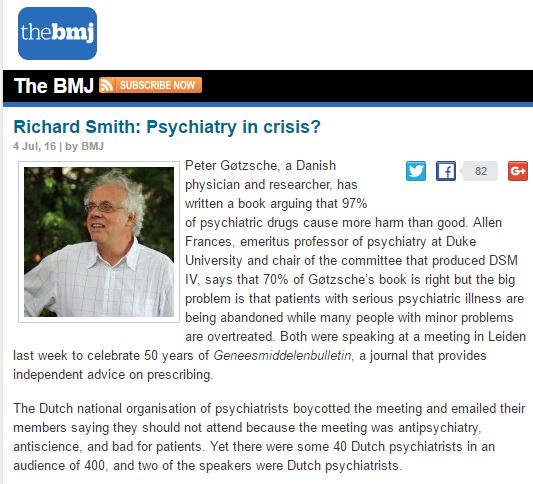
Richard Smith, the former editor of The BMJ, reports back from a meeting in the Netherlands last week featuring former DSM-IV chair, Allen Frances, and Peter Gøtzsche, a Danish physician, researcher, and leader of the Nordic Cochrane Center. “Dutch psychiatrists, it was explained to me, are feeling vulnerable because there are too many of them. They have two treatments to offer–drugs and psychotherapy. But the Netherlands has many clinical psychologists, and they have taken over the psychotherapy,” Smith writes. “Psychiatrists are left with drugs and anxiety about their future.”
Full Report →

psychiatry in crisis


Previous articleHouse to Vote on Murphy Bill After Holiday
Next articleThe Murphy Bill, HR 2646 — a Heinous Piece of Legislation — is Coming to a Vote. Act Now.
Justin Karter
Justin M. Karter, PhD, leads research news coverage and editorial strategy at Mad in America. He is the Acting Program Director of the PsyD in Clinical Psychology & Psychological Humanities at Boston College and part-time faculty with the Center for Psychological Humanities & Ethics. His scholarship examines historical and cultural formations of mind, subjectivity, and personhood; the roles of activist movements and lived-experience communities, including the consumer/survivor/ex-patient (C/S/X) tradition; and how mental health discourses shape institutions, practices, and identities. He works across mad studies, critical psychology, philosophy of psychology, and rights-based global mental health. Methodologically, he specializes in critical qualitative inquiry and psychotherapy process research grounded in intersubjective and phenomenological approaches. He is the President of APA Division 24 (2025-26) and serves on the Executive Board of Division 32. Previously, he was a Research Officer to the United Nations Special Rapporteur on the Right to Health. He earned his PhD in Counseling Psychology at the University of Massachusetts Boston, where his dissertation examined psychosocial disability advocacy in the global mental health movement. He also holds graduate degrees in Journalism and Community Psychology from Point Park University.

2 COMMENTS

  1. I agree with anothervoice. Thanks for posting this article.

    One of the things I like about Dr Peter Gotzsche is his straightforward approach – in his opinion a person can definitely recover from the ‘Severe Labels’ without drugs – and he doesn’t make any big deal of this.

    He says a reliable person that can be trusted can act as advisor (/therapist) and I agree with him here – its been my own experience; and it’s helped me in my recovery.

    I think myself that these Severe Mental Illness Labels don’t exist as conditions and should be scrapped – “They’re more harm than good”

    Report comment

LEAVE A REPLY