On September 28, the NY Times published a short article titled “VA Institutes New Consent Requirements for Some Psychiatric Drugs.” While the article is of little lasting import, reviewing it does provide an opportunity to reveal how the newspaper constructed a story that is protective of the conventional narrative of helpful psychiatric drugs, and while doing so commits what can only be described as journalistic malpractice.
The Historical Context
The VA’s mandate, which will require VHA doctors to obtain written consent when prescribing antidepressants to veterans under 30 years of age, is simply the latest development—and a small development at that—in a much larger story that dates back to at least 2006, when the VA launched a focused suicide prevention effort.
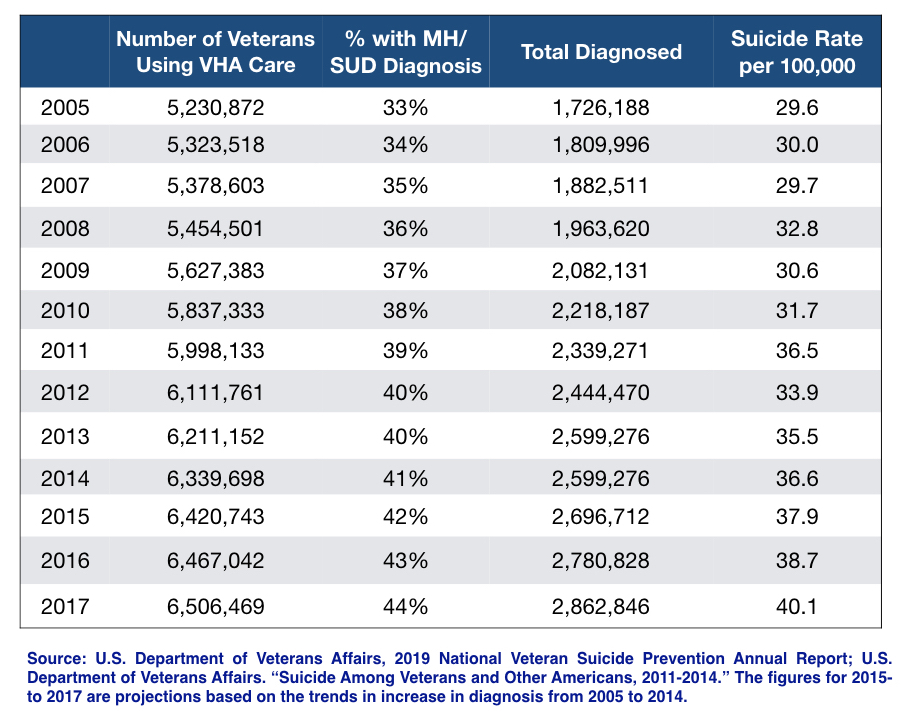
Around that time, Veteran Health Administration facilities began regularly screening veterans for depression, PTSD and substance use. This screening naturally led to a steady increase in the percentage of veterans diagnosed with a psychiatric disorder and treated with psychiatric drugs.
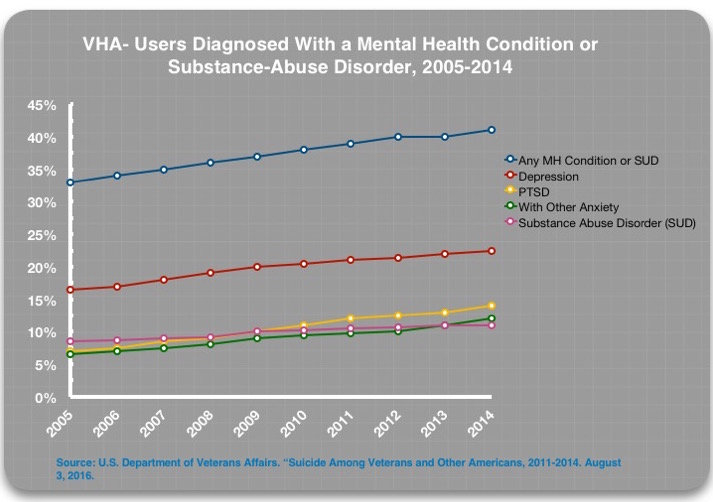
This initiative was expected to decrease suicides in veterans. Instead, suicides among veterans accessing VHA facilities steadily rose. So too disability rates among veterans, which more than doubled from 2010 to 2024.
In response, there arose within the veteran community the feeling that this treatment paradigm—screening plus drug treatment—was doing great harm, and a smoldering protest against this “drugging of veterans” began to arise in many veterans groups.
The veteran who stepped up to spearhead the protest was Derek Blumke. Derek served 12 years in the United States Air Force and Michigan Air National Guard, and had his own experience of seeing his life becoming undone after being prescribed antidepressants. In 2017, he launched the Veterans section on our Mad in America website. He worked for us as an editor for a period of time, and then he returned to working in various veterans organizations, where he continued to focus public attention on this issue of the “drugging” of veterans. He eventually joined with the Gruntstyle Foundation to launch a War Cry For Change project to make this issue known to the public. Mad in America collaborated on this effort by publishing stories by veterans who had been diagnosed and medicated to the point that their lives fell apart.
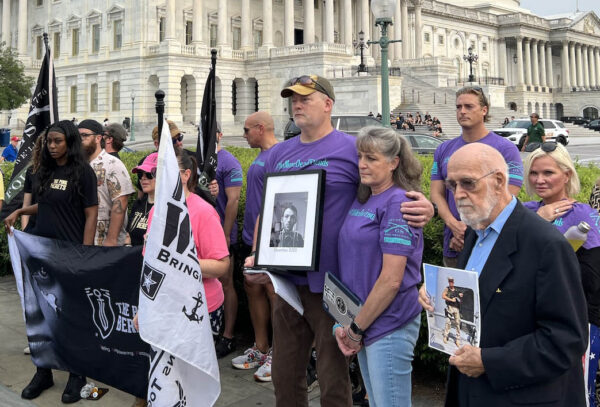
Blumke and colleagues organized events in Michigan, Boston and elsewhere to advance their War Cry For Change, which in 2025 culminated with an event on Capitol Hill. At these events, I was invited to speak about research related to the impact of antidepressants on the risk of suicide. The Capitol Hill event led to the introduction of the Written Informed Consent Act in the House of Representatives, with 35 veterans organizations stepping forward to support this legislation. That bill, which has yet to be voted on in the House, would require the VHA to obtain written informed consent for all major classes of psychiatric drugs.
As part of this effort, Blumke and his collaborators pointed to OIG investigations that had found that VHA prescribers often failed to provide veterans with informed consent about psychiatric drugs. The right to informed consent is enshrined in U.S. law, and thus the OIG reports documented a legal failure in VHA medical care.
While waiting for that legislation to proceed, Blumke and his fellow veterans urged the VA to remedy this failure without waiting for passage of the Written Informed Consent Act. The VA’s announcement on September 28 marked a small step forward in responding to the “informed consent” demands of the veterans groups.
The VA, beginning in 2027, will require veterans under age 30 to sign consent forms when prescribed antidepressants, or when veterans are prescribed opioids and benzodiazepines together. However, this requirement falls short of the demand present in the Written Informed Consent Act, which would require written consent for prescribing all classes of psychiatric drugs, with this requirement applying to veterans of all ages.
That is the larger story. It’s a story of veterans accessing VHA care being diagnosed with depression, or other psychiatric disorder, and prescribed psychiatric drugs at exceedingly high rates, with tragic outcomes: rising suicide and disability rates. The personal stories told by veterans who have seen their lives fall apart, or by families who told of a son or daughter lost to suicide, are heartbreaking. They give voice to a story that tells of a nation’s failure to do well by its veterans.
And here is the most relevant point for this article: the OIG reports serve to validate their complaints that they were not provided with informed consent when they were prescribed the drugs.
The New York Times Story
Now we can see how the New York Times presented this story.
- The subtitle touts criticism of the veterans initiative that goes unsubstantiated in the article
Here is the subtitle on the article: “Medical groups fear the move may stigmatize mental health treatment.”
Now this subtitle would be okay if, in fact, medical groups expressed this worry after the VA announced it was strengthening informed consent requirements for prescribing antidepressants to veterans under age 30. The article would then need to substantiate that medical groups outside psychiatry expressed such concerns. A simple rule in journalism is that subtitles should tell of information to come, but as will be seen, that isn’t the case in this article.
- The article fails to present the veterans’ case
The first paragraphs of the article tell of the informed consent requirements that the VA is mandating beginning in 2027. The story then has a short paragraph stating that veterans groups have lobbied for more stringent informed consent provisions, and that they “argue that veterans have been prescribed powerful medications without being fully informed of their risks.”
Notice the word “argue.” That is a word that questions whether the veterans actually have a gripe regarding informed consent practices in VHA facilities. But, in fact, the government’s OIG investigations found that to be the case. Thus, this should be a story about veterans fighting for their legal right to informed consent.
However, the article makes no mention of the OIG reports, and indeed, the article includes a statement from the VA that doctors already conduct “a full discussion of the risks, side effects and benefits and alternatives to psychotropic medications.”
Readers at this point must be scratching their heads: what exactly do these veterans want?
- Failure to present the veterans case, part two.
Derek Blumke was quoted in the article. The purpose of the initiative, he told the New York Times, was to “ensure patient safety and ensure that patients are able to make decisions about their own health.” And then he is quoted as saying, “These treatments are not benign.”
That brief statement—these treatments are not benign—is a window into the larger story cited above. The journalistic imperative at that moment is this: the reporters need to ask Blumke what he meant by that. In what way were the treatments not benign? Could he tell of harm done from the treatments? Was their data to support his claim?
That’s what you would do if, as a reporter, you wanted to present the veterans case to the public. The article could then present the data discussed above: screening led to rising rates of diagnosis, diagnosis led to a rising number of prescriptions, and there was a steady rise in suicide and disability rates as this occurred.
That would be reporting that revealed that the veterans had an urgent complaint that society needed to attend to, and it would fulfill the reporters’ obligation to present the veterans’ initiative in a detailed manner.
However, the reporters did not follow up on Blumke’s comment. They did not present any of this data. Instead, they crafted a segue to a next paragraph that served, in essence, to turn readers against the demands of the veterans organizations.
- The power of the word “but”
Here is the paragraph that follows Blumke’s quote:
“But psychiatrists and major medical groups said they were concerned that the new policy would increase stigma and dissuade veterans from using medications that might be lifesaving.”
Notice the role that the word “but” plays in that transition. It’s a way to subtly discredit what we just heard from Blumke. It’s the medical establishment’s turn to weigh in, and of course that term—”major medical groups”—presents the critics of the initiative as the experts we trust to safeguard our wellbeing. Meanwhile, Blumke and the 35 veterans organizations are implicitly being presented as misguided in their efforts, as they may be keeping people away from “life-saving” treatment.
- The phantom medical groups
The reporters, in the paragraph cited above, are asserting that major medical groups (plural) have expressed concern that the VA initiative will scare people away from treatment. That echoes what the subtitle asserted. Yet, there is no such statement from any major medical group to that effect that is presented in the article.
Moreover, it seems quite unlikely that any major medical group would have done so. Are we really expected to believe that the American Medical Association, or any other major medical organization, got their knickers in a twist over an announcement that the VA would require written informed consent when prescribing antidepressants to veterans under age 30? So much so that they immediately spoke out against it?
In fact, the only two people quoted about such concerns are psychiatrists. One of the two is president of the American Society of Clinical Psychopharmacology, which is not a “major medical group,” but rather a society with a vested interest in promoting the use of psychiatric drugs.
So what are we to conclude? It would seem that the reporters made up this bit about “major medical groups” worrying about the VA announcement. This lent weight to a critique that, if voiced only psychiatrists, would be understood by readers to be a critique born out of self-interest.
- Antidepressants are a lifesaving treatment
The “but” paragraph cited above describes antidepressants as possibly “lifesaving.” However, neither of the two psychiatrists that were quoted used that term. So, the assertion is not sourced, but rather is presented by the New York Times reporters as a truism, a basic fact that we can all agree on.
- Taint by association
The remainder of the article is really more of the same. The article diverges into MAHA’s and Robert Kennedy’s criticisms of antidepressants, with the implication that the veterans’ criticisms are of the same type. Kennedy’s efforts are of course associated with anti-vaccine statements, and any linkage to that effort will taint the veterans’ cause in the minds of many New York Times readers.
- The last word: hostility meets rigorous science
In conclusion, the reporters write:
“Psychiatric organization have been alarmed by the mounting hostility to the medications, and say their use in treating depression, mania, and psychosis has undergone decades of rigorous testing and analysis.”
The conflict set forth in the subtitle has now been brought to a conclusion. The veterans are said to be “hostile” to medications, even though science, lovely science, has shown antidepressants to be so useful and apparently “lifesaving.”
Journalistic Malpractice
As I said, the article itself is of little importance. But it does provide an opportunity to see the journalistic malpractice present in the construction of the article, which ultimately serves to protect the conventional narrative of a helpful paradigm of care.
The reporters did not mention the OIG reports. They did not mention the data telling of worsening outcomes in veterans treated over the past two decades with this paradigm of care. They did, however, present psychiatric drugs as lifesaving medications that had been proven safe and effective in rigorous clinical studies. That is the little nugget of information dropped into the public mind by this article.
However, I wouldn’t have bothered to write this post if it weren’t for the fact that it does such a disservice to veterans. The VA adopted a treatment paradigm that has caused harm to so many of our veterans, and what did the New York Times do in this article?
It failed to tell their story.
That is the bottom-line journalistic malpractice present in this article.
****
Editor’s note: This post was also published on Mad in America’s Substack.










Great article. Most of the mainstream media is brought to us by pharmaceutical corporations, so I can understand why this article would favor the conventional psychiatric narrative. Eighteen years of psychiatric medications destroyed me, so the medical establishment need to start listening to the patients rather than gaslighting them.
Report comment
The context if not content becomes “more data” when simply said, Any human ever treated in the mental health care system becomes a Veteran! One can be drawn into advocating, attending conferences to learn from the others, though the serious lack of monetization for the non-profits where the citizen veteran learns of their unqiue journey is creating value with values!
Report comment
Robert, Thanks for this but there is also the history with the military as well as the uptake of suicides from vets around that time period. My one friend lost a daughter to suicide and the only support she could find was through the vet family community . Bruce Weigl Phd poet , a vet and peace activist said he at his community college saw the vets returning to school and felt they needed help so he became involved on that level.
The history with the military and trauma is deep and very unknown to the general populace. If the NYT journalists knew about the poetry and death of WWI poet Wilfred Owen or the programming at the Crile Hospital in Ohio post WWII they would have not written the fluff you caught them inserting .
This knowledge on war and trauma can be found in ancient times as well . One has to be curious and also care about vets and their families. I think you could once again to write a rebuttal as you did here and send it to the authors individually . I would also send a bibliography and film and art resource list as well .
That could be a MIA project flood the media zones with strong and solid historical information on each issue dealt with in this space . Send it out and resend in comments and letters to the editor and other social media spots.
Report comment
Thanks, great article. The psychiatric industry is desperate not to let the paradigm shift and major media outlets are complicit in suppressing these issues.
Report comment
I think it’s due to the vast sponsorship by the pharmaceutical industry of most major American news outlets.
Report comment
I met Derek Blumke at the Michigan picnic this past July on the state house lawn regarding this issue. When he said people want him dead, I believed him.
People in Michigan, elites, lawmakers, politicians in both parties, would prefer I be dead and silent too.
Oakland Community College sexist gaslight bogus mental health care witchhunt since 2013 silenced with retaliatory criminal psychiatry because of my English teachers views on reading silenced by criminal Catholic psychiatry of all the nonsense wrapped inside nonsense buried in Jesus crap brain rape hell pain. Jesus was a nutcase. I wasn’t evaluated by Dr. Andrew Muzychka at Trinity Health Livonia, Michigan. I wasn’t suicidal. I was suicide swatted by the school. All documented. But who reads? Now trolls hacks and harassment because I have asked for justice and spoken out online. Retaliation with no protection coming from human excrement like my congresswoman Kristen McDonald Rivet (suicide swatted me on Oct 17, 2024 instead of constituent services) and Sheriff Troy Cunningham Bay County suppressing a police report regarding McDonald Rivet and a complaint about the suppressed police report–with more brand name examples available. Documented. Hell till death by psychiatry.
Report comment
I fully support this legislation but factually it was opposed by major medical organizations, namely American Academy of Family Physicians, American Academy of Neurology, American College of Obstetricians & Gynecologists, American Psychiatric Association
In fact MIA covered it last year “The APA Opposes Written Informed Consent for Veterans By Robert Whitaker -December 10, 2025”
From their statement:
While we share the bill’s goal of promoting informed, collaborative decision making between clinicians and patients, as currently written, it risks creating unintended barriers to timely treatment and duplicating existing processes. The VA’s current informed consent policy (VHA Handbook 1004.01) already requires written consent for treatments and procedures involving significant or unusual risks, including certain psychiatric and pain management medications. By requiring a new, separate written consent process for virtually all psychotropic drugs (antipsychotics, stimulants, antidepressants, anxiolytics, and narcotics), the legislation would add unnecessary administrative steps that delay care without improving patient safety or understanding. Critically, because psychiatric medications are often initiated under urgent circumstances when veterans are in crisis, at risk of self-harm, or struggling to maintain stability, imposing additional paperwork could delay care at precisely the moment when timely treatment is most critical….
END QUOTE
Shame on these orgs
Report comment
How terrible of you to present a side of the story that omits so much life saving data. Millions, MILLIONS are alive and living meaningful lives due to psychiatric drugs. It is inexcusable not to acknowledge that fact. Indeed, it is dangerous. Many might turn away from wonder working medications because of your unwillingness to be forthcoming and suffer horrible consequences, including death. Deeply disturbing.
Report comment