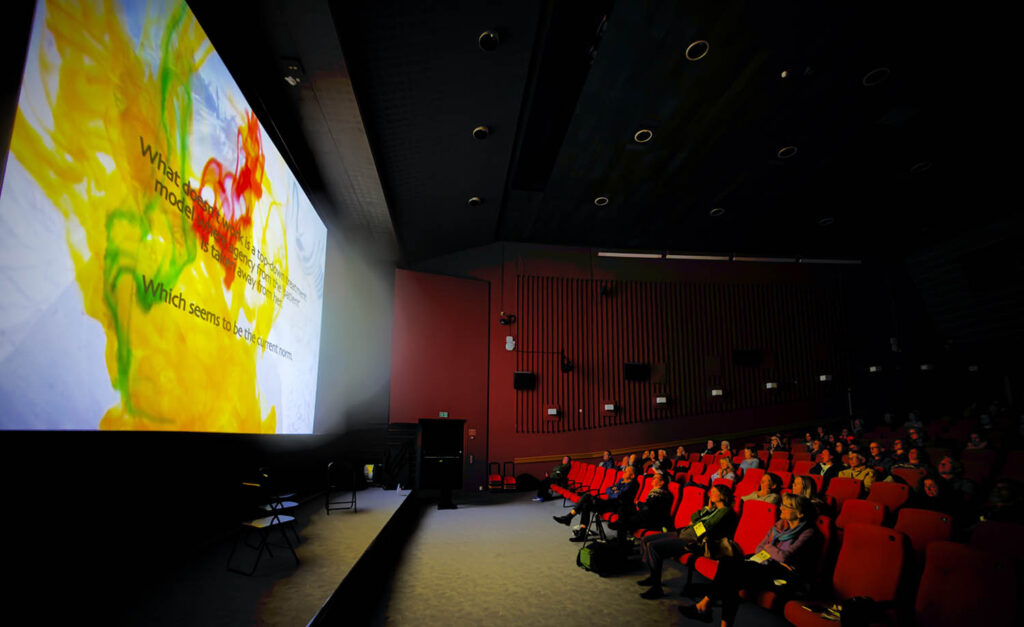
The Mad in Norway film festival took place in Lillehammer, 24-26 September. It was a remarkable experience. The participants came from many parts of the world and counted psychiatrists, psychologists, other health professionals, filmmakers, musicians, other artists, and previous and current patients.
It struck me that, despite all the diversity, people agreed that mental health needs to be systematically reformed, with more emphasis on psychosocial interventions, as was recently recommended by the United Nations and the World Health Organization. What I felt the strongest during the festival was how rewarding it was to interact with so many kind people who could think for themselves and look through the drug industry propaganda.
The stories I heard during the breaks confirmed how harmful drug focused psychiatry is. A German woman told me she lost her husband three years earlier. After they tripled the dose of his antidepressant, he developed adverse effects. In response, they also tripled his dose of olanzapine, and he died two days later.
Another German woman told me she became diagnosed with anxiety and depression after she had been prescribed a birth control pill as a teenager. Depression is a well-known harm of such pills described in the package inserts. This led to treatment with an SSRI. When she stopped the birth control pill, her anxiety vanished, but she got withdrawal symptoms every time she tried to come off the SSRI. It went on for years because the withdrawal symptoms were constantly labelled as relapse, which led to further drugging. When she finally tried to discontinue all the drugs according to psychiatric advice, she developed akathisia, and to her great surprise, her psychiatrists didn’t know what this was; they had never heard the word before. They claimed her symptoms were just psychological. But she survived a nine-month hell of akathisia and is now slowly tapering off the last drug.
Akathisia is one of the worst harms of psychiatric drugs. There is no excuse for not knowing about it because it is listed in the package inserts and is mentioned in psychiatric textbooks. Moreover, patients often complain about it.
Akathisia is characterised by intense restlessness, inner turmoil, agitation, and a compelling need to move frantically around. Patients may think they have gone mad and may describe it as wanting to jump out of their skin. They cannot control their agitated manner and can experience unbearable rage, delusions, and dissociation. It is a life-threatening condition because it increases markedly the risk of suicide and violence. Patient reports on the Internet show that suicidal thoughts when taking psychosis pills are strongly associated with akathisia; 13.8% of respondents reporting akathisia also reported suicidal thoughts, compared with only 1.5% of those who didn’t mention akathisia (P < 0.001).
The film Diagnonsense was made by Norwegian filmmaker Ane-Martha Tamnes Hansgård. She felt she didn’t fit in with the other kids in school and tried to kill herself at age 14. During the following 15 years, she received 12 different diagnoses, which never addressed the deeper causes of the emotional pain she had. An inner conflict related to her homosexuality remained unrecognised, as she was heavily medicated and lost touch with her sexuality. At one time, she was treated with three different antidepressants and two antiepileptics simultaneously.
Her many diagnoses and drugs made matters worse and she started questioning the diagnoses. She consulted two psychiatrists in the United States who said she was bipolar. She doubted this diagnosis was correct, and on her way back to Norway, she passed New Orleans and saw an ad for a shaman. He listened to her and said one simple sentence that was the defining moment for her:
“Didn’t anyone tell you it’s okay to be different?”
He also told her that it was up to her to choose if she wanted to define herself or if she preferred that others did it for her.
She decided it was okay not to be like most people. She made several courageous attempts to stop taking the drugs, but without proper support, this proved nearly impossible. The hospital offered no meaningful alternatives and left her to manage on her own because she had chosen to discontinue the treatment. Even when she had developed horrible withdrawal symptoms compatible with akathisia and desperately called the hospital, they declared they couldn’t help her.
The akathisia lasted a very long time but she regained control of her life after having come off her many drugs.
I would not normally consider it of value to listen to shamans, but in a way, this shaman’s simple question encapsulated the whole film festival. It was a recurring theme that we should respect people as they are and give them more space to be themselves instead of trying to drug them towards normality, which won’t work.
This shaman had common sense. Someone said at the festival that when patients had been surveyed after a stay at a psychiatric ward about which type of person that had been most helpful to them, it was never a psychiatrist but someone much lower down in the hierarchy. It could be a cleaner who had listened to them and respected them, the human element, which we talked a lot about. Relationships are what matters.
Instead of trying to find a “right” diagnosis, as Ane-Martha did, we should realise, as a psychologist said at a panel, that they are all nonsense. Another panellist said that some people find comfort in a diagnostic label, e.g. ADHD or autism, because they falsely think it explains something even though it’s just a name. Ten years ago, parents cried when their child got a diagnosis; today, they cry if the child doesn’t get a diagnosis. A patient had even said, “If I don’t get a diagnosis, there is something wrong with me.” It is so absurd that a panellist had experienced that everyone in a class had a diagnosis but one who then asked, “Is there something wrong with me?”
In Love with Craziness was about a highly energetic rapper who got an ADHD diagnosis. A line in one of his songs, “Why do I judge myself, when the whole world is already doing it?” went straight to the heart of child psychiatrist Melanie Ekholdt who contacted him and produced a film about him. She became interested in his story after he publicly stated that his struggles with substance abuse began with his medication prescribed for ADHD.
This challenged her long-held belief that such drugs help prevent addiction. This has never been documented. In fact, Ritalin and other amphetamine-like drugs have a high abuse potential. In the United States, Ritalin and Adderall are Schedule II controlled substances, which cocaine, oxycodone, and fentanyl also are.
A turning point for the rapper came through his relationship with his music producer, who encouraged him to confront his inner struggles and emotional pain. This helped him begin a process of self-reflection and healing.
Melanie realised that she had caused much harm by handing out ADHD drugs to children too easily and quickly. She described at the panel debate how her courthouse of psychiatric knowledge tumbled down. She decided that it was important to try therapy first, but when she suggested this at the clinic in Oslo where she worked, her boss said that their job was to assess children referred to them, not to offer treatments. She quit her job for 7 years and started making short movies. She also offered therapy in private practice. She is now back working in a public hospital at a team of Infant and Toddler Mental Health. She meets pregnant women and young parents with their newborns and they are clear: They want healing and they want to work with their feelings and their history. They do not ask for diagnoses or drugs.
In Inner Fire Healing Community, the director of the board recounted that when her son was admitted to a mental health facility, he was told that his brain was broken and that he would never recover. His autonomy and dignity were stripped away, and he was put on drugs. Ultimately, unprepared to live on the cocktail of medications, he chose suicide.
Beatrice Birch, the founder, said that the community helps people to reclaim their lives without relying on mind-altering psychotropic medications. She said that every medical director at hospitals she had spoken to had admitted that the system is broken, and many psychiatrists have left the system. She challenged the prevailing narrative, that people’s brains are damaged and that they must remain on medication for life, which she called a powerful and harmful lie. She never expected to create Inner Fire but after encountering many people who expressed the same pain: “I hate being medicated!” and asked, “Isn’t there another choice?”—and then learning later that many of them had taken their lives, she chose to see their suicides as their “sacrifice and a wake-up call” and made a commitment: “You have not died in vain.”
There was a report from the Medication Free Unit in Tromsö and a film about Open Dialogue and the randomised trial of it, Open Dialogue & the ODDESSI Trial, which was published online on 26 August. A French TV team who visited the unit had spoken with a professor of psychiatry in Oslo who called it pill shaming to have a unit that treated patients without drugs.
The UK ODESSI trial confirmed the extraordinary results obtained in Finnish Lappland that were earlier reported in observational studies. Adults in a mental health crisis were randomised to treatment as usual (TAU; 223 patients) or to Open Dialogue (271 patients), with a two-year follow-up. Time to relapse after recovery was not different but Open Dialogue resulted in large and statistically significant reductions in psychiatric inpatient admission, re-referral to crisis care or secondary mental health services, and in improvements in self-rated recovery, health-related quality of life, and satisfaction with services. There were also large differences in serious adverse events, which were life-threatening in 18 vs 4 patients, and those in the TAU group required hospital admission or prolongation of hospital stay more than twice as often as in the Open Dialogue group (262 vs 98 patients; the same patient could be counted more than once). Open Dialogue is not only better than drug-focused psychiatry, it is also vastly cheaper.
A Drop of Sunshine is a high-quality film that shows a young Indian woman’s journey of eventual triumph over paranoid schizophrenia. She is a highly creative and unconventional person who strongly asserts her independence. Initially, her parents sought help within the psychiatric system, but neither she nor her family felt that a life centred on medication is a sustainable or fulfilling solution. She explored alternative and more holistic approaches to coping with her experiences. Over time, she learned to embrace her condition as a source of creativity rather than solely a limitation. She also learned how to live with her voices by talking to them, which made them more friendly.
Her parents and her psychiatrist strived to support her individuality and respected her personal understanding of reality and her right to define her own place in the world. At one point, she stopped taking medication entirely and built a life for herself through her art, finding a sense of mastery, connection, and belonging.
The film proposed that the only treatment that can work is one where the patient is encouraged and empowered to become an equal partner in the process of healing, which is a key principle in Open Dialogue.
Historian and filmmaker Janus Bang and I showed two films in Lillehammer, Silence of the Truth: When Health Becomes Big Business and People Die and The Illusion of Psychiatry. The latter film consists of a series of interviews. In it, psychiatry professor Joanna Moncrieff, founder of the Critical Psychiatry Network in the UK of which I am a member, says:
“When I was doing my psychiatry exams, this was a few years before I set up the critical psychiatry network, I remember feeling like I had to get rid of all my common sense and then put all the psychiatric knowledge into my brain to get through the exams.”
The film starts with Bob Whitaker who explains that it would have been one of the greatest discoveries in medicine ever if psychiatrists—as they claimed—had discovered the very molecules that caused madness and could fix these chemical imbalances with their drugs, just like insulin for diabetes. But, as lawyer Jim Gottstein, who won two Superior Court cases in Alaska about forced drugging, says in the film about psychiatry: “It’s a total fraud.” He told me that the psychiatrist who saved him from a permanent career as a mental patient, Robert Alberts, said it was hard to find a psychiatrist to join his practice who had any common sense.
After I came home from Lillehammer, a festival participant sent me an article from the British Journal of Psychiatry that she was very concerned about. Here is what the abstract says, published online 14 September:
“Antipsychotic non-adherence, driven partly by stigma, worsens outcomes in severe mental illness. Beyond ameliorating psychosis, evidence shows sustained antipsychotic treatment reduces mortality, cardiovascular risk, suicide, inflammation and cognitive decline, while improving quality of life. Reframing antipsychotics as essential medical care may reduce stigma and improve engagement with patients and clinicians.”
The truth is that, apart from cancer chemotherapy, antipsychotics are some of the most toxic drugs ever invented. Antipsychotics are highly lethal—they double mortality in elderly people—they have no relevant effect on psychosis according to the psychiatrists’ own studies, they can cause permanent brain damage, and they can make it impossible for patients to return to a normal life.
Mad in Norway organised the festival. Just outside the door to the festival venue, the mad world begins where millions of patients are killed every year with psychiatric drugs. Too many doctors don’t know how to handle their drugs prudently and safely and don’t meet their patients in a respectful dialogue but treat them as subjects. Many of the films documented exactly this.
Fortunately, there are many signs that the bubble may burst soon. During the panel discussion after our film, we noted that lawsuits and filmmaking will be two very important drivers for change.
I have often been asked by psychiatrists, patients and relatives: “What’s the alternative to drugs?” My reply always is: “Easy, no drugs.” That would be hugely beneficial for the patients, society and our national economies. But we can do much better than this, which the film festival was about.
I am deeply grateful to the organisers, Ragnfrid Kogstad, Grete Johnsen and Hilde Marie Rekstad, who made this highly inspiring film festival possible.











The study, led by researchers from the University of Toronto and York University, examined the health histories of 213 mothers and children over the course of 11 years and found a notable link between higher levels of fluoride among pregnant women and babies who ultimately develop symptoms of attention-deficit/hyperactivity disorder (ADHD), including cognitive problems and inattentiveness.
Report comment