
When Stopping Prescription Drugs Is Hard: Alicia Martin and the TaperMate Story
Alicia Martin is an Australian community pharmacist and the creator of an ingenious mobile app, TaperMate, which aims to help people with hyperbolic drug tapering and prescribed drug withdrawal.

Remembering Dory Previn: An Interview by Peter Sterling in 1974
Dory Previn was an American lyricist, singer-songwriter, and poet whose deeply personal work explored her struggles with mental health, including experiences of psychosis. In October 1974, she met with neuroscientist Peter Sterling for a candid conversation about her psychiatric treatment.

First-Person Knowledge and the Meanings of Madness: An Interview with Gail Hornstein
Psychologist Gail Hornstein discusses her search for the meanings of madness, from asylum artifacts and memoirs to the contemporary peer-support groups reshaping how people understand voices and visions.

Mad Studies Is More Than Lived Experience: An Interview with Merrick Daniel Pilling
Pilling explains how Mad Studies moves from first-person knowledge to questions of sanism, psychiatric authority, mutual aid, and collective resistance.

The West Doesn’t Have All the Answers: An Interview with Dinesh Bhugra
In this wide-ranging conversation on public mental health, psychiatrization, and community care, Dinesh Bhugra explains why meaningful lives, not symptom reduction alone, should guide mental healthcare today.

Go/No-Go—How Mental Health Research Took a Wrong Turn: An Interview with Author Marianne Apostolides
Marianne Apostolides discusses how Go/No-Go grew from her search for new eating-disorder treatments into a critique of the metaphors, experiments, and technologies shaping contemporary neuroscience and psychiatry. She argues that efforts to reduce distress to circuits, algorithms, and biomarkers often overlook subjectivity, agency, and the human relationships that meaningful care requires.

Unlearn Your Pain: Harnessing the Power of Neuroplasticity – A Conversation With Howard Schubiner
Dr. Howard Schubiner joins us on the MIA podcast to discuss his work and the power of neuroplasticity to address psychological or physiological pain.

How Psychiatry Launders Our Debts: An Interview with Khameer Kidia
Physician-anthropologist Khameer Kidia examines how violence and inequality shape mental distress, arguing for patient autonomy, community care, and structural change beyond diagnosis, medication, and individualized psychiatric treatment.

A Mother’s Journey Through Psychiatric Drug Harm and Healing
Chelsea McVeigh joins us to discuss her journey through antidepressant withdrawal. At 31, during a new pregnancy, she suffered a severe adverse reaction that turned her world upside down.

Using Lived Experience to Challenge Systemic Prescriber Inexperience of Antidepressant Withdrawal
Carla Delgado joins us to discuss her experience of antidepressant withdrawal and the hurdles created by dealing with a system that is largely ignorant of withdrawal and tapering.

Mercy, Magic, and the Medical Humanities: An Interview with Jussi Valtonen
Novelist and neuropsychologist Jussi Valtonen explains how close reading and creative writing can sharpen clinical attention, deepen perspective-taking, and help clinicians notice the language they use to describe patients.

Meeting Life Unmedicated: Aging, Protracted Withdrawal and Healing—A Conversation With Marsha Zaritsky
Marsha Zaritsky is a licensed mental health therapist certified in Internal Family Systems. She joins us to explain how her experience with polypharmacy and psychiatric drug withdrawal has changed and informed how she practices.

Faith, Culture, and Coercion: An Interview with Cultural Psychiatrist G. Eric Jarvis
Cultural psychiatrist G. Eric Jarvis discusses religion and mental health, the social determinants of psychosis, and how coercive treatment can deepen mistrust in psychiatric care.

Kindling Our Inner Fire: A Residential Program Where Drug Tapering is the Norm
Robert Whitaker interviews Beatrice Birch, Founder and Director of Inner Fire, a residential program in rural Vermont.
The Madness Pill: How Psychedelics and Stimulants Shaped Biological Psychiatry — An Interview with...
Justin Garson joins us to talk about the work of Solomon Snyder, whose discoveries ushered in the era of biological psychiatry.

Finding God and Leaving Psychiatry: An Interview With Kelsey Osgood
Kelsey Osgood joins us to talk about her new book Godstruck: Seven Women's Unexpected Journeys to Religious Conversion and her experiences with anorexia and psychiatric drugs.

Fighting Psychiatric Subjectivation and Helping Others Along the Way: An Interview with Prateeksha Sharma
Prateeksha Sharma reflects on her own experience of recovery from psychosis with the help of music, family, and dogs, sheds lights on the treatment harms that often go unnamed and thus unnoticed, and discusses how to claim narrative, dignity, and voice.

The Fight for the Soul of Psychotherapy: An Interview with Linda Michaels
Linda Michaels is a psychologist in private practice in Chicago and a co-founder of the Psychotherapy Action Network (PsiAN).
She trained at the Illinois...

Spiritual Emergency and the Collective Work of Staying Alive: An Interview with Nisha Gupta
Nisha Gupta reflects on spiritual emergency, wounded healing, and why staying alive in times of profound pain is not only an individual task but a collective one.
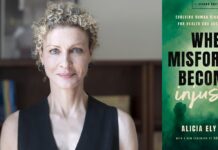
The Political Systems Driving Abuse in Psychiatry: An Interview with Human Rights Lawyer Alicia...
Alicia Ely Yamin is the Director of the Global Health and Rights Project and a lecturer on Law at Harvard Law School. She's also...

History, Eugenics, and an Inquiry into Mad Consciousness: A Conversation With Susanne Paola Antonetta
Suzanne Paola Antonetta is an accomplished writer and poet, She joins us to discuss her latest book: The Devil's Castle, Nazi Eugenics, Euthanasia, and How Psychiatry's Troubled History Reverberates Today.

How Our Blindness to Context Harms Patients and Breaks Practitioners: A Conversation With Kamaldeep...
Kamaldeep Bhui joins us to challenge the myth of clinical neutrality, arguing that culture informs not only patients’ experiences of distress but also clinicians’ judgments about what counts as pathology. From voice-hearing to addiction, meaning depends on context, class, belief systems, and power relations.

UberTherapy and the Enshittification of our Relational Lives: Part 2 of our Interview with...
Elizabeth Cotton traces how digital therapy can block the very thing people come for: a stable, human relationship that can hold fear, dependency, and ambivalence.

UberTherapy and the Enshittification of our Relational Lives: Part 1 of our Interview with...
With UberTherapy, Elizabeth Cotton follows the gig-economy playbook into psychotherapy, where platforms lower costs by depressing wages and standardizing treatment.

Mitochondria and Energetic Failures: A New Understanding of Antidepressant Withdrawal? An Interview With Chris...
Chris Masterjohn joins us to discuss the importance of our mitochondria, the role of serotonin in our body and whether a new understanding of antidepressant withdrawal is urgently needed.