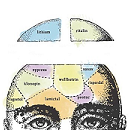
On a recent PBS television show hosted by Charlie Rose on the “mentally ill brain,” Columbia University’s Jeffrey Lieberman presented a series of brain scans of a person with schizophrenia, which showed enlarged ventricles and thus, as Lieberman told the audience, “loss of brain gray matter.”
(See minute 29:30 of video.) The idea being presented by Lieberman was that schizophrenia is a neurodegenerative disease, characterized by brain tissue loss.
In the discussion, Lieberman also implied that antipsychotic medications, in some way, protect against this neurodegenerative process. The drugs “stabilize the illness,” he said. But when people “stop taking the medicines, they get sick again, and when this happens, they have repeated insults to the brain . . . and this leads to a progression, and the progression, like somebody who has multiple little strokes, can lead to some decline in which people are not able to recover to the same level. And if you actually take brain scans over time, you can see the subtle, perceptible loss of brain grey matter.”
To the public, this is a new paradigm for understanding why antipsychotics are an essential treatment for schizophrenia. Schizophrenia is a neurodegenerative illness, characterized by brain tissue loss, and antipsychotics are “neuroprotective” agents that thwart that pathological process in some way.
Given that this idea is taking hold, it seems worthwhile to check the literature to see if it is well grounded in science.
MRI Scans
Making sense of MRI studies of schizophrenia patients can be a difficult task, partly because the results can be so inconsistent, and partly because the results are confounded by exposure to antipsychotics. However, earlier this year, Joanna Moncrieff and Jonathan Leo brought new clarity to this topic by analyzing the studies based on the patients’ exposure to antipsychotics.
Here is a summary of their findings, which they published in Psychological Medicine.
Studies of chronic patients never exposed to antipsychotics
They identified three studies of schizophrenia patients who were ill for extended periods of time and were never exposed to antipsychotic medications. In comparison to the “controls” in the studies, these never-exposed patients showed “no major differences in global cerebral, grey-matter, ventricular, or CSF (cerebrospinal fluid) volumes.”
Studies of first-episode patients with limited exposure to antipsychotics
A number of studies have found brain abnormalities in first-episode schizophrenia patients, and these findings have been seen as proof that the abnormalities must be due to the disease and not the treatment. But as Moncrieff and Leo noted in their paper, many of the patients in the first-episode studies had been on antipsychotics for months, and there is evidence that antipsychotics may induce changes in brain structures in a short period of time. As such, the results from first-admission studies — as a group — are confounded by drug exposure.
To counter this problem, Moncrieff and Leo analyzed the results from studies of schizophrenia patients who were either drug naïve or had limited exposure to antipsychotics (on average less than four weeks.) They found 18 such studies (in addition to the three studies discussed above.)
In 13 of them, researchers did not find any differences between the patients and controls in whole-brain volumes, total grey matter, and CSF volumes. Of the five studies that did show differences in brain volumes, one included a subset of patients that had taken antipsychotics for up to 24 weeks, which could have confounded the results. A second study reported differences in an initial sample of 18 patients, but then, in a larger sample of 51 patients, no global differences were found. The remaining three studies found a difference in the size of the “third ventricle only;” a “trend level reduction in whole-brain volume;” and “smaller cerebellar volumes.”
Longitudinal studies of patients treated with antipsychotics
In 14 of 26 MRI studies of schizophrenia patients treated with antipsychotics for periods ranging from eight months to 10 years, the patients “showed a greater reduction in whole-brain, cortical or grey-matter volumes, or a greater increase in CSF or ventricular volumes, compared with controls.”
Several of the 14 studies quantified the brain-volume loss. In adult patients, “grey matter, whole-brain or cerebral volume showed a decline of 1.2% to 2.9% per year.”
Summing Up The MRI Studies
With the MRI literature parsed in this way, it’s easy to see that the studies do not provide convincing evidence that schizophrenia patients, if they were not treated with antipsychotics, would regularly suffer “a loss of brain gray matter.” A reduction in whole brain volumes is not regularly seen in first-episode patients with limited exposure to neuroleptics, and it was not seen in the three longitudinal studies of never-exposed patients. The fact that it shows up in the majority of studies of drug-treated patients simply leads to this possibility: It could be due to a disease process, or it could be due to the medication, or it could be due to a combination of the two.
The Effect of Antipsychotics on Brain Volumes
To best assess the long-term effects of antipsychotics on brain volumes and to distinguish drug effects from disease processes, you would need to run a long-term study that compared brain volumes in four groups: healthy people on the medications, healthy people off the drugs, schizophrenia patients on the drugs, and schizophrenia patients off the drugs. But you can’t put healthy people on antipsychotics and it is considered unethical to withhold antipsychotics from schizophrenia patients for long periods, and so you can’t run studies of that type. However, animal research and MRI studies of medicated schizophrenia patients do provide evidence that antipsychotics may cause “brain gray matter loss.”
In animal studies, typical antipsychotics have been found to cause neuronal loss and gliosis in the striatum, hypothalamus, brain stem, limbic system and cortex. In a study of non-human primates (macaque monkeys), a daily dose of haloperidol or olanzapine for 18 months led to an 8% to 11% reduction “in mean fresh brain weight compared to controls.”
Next, as Moncrieff and Leo reported, a majority of studies of schizophrenia patients on the drugs for longer periods found that they had reduced brain volumes, while in the three longer studies of never-exposed patients, there was no such finding. Furthermore, researchers have found that gray matter loss varies according to whether a typical or atypical antipsychotic is prescribed, and if the drugs did not affect brain volumes, there shouldn’t be this variability. Lieberman and others recently conducted a study of this type, mapping the cortical changes seen in 36 first-episode schizophrenia patients treated with either haloperidol or olanzapine for one year.
Here are their results, which they published in 2009:
• In the haloperidol patients, “a dynamically spreading wave of significant gray matter loss was detected . . . progressive gray matter reduction began in lateral parietal-temporal cortices by three months, spreading into the dorsolateral, medial frontal and prefrontal cortices by six months, and involving most of the frontal cortex by one year after the first psychotic episode.” The “total loss is severe by 12 months.”
• In the olanzapine patients, “regions of significant progressive gray matter loss were found at all time points, but these were less intense and widespread. These changes also evolved in a distinct antatomical trajectory” compared to the haloperidol-treated patients.
So how should these results be interpreted? Given the effects of haloperidol and olanzapine in macaque monkeys, you might conclude that both drugs cause brain gray matter loss in schizophrenia patients, with olanzapine perhaps less toxic than haloperidol. However, since there was no control group in this study and thus no mapping of gray matter loss in unmedicated schizophrenia patients, the researchers concluded that it was also possible that olanzapine was “neuroprotective,” i.e. that it slowed down the loss seen in the haloperidol patients (which presumably was due mostly to the disease.) But, they wrote, without a control group “it is difficult to be sure that the effect is either due to toxic effects of one drug versus protective effects of another (among other interpretations), and it cannot be determined what the normal trajectory of such change is in schizophrenia.”
The Bottom Line
While the public may be hearing that schizophrenia is a neurodegenerative disease characterized by a loss of brain gray matter, with atypical antipsychotics neuroprotective against that process, even a quick review of the scientific literature reveals that it is unclear whether the gray matter loss is due to the disease, or to the drug, or to a combination of both.
Here’s what Moncrieff and Leo wrote in their conclusion : “Overall, there seems to be enough evidence to suggest that antipsychotic drug treatment may play a role in reducing brain volume and increasing CSF or ventricular spaces . . . although it remains possible that the underlying disease process also causes brain volume changes, we suggest that antipsychotic drug treatment may be responsible for some of the changes that are usually attributed to schizophrenia.”
Thursday, August 12, 2010









After Charlie Rose’s program here on schizophrenia /mental illness, I completely lost all my former admiration and respect for him, which was replaced by disgust, anger and contempt for allowing such deadly, harmful lies and fraud to be promoted as absolute truth and proven science. Whether it was by laziness, failure to prepare and research all sides of the issue or deliberate malicious, dishonest fraud to fawn over the mainstream elite, the horrific assault on humansin emotional distress he helped to promote is just as evil, deadly, cruel, self serving, dishonest and unethical. I’ve noted he prepares for other interviews, but like other journalists he emulates, he can’t be bothered with those the mental death profession or current nazi doctors (see Dr. Jay Lifton’s THE NAZI DOCTORS, true creators of the Holocaust, mostly psychiatrists) stigmatize as subhuman and deserving the horrible abuse heaped on them by these psychopaths (See Dr. Robert Hare, SNAKES IN SUITS: WHEN PSYCHOPATHS GO TO WORK). Could Robert Whitaker and noble whistleblowers like Dr. Peter Breggin force him to present the other side or make him aware of the truth?
Report comment
[…] Charlie Rose and the Mentally Ill Brain […]
Report comment
As well-intended a this article may be, your ‘bottom line’ conclusion, which BTW is inappropriate for a page such as this, since it NORMALIZES/risks-normalizing making decisions based off economic considerations/prioritizations, and-yes, even though by-itself, the expression has been used outside finances/economics, in terms of risk,..
… that ;
“…even a quick review of the scientific literature reveals that it is unclear whether the gray matter loss is due to the disease, or to the drug, or to a combination of both.”
Is little better a consolidatory nor balanced statement, than many of the people being criticised in the article, and almost sounds apologist, in seeming to reinforce conclusions made by those being criticised for their methods and use of or retention of authority.
Why?
Because while valid criticisms of such authority in the first place and societal acceptances or rejections of such are fundamental to society, compared to any/many types of impositional rule / cryptofascism … it misses the valid PARTIAL you might say derivative-logic, that the evidence DOES proove-against the med.s … while-not necessarily when-applied, implicating no-benefit, to-some,.. because of individual case/causation diversity/variability. (including sector-by-sector hoarding or monopolies on expertise, and when governments or heavily-DEPENDED-on professional expertise(s) CLAIM to be responsible, there needs to be not only validity of purpose, but clarity of DEGREES-of-applicability of conclusions-from treatment experiments,.. when it comes to what your country does-TO you. Not just FOR you,.. but-TO,.. you. Why? Because that is what they USE, to supposedly justify the use of already known-harmful treatments – when an OTHERwise, should-be-out, treatment type, can be RE-proven to have some degree of ‘effiacy’ … who’s who becomes blurred, and it then gets clinged-to, in quite to be blunt duplicitous and careless / duty-of-care abandonment-‘rationalized’ , and at times DESPERATE, politics.
(un-democratically validated rationalization, that is, and therefore NOT-with a mandate from/by the people, in your law.)
And more specifically ;
One CAN conclude, from especially the 14 out of 26 londitudinals/animal studies, that there would not be AS-MUCH,
and therefore that it is correct, to start with a 1/2-causational statement ;
Something like,.. although not-all of what is observed can be attributed … to-ONLY … the disease itself,.. it is ALSO-true,.. that the ADDITIONAL,.. was confirmed by the control methodologies.
i.e. Although one is not able to especially individually, attribute what has been the source for-all, in both,.. the additional,.. is, through the implications of the use of controls in a valid comparative experiement,..
… and that is ALREADY … differentiating,.. of the prescence-OF, or the abscence-OF,.. an increase,..
due to the drugs in Q. …
… and therefore IS,.. already confirming without further analytical squirmings (liability) of those unwilling to admit to the damage they cause,.. of partial cause & effect.
i.e. Just-because not-100% is,.. does not mean that one/we do not yet have evidence, that SOME is.
i.e. If patient A shows a moderate/low amount of cellular loss, when assumed to have degridational symptoms, but-is-ALSO on meds. then how MUCH from-both is what is difficult to estimate / be sure of,
BUT,
If patient B, had-not shown cellular loss but still seemed to have symptoms at-least outwardly in terms of the risks of mis-interpretations of behaviour,..
… but-THEN also showed cellular loss after being put on med.s …
… then that consists of a continuity-of causation, and therefore evidence that med.s DO also-cause-additional or cause-loss in those who do-not show symptoms of-loss, already.
And that evidence means you DO-know, that med.s DO,.. but that not-all-schizophrenics already-do.
That is damning, careless, and already-indicates / highlights, that psychiatry as a whole, has not put it’s foot down, in demanding more funding to be able to at least test ;
1 WHICH patients do-already show signs of the characteristic physical losses, and therefore might benefit from the prevention of the sub-organ-body causation interventions from med.s (programmed-cell-death cascades, abberant DNA-disorder by-products from other diseases, breakdown from outside sources, hypothetical-genetic inheritence (if it ever REALLY gets proven rather than statistically guessed-at) etc,.. whichever) … … and
2 WHICH patients do-NOT-already, show signs of physical losses per the discoveries highlighted here – ventricles/grey matter, whatever it was.
So-that-THEN, if any responsible psychiatric interventionary let-alone involuntary power using group, including governments,..
… were making SURE,.. that those under an order or strongly encouraged / blackmailed, effectively, such as employees demanded to take their meds. or be dismissed, etc,..
… they could actually proove they were at least TRYING, to make sure, that the people actually MEANT to be being-targeted, by the preventative function, of the med.s in Q. were the ones that RECEIVED it / were-‘given’.
(observe the language-shift there, BTW. receive, give, given – all of supposed ‘generosity/ies’)
As it is,.. BOTH those who-are, and those-who-are-not-necessarily, are being clumped into a single PRESUMED, group, and i say so as one such a victim myself, where only some of whome, are presumed “yet” to show signs of the disease-source or cause,.. of the physical loss.
While that’s conveniently of-confidence, for chief-psychiatrists, ministers/politicians, it does NOT demonstrate self-discipline, in recognition,.. that there should be EVIDENCE,.. ACTUAL evidence,.. of pres-existing physical loss, just like in, say,.. alzheimers,.. BEFORE,.. an argument applicable-FOR,.. an ‘only-when’ logic,.. is actually APPLIED,.. to those that-that only-when logic,.. is meant to be being applicable-to.
And THAT, is what both politicians AND psychiatrists themselves,
avoid.
—
A REVERSION to the weak, and LESS-accurate,.. and avoiding-PARTIAL applicability realizations from the complication of only-some already show signs of physical loss,.. “… it is unclear whether the gray matter loss is due to the disease, or to the drug, or to a combination of both.” …
… in other words, FAILS, to highlight, that it IS known, that ;
the drug’s effect, A,
compared to the inconsistent state of the patients to group them, B & C
(some who do, show signs of physical loss, and those who do-not),
WILL, cause,
(in the case of A X C and all the liability included)
or cause-MORE, cause-ADDITIONAL,
(in the case of A X B).
—
THAT, is the reality, and so too, is that legally, ONLY in the case of ABs, is it at all,.. WHAT,.. we are trying to do here.
Gov.s all around the world, have your country’s acceptance of the supposedly ‘valid’ GUESS, that all ACs, will BECOME ABs,.. in TIME.
Yet that does not account for MIS-diagnosis, because of there being also-2, not only 1, victim, IN-time, in the ABs.
And THOSE patients, or VICTIMS, they should be called,
deserve both justice, apology, and ongoing diligence in remembering the LIMITS, of what re-hashing SEEMINGLY-inconclusive results,.. does-NOT validate,.. of already known-harmful treatments.
That’s not to say that none should be treated, with in effect, harmful, since this is already a question of cost-benefit analysis / pros/cons weighting,..
… but it is to reiterate that because of the known, one-directional logic, in the more-correct GRAMMAR,..
… of “additional”, or ‘further-loss’, etc,..
… that we are self-presenting, the very evidence that condemns us, as USERS, of known-harmful method (or insufficient testing/identification / diagnosis),.. as-well-as harmful-treatment.
i.e. That there is also HARM, caused BY-that misdiagnostic negelct / acceptance-of Rosenham-experiment LIKE, risks, or even simple yet-DIFFERENTIATED diagnositc follow-up.
In my case, (both a psych student AND a victim of misdiagnosis, just to clarify who/what i am) i am in over 20 years, of WAITING, for my state, Australia,.. to ‘get-around-to’ my situation’s need FOR, differential RE-diagnosis.
Instead, prioritisation for the extremes of prevention of psychosis, spits you out, and leaves you there… ‘able to sue the government’.
Well not every country has laws, that ALLOW, people to do that, and to be frank, we avoid the politics/laws COMPLICATIONS-of the IMPACT-of, presumed facilitations of justice, while ironically, ending up FANTASIZING,.. about such fictional justice,.. that does not even exist in YOUR country,.. let alone anywhere else.
THAT, is an UNAVOIDABLE legal miasma / mess, and it is clear to many that what applies to hot-potato like cases like mine, reveal, or implicate,.. what is wrong, with the (psychiatric-diagnositc) system-as-a-whole, as well as a lack of honesty, hindsight, decency, honor,.. whatever,.. on the part of chief-psychiatrists, advisers, consultants,.. whoEVER,.. who perpetuate the false-promises of business-as-usual gets the A-OK,.. BACK, to-government.
It is this final regular RE-betrayal, that is IMPEDING, both victims, patients, and even psychiatrists themselves,.. from speaking out more loudly, and clearly,.. such as is present in even the lowliest urban-services worker UNIONS.
The moral cowardice, in avoiding forming into one, and demanding, change, FROM, government, instead of being unnecessarily apolitical about it, behaviourally, suggests, that those who do,.. are not,.. ‘unable’ to comment on the politics/legal side of it,.. but actually-ABLE,.. but unWILLING.
And that, does NOT, have to be respected. The population as a whole, individual states, individual hospitals, individual HCPs,.. do-NOT, have to reciprocate, suspiciously-incomplete, or CONCLUSIONS-avoiding, conclusions,.. from-those brave enough, to challenge the METHOD, for diagnosis, especially,.. while still being free to have whatever opinions they want, about treatment improvements over the years.
If whatshisname in this book here, Leiberman, DOES, give fundamental recognition of the importance in getting diagnosis right once and for all, then IMO he IS,.. a part of those who want that sorted out, and the failures / crime/harm of the past, AND the present, if-not also the future as well,.. while perhaps ESCAPING,.. into more reliable parts of the process overall,.. like an engineer, who doesn’t want to work on preventing bridges from falling down, but is more than happy to work on just-tensile strength of steel, or some attribute of concrete. Only-a-PART,.. creates diversion, or re-concentration, of blame,.. on the designers of or rationalizers-of, the status-quo,.. when it comes to diagnosis/mis-.
But thanks for the page anyway, i’m not trying to criticize you too much,
but from my POV, as a defender of HISTORICAL psychiatry, that brought science back into rationality compared to risking reverting into religious insanities,.. and despite your inaccurate American-centric , time-delimitative version of history *scoff* … you are at least putting yourself out there, as someone who cares about revealing the DIVERSITY of MIXED opinion,.. compared to the fantasy-of-confience, that ‘coincidentally’ surrounds chief-psychiatrists / ministers, etc,.. when the implications of supposed trust in treatment,.. somehow equals a automatic entitlement,.. to go-ahead with the same old shitty diagnostic methodology.
It … does … NOT.
When those 2 are blurred, or diagnostic failures / systemic-ABANDONMENT of care / duty-of-care … is obscured, by talking about treatment- -types / -validities?
We completely miss the point, about what is fundamentally flawed in the process,.. well-BEFORE, treatment type considerations.
Fix-that, and a LOT of people, will receive what they deserve, of if-not-only differential-D.s they deserved all along,..
… then at least fair/proper PROCESS,..
… as-well-as more of their lives spent NOT-on med.s … until they did start to show grey-matter / ventricular malfunction/obstruction / whatever.
i.e. UNTIL getting confirmed,.. their lives are actively HARMED,.. by the presumption that all-diagnosed at … what … ANY? point in their lives? … will-neccessarily BECOME,.. full blown, chronic cases, with plenty of physical degradation along with it.
—
And thank you also, for re-highlighting the cause & effect risk here,
But statements whose literal meaning do-not MATCH the intent,.. like ;
“…that it is unclear whether the gray matter loss is due to the disease, or to the drug, or to a combination of both.”
Can be IMPROOVED, semantically/grammatically and INclude, the 1/2-way logic, that DOES apply, if you start the logic with med.s-DO,.. but WHOME the med.s are being given to,.. and the results-FROM all-included,.. i.e. … a invalidly,.. NON-isolated testing population group,..
… is NOT scientific.
isolating/purifying a testing population group, is FUNDAMENTAL, to it being reasonable to concluded that your results CORRELLATE,.. with what you were trying to test.
When that is abandoned,.. you abandon the method,.. as-well-as line yourself up for joining the causing-harm implimentors,.. just-as-much,.. as politicians do,.. in terms of it’s safety to be used… for DECISION MAKING (governmential/corporate).
Decision making, might not seem? like it’s directly relevant?
But in terms of study, and fingers-crossed-with-confidence methodology in government/democracy especially (with short turn overs of ministers/departmental-heads) … UNlike many gov. sectors,.. psychiatry’s struggling to find reliability/consistency,.. has been accepted as-is … has been depended-on,.. in DESPERATION,.. for something better.
That is not even remotely like other sciences, and if we are honest about it, we KNOW it, when simply remembering the basic warnings we should all be getting, far-back in our schooling, let-alone in-practice,.. that fundamental OUTSIDE-OBSERVATION as a method,.. is derivational,.. NOT DIRECTLY-observational,.. of then-inferred internal processes / diseases / whatever. That fundamental acceptance, is MMMMMASSIVELY underestimated, as a fundamental legal, reason, to deny, control, really choke, and open-up, all psychiatric processes, and really NARROW-down, who even-CAN, be an expert,.. while simultaneously not allowing extremist ‘family’ groups to take over either.
Unfortunately in politics, short-term votes, corrupts decision making in the short-term, and it is an impossible task, to get the poplulace in general, to somehow be as exposed-to these considerations,.. if-not-also then-appreciate,.. new LIMITS,.. on what surgeons, proscription-givers, and others who always want to steam-ahead into quick diagnosis,.. treatment,.. want,.. especially when legal betrayals of safety and process,.. have become insanely accepted, inside YOUR country, but are usually rejected, in the REST, of the world.
( like the pseudo-legalities of ‘incentivised’ diagnosis, from pharmas that sponsor doctor’s careers )
It is truly refreshing, to see an American, be upfront about that particularly nasty / intolerable COMBINATION.
But also, it is important not-to accidentally make-vague, again,
bi-directionally,.. cause,..
… if SOME of the time,.. cause was concretely identified.
i.e. Ironically, against defenders-of-psychiatry such as myself,
when it comes to there being more evidence that med.s in this case,.. do-ADD,.. to the amount of loss.
So avoiding that directional logic, does not help. It in fact perpetuates the same *shrug* new-norm,.. of people not wanting to RE-complicate something,.. that should have STAYED-complicated,.. i.e. you are risking causing people to say things like “Oh, no-body knows”.
WRONG.
We PARTIALLY-know,.. but because of that inconsistency, to use another expression, it’s tricky to say, or a… ‘only-sometimes’
‘Only-sometimes’ (es) … are not wholly ;
“… unclear whether the gray matter loss is due to the disease, or to the drug, or to a combination of both. …”
(sub-quote) “… unclear whether …”
i.e. if you add PARTIALLY … into the mix there, you can give yourself more grammatical-room-to-move, and do-not end up MISLEADING readers, into thinking there was nothing reliably-concluded from those experiments you quoted. (i.e. even if the PRIMARY aim of them, did not yield wholly-one-directional logical-indicators (partially one directional indicators, can still be useful))
P.S. Apologies for my spelling mistakes, i wanted to rattle that off without spending the time checking.
Report comment