
According to new research, the United States spends over 200 billion annually on treatment and hospitalization for mental health issues, exceeding spending on heart conditions and cancer. Previous estimates of total healthcare spending by condition failed to account for costs associated with institutionalization but when this was factored into the latest research, the category of “mental disorders” moved to the top of the list by a substantial margin. More than 40% of spending on mental health issues are associated with institutionalization, the researchers found.
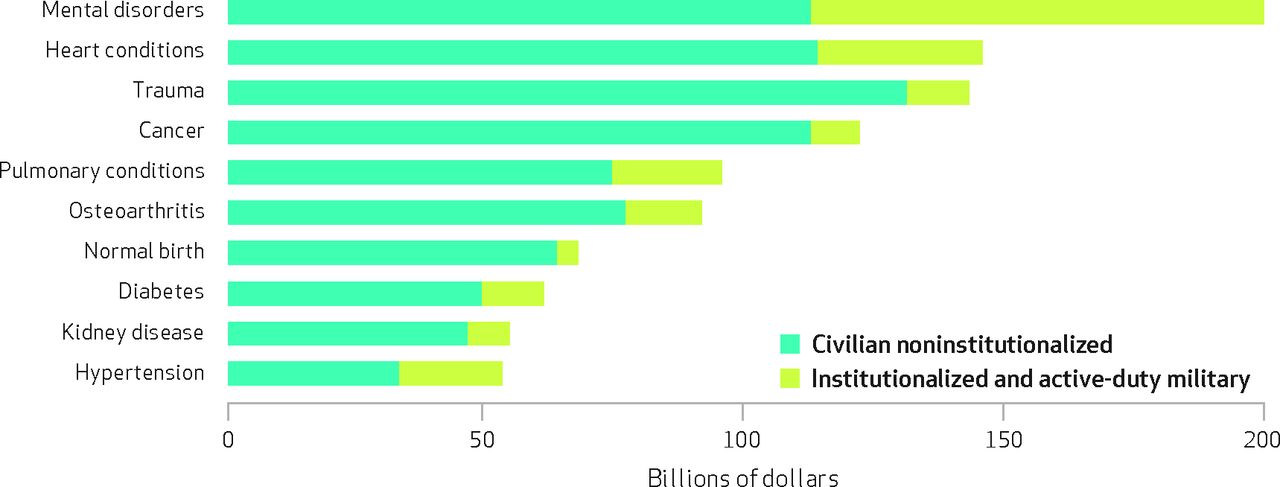
SOURCE Roehrig, 2016
NOTES Institutionalized populations include nursing home residents, long-term patients in psychiatric hospitals, and prisoners. Trauma is fractures and wounds. Pulmonary conditions include chronic obstructive pulmonary disease, asthma, and other pulmonary diseases.
*
Roehrig, C., 2016. Mental Disorders Top The List Of The Most Costly Conditions In The United States: $201 Billion. Health Affairs, pp.10-1377. (Full Text)













Universal Health Services (UHS) is a Fortune 500 corporation with approximately $7.5 billion in annual revenue and over 65000 employees… Universal Health Services, Inc. (UHS) is the largest facility-based behavioral health … the nation’s largest facilities-based provider of mental health …
UHS patient abuse http://www.google.com/search?q=UHS+patient+abuse
Report comment
WOW – look at that military spending. Almost half of the 200 billion we spend is for our military’s “mental health”. Our military, for those who don’t know, is just above 1% of US population. So 1% of the population is costing the country almost as much as the other 99 percent, if these figures are correct. That would be incredible, and might indicate how much psychological damage is being done to people by our wars.
Report comment
“That would be incredible, and might indicate how much psychological damage is being done to people by our wars.”
Yes, wars are horrible….
…. however, the figures don’t separate out the damage that is almost certainly being done by the prescribing practices of the “mental health professionals” charged with looking after military personnel from the damage of trauma inherent in such situations.
If drugging is the first line of treatment there’s probably a lot of iatrogenic injury occurring on top of the immense distress inherent in war.
Report comment
“200 billion annually on treatment and hospitalization for mental health issues,” and the psychiatric industry is still whining that they need more money spent on “mental health care.” Even after the DSM disorders were confessed, by the head of the NIMH, to be void of any scientific validity or reliability, and the UN confessed “forced psychiatric treatment is torture.” I’m quite certain providing food and shelter to the poor would be a better use of that money.
Report comment
And yet all we ever hear in the media is how “grossly underfunded” mental health services are.
Report comment
This doesn’t take into account all the iatrogenic disability caused by these “safe and effective treatments.” Many of us are too damaged to work and forced to live on tax dollars. Then we develop horrible physical problems and need medical treatment for those–also expensive. The shrinks want to cause more long term disability than ever, starting with small children. Sickening–in an all too literal sense!
Report comment