Researchers Pressure Psychiatric Journal to Retract Misleading Celexa Study

2
529

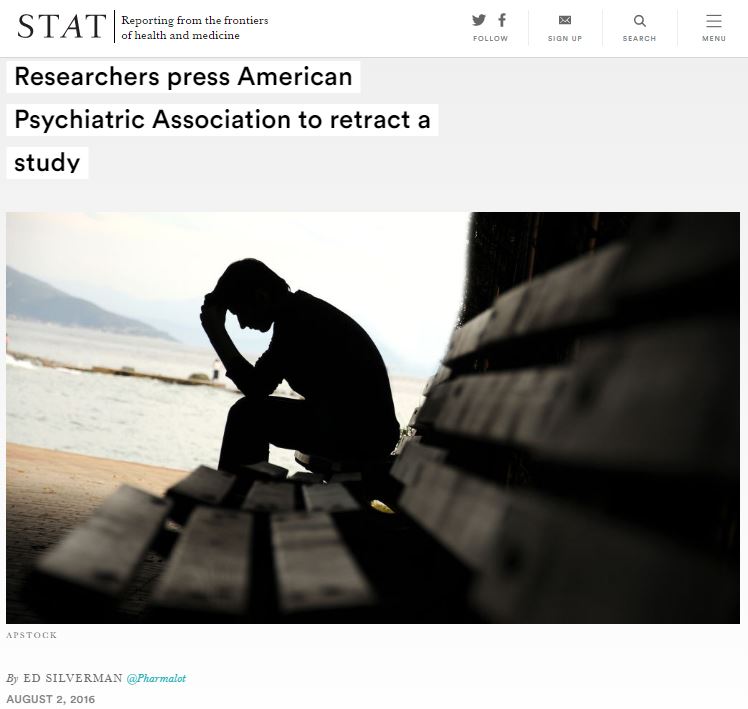
In 2004, the American Psychiatric Association published a paper supporting the use of the antidepressant citalopram (Celexa) in children and teens. After reanalyzing the data, however, researchers found no difference between the drug and placebo. It also became evident that the original study misrepresented the data and was ghostwritten, in large part, by industry insiders. Journal editors continue to refuse to retract the original study in the face of rampant criticism, and, as a result, the paper continues to be cited uncritically.
Article→

retract citalopram

More:

Interview: Researchers Deconstruct Ghostwritten SSRI Trial

www.madinamerica.com/…/researchers-deconstruct-ghostwritten-industry- trial-for-antidepressant/

May 14, 2016 … Researchers take a closer look at a trial of citalopram (Celexa) that was ghostwritten and then used to get FDA approval with children.


Previous article“Here are 20 Drug Combinations that you Should Absolutely Avoid”
Next articleOhio Mental Health Services Publish Video Tribute to Pat Risser
Justin Karter
Justin M. Karter, PhD, leads research news coverage and editorial strategy at Mad in America. He is the Acting Program Director of the PsyD in Clinical Psychology & Psychological Humanities at Boston College and part-time faculty with the Center for Psychological Humanities & Ethics. His scholarship examines historical and cultural formations of mind, subjectivity, and personhood; the roles of activist movements and lived-experience communities, including the consumer/survivor/ex-patient (C/S/X) tradition; and how mental health discourses shape institutions, practices, and identities. He works across mad studies, critical psychology, philosophy of psychology, and rights-based global mental health. Methodologically, he specializes in critical qualitative inquiry and psychotherapy process research grounded in intersubjective and phenomenological approaches. He is the President of APA Division 24 (2025-26) and serves on the Executive Board of Division 32. Previously, he was a Research Officer to the United Nations Special Rapporteur on the Right to Health. He earned his PhD in Counseling Psychology at the University of Massachusetts Boston, where his dissertation examined psychosocial disability advocacy in the global mental health movement. He also holds graduate degrees in Journalism and Community Psychology from Point Park University.

2 COMMENTS

LEAVE A REPLY