
Modern life can feel dis-jointed, chaotic. Phones ding, screens flash. Our attention is pulled in every direction but the present. While technology has increased access to online therapies and digital wellness tools, we can forget our brains and bodies are one.
Somatic techniques, like box-breathing and meditation practices can calm a dysregulated nervous system. For folks with trauma histories, feeling the weight of memories and unexplained pains throughout the body, are common experiences. For trauma survivors, hypervigilance and fear are the norms for so long, the body adapts. For trauma survivors, a one-size approach to mental health care does not work. Trauma overwhelms. PTSD, and C-PTSD, a diagnosis given to those who’ve endured extended, repeated trauma, often during the developmental period, can manifest as a whole spectrum of moods and behaviors. Withdrawal. Avoidance. Anger. Dissociation.
One holistic approach to treating folks with trauma histories is ecotherapy. Defined broadly, ecotherapy is a modality that incorporates nature as an element of healing. This might look like going for a hike with a trained therapist. It might look like joining a meditative support group in nature.
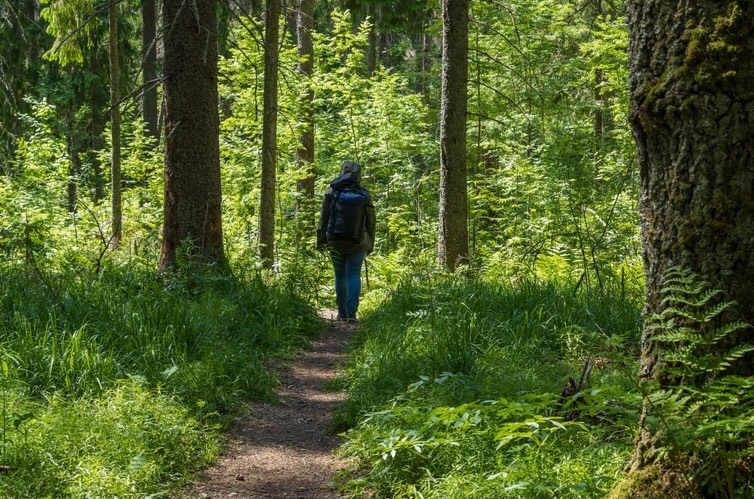
Last fall, I attended the Peace in the Wild retreat through the Center for Nature Informed Therapy. The weekend involved nature journaling, forest bathing (a Japanese practice, done fully clothed for all who are wondering), and walking meditations. The Center for Nature Informed Therapy also provides training for mental health professionals, and folks in any field.
Beyond this, I volunteer for Philly Goat Project, a nonprofit community wellness program that encourages folks, especially families, to spend time in nature through walks with trained therapy goats. Philly Goat Project also maintains a grief garden that’s free and open to the public year-round at Awbury Arboretum. I’ve seen the anecdotal benefits of time in nature at Awbury. I’ve felt the benefits myself, with the Center for Nature Informed Therapy and in my own nature practices.
Ecotherapy can be a multi-faceted answer to trauma, a multi-faceted experience. For as many folks with trauma histories, there are trauma responses. Trauma symptoms can shapeshift. Yet, a unifying experience is often ruptures in attachment. For survivors of abuse during childhood, trusting in relationships as an adult can be challenging, to say the least. Yet, in order to heal from trauma, establishing healthy attachments can be crucial. For folks who struggle to fully trust, or attach, to a therapist, forming an attachment with nature can be revelatory.
Research
Emerging evidence suggests that clients may develop strong attachments with nature. Nature-informed therapy allows for full-sensory experiences and for clients to find comfort and safety in their bodies as it focuses on the present moment. Nature isn’t simply the setting, but rather a participant in ecotherapy for complex trauma. Trauma-informed ecotherapy interventions have shown to stabilize patients with hyper-aroused nervous systems. Patients in a German in-patient psychiatric unit described feeling safe when ecotherapy was added to their treatment plans. A sample of U.S. veterans similarly saw a lessening of emotional reactivity after participating in ecotherapy programming, specifically group ecotherapy.
A hospital in Germany found improvements in psychiatric patients’, ages 18-27, attachment styles, and overall sense of wellbeing after ecotherapy interventions were implemented. The researchers used depression and anxiety screeners to determine the interventions’ results. The interventions combined traditional group psychotherapy and gardening. Once a week, for four weeks, participants spent a structured hour in the garden, after listening to a poem chosen by clinicians on topics that emerged in group psychotherapy sessions. Participants reported feeling that the interventions were beneficial to their healing on follow-up surveys and that they felt more connected to the other patients. Depression and anxiety scores decreased after the interventions.
Beyond healing attachment wounds, ecotherapy can support folks’ capacity to pay attention. Spending time in nature offers a distinct pace from daily life. Nature allows us time to slow down, which in turn offers the nervous system an opportunity to regulate. Attention Restoration Theory (ART) demonstrates that exposure to greenspaces can lengthen attention spans and improves cognitive functioning.
Ecotherapy has shown to be effective when it comes to Attention Restoration Therapy, particularly with veterans. Veterans, as a population, experience high rates of PTSD. While veterans experience PTSD and related mental health challenges, the population is less likely to seek help due to stigma. However, ecotherapy is seen as alternative to seeking help in an austere medical setting, and therefore possibly more appealing. In Duvall et al.’s study, 98 veterans participated in 4-7 day ecotherapy program funded through the Siera Club’s Military Families and Veterans Initiative. The researchers analyzed attention refocusing with surveys conducted one week before programming, one week after, and one month after. The results indicated that social functioning and life outlook improved, as well as psychological well-being. Veterans with “daily health issues” benefited the most from the program.
In a Danish study, ecotherapy similarly proved beneficial for veterans diagnosed with PTSD. Eight veterans participated in a ten-week ecotherapy program at the University of Copenhagen’s Forest Therapy Garden. Interventions included yoga in nature, wood-splitting and tree planting. Veterans expressed appreciation for the self-directed programming as it fostered autonomy and allowed for the participants to regain feelings of agency. The programming fostered both strengthened attachments between the veterans and nature, and notably encouraged connections between the veterans. A striking example of this is that initially the veterans found comfort in isolation in the garden, but over the course of the ten weeks, chose to be near one another during meditative moments.
Accessing Ecotherapists and Practices
- If you are interested in working with a therapist trained in ecotherapy, consider browsing directories such as International Community for Ecopsychology and Mindful Ecotherapy Center.
- If you are interested in forest bathing, the Japanese practice of spending nourishing time in nature, consider joining a workshop. Forest Bathing Finder offers guidance on joining a walk and finding a guide who resonates with you.
- If bird watching appeals to you, the Mindful Birding Network connects folks to engage in mindful community.
There are challenges to studying ecotherapy as a modality for folks with trauma histories. Indeed, as ecotherapy is an emerging field, there is no one treatment manual. While this makes the practice dynamic and adaptable, it also means there’s less oversight for clinicians. There have been instances of severe harm caused by wilderness therapy, which is encompassed in ecotherapy.
Similarly, standardizing a definition for people who’ve experienced prolonged trauma, either by including C-PTSD in the DSM in the U.S., or by strengthening language for existing diagnosis, is important for studying emerging trauma-informed interventions. It is important to note that C-PTSD is in the ICD-11, which has led to more international research on ecotherapy and C-PTSD.
How can treatments for a disorder be developed, if the disorder itself is contentious? The nature of compounded trauma renders research difficult. In a study examining AAT on survivors of sex-trafficking, the authors notes “It is unclear if the traumatic experience of being trafficked resulted in mental health symptoms or exacerbated underlying pre-dispositions.” This gives a snapshot into the challenges of determining where to start in both defining traumatic experiences clinically, and developing treatment interventions.
No one should feel alone in their experiences. Survivors of harm deserve equitable, holistic treatments. Studying ways to best meet the needs of those with trauma histories is vital. I believe in the power of nature to heal. I believe in the power of community to create spaces for healing and give voice to those marginalized by injustices. Ecotherapy shows promise as opportunities for folks to connect, to mourn, to form healthy attachments, to be creative and genuine, and connect with what matters to them. I am hopeful after analyzing ways that researchers and practitioners are implementing ecotherapy practices in rural communities, towns and cities across the world.









Capitalism can turn pretty much anything and everything into a profit seeking self interested market – nature repackaged and sold as ‘treatment’.
Report comment
I was thinking the same thing. Kinda capitalism meets therapeutic industrial complex. Nature walks helped me when I was being criminalised in Australia for having a mental illness 21 years ago. Nature has much to offer & it’s free which is great if you’re poor.
Report comment
Walking with a goat in nature is never what I would call healing. The lowest type of comedy .And there are old songs about goats getting killed on the railroad track Bill Grogan’s Goat is one of the many titles. that cone to mind. Nothing new here move on.I saw that about six years ago and thought nope never not for me and why? Why leash an animal let it go free on the hills and valleys.
Report comment
And last comment. Goodbye you all.
Report comment
Mary, are you referring to the systemic problem of the “mental health professionals” regularly turning their clients into scape goats? And I know I was railroaded by pathological lying “mental health professionals,” so I do need to get that Railroaded painting I’ve been meaning to do, painted.
Report comment
Everything about the mental health system is traumatizing. Best to avoid it.
If you can’t get away to the woods, go to a local park for a walk. Then go home and take a hot shower. The warmth helps the body exit the fight or flight mode, reducing cortisol production while releasing endorphins. Do what you can to get some fresh air, greenery, sun and silence.
Just be sure not to let other people distract you from taking in the surroundings.
Report comment
I wish I could be there for traumatized people, I’d say, let’s just go walking outside, or find a safe, quiet space to just sit and cry for a while.
No drugs or insurance required. No fake medicine, no imprisonment. We’d all be so much better off.
Report comment
I agree, Dead soul. We’d be much better off without the mental health system’s exploitative garbage.
But people are conditioned to think they need “expert intervention”, to trust an industry that has no integrity. A sad state of affairs, to be sure.
I think the best thing anyone can do is let others know there’s much better ways of dealing with trauma, like letting it resolve itself with simple things like enjoying the outdoors instead of looking to “experts” who pathologize with damning labels or prescribe junk “medications” that numb them into oblivion and ruin their metabolism—where “treatment” becomes trauma and all the “experts” can do is “blame the patient” while patting themselves on the back while depositing their fees.
Why is it so hard to disrupt this parasitic paradigm? Because there’s huge, powerful group of people whose livelihoods and egos depend on subjugating others.
FWIW, experience has taught me the biggest obstacle by far is a therapist’s egos.
Report comment
Great point Dead soul! Imagine this ‘walk” being the starting point of someone’s therapy, instead of handing over a $200+ check, and taking a seat across from someone who’s had their wisdom, compassion, and critical thinking institutionally (i.e., pedagogically and credential subordinated) excised from their humanity.
Report comment
I agree, getting a psychotic loved one away from the systemic anticholinergic toxidrome poisoning “mental health industries,” and into nature, did help me help him heal.
Albeit, not without him doing his part in healing, due to a truthful understanding of the actual etiology of his psychosis.
Report comment
… and also, the even harder-to-shake “appeasement” mode.
Report comment
The mental health system is institutionalized cruelty: “diagnoses” that stigmatize, “medications” that zombify, and “therapy” that patronizes.
Psychiatry built an entire industry to subordinate those needing respite and human connection—not its feckless version of pseudo-medicine.
No need to re-traumatize the already traumatized, or anyone in emotional, spiritual, psychological distress.
LEAVE PEOPLE ALONE.
Report comment
CLARIFICATION:
The mental health system is institutionalized trauma: “diagnoses” that stigmatize, “medications” that numb, and “therapy” that infantilizes.
It captures people in their most vulnerable moments and makes them into permanent patients. Why else would they keep saying you’ll need “medication” and “therapy” for “the rest of your life”???
Nature calms the over-stressed central nervous system. Therapy and drugs too often do the opposite to already stressed-out minds, bodies, and souls.
And it’s all from psychiatry—the hub of commercialized dissociation, the purveyors of the worst kind of identity theft.
Psychiatry fucks with minds, bodies, and souls, while nature restores al
Report comment
I would just like to mention that if Nature included lions, tigers and bears (oh my!) it wouldn’t necessarily calm the nervous system. What we today call “nature” mostly consists of parks that have been rendered relatively safe by human actions. The intent, I believe, was to calm.
I perhaps overstate Man’s hand in this matter, but I thought it necessary to point out the Nature does not only consist of babbling brooks and chirping birds.
Report comment
Thank you for pointing that out. Not all nature is safe.
Report comment
… nor is “talk therapy”, contrary to popular opinion.
Report comment
CLARIFICATION:
And it’s all from psychiatry, the hub of commercialized re-traumatization, the purveyors of the worst kind of identity theft, the kind that steals your agency that only nature knows how to truly restore.
Report comment
I found this article to be very well written. And informative, I also found some of the resources listed to be helpful. And even saw some events for forest bathing in my local area. Thank you for this. This has been eye-opening for me. But, yes, it is based upon a simplistic philosophy of just slowing down and absorbing the present moment and surroundings. I have used talk to text, so please excuse any.Errors
Report comment
I like the idea of the “grief garden,” but why would I need a therapist to go hiking with me? Why can’t I go hiking on my own or with a friend? Did they study the effects of just plain gardening or hiking or bathing WITHOUT the therapist? Maybe the therapist is a useless addition or makes it less effective?
Generally, I resent efforts to commodify simple pleasures like gardening, hiking, and bathing. They aren’t therapies, they’re just things to do that help us heal and get centered. Let me go hiking and leave the therapist at the office!
Report comment
These are great points! Also fruitful to reflect on ways to get folks outside who may not feel comfortable, or who don’t have any experience with hiking. Becomes a policy question too of promoting equitable access to green spaces…
Report comment
I think there’s a need for ecotherapy practices. Nature therapy, forest therapy, forest bathing, bird watching, etc. There are so many therapies… they must be used with caution. There is a need for individuals who are skilled (master) and specialized in these therapies. If ecotherapy had been common in my country in the 1990s, it could have saved my brother.
Now, we are trying to save him from “death camps care-nursing homes and psychiatric persecution.” I submitted a story about my brother to MIA for publication yesterday. I haven’t heard back. This is very important to us. I hope it’s considered. Thanks.
With my best wishes. 🙂 Y.E. Researcher blog writer (Blogger)
Report comment
Taking a walk in nature, etc., can often be a good idea.
But this article is full of modern “psychobabble” catch phrases like “holistic,” “modality,” “ecotherapy” and DSM designations.
I appreciate that the writer has studied creative writing and is now a student of clinical psychology.
I wish her the best, but suspect this will not happen, as ordinary psychology training still leaves out a lot of very important findings and techniques (like past life recall) and still relies on the silly list of “disorders” set up by the psychiatrists for goodness knows what reason.
Report comment
Psychiatrists medicalized the DSM because they were losing patients to non-medically trained therapists who charged less.
They believed a medicalized doctrine of “disorders” would save their dwindling practices.
Did they have any credible evidence/research to back up their so-called “diagnoses”?
Nope.
They hired a public relations firm to manipulate the public’s perception of psychiatry.
Their medicalized sleight-of-hand seems to have worked.
For them.
Report comment
Quite so. There are plenty of documents explaining and justifying their rationale at the time. It was not a secret. The DSM III moved from billing codes to a marketing strategy. Science had absolutely nothing to do with it.
Report comment
Gotta get the word out. Psychiatry has played the world for fools for far too long.
Report comment
I don’t think anyone needed to be told that spending time in nature makes you feel better. Can we do away with the jargon of “therapy” and “treatment”? Psychiatrists literally can’t let the simple mindful (or mindless) pleasures of walking outside exist without wrapping it up in “modalities” and diagnostic labels and “therapists” and commodifying it to resell it back to us like we need some fucking “expert” to tell us how to think and feel and be human.
You know what this is? This is psychiatry telling us to “touch grass”.
Report comment
Just how I feel myself!
Report comment
Thank you for articulating my thoughts exactly, Dead soul!!! Adding therapy/therapists to the mix ruins everything. And it says even more about the people who do this.
Using words like “therapy” and “treatment” lets shysters put a price tag on their “psychological services” to boost their already inflated egos. At least that’s my opinion.
Report comment
Not everyone has access to green spaces. Folks may want to go for a walk or a hike but not feel comfortable. Beyond psych-buzz words, what about increasing access? What about creating infrastructure that supports peoples’ relationships with nature?
Report comment
Oh, my. Can’t have that. It would take too much money away from psychiatric “research”!
Report comment
Thank you for your advocacy, Betsy. In a time in history where many people are spending more time on screens than connecting with the natural world, it’s important to take even therapeutic work outdoors when possible. Nature Informed Therapy can build a bridge between mental health services and environmental advocacy. Of course, one can gain mental health benefits from engagement with nature without a therapist being present. That’s indisputable. However, when people seek out therapy why can’t we bring nature into the therapeutic experience as a CO therapist? Before long, the therapist becomes irrelevant, and the person has discovered that nature is the true healer. Which consequently can lead to conservation and preservation.
Report comment
When I was trying to save my child, this is a main thing I did to try to cope – drive to see my closest friend who lived in the country- as many as a weekend a month.
Then go see my hip psychologist, who dealt in spirit animals, not meds. He was a good listener – every now and then a
suggested. But only if I asked.
Report comment
Nature was the only source of all healthcare for humans for two million years until fairly recently. But now humans have become so separated from their own inner nature that most humans simply don’t know how to connect to anything but their devices. So yes, it would be ideal if people just spent time outdoors but it’s not just connection to Nature that matters, but it’s the nature of the connection that makes all the difference, and most people need some support in order to discover their authentic relationship to Nature
Report comment
Sounds fine. As long as people aren’t charged for it.
Report comment
This may not be strictly true.
“Healers” have been around for a very long time. But they used to work mostly on a spiritual basis, and with herbs in the context of Earth.
And before humans developed more advanced technologies, there were the technologies of the beings who put humans here – the ones we called “gods.”
Report comment
If you can only earn money in order to exist in a capitalist system by harming people then Nature connection, art and music therapy and any community based initiatives, such as social prescribing stand no chance of getting traction against government investments in big pharm and psychiatry. Unfortunately, people like me need to eat and have a place to live but I would rather make $40 an hour doing Nature therapy or music therapy than $200 an hour doing harm to people with psychiatry, medication or even many talk therapies. I absolutely get that people shouldn’t be charged so much money for preventative healthcare, but for those of us trying to offer evidence-based, cost effective alternatives – we are simply not able to just volunteer our time 40 hours a week. Do you also think health educators, social workers and peer support workers or anyone else who is trying to genuinely help transform people’s live and the systems they live within should just work for free. Nature therapy also leads to more ecologically conscious and empathic humans who are less narcissistic and this has far more societal benefits than ANY other healthcare currently being offered. And it has an 8 to 1 cost benefit ratio, far more cost effective than ANY other therapy. As someone who has experienced bipolar and ADHD and is currently working as a community link facilitator and peer support worker making $40 an hour in community mental health in Australia I can tell you that Nature and music therapy saved my life and that low income, vulnerable people I now work with get far more benefit from Nature connection than anything else they are offered, but based on the logic that people shouldn’t be paid to support people who seek healing in the natural world or in the creative arts, perhaps people struggling in a soulless, materialistic society completely disconnected from Nature and their own creativity will somehow be able to simply realize that they can just DIY their mental health. Most people will never discover other alternatives if they are not introduced to them by someone who has experienced firsthand how their psychological, emotional, physical, social, spiritual and ecological health can all be improved. No one should be deprived of alternatives to the harmful system that exists, but not properly funding people who are striving to show struggling people Nature connection and creative therapy practices means only the affluent and privileged who have time on their hands will have access to potentially life saving alternatives. And often all one needs is a few meaningful guided sessions in Nature to begin healing lifelong wounds. Very few, if any talk therapies have that power.
Report comment
Thank you for this thoughtful comment, Jeffrey, and all the work you do. I agree, folks should have access and choice when it comes to care.
Report comment