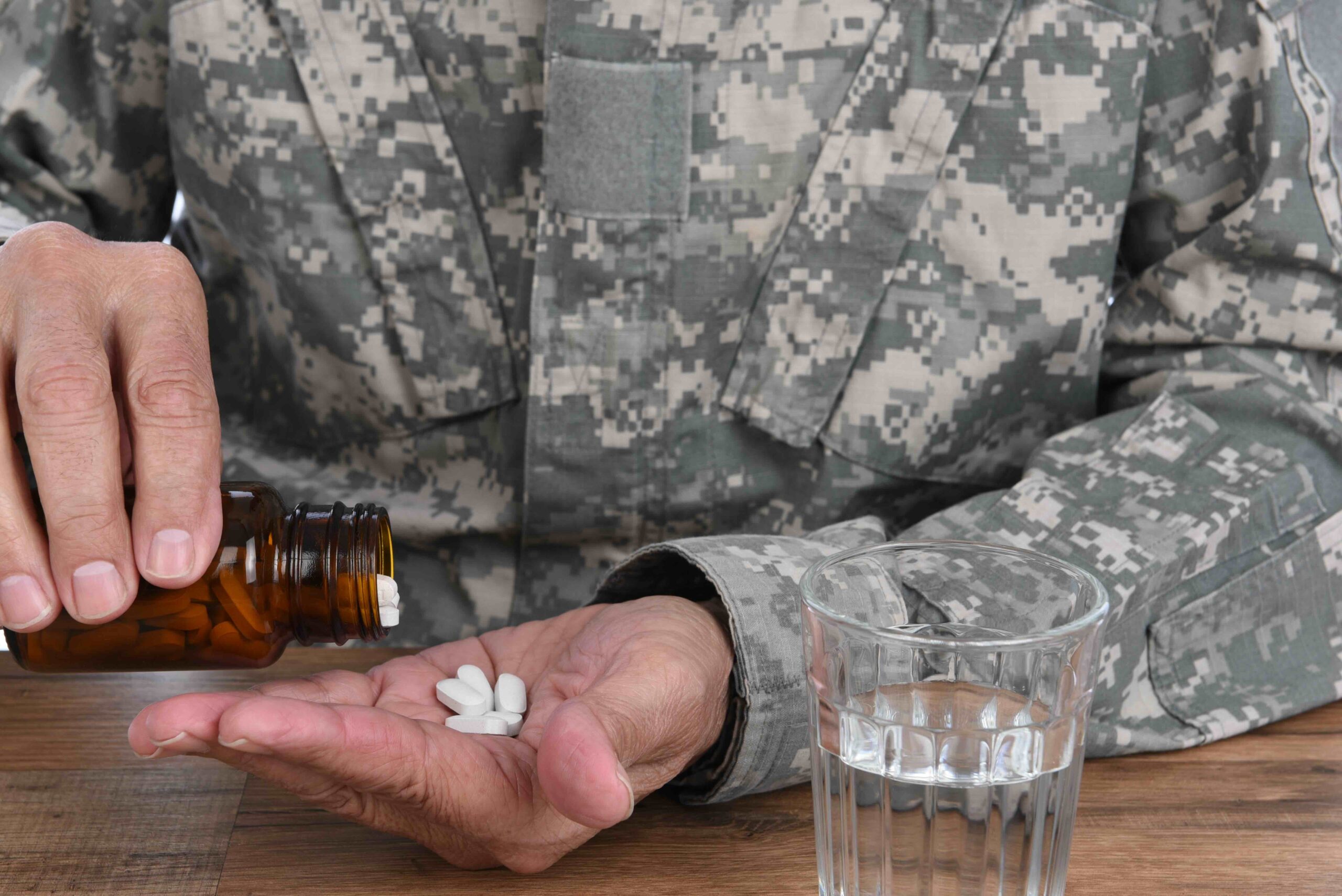
The American Psychiatric Association, VA and other prominent medical associations are lining up in opposition to proposed legislation that would require prescribers of psychiatric medication to obtain signed consent from veterans acknowledging the side effects and risks of psychiatric drugs.
The proposed legislation, dubbed the Written Informed Consent Act, was introduced into the House by Gus Bilirakis of Florida in August, with a companion bill introduced into the Senate by Tim Sheehy of Montana on December 3. Both of the sponsors are Republicans; one Democrat in the House has joined as a sponsor of the proposed legislation.
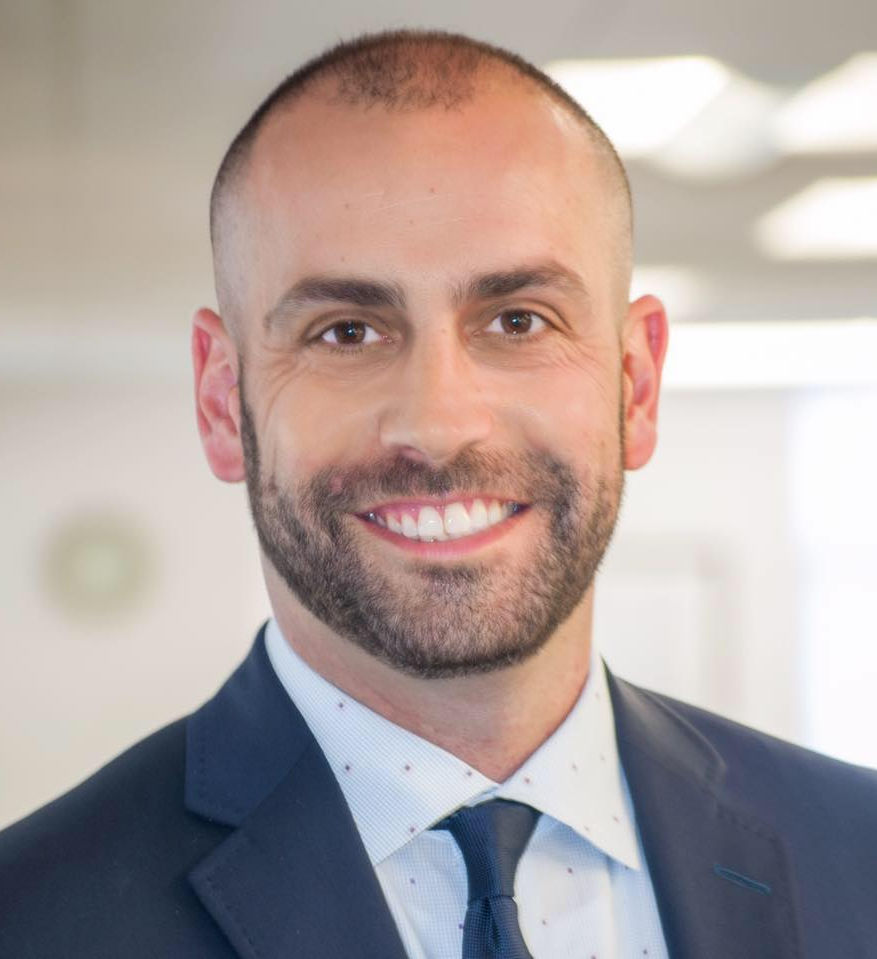
Derek Blumke, who was Mad in America’s editor of our Veterans section for several years, has been working for years to get this legislation introduced. Although existing VA directives (and federal law) require that prescribers provide patients with informed consent about the risks and benefits of any proposed treatment, veterans regularly tell of how they were not informed of the risks of psychiatric drugs, including the risk that antidepressants may induce suicidal impulses.
In 2024 and 2025, the VA’s Office of Inspector General in 2024 and 2025 provided confirmation of this failure, telling of how it found a lack of evidence that prescribers had properly discussed the risk and benefits of psychiatric medications for patients at VA hospitals in Georgia, Pennsylvania, Virginia and Massachusetts.
An Air Force veteran who did three tours of duty, including two in Afghanistan, Blumke has written on Mad in America how his life and career were derailed after he was prescribed an antidepressant and subsequently suffered horrific withdrawal symptoms, and how he personally was never informed about the risks of psychiatric drugs. In his long campaign for reform, he has documented the extraordinary rise in prescribing of psychiatric drugs to veterans; organized conferences on the overprescribing of psychiatric drugs to the nation’s veterans and the harm that has come from such practices; lobbied veterans organizations to back “informed consent” legislation; and pushed state and national elected officials to take up this cause. He dubbed this effort, which has been supported by the Grunt Style Foundation, War Cry for Change.
In collaboration with Blumke and the Grunt Style Foundation’s War Cry for Change initiative, Mad in America has published many personal accounts of harm in our veterans section. Blumke also co-authored a MIA report on how the suicide rate among veterans has risen dramatically since the VA initiated a suicide prevention program, which featured regular screening of veterans. The MIA report was titled “Screening + Drug Treatment = Increase In Veteran Suicides.”
This is particularly true for younger veterans treated at VA facilities. There were 3,879 suicides by veterans ages 18-34 from 2006 through 2022. If suicide rates had remained stable at the rate they were in 2006, which was the year that the VA launched its suicide-prevention efforts, there would have been 1,500 fewer suicides among veterans ages 18-34 during that 17-year period.
At the conferences that Blumke has organized, a number of parents have told how their sons or daughters, after having served in the military, were diagnosed with PTSD or some other psychiatric disorder, and committed suicide after being prescribed an antidepressant or put on a cocktail of psychiatric drugs. Many told of how their son or daughter was told that an antidepressant fixed a chemical imbalance in the brain and were never warned about the risk of suicide or long-term harms.
Blumke has garnered support for the proposed legislation from nearly every veterans organization, including the American Legion, VFW, IAVA, DAV, Jewish War Veterans, Reserve Officers Association, Association of the United States Navy, Special Operations Association of America, Military-Veteran Advocacy, Fleet Reserves Association, Navy SEAL Foundation, Vietnam Veterans of America, Air Force Sergeants Association, Grunt Style, American Veterans, Military Order of the Purple Heart, and Tragedy Assistance Program for Survivors.
The proposed legislation will “save lives,” Blumke says, and an existing VA directive that requires prescribers to obtain written informed consent for long-term prescribing of opioids for pain provides evidence of that. A 2018 Government Accountability report found that requiring veterans to provide written consent to long-term opioid use had led to a decrease in such prescribing, and concluded that such mitigation strategies were helping reduce “the potential health risks associated with opioid use.”
The proposed legislation would add psychiatric drugs to that existing mandate for obtaining written informed consent for long-term opioid use. However, the American Psychiatric Association is now publicly opposing it. In a December 2 letter to the chairs of the Committees on Veterans Affairs, the APA and six other medical associations wrote:
“While we share the bill’s goal of promoting informed, collaborative decision making between clinicians and patients, as currently written, it risks creating unintended barriers to timely treatment and duplicating existing processes. The VA’s current informed consent policy (VHA Handbook 1004.01) already requires written consent for treatments and procedures involving significant or unusual risks, including certain psychiatric and pain management medications. By requiring a new, separate written consent process for virtually all psychotropic drugs (antipsychotics, stimulants, antidepressants, anxiolytics, and narcotics), the legislation would add unnecessary administrative steps that delay care without improving patient safety or understanding. Critically, because psychiatric medications are often initiated under urgent circumstances when veterans are in crisis, at risk of self-harm, or struggling to maintain stability, imposing additional paperwork could delay care at precisely the moment when timely treatment is most critical.”
The other medical organizations signing the letter were the American Academy of Family Physicians, American Academy of Neurology, the American College of Obstetricians & Gynecologists, the American Psychological Association Services, Inc. (APASI), Mental Health America, and National Association of Social Workers. Their letter did not address the rise in veteran suicides over the past two decades, or respond to the findings by the VA’s Office of Inspector General that VA prescribers had failed to provide documentation that they had provided informed consent to their patients being prescribed psychiatric medications, or that the written consent directive for opioids had succeeded in reducing long-term prescribing of those drugs.
This is not the first time that the APA and the VA’s Office of Mental Health have opposed a legislative effort to strengthen informed consent practices at the VA. In 2016, the House Veteran Affairs Committee held a hearing to discuss the draft of a bill that would require the VA to establish a “list of drugs list that require an increased level of informed consent,” but both the VA and the APA testified against the proposal, and the legislative effort died. In 2021 another such bill was drafted, and according to the Grunt Style Foundation, once again the APA worked to block the legislation.
This is the first time that a bill to mandate written informed consent for psychiatric drugs has been successfully introduced into the two houses of Congress. The veterans committees for both houses must now approve the proposed legislation before it can be presented to the two houses of Congress for a vote.
****
Editor’s note: Peter Gøtzsche, who spoke at the War Cry For Change presentation in Washington D.C. this past June, has written a letter to the Senate Veterans Affairs Committee, arguing that the letter from the American Psychiatric Association should be “ignored,” as the proposed legislation would help “avoid thousands of veteran suicides, and also reduce other important harms of psychiatric drugs.”
Very interesting piece, thank you for publishing.
Report comment
Shocking, I thought the increased diagnosis’ of PTSD would preclude more psychotropic use. What do I know.
Report comment
I am writing to my Democratic congressperson tomorrow, and also to his staff member with whom I have some contact.
Report comment
Once again, guild interests outweigh public awareness and safety. Is there any limit to the greed, apathy, and arrogance of not only biomedically oriented psychiatrists, but also psychologists and LSWs?
Report comment
Written consent is the only way to go. Expecting primary care doctors to inform people when a) they think the meds are harmless b) they “have to do something” c) don’t have time d) convinced they’re smarter and know what’s better for the patient e) can easily lie in their documentation that consent was verbalized
Yeah, just get a signed consent with an accurate and thorough form. If you don’t have time then you also don’t have time to write a prescription and enter billing codes either.
Report comment
It’s bullshit to say they don’t have time. All they need to do is come up with a one-page summary for each drug to hand out. They do it once, then it takes seconds to give it to the patient. What they’re REALLY saying is they don’t WANT their patients to be well informed, because then a lot of them would opt out on their wonderful drugs!
Report comment
Not accurate, Steve. It takes seconds to hand a form to someone, and then anything between one to twenty minutes to discuss it and come to conclusion.
Don’t get me wrong, I am wholeheartedly for this type of time management. Invest these 20 minutes now, and you will save much agony – and much time! – later.
Report comment
Of course, I agree with you. But they seemed to be arguing that creating the materials would be too time consuming. Naturally, handing someone a handout is hardly an adequate informed consent process, but I was mainly pointing out that creating the materials for such a discussion would be a one-time investment that would not be particularly taxing on the system.
The real problem isn’t that it takes too much time, it’s that they don’t really want people to know this information. If they devise such handouts, it would mean they’d have to talk about things they’d rather keep secret.
Report comment
This was accurately and brilliantly stated. Let’s focus on protecting the rights and lives of our veterans.
Report comment
Yes, psychiatrists do not provide their patients with any information about the ‘(harms) dangers of psychiatric drugs’. The APA should acknowledge that all psychiatric drugs not are medicines, but simply “narcotic (drugs)”. These psychiatric drugs are far more dangerous than even illegal street drugs like “marijuana, heroin, and cocaine.” Because they cause iatrogenic disability (injury) and kills millions of people worldwide every year – the exact number is unknown. So mainstream psychiatry… is committing a genocide – as yet unnamed – every year worldwide. APA doesn’t see these things – actually, it does see them but is ignoring them and hiding them.
Why does the APA oppose informed consent? The APA’s opposition to this… means it acknowledges the genocides perpetrated by psychiatry. This also means they acknowledge the “permanent and fatal harm” of psychiatric drugs. If the APA accepts this… it could face billions of dollars in compensation lawsuits. The APA sees this danger – right under its nose.
And what purpose will informed consent serve? I don’t understand who it will benefit. Someone who is mentally distressed and therefore seeks help from a psychiatrist… what happens if they don’t sign (accept) the “informed consent”? Psychiatrists will probably not prescribe psychiatric drugs to clients who don’t sign informed consent.
Alright what happens if they do sign (accept) the “informed consent”? What happens if they use the psychiatric drugs prescribed to them? Let’s say it right away.
Individuals in mental health distress… will suffer harm whether or not they use psychiatric drugs. The reason for this is… probably that there are no other alternatives to help such individuals in these kinds of situations. In fact, there are alternatives, but most people don’t know about them.
Mainstream psychiatry, mainstream medicine, and governments… do not support and/or promote alternatives to psychiatry. These alternatives need to be included in hospitals and all other mental health facilities. The public and societies should be informed about such issues.
Psychiatric drugs… only quickly numb healthy brains. It’s a quick fix, but not a permanent solution. It also has highly lethal effects. When the effects of psychiatric drugs wear off… there is a dramatic increase in suicides, violence and murder, and other psychological symptoms.
If psychiatric drugs are administered continuously to prolong their effects… this can lead to permanent chemical brain damage and associated in need of care (dependent) status in individuals later in life.
Psychiatric drugs… cause permanent chemical brain damage and associated chemical brain trauma. The main cause of suicide, violence, murder, and all other psychological symptoms in individuals is that psychiatric drugs cause “chemical brain trauma” resulting from “chemical brain damage” in individuals. Chemical brain trauma… is both a cause and a consequence of chemical brain damage caused by psychiatric drugs. Possible psychological symptoms stemming from psychiatric drugs… are both a cause and a consequence of this chemical brain trauma.
Psychiatric drugs… cause chemical brain trauma. They do this by causing “chemical brain damage.” This is the root cause of the “possible psychological symptoms” experienced by individuals using psychiatric drugs – chemical brain trauma caused by psychiatric drugs. If someone experiences “possible psychological symptoms” after using psychiatric drugs, this is a result of chemical brain trauma caused by psychiatric drugs.
—
Alright! When an individual is harmed by psychiatric drugs… will they be told: “By accepting informed consent… you also accept the harms of psychiatric drugs. If you are harmed by psychiatric drugs… that’s your business.”
It’s not about obtaining informed consent… what’s needed is a restructuring of the mental health system, in line with the MIA’s “rethinking psychiatry” policy. Probably rethinking psychiatry means revising the mental health system with “non-drug treatment methods.” Best regards.
With my sincerest wishes. Y.E. 🙂 Researcher blog writer (Blogger)
Report comment
Yildirim, while I agree with your critique of mainstream psychiatry, your well-meaning proposal to revise the mental health system with “non-drug treatment methods” misses the mark.
Various states of mind that have been arbitrarily classified as psychiatric disorders aren’t discrete physical conditions that can be “treated” or “healed,” nor do they exhibit “symptoms.” This is yet another misleading metaphorical conflation of physical illness with emotional distress. Szasz pointed out this fundamental error in logic decades ago, and his arguments remain as sound, convincing, and relevant as ever.
Report comment
Hi, Joel Stern.
What we call emotional distress… is essentially “possible natural psychological symptoms.” They are not different things.
“If someone who has never used psychiatric medication in their life… becomes prone to violence, murder, and/or suicide due to emotional distress… what is your advice?”
Thanks… 🙂
Report comment
Yildirim, if someone exhibits homicidal or other forms of violent behavior, that’s a matter for law enforcement to address.
If an adult exhibits suicidal tendencies, that’s a matter of personal autonomy. Neither the state nor its coercive organs, including psychiatry, should have the right to intervene forcibly in such a case with confinement or brain-disabling substances or ECT.
If a child exhibits suicidal tendencies, an effort should be made to discover their cause. I don’t accept the idea that so-called mental health professionals possess the unique ability to accomplish this.
Report comment
Hi Joel Stern.
You’re right. If someone commits a crime… law enforcement should deal with it and they should be punished. I think there’s a misunderstanding. You’ve taken the question in a completely different direction. Your answer deals with different situations. But the question I’m asking… is quite different.
* If someone is experiencing one or more emotional distresses that could cause these problems… what should they do?
* If they can’t overcome this emotional distress on their own and no one is helping them… what should they do?
* Etc. etc…
A) He should receive psychiatric treatment.
What happens if he receives psychiatric treatment?
Probably…
There is a danger risk of being caught (developing) chemical brain damage.
There is a danger risk of being caught (developing) various fatal diseases.
There is a danger risk of sudden death and various iatrogenic deaths.
There is a danger risk of the mental illness becoming permanent.
He may have the potential to commit crimes.
Etc. etc…
B) He should do nothing.
What happens if he does nothing?
Probably…
A theory that it will pass on its own might emerge.
Natural psychological symptoms (emotional distress) may increase.
The potential for committing crimes may also develop.
Etc. etc…
C) They should consider alternative non-drug treatments and humane behavioral therapies.
What happens if he receives non-drug treatments and humane behavioral therapies?
Probably…
A theory of spontaneous recovery might develop.
This could also increase the potential for criminal behavior.
However, there is a possibility of improvement with non-drug treatments and humane behavioral therapies.
Etc. etc…
This improvement (recovery)… is usually something that happens over the long term, but it is a permanent improvement. If in others (A and B), this kind of permanent improvement is either nonexistent or only partial. Moreover, it can have many harmful effects on both individuals and the environment.
I hope I’ve explained it clearly. Best regards.. 🙂
Report comment
A legitimate question that goes beyond your ideas (which I very much agree with): What are we doing socially, biologically, culturally, intellectually, spiritually, that helps create or mitigate this kind of experience? To what extent is our social system responsible for creating better environments so that such detachments from our current reality are less likely to occur and more easily resolved when they do occur? My perception is that we are not only poisoning the environment in a physical sense, but poisoning the social and spiritual environment that people have to grow in such that it’s MORE likely that people experience this kind of alienation. We know, for instance, that urbanization leads to higher levels of psychotic symptoms, as well as to higher rates of crime for all people. What is it about urban environments that is so unhealthy, and what can be done about it? And so on. Prevention may be more important than “treatment” in the long run!
Report comment
It’s very disturbing that the VA wants to deny written informed consent for psych drugs–drugs that can cause immense physical and psychological harm. Unfortunately, it has been my experience that most doctors provide very little information when prescribing drugs and certainly not enough info to really inform a patient about what to expect. I hope the vets will keep fighting for this simple request. In doing so, it may well benefit all of us.
Thanks, Bob, for another informative article.
Report comment
I want to add two things I learned from the Connecticut Shock Data published here last weekend:
1) West Haven Probate District had 53 forced electroshock requests filed to the probate court between 2012 and 2024
2) the West Haven VA Medical Center is the only inpatient psychiatric unit in that district
I wonder what the APA’s expressed position would be if they were compelled to make one about veteran’s receiving forced electroshock.
Report comment
When not more blatantly coerced by conscription, soldiers are recruited without their informed consent, whether told lies of patriotism or sold false advertising about benefits of enlistment. Once they sign on the line, they are prisoners of the state, effectively stripped of whatever paper rights citizens imagine themselves to possess, no more than materiel (cannon fodder) to make the ‘ultimate sacrifice’ of exploited labor for the rich man’s gain, human resources for resources of wealth redounding to ruling powers who declare wars for their subjects to fight (‘thank you for your service’).* Soldiers also serve as ideal experimental subjects for all sorts of Frankenscience, lab rats exposed to nuclear or chemical weapons to test effects, or beta data for R&D rollout of next generation warfare like biotech to create cyborgs.**
Who among any of us has not had our so-called informed consent routinely violated? A typical trip to the doctor consists of assembly-line processing of meat on the market of the Medical Industrial Complex. The ideal patient is the passive guinea pig for drugs pushed by mind-controlled MDs of the MIC who know next to nothing beyond what they’ve been told by snake oil sales personnel of the Pharmafia. Most any job shares the military rationale and rationalization of human resources as materiel for gain by bizzness owners of labor, our ‘rights’ be damned. And to that end, more are killed every year from preventable workplace hazards, informed consent be damned, than in the entire casualty count for war in Vietnam and SE Asia (officially, ca. 58,000). Is it at all possible to have informed consent in a social ecology where we hardly can begin to know what’s really in the air we breathe, the water we drink, the food we eat…because we live, and die, at the disposal of ruling powers for whom we are disposable units of production and consumption?
Why keep snipping away at branches of a rotten tree rather than striking at the root? Spend years to pass piecemeal reforms which may be overridden by bureaucratic inertia in their execution? Since when has the rule of law not been a law of rule by organized crime against humanity, out to take back whatever little might be given, temporarily, in order to hold onto a lot? And as nightly news commercial broadcasting abundantly indicates, what real-world difference does information on ‘possible side effects’ make for bizzness products, backed by rigged trials approved by regulatory partners in crime, from a medical monopoly of health care for which there is hardly any alternative but none? In the short as well as long run, wouldn’t it be better to have fuller say-so in running our lives, altogether different from being informed to manufacture our consent to institutionalized violence passing for law and civil order?
Spare us support-the-troops politricks from profiteers who wear flag pins on designer suits that never show any trace of blood spilled by others who suffer their hypocrisy. The best if not only remedy for ‘PTSD’, as if we need another DSM name for permanent trauma in social relations rooted in systemic abuse, is preventive: abolish the class war of the few over the many that makes mass murder ‘normal’ to ‘human nature’. If we must fight, let it be for peace and justice, genuine care and compassion, in a “revolution of values” (ML King) where an injury to one is an injury to all, and no one is free until all are free.
*
“I spent 33 years and four months in active military service and during that period I spent most of my time as a high class muscle man for Big Business, for Wall Street and the bankers. In short, I was a racketeer, a gangster for capitalism. I helped make Mexico and especially Tampico safe for American oil interests in 1914. I helped make Haiti and Cuba a decent place for the National City Bank boys to collect revenues in. I helped in the raping of half a dozen Central American republics for the benefit of Wall Street. I helped purify Nicaragua for the International Banking House of Brown Brothers in 1902-1912. I brought light to the Dominican Republic for the American sugar interests in 1916. I helped make Honduras right for the American fruit companies in 1903. In China in 1927 I helped see to it that Standard Oil went on its way unmolested. Looking back on it, I might have given Al Capone a few hints. The best he could do was to operate his racket in three districts. I operated on three continents.”
—Smedley Butler, War Is a Racket
**
Used & Betrayed – 100 Years of US Troops as Lab Rats
https://www.youtube.com/watch?v=TRMT1eozxPg
Report comment
John, thank you for the insightful comment. I particularly like your expression “Pharmafia,” which I will now make a permanent part of my critical vocabulary!
Report comment
Today is day 905 still a month out from seeing a neurosurgeon about the herniated discs and nerve compression in my spine. I had a claim filed before Covid and I’m scheduled for another C&P on Tuesday 16 December 2025. This will be my third C&P + ACE review for reasons that are beyond me. I ended up homeless during the pandemic they kept telling me I didn’t fit the criteria for homelessness. On day, 189 of being homeless, they said that one too many times to me and I got violent. All of a sudden I fit the criteria for homelessness. I’m so sick of the VA and I’m tired of watching my friends die left and right because of right and left. Patient Hampton VAMC since 2010
Report comment
I support the bill that would mandate written informed consent.
Let’s not presume that signing a form means that there was, indeed, informed consent.
The key is the conversation, not the form, and it doesn’t automatically follow that having the form leads to that conversation. It could even short-circuit it. Every patient deserves that conversation, but not all patient want it (even though they should, in my view), and I’ve had the experience of patients saying “I need my meds, so where do I sign?” And I have to say “not so fast.”
Informed consent is a process, not a one-time deal. If someone signs a consent on day one, it’s not a ‘contract’ to take meds indefinitely. A prescriber who learns of new information about a med later on in treatment, no one would say that “well, the patient already signed a consent, so there’s no obligation to tell the patient the new information”. That’s also part of informed consent.
The bill is only as good as the conversations (plural) that it leads to; otherwise, it’s just another box to be checked off, without much meaning besides allowing legislators to be able to say “look how we show we care.”
Report comment
Excellent point! Even a conversation does not ensure that informed consent occurs. I have found such “conversations” frequently one-sided, with the purpose being to get the consent without really offering any other options, or making them all sound so scary that only an idiot would withhold consent.
Report comment
Thanks – I appreciate that
Report comment
Dear Robert omg what information & your writing on this will help SAVE MANY families! God Bless y’all for help in the war cry for change!! Psychiatric drugs and opioids are all double edge sword and they want us to be the sword swallower it’s terrible how they have harm so many people for the rest of their lives!!! ONLY if they live through it??? They should be shamed & Blamed!! It’s to do no harm was the first rule for doctors I guess psychiatrist forgot that!!!
Report comment
Veterans more than any other single group must have written, informed consent. The only question I have is:Is this compatible with the case of someone with bipolar disorder in full blown mania because that is, indeed a physical illness from what I know. A person in mania is unable to act on their own behalf. Please explain if this would be an exception due to the diagnosis. The other thing that occurs to me is that so many people stop taking any psych meds of their own volition after a time. It’s so important that other resources are provided to Veterans in a regular, ongoing and available setting so people have a place to turn – in person – 7 days/week, 365 days/year. With a hot beverage and food available. In all 50 states. Veterans deserve that.
Report comment
Libi, what credible evidence have you seen that proves a “bipolar disorder” is indeed a physical illness? Are there any biomarkers or genetic test findings that corroborate this assertion?
Report comment
Bipolar disorder has been characteried by laboratory testing demonstrating Litium imbalance creating mood swings. Objective reporting on devasting loss of autonomy and catastrophic outcomes including suicide have been documented in medical literature for many years. This is why I am questioning this facet of pychiatric diagnoses. It would be great to get feedback from someone with advanced credentials to shed further light.
Report comment
I am not aware of any testing demonstrating lithium imbalance. In fact, the dosage of Lithium normally used for “treatment” is very close to the lethal dosage, such that people taking Lithium are supposed to be constantly tested to make sure their levels are not so high to create acute Lithium toxicity. It’s definitely not a shortage of Lithium causing it! Or, please provide a link to a study showing this if you still think I’m wrong.
Report comment
My comment did Not state “Deficiency”.
Report comment
Sorry about that! Thanks for clarifying!
Report comment
I’ll be presumptuous enough to say I have credentials to speak on your comments; board certified psychiatrist with decades in practice. (I know that not everyone would think that qualifies, but so it goes.)
(1) There is no evidence I’ve ever heard of that says bipolar is linked to any lab testing with any reliability. That includes any related to lithium
(2) Bipolar is not – not- not caused by some imbalance in lithium level
(3) I believe that lithium is often effective for bipolar, but that’s way different from thinking bipolar is a lithium deficiency. It’d be like saying strep throat is caused by a penicillin deficiency. We do know more about what causes strep throat than we do about what causes bipolar, but that is separate from the idea of a lithium deficiency.
(4) I would add, in response to Steve, that there has been a growing body of evidence that lower doses of lithium are usually effective and relatively safe. These doses are not close to lethal doses. Lower lithium levels (0.5-0.8 give or take) are now generally recommended; used to be 0.6 – 1.2 (give or take), and even those aren’t close to lethal levels. Toxic (not lethal) levels can begin at 1.5-2.0 – again some variation there.
There are some psychiatrists who have found even lower doses and blood levels (0.3-0.4) to be effective, and of course a little safer.
Never a need to take more than what’s needed.
Report comment
My comment did Not state “Deficiency”. Thanks for the laboratory references. This is helpful.
Report comment
Thanks for your comment. As a layman, I would just ask whether administration of even very low dosages of lithium over a long period of time can seriously impair a client’s physical health and cognitive faculties.
Are there any MIA posters who have experienced this kind of therapy? I personally am skeptical of drug treatments for states of mind that do not originate in verifiable organic pathology.
Report comment
Yes I agreed that all humans need someplace to turn to be able to get some sleep some food a hot beverage and shelter from the weather not just veterans there’s a lot of people who just need that once in a while it would be something that would save people lives and keep them out of hospitals and the big expense to everybody in the end Martin Luther King was right we should be fighting for our rights as Human beings not to be harmed it’s terrible what’s happening out in this world terribly not nice
Report comment
Informed consent is a must in every area of life and that goes for sex too just saying everybody and I don’t care if you’re married or not yes still have to have consent some of us get bitchy about that shit and for good right it’s not veterans! domestic violence patient’s an abused women and children or anybody who’s been abused for that matter why do they need to be re-traumatized and then they have to deal with side effects that could kill them boy here take this it’s only poison dodger think that we know that I worked for doctors for years! No doctors should be harmful to our health & life! Plan & Simple! But they R BIG & we R little! Wow! Think about it please lord save yourself from side effects & Possibly poisoning your body or dying do you wanna take that chance take this pill it’s like playing Russian roulette that’s like telling me here’s a gun and I’m gonna give you one bullet in it and you keep shooting until you’re dead ,well y’all please think, do I need that like a hole in the head? Do you? Fight for FREEDOM! Y’all groups please stand together & fight for RIGHT TO LIFE!!! Because no one can say that we all don’t matter we all matter I’m sick and tired of people trying to say that it’s better when it could kill you think about it please hard! If all these different groups stood together and even the Democrats and the Republicans it would help save a lot of peoples lives and a lot of money and resources it’s pitiful how you guys waste money and fight just a lame duck as usual!
Report comment
A lot of psychiatric drugs cause sexual dysfunction not for men but women too! Who is the judges and the doctors weren’t getting their sex or something was going to affect their sex life there would be an outrage an uproar but so many are treated on human life as usual just another lame duck! Love and intimacy come from emotions it’s a human need I guess that’s why Viagra make so much money thank how many women have the same problem because of these drugs!! No sex now that hurt and happened due to side effects! Wow! Why is nobody talking about the side effects on women sexually and how it affects their love lives and their families why do they only say it’s happening to men know it’s happening to women too and nobody’s discussing it wow y’all better join together it’s the only way we’re gonna win the fight for our freedom and our rights as humans that’s the only thing I can think of stand together or divide it you will fall!
Report comment
In response to Joel’s response to my response to Libi….
can low-dose lithium cause problems? – (1) have to say it’s possible but I say that in the sense that almost anything is possible. Evidence that it happens is very close to zero. If a person has horrible kidney function, then a low dose would affect them as if it were a high dose, in which case using lithium at all would not be a good idea. Bottom line to your question, a very low-level worry assuming lithium is otherwise am acceptable choice.
(2) Reasonable to be skeptical of using meds when there’s no certain organic pathology. There is evidence of some organic pathology in bipolar, but it’s not conclusive by a long shot. If a med has evidence of benefit ( not saying it’s perfect and without risk) for a person’s problems and suffering, and the person is OK with taking it, I would say that it’s unreasonable to withhold it just because there’s no “certain” pathology. Except if you have an alternative that you can show is better under those circumstances.
Report comment
Richard, I find it difficult to accept your confident assertion that the possibility of harm from ingesting low doses of lithium is “very close to zero” and is therefore a “very low-level worry.”
In this connection, I refer you to an article titled “Lithium: A Survival Guide for Parents,” which appeared on the MIA website on May 1, 2019. Its author, Julie Green, underwent lithium therapy for a supposed “bipolar disorder” and consequently suffered from an acute renal failure.
Dr. Peter Breggin has described lithium as a potent toxin that works by disabling normal brain functions. Do you dispute his findings, and if so, please cite corroborative sources.
Lastly, from a strictly linguistic viewpoint I question your use of the misleading term “meds” in reference to psychiatric drugs. Medications are remedies for specific, verifiable physical conditions; the brain-numbing substances administered by psychiatrists for treatment of hypothetical DSM disorders are more properly termed “neurotoxins,” and unlike you, I don’t consider it unreasonable to withhold them in the absence of a pathology clearly proven through laboratory tests..
As for better alternatives for dealing with cases of extreme emotional distress, I think anything would be preferable to ingesting drugs with side effects that might result in severe long-term physical impairment and possibly premature death.
Report comment
Joel – thanks for the reference re Julie Green, whose awful story I did read (not just the part 2 you referenced, but part 1 as well). I’m sure there’s even more to her story, but in response to your question, I did not see anything specific there that said what her doses were or for how long she took lithium. I don’t know, but assuming she took typical doses as recommended years ago, it’s likely that it was the low doses that I am referring to here.
Drugs or medications (I don’t want to get sidetracked on the terminology right now, though I suppose there is some official definition somewhere ) ALL can be dangerous at any dose. Most of the time, the higher the dose, the higher the risk. Can we agree on that? If so, then also true that the lower the dose, the lower the risk. It is never zero. I think about a car; it’s dangerous, and the higher the speed the higher the danger. If I’m going 3 MPH, the danger is less, and again not zero. 3MPH is safer than any number over 3. Agreed?
To call something a neurotoxin is another way of saying it can have dangerous side effects. I agree with Breggin on that, but it is dose-related. I would bet that even he would say that 1500 mg lithium worries him ( and me ) a lot more than 300 mg a day. It’s not all-or-none. Just because something can be dangerous does not automatically make it a danger all the time. If it were, nobody would drive a car.
I’ll refer you to psychiatrictimes.com, Oct 9 2024 article by James Greenblatt. It addresses some of the surprising benefits of low-dose lithium. Also take a look a psychiatryredefined.org for more on that.
There is no avoiding risks, as I see it. One kind is the risks of taking medication, which vary with the med, the dose, the length of time, and other factors. The other kind is the risk of not offering something with a chance to help the patient. It’s up to the patient which risk s/he opts for. I respect that you would prefer no meds if you were in extreme emotional distress. Many would agree. Many would opt for the risk you prefer not to take.
I appreciate the dialogue.
Report comment
Richard, after a second reading of your latest comment, I’d like to address your question whether low doses pose a lesser risk than higher ones.
That’s true in the case of verifiable physical illnesses. However, when we are dealing with the vast majority of the disorders in the DSM, which are facile but misleading metaphors for a given society’s proscribed thoughts, emotions, and behaviors, administering ANY dose of a neurotoxin with potentially harmful side effects for a non-medical condition is totally inappropriate and unethical. Such conduct on the part of psychiatrists, who claim to be medical specialists, places them on the same level as a drug dealer who provides addicted clients with mind-altering substances.
Labeling psychiatric drugs as “medications” is a travesty of genuine medical practice.
Report comment
It’s interesting that you are a “words guy,” as I am as well, and you’re right that any conversation has to have at least some agreement on what the words mean if we’re going to do other than reject each other’s points. I had tried to set aside the drug/medication matter just to get to the matter of low dose lithium, but I agree it’s a debatable question. You have separated out psychiatric drugs from medications. Here’s how I see it: we are talking about chemical compounds which can do different things; some of the things we like, others we hate. That is equally true of medications used for cancer (with defined organic pathology), strokes (ditto), and what some call psychiatric illnesses. Some of those things we hate are neurotoxic effects; that a med can be neurotoxic doesn’t, as you imply, make its primary definition a neurotoxin. If you’re going to be consistent, you must say that some anticancer drugs are neurotoxins, and, presumably shouldn’t be used. Neither psych drugs ( please allow that for now) nor anticancer drugs are DESIGNED to be neurotoxic; you can’t say that without a basis. You can say be very careful – and I am – but rat poison is a neurotoxin and DESIGNED for that use.
also
(1)
I’ve a great many patients who have freely accepted taking these chemicals. The MIA site provides stories that give an important balance to mainstream psychiatry; that’s why I’m here. It does not follow that most/all who freely consent are coerced. Just not a logical conclusion. It happens, just can’t say most or all.
(2) You asked about the low dose lithium and safety. I responded directly, gave you a reference or 2. You zipped right past that, as if you are not open to the possibility of my having a science-based point. That’s not, in my view, the spirit of dialogue.
(3) I see meds-drugs-substances as tools. They have no inherent morality, but it’s how we use them that counts. Kind of like a hammer: if we use it to help build a house, it’s great; if we use it to hit someone, that’s horrible and evil. Is the hammer a wonderful tool OR an instrument of evil? Hammers are not good or bad, and neither are these chemicals in themselves.
(4) I agree that words like patient vs client vs service-user can have some judgment implied and we have to respect that person’s preference. This also applies to whether one believes any mental illness is “real”. Not everybody, as you well know, uses words the same way. Who is the final judge as to the “true” meaning of a word? You? Me?
thanks again
Report comment
I do think it’s worth noting that the term “medication” has been pushed by the psychiatric industry and the word “drug” has been avoided very specifically to differentiate psych drugs from street drugs. The fact that some of them literally ARE street drugs (such as “Desoxyn” aka methamphetamine for “ADHD”) does not seem to be something that we’re supposed to recognize. So I think the term “medication” has become loaded, as it has been quite intentionally used as a marketing tool. I think the word “drug” sums up the situation just fine, and nobody is concerned about calling cancer drugs “drugs” or essentially any other drug a “drug” EXCEPT for psychiatric drugs, which we’re “supposed” to call “medications” because of fears that clients will make the connection. The term “drug” (I have been told) is “stigmatizing” for “mental health” patients, even though it isn’t considered the least bit stigmatizing for cancer patients or anyone else. That’s why it rankles.
Report comment
Richard, I appreciate our dialogue too. However, it’s obvious we are proceeding from totally diametrical premises.
As a former translator and editor, I’m sensitive to the subtle nuances and connotations of language. That’s precisely why I strongly object to use of the word “medications” in reference to psychiatric drugs, which are actually toxic substances administered for the treatment of purely mythical disorders voted into (and sometimes out of) existence contrary to all recognized standard scientific procedures. I likewise reject the word “patient” in referring to individuals in emotional distress, since what they experience does not originate in some organic pathology, defective brain circuitry, or chemical imbalance, unless this can be proved otherwise through rigorous, verifiable testing.
Careless conflation of physical with metaphorical illnesses is not just a trivial matter of semantics, but has serious real-life consequences, as one can readily see, for example, in the mass drugging of schoolchildren with neurotoxins to treat them for ADHD, which are behavioral patterns hypothetically classified on a spectrum of disorder.s
Lastly, you claim without evidence that “many” people would opt for the risk of undergoing chemical lobotomies (and perhaps ECT?). Frankly, I doubt there are in fact many mature adults in full possession of their cognitive faculties who would WILLINGLY agree to have their brains and bodies permanently impaired by such treatments if they were fully informed of the lifelong harm that might result. Do you think so-called mental health professionals, the great majority of whom base diagnosis and therapy on the bogus categories of the DSM, provide accurate information to their clients? The harrowing accounts of psychiatric survivors (including Dr. Phillip S. in the UK) featured regularly on this website tell quite different story.
Report comment
Richard, I never said that most psychiatric clients are “coerced” to undergo brain-disabling treatments of one sort of another, but I do contend that many psychiatrists, whether out of ignorance, apathy, laziness, or mercenary motives, fail to provide complete, accurate information on serious, sometime lifelong harms that could result from such risky procedures, for questionable benefits. The collusion between the mental health system and Pharmafia is notorious and well-documented, and the fallacious premises of the DSM have been admitted by some of its compilers.
In short, given the proven widespread corruption and incompetence in this field, I see no valid reason why the host of practitioners engaged in it should be granted undue authority to freely recommend mind-altering substances and ECT for the purpose of treating purely metaphorical illnesses–especially in the case of young children and elderly dementia patients who lack the capacity to make an informed judgment.
Report comment
I get that you see the field as pervasively corrupt and incompetent, that you think practitioners shouldn’t have the authority to recommend substances and ECT for treating metaphorical illnesses for patients ( patients!) without capacity to make informed judgments. It helps to clarify your point of view. I’m sure if I saw the field in such absolute terms, I’d fully agree with the rest of what you have said.
You say you never said most psychiatric clients are coerced to undergo horrible treatments.
OK, but what you did say was this: ” Frankly, I doubt there are in fact many mature adults in full possession of their cognitive faculties who would WILLINGLY agree to have their brains and bodies permanently impaired by such treatments if they were fully informed of the lifelong harm that might result”.
I don’t see a big leap from what you wrote to having a reasonable person conclude that they must be being coerced if they would never do it willingly.
I don’t accept your premise that many fully informed adults would almost never agree. I think the way you would like to have people fully informed would be in a way that would guarantee their declining treatment. If you were selling me a steak knife and told me that it’s mainly a way to sever my arteries, I’d say no thanks. If you told me the pros and cons, I’d be in a better position to decide. Your contention that most fully informed people would decline meds could be true or false. If you have data to back it up beyond anecdotes, I’d truly like to see it. Otherwise it’s more your opinion, which you’re perfectly entitled to have and not have to defend unless you present it as fact.
Report comment
Richard, the word “coerce” carries implications of duress, pressure, or FORCIBLE persuasion. In the case of psychiatric clients, the proper term would be “manipulation.” Laypeople tend to be unduly influenced by ubiquitous Pharmafia marketing and awed by the credentials and authority of so-called professionals who are supposed to have their best interests in mind. It’s this misguided trust, not coercion, that leads people to undergo brain-disabling treatments in order to alleviate emotional distress. Similarly, it’s a naive belief in the fallacious claims of psychiatry that impels parents to permit the drugging of their children who are diagnosed with purely hypothetical learning disorders.
As for widespread corruption, fraud, and incompetence in the mental health system, researchers such as Robert Whitaker, Bruce Levin, Peter Breggin, Jeffrey Schaler, Thomas Szasz, and Peter Goetzsche have written extensively on this subject, and I don’t think it’s necessary for me here to recapitulate their well-founded arguments.
Lastly, numerous accounts by psychiatric survivors (not only on the MIA website) show that a lack of accurate, objective information led them to believe in the empty reassurances of their therapists. I refer you, among such examples, to the harrowing testimonies of Dr. Phillip S. in the UK and Julie Martin, both victims of unconscionable psychiatric abuse over a period of many years. These are by no means isolated incidents or mere “anecdotes.”
Report comment
Richard, your analogy with the steak knife is unconvincing.
Steak knives are material objects with sharp blades. Their existence is visually evident and demonstrably tactile, and the uses to which they can be put are equally apparent.
Psychiatric disorders, however, are not material entities and their existence is hypothetical (unless one considers lists of arbitrarily concocted DSM “symptoms” to be definitive proof of their existence).
So, if a psychiatrist attempted to convince me that I (or my elderly parent or child) needed a chemical lobotomy or ECT to treat a putative hormonal imbalance, genetic defect, or dysfunctional brain circuitry, I would demand much more evidence than his/her credentials, a drug company brochure, or a corporate-sponsored website to corroborate such a claim, especially as the conflicts of interest in the mental health field are so blatant.
Report comment
Joel – the analogy is that steak knives are tools, and we can think of medications as tools. Both can be used for good or ill. They have no inherent moral quality. You wrote as if my point was that knives are analogous to psychiatric disorders. No. We can debate if psych disorders are real, but we cannot debate whether steak knives and medications – both just sitting there on the counter – are real.
You said earlier on that we are proceeding from diametrically different premises. I think that MIA email is not the ideal way to discuss our differences, but we’ve been stuck with it. I think were we able to have a normal conversation, just you and me, we’d find more common ground that you think.
I have appreciated the give-and-take, though as I re-read all 6 of your posts in reaction to mine, I’m hard pressed to find one in which you could say “well, I can see that,” or ” you do have a point.” I respect that you believe you are correct in what you say. From the standpoint of a dialogue, having you dismiss my points one after the other doesn’t make me see it as a true dialogue. Feel free to respond to this, but I respectfully tell you here not to depend on me to reply. I’m sorry to think that I have come to expect that you’ll dismiss what I’ve written here. Not saying you’re wrong to believe what you believe, just saying it’s not the kind of dialogue that adds value to the things we both care about.
Report comment
Richard, I conceive knives and other tools as implements used to shape, transform, and manipulate objects existing in physical reality. Similarly, medications in the true sense of the word serve to treat and possibly cure genuine injuries and illnesses.,
Psychiatric drugs (neurotoxins) are administered to alter states of mind that are subjectively hypothesized as manifestations of a chemical imbalance, genetic abnormality, defective brain circuits, or other supposed pathology.
Do the majority of therapists make this distinction perfectly clear to their clients and give them accurate, comprehensible information about potential serious side effects? If so, then I accept the logic of your argument. However, judging from the numerous accounts of psychiatric survivors that I’ve read on the MIA website and elsewhere over the years, I am yet to be convinced that such information is being provided.
I have no other comments to make on this particular subject.
Report comment
Well Herr Doctor, toxic cancer drugs work to kill cancer cells, psychiatric drugs work to kill the symptoms of stipulative and lexical definitions implying scientific validity, save to systematically deceive-reify what A.N. Whitehead referred to as ‘the fallacy of misplaced concreteness”. Therefor, the cancer patient is taking drugs that actually address/treat the cancer cells of said illness, while the psychiatric patient is taking toxic drugs to merely treat the symptoms of largely disproven depoliticizing scientific frameworks, i.e., scientism (this but the tip of this manufactured psychiatric miasma iceberg).
Moreover, your hammer analogy is, for me, a rather curious metaphor. For it seems to me that psychiatric drugs are used much like that of a hammer; everyone’s symptoms are a universal nail to be drugged into symptom compliance. The bigger problem is that all the other tools in the tool box, and the availability of competent clinicians to utilize them, scarcely exist anymore. To suggest that there hasn’t been a gross systematic misuse of psychiatric drugs over the last 30 plus years, is either flat out pathological denial, or unredemptive ignorance. Hell, the use of psychiatric drugs on foster children alone is so gratuitously vile that it borders an organized crime wave.
How many of millions of people began antidepressants because they were told they had a serotonin imbalance? What got explained there just wasn’t so, the real causes thereby systematically obscured from everyone. How many children have been told they have the medical condition ADHD and bi-polar over the last 30 years, when there were a plethora of relationship and environmental causations that were systematically denied or otherwise incompetently missed? And what the hell ever happened to the deliberative psycho-social evaluation? When I think back to my own immutably egregious and erroneous ADHD and bi-polar diagnoses nearly sixty years ago, a chill comes over me that the same lies, hubris, and ignorance that gave rise to my two non-existent psychiatric diagnoses, and thus justified 7 years of oppressive toxic drugs, have only grown in scale and refinement since. I hazard to imagine our society 60 years from now given the scale and total societal buy-in of psychiatric narratives, psychiatric pills, AI, the critical thinking crisis, institutional decay, and a dozen more other factors. Can’t say I’m sorry that I’ll miss that shitshow…
Report comment
I wish you hadn’t been mis-diagnosed and then been subjected to years of drugs that, I presume, you didn’t need, didn’t find helpful, and maybe caused other problems.
I also, as you do, wonder about how things will look in 60 years.
I also agree that societal issues have much more power than the field of psychiatry does, did, or will.
I also agree that psychiatry has much to do to improve what it has to offer; I know some people think it has zero to offer and they don’t see it as a debatable item.
Those are my honest responses to what you wrote. What follows does not detract from what you read in this reply.
I can’t know what was in your mind and heart with the “Herr Doctor” opening. What it conjures up – and I presume you intended it – is that you link psychiatry ( or maybe just me, as if you really knew me) with not just ignorance, but evil. I also presume you know you have a sympathetic audience here in MIA who are likely cheering you on with that kind of swipe at me. I don’t expect to alter any of your views, and I certainly don’t question what happened to you. That fully acknowledged, using a cheap and nasty opening seems to me betrays any idea you might have that you truly want to engage with any point of view not your own. I think it’s sad and shameful, and I bet you could have chosen a different opening if you wanted to.
Report comment
I quite agree with you Richard. My inference was gratuitous and wrong, of which you, on every personal level, did not deserve. If it matters, at all, I sincerely apologize!
FWIW; My anger at my childhood psychiatric diagnoses isn’t because they were both unwarranted, reckless, gratuitous, or that each were given to an abused kid in an emotionally and psychologically toxic home. My anger is at the scale of denial of not only my personal history (adult therapist, et al), but rather the denial and suppression of the subject matter as a structural imperative; thus…wait for it…a history very much repeated/practiced with abandon at scale today. Thus, my anger is the moral wound of an institutional betrayal (i.e., individualized interpersonal violence one internalizes, until, at the least, the dam of their own psychological defenses breaks, and only then do they begin to comprehend the scale “and consequences” of the betrayal-which, for me, was 12 years ago at age of 56). This is complex subject matter; and complex subject matter is a dialogical process that is, effectively, antithetical to psychiatric discourses. Suffice to say, if I may, that complexity is one of the more diabolical (i.e., per its Greek etymology) features of psychiatric diagnoses.
I wish you well Richard.
KS
Report comment
I forgot to mention, Richard, that I wasn’t “misdiagnosed”, I was “maldiagnosed”, and that distinction is both necessary, and far, far from confined to little old me.
Report comment
“Misdiagnosed” implies there is some way to establish a correct diagnosis. As we all know, there is no such mechanism in psychiatry. Every “diagnosis” is entirely subjective and unable to be objectively verified by any test. Same with “overdiagnosis”. No such thing if you can’t actually determine who is legitimately “ill.”
Report comment
In response to Steve’s most recent response to my almost-as-recent post:
(1) True that psychiatrists prefer “Medication” to “drug” – as do most physicians of all types. Mostly because, yes, “drug” connotes for some people the notion of street drugs. This is natural because psychiatric drugs are psychoactive as are street drugs; they’re all on the psychoactive spectrum. It’s a similar problem with pain management – most of them are “addictive” which becomes a potential obstacle to good pain care if there’s not an honest discussion. I agree it can be rankling. I do believe that honest conversation makes that addressable, not an end point.
(2) to say that “I have been told” the term drug is stigmatizing is no doubt true for some; you write it as if it is the usual response. I differentiate between what I have been told on the one hand, and what is more broadly the case on the other.
(3) Here are some widely-used, leading, and authoritative psychiatric books with “Drugs” in the title, countering your contention that the word has been systematically avoided:
Psychiatric Drugs Explained – David Healy
The Prescriber’s Guide: Stahl’s Essential Psychopharmacology – Antidepressants, Antipsychotics, and Other Drugs – Stephen M. Stahl
Drugs and Behavior: An Introduction to Behavioral Pharmacology – William A. McKim & Stephanie Hancock
Clinical Handbook of Psychotropic Drugs (Ric M. Procyshyn, Katelyn Halpape, David D. Kim)
(5) I understand and have respect for different points of view about psychiatry, mental health and whether psychiatry is a good or an evil. I also believe that if one has an agenda (including me), one is either obligated to acknowledge facts that are not in line with one’s agenda, OR acknowledge (even to oneself) some acting as if there’s only one side to a complex situation.
Report comment
Omg Bless y’all and Robert for being the founder of Madden America. They tell all of us never to speak with each other about any of this. It’s a real big cover-up. Where is the transparency? I worked for doctors for years this is ridiculous. What’s happened to so many people and they want to keep it under wraps, that’s bullshit as my mother would say she would be pissed off ( PO) I agree with my mother 100% and with what Robert is doing with matter in America to go Herian that all to make a friggin profit and destroy families at the holidays of worst time, I’ve lived through a bunch so have my family because of this nonsense I am very upset about that. They have been playing a game on all of us. Do the research proper test I dare them.
Report comment
Robert & Steve M. Omg my gut to me what happened to y’all & families all “wrong omg Terribly not nice neurotoxins poisoning family’s brains until they killed themselves that’s a f up scenario And everybody’s like oh you just should be happy and keep going on knowing what you’re doing now they might be big and I might be a little bit I gotta say something about what they’ve been doing to family’s like mine it’s a bad time I gotta not be scared anymore to speak the fifth amendment is supposed to protect that but I guess they’re going to stay for me to unsilenced me somehow and she was they won’t like what I have to say please I have all the proof to back it
Report comment
Yeah but everybody is an ex doesn’t like you they can set up whatever they wanna do to try to upset your life so welcome to the knots and Camp and then they can manipulate whoever they want to try to hurt you I never becomes a big conundrum a lot of women deal with that on a regular basis they’ve been doing it for centuries now so many other groups as well what do we stand together and fight for freedom that time!!! Y’all think ! I do and at this point in my life I will stand up and fight for freedom and speak my mind I am allowed to have free speech I mean that was part of the bill of rights but they want to change that one to remember that they’re taking away your freedoms one thing at a time!!!
Report comment
Y’all think HARD !? Y’all if It was your kid if it was your family if it was you how would you feel would you like it happening to you just remember do want to others what you would like to be done to yourself and then look in the mirror and say was it OK what you did question yourself God has a way of looking at it
Report comment
These chemical and balances lithium whatever I caused because they pumped up the people to begin with with crap that screws I’m not even more just because somebody’s family died or whatever happened to them or their family members because of medication‘s so-called that ended up by them committing suicide wow that’s real recovery real help without Real research why snake pit with snake oil obviously concur
Report comment
Wow in this day and age of technology why don’t we do informed consent under video like they do for police right so that everybody has the proper understanding that way we can’t be doing that he said she said bullshit because guess what informed consent is the big are big and weird little girl just gonna call her shit like a little Nazi camp anyway so why don’t you do it on the video at least the family can see what happened to you it’s a plan plain and simple
Report comment
Wow, that would just be a bit too simple, wouldn’t it? Make one video for each drug, put it on YouTube, show it to millions of people? Nah, it would never work! Actually, the problem is it WOULD work! And they don’t really want it to!
Report comment
Inform written consent should be granted to all patients not just that we’re all people we all bleed red and it should be in the video team because they threaten people with the terroristic saying that says if you don’t sign and don’t cooperate with us will only make you stay longer we are more powerful than God don’t worry about it sweetie the Repper stamped by the court is going to happen if you don’t sign talk about the mean people
Report comment
Police and everybody else have body cams why can’t patients have them and doctors I mean really not just the cameras in the room because they can be doctored any time and say that the person had informed consent know what a video record be shown we’re not computer dinosaurs are you obviously not why don’t you have a video and a written consent and then there’s no bullshit attached because they wanna Nazi camp don’t let it happen nothing today And technology should allow that type of abuse to go onto women and children or anyone else or the vets or gay population or anybody else it’s all wrong and so is domestic violence and nest is the same shit
Report comment
Yep The person who posted up above Rx mafia is controlling many people trying to rubberstamp everything informed consent and a piece of paper don’t mean a hell of fucking beans you guys better wake up and smell the coffee they better have it videotaped they’re more than capable of doing same but they want to make different families look like they’re insane if they have good health insurance understand don’t wanna push you into the government and then will keep pumping you for more and more drugs !? Why I ask do I gotta take anything that’s gonna hurt me and I like just do what we say will all go away well someone lie and my relationships and everything else and then dear you end up on disability wow when I get help so many patients I know Vet necrotic tissue etc. and I see it in the psychiatric world as well it’s necrotic tissue oh that means dead tissue maybe we should actually get that out of the friggin hole and start doing video tapes of everything that happens with patients not just informed consent let’s give the patients and the vets and everybody real documented proof just saying so that when they say they wanna go pro side and pro hac vice they know their case is better than anybody you guys just walk in on the tip of the iceberg why waste resources when you could fix a Problems plain and simple but now they wanna make their money off of everybody and destroy the family prices and that way they can put family on medication for life well I want to come see your family do you want that I like the video tape of everything all the LEXIS-NEXIS in my case please all the times I’ve been on the radio station about the bullshit and domestic violence and all this other shit and everybody wants to hide and the rug makes it look good for them well welcome to the snake pit and the snake oil! Y’all think
Report comment
Look some of the post by some of the people are like yeah we have to give them Bread or any of them willing to take the same pill sometimes I wonder about the snake pit and the rubber stamping and one day I’d be like here there’s one for me one for you do you want to keep playing Russian roulette with my life before I don’t we do it was yours but they’re like oh it’s you not me what ego centric people they are
Report comment
Y’all fighting against each other like sibling rivalry well that’s expected. That’s exactly what they want. Think about it not one group or the other should have human rights whether you be women, children, or men we all should have informed consent and a little videotape going why we’re doing it because guess what they can call her she before you ever walk into that room or even sign that paper they can scare the shit out of you and your family to no one, but for anybody to say that one group is more important than the other well when you put up your kid to become a vet or even if your kid is not grown up enough yet, do you think they’re worth less than any other group it’s human life and when you guys get that enjoying together instead of fighting with each other like a little lame duck, then you’ll figure it out until then you’ll all be like lame ducks just waiting
Report comment
Steve Mc hit the nail on the head. Everybody thinks psychiatric drugs are medication and not drugs. Well, I had family members who died from cancer and they called them drugs but yet they wanna call the other ones in my family who died a suicide because of the same psychiatric drugs that they gave him so much and they were veterans that it could’ve drugged a horse but yeah they wanna call medication’s wonder why what a marketing tool you’re perfectly correct Steve MC
Report comment
Omg Recall y’all I want to label mentally ill no matter what your accolades are or whatever everything will go downhill from there no matter what you do because you lose all credibility in there above because you become their lab rat I mean animals have more rights than humans at that point
Report comment
Not only put each drug on a YouTube video for the patient too see but also the signing of a full informed consent should all be videotaped so that the family can see what their consenting to and why their family was harmed or drugged up so heavy or put into an electric chair against their will!?! Why harm?
Report comment
Not a bad idea, Cecily. I would also like any consent form to be written in comprehensible, jargon-free language so that laypeople can clearly understand all the medical and legal aspects of their decision. An accountability procedure should also be stipulated in the event of gross malpractice on the part of the party prescribing a chemical lobotomy or ECT procedure.
Report comment
Hear Hear y’all clearly now Please don’t be like a lame duck situation or sibling rivalry who’s doing the better job people are dying in the process and ruining their families Y for profit do they take the change purse to having no we should all be able to have body cams on us at all times because when people are giving you crap behind closed doors that’s pretty cool herself don’t you think just saying the rubber stamped by the reaper farmers market no that’s not organic it’s called the Rx Mafia And that’s plain and simple everybody who ever goes into one of the Nazi camps should be able to have a police came on them at all times that way nobody can say they said something they didn’t do it makes it plain and simple it saves everybody a lot of legal mambo Jumbo what a waste of resources stand together are divided you will all fall and that is there a plan! Y’all plain and simple!SEE!!
Report comment
Rx Mafia–a great description of the legalized drug-pushers in white coats!
Report comment
Plain and simple every patient deserves the right to have complete informed consent and should have the right to refuse any drugs. They want to push down your throat. Is this a Nazi camp the United States?
Report comment
Look y’all my dad died of lung cancer. He worked for world trade building number two when I was a child. I used to make Christmas cards for everybody and color the little Christmas ball so I was a kid then when I was working for doctors, I wanted to go into New York to try to help the other doctors, but none of the other assistance would show up to help the doctors that were dealing with all of the emergency emergencies supposedly that everybody had for their teeth so I had to go up to work and try to figure out what to do as being a single mother and figure out how I could get into New York already. Dr. Napoli was in there the oral surgeon from work and everybody’s like Cecily you gotta stay with us and help us now and it was many doctors there. I was doing flips up and down the hallway, trying to get all of the tree set ups to everybody diamond spring dental help many people you have no clue and my mother and she helped create prednisone and Cortizone, but some people are allergic to that stuff. Unfortunately, I happen to be one of them. Could you imagine how hurtful this is to me because I want to go save and all these people I work for an even my mother and my ex-husband‘s family were all in our ex companies and I’m trying to help everybody. You wanna talk about trying to figure a conundrum. You guys just better do inform consent and what tape recorders be on patients and cut the shit and stop fighting with each other. It’s a stupid lame duck. If you wanna fix something then do it. It’s about freaking time don’t you think say families? Think informed consent is the topic why don’t we stick with it? I suggest that all happens for everybody. ECT people this that the next thing women and children are always sacrificed and their children as Vet the crap gotta stop here.
Report comment
This primarily is for Kevin Smith, but of course it’s all open to all
Kevin – I am grateful for – and admiring of – your response to me today. It took some courage, I’m sure, and it’s the kind of action which gives me hope, not only for what often is written on MIA, but more importantly, a step to bridge some of the chasm that exists between part of the psychiatry world and the people who interact with it. Thank you.
Again, I wish you had been dealt with better by those whom you had to deal with years ago (and more than once). It has always made me a little nuts to see or hear of evaluations that are more focused on some checklist than on the person. I have seen that a lot. There are many reasons for it, some understandable but none excusable. I get the distinction between mis- and mal-diagnosis; that gets into presuming diagnosers’ motivations, which I try to be cautious about doing. I published a paper several years ago which expressed in a medical journal some of my worries about bad history-taking and how it makes for bad care. Here’s the reference, if you’re at all curious – Perm J 2020;24:19.186 (free to access).
thanks again
Report comment
I don’t agree that it’s about motivations of the “diagnosers.” I think the problem is that the “diagnoses” themselves have no objective means to be established or verified or agreed to. So we are left with nothing but “diagnosis” being someone’s opinion, and opinions are always open to biases and assumptions even if the “diagnoser” has the best of intentions. It is the DSM system of pseudo-“diagnosis” which is at fault and needs to be set aside or at least not taken as something more than the billing code document that it actually was created to be.
Report comment
Absolutely! In the psychiatric context, terms such as “diagnosis,” “clinician,” “therapy,” “patient,” “psychopathology,” etc. are examples of deceptive medicalized language that practitioners employ to mask and dignify the empty claims of cult-like movements that seek an unwarranted scientific status, public acceptance, and respectability.
Stripped of pretentious misleading rhetoric and without the authority of the fallacious DSM gospel, the Psychiatric Emperor has no clothes.
Report comment