
I’ve written before about the impact of living through a psychotic episode, but have always wanted to go a step further to try and understand the root cause, which for me always started with mania.
After much reflection on the two major manic episodes in my life, including what was going on during the lead-up and how I felt during them, I had come to a rough definition of what mania felt like: a period of deep personal growth that you do not have the emotional tools to support or understand.
When describing this to people, I often used the analogy of upgrading the engine in your car to NASCAR or Formula 1 levels of power but never upgrading the brakes or suspension—it’s fun, even addicting, as you accelerate down the straightaway, but since controlling your speed or turning were not part of the upgrade you crash and burn at the first corner.
This was a good enough definition for me. I had enough typical middle-class childhood trauma to explain both the lack of emotional tools and personal growth. However, I was always curious about the broader social context and whether more significant forces beyond me were at play.
Specifically, I wondered about the societal pressures that have stamped out massive developmental areas as off-limits to men.
Thankfully, while on this journey I came across a critical book by bell hooks that drew a direct line between the patriarchy (the social system in which men hold primary power—it often perpetuates gender inequality, restricts women’s rights and reinforces traditional gender roles) and men’s mental health through the lens of truncated personal development.
I will not be able to do justice to how well bell hooks describes the impact that patriarchal or modern-day societal norms have on personal development, but to set the stage, I’ll quote the following powerful sentence:
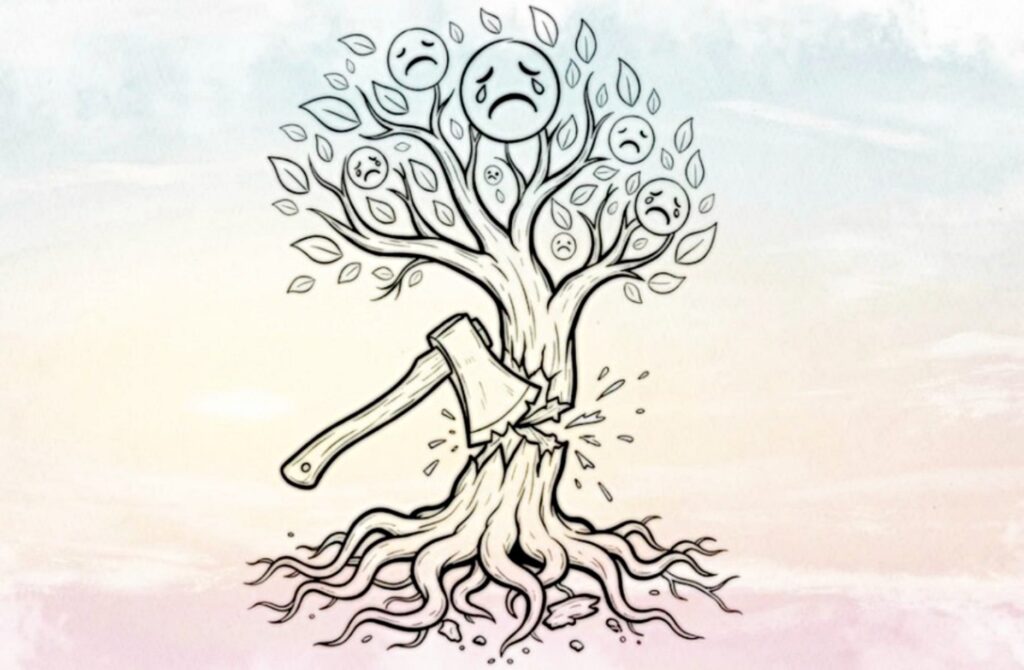
“Asked to give up the true self in order to realize the patriarchal ideal, boys learn self-betrayal early and are rewarded for these acts of soul murder.”
While “soul murder” may sound dramatic, it’s worth taking a moment to reflect on what we value in men as a patriarchal society.
Think about the phrase “man-up” for a second. A phrase I heard from a very young age, normally when all the situation called for was a really good cry and a hug.
It sets a tone and expectation of what it means to be a man, framing it in a way that suggests that ignoring your emotions is somehow superior.
You are then bombarded through popular culture with archetypes and role models that promote violence, demonstrate consistent misogynistic behaviors, and continually reinforce the message that the path to success is based on being emotionally isolated and “strong.”
Once the brainwashing is complete during your highly impressionable teen years, you then enter the work force which only validates that “manning-up” is indeed the right path.
Just look around at our leaders in business or politics today to see what I mean. While it may be hard to empathize with them, most do remind us of little boys who had to get rid of their own souls and hence never really grew up.
But all hope is not lost. I will try to explain the profound and scary experience of bringing my own soul fully back to life, and the impact on my mental health. This will hopefully help drive a conversation about what a poor job we do to support that process with the mental health tools available to us.
My first period of deep personal growth came in my late twenties when I realized I was creative. It sounds simple, but unless you played the guitar (one of the few creative outlets that didn’t fly in the face of the 90s definition of masculinity), creativity was not something that was talked about. “He’s creative” always had a derogatory undertone and was mainly used, at the time, to explain why it was okay to be friends with another man with long hair or who played the piano.
More specifically, my first experience of mania was born out of realizing that creativity was not some separate skill or function that only certain people were born with or could access (during socially acceptable “creative” activities for men like being in a band), but that it was a core tenet of my intellect that could be incorporated into all sorts of endeavors. The most rewarding thing at the time was bringing creativity into my straight-laced, process-oriented work.
At the time I was working as an engineer, which I had assumed always required linear and logical thinking. Supplementing that approach with imagination and creativity allowed me to bring more vision and passion to my work. This opened up more customer-facing roles and fundamentally changed my career path, allowing me to excel in areas such as sales and entrepreneurship.
The results were phenomenal, leading to a highly addictive, open-minded flow state (what the DSM would probably call hypomania). Unfortunately, when you experience that state for the first time, it’s hard to let go of it. This can lead to all the well-known adverse aspects of this state: grandiose thinking, risk-taking, racing thoughts, and eventually insomnia and then psychosis.
My second period of deep personal growth was all about not just getting in touch with my emotional self (something I’d never really had an issue with) but accepting and integrating my emotional self and the depth of feeling that brought.
The former was something that got you the label of a “sensitive” boy (not a good thing), and the latter was something society trained you as a man to push deep down inside of you rather than embrace.
If you’ve ever wondered what repressed emotion feels like on the way back up, it’s the same rushing feeling that taking MDMA or Ecstasy brings on. If you’ve ever tried it, you’ll know that intense euphoric rush that starts in the pit of your stomach and exits with such force through your mouth that you need to take a deep breath right afterward to counter it (or so I’ve heard). Although a lot more crying was involved than would be acceptable at a rave.
Again, the DSM would write this off as a symptom of mania, aka euphoria. While that’s not technically incorrect, it is just that—a symptom. What’s never talked about is the cause. No one ever validates that, yes, integrating 40 years of repressed emotions could 100% feel euphoric, and for good reason—it’s awesome.
Just like my first manic experience, this second period of explosive personal growth brought on an addictive flow state that, while triggered by an emotional versus creative awakening, followed a very similar pattern and eventually led to psychosis—which is definitely not so awesome.
Reality shattered around me and it took two weeks of medication and hospitalization to bring me back. Not to mention the trauma and poor medication management after going “insane” that took two extremely hard years to navigate and get back fully to myself.
So what does this all mean in terms of my mental health journey and where I go from here?
Interestingly, bell hooks touches on mental health in this way in her book, and it’s the one thing I think she gets wrong. Or at least doesn’t go far enough with.
She suggests that the journey to fully integrate the soul leads to a mourning for what could have been. A mourning that leads to depression.
While I don’t disagree with that in itself, I don’t think it’s the full story. I think anyone who does the profoundly hard work to break down the compartmentalized elements of their soul and integrate them back together needs a form of guidance that is mostly lacking in our communities today.
We are too quick to diagnose and then truncate growth with medication, ending the journey before it’s really begun. Rather than reward the level of self-awareness and acceptance that can lead to a sense of mourning for what was lost or missed in life, we label people as having depression. “Good news, it’s not the world that’s messed up; it’s you. Now take this pill so you don’t feel so sad about it.”
Once diagnosed with “bipolar” after my second period of explosive growth, I was now labeled as someone who had not only gone “insane” but who had a brain that was wired in such a way that I had to live with the risk of going insane again at any moment.
Coming to terms with that, compounded with the trauma of my psychosis, of course led to me feeling down. Rather than address those concerns, my med manager wanted to prescribe more drugs to now treat depression. It was as if my soul was sparking back to life and the whole DSM-based system was geared toward stamping out any glimmer of hope or possibility for a fully integrated future.
Thankfully, I’ve always surrounded myself with powerful, non-patriarchal loved ones, friends, and role models, so that when the walls of my soul came crashing down, it led to a celebration (albeit a manic one) of what was to come versus a mourning of what I’d missed.
While I continue to work closely with my therapist and psychiatrist, including a comprehensive emergency plan for if the early signs of mania pop up again, I am hopeful that for me and others, DSM-driven diagnoses like “bipolar” can be seen as more transient states, as part of a greater journey of the soul, and that we can seek to understand and treat the causes versus the symptoms.












Love the title.
I agree that patriarchy, sexism and misogyny are rampant in the US and the world and it is a kind of blight that causes all sorts of pain, for women and men.
I joke that men, particularly dominant Caucasian men, should be outlawed.
I’ve suffered so much and it will never end until death and there is nothing I can do about it so I am permanently pissed off, frantic, etc. Its not okay. It’ll never be okay.
So I have King Herod Old Testament fantasies, and no male makes out intact alive. Oh the pleasure of fantasy retribution. Smile!
In the real world, there are many Ghislaine Maxwells and a few people of color I see working against good, my own and the whole. But mostly men.
blah blah blah
Report comment
What a nasty diatribe against men! The “patriarchy” is ( and) always was a very small minority and while women have often been oppressed and marginalized, a huge majority of men have also been exploited. There are many examples of sensitive, caring men in our society. It is misleading and detrimental to push the blame onto men in general for societal ills. We should be aware that there are certain ideologies that have caused our downfall, not just the agenda of one sex!
Report comment
thank you! we should all speak our minds! didn’t like the joke eh? I didn’t like your use of diatribe! i always do! ( hitler psychological oven hell rape by the patriarch and supporters forever for all! trinity health livonia jesus my rapist. learn. leave. no place for oakland community college sexist gaslight bogus mental health care witchhunt views not even here not news.
Thoughtful people, realize could be patriarchy killer troll from Kiwi Farms. Who harass me for sure.
So many truly dangerous men.
Everywhere.
Report comment
You may find value in these:
https://totalmentalhealth.info/cured-of-schizophrenia/
https://totalmentalhealth.info/freed-from-drug-addiction/
https://totalmentalhealth.info/cured-of-bipolar-disorder/
Report comment
I relate to your journey, and as a mosaic designer who has had numerous engineer clients, I will say I love engineers because they are, not just technically minded, but also very creative. And I do agree, we have a patriarchy problem in this world.
God bless in your healing journey.
Report comment
guy a god my brain rapist
Trinity Health Livonia
William MacQueen, Terry McCauley, Eric Abbey, Owen Keaton, about 50 cops in total most male, Dr Andrew Muzychka, plus a few other swinging ball sacks allowed to poke me, male docs and female underlings so Catholic
patriarchy kill me already
Oakland Community College sexist gaslight bogus mental health care wtichhunt since 2013
hack hack
since 2013
theory a few hacks
but they all smell like old dirty unwashed scrotums
Kiwi Farms
proud dangerous misogynists (ever covered here?)
way too many seriously dangerous white men on my back
Terry McCauley, David Crown, Michael Jarabek
triptych of diry white men community college cops
my story is distinct
but Im an old ugly alone woman so go ahead and shit on me
this is Christian Nationalist Trump the rapist USA afterall
Sheriff Troy Cunningham, Deputy Brett Dobbins
blocking equal protection with patriarchal
we can annihilate you smiles
this is patriarchal america where things are truly dangerous for women who don’t follow fox tv beauty standards
glad you stepped in dog shit the last time you harassed me Dobbins
calling me a known 48
cop crap for crazy
while protecting one my political attackers
retaliation
Dan Kildee
so many bogus retaliatory so called welfare checks like 25
i should be shot dead soon
more lives than black men
realize the color aspect of this “Discussion”
love title
essay meh
but thanks
it helps to bleed in public as I am tortured slowly to death in a Hitler psych oven
so I wont need to take it from the man and his Ghislaine Maxwells any longer
(hello? cultural context Jeffrey Epstein reference)
no one is forgiven
Report comment
Of course, Gina! Inherent and remedial constructs with hyperbaric fundamental bias, consumed with apropos and contiguous influence. In other words, DON’T!
Report comment
Psychiatry’s success comes from promoting “medications” that cut people off from their feelings rather than developing a healthy relationship with them.
I think mania/psychosis are the result of unprocessed emotions: when feelings have nowhere to safely land, they end up consuming the feeler.
Report comment
Patriarchy is a power line energy circuit. Matriarchy is a circle of life energy circuit. Think chimpanzees vs. bonobos.
Report comment
I once told a psychiatrist that men’s minds are like squares & women’s minds are like circles. I still think that’s true.
Report comment
No, men’s are parallelograms, & women’s are spirals!, lol….
Report comment
I like that! Men are more like parallels than squares for sure.
I’ve always loved seeing spiral shapes: soft-serve icream cones, spiral staircases and spiral-shaped seashells… and I’ve also learned how energy workers frame healing as a spiral-shaped journey upward thorugh the chakra system to realign the body’s energy system, that spirals in general are ancient symbols representing growth, evolution, expansion, and connection between inner and outer worlds.
And DNA is famously shaped as a double helix!
Report comment
Psychotic states and other signs of “bipolar” do not indicate a discreet biological malfunction/disease of the brain; they indicate extreme reactions to psychological stress or emotional trauma that need time, space and privacy to play out safely around people knowledgeable enough to know that the true trajectory of such states is intermittent, not permanent; therefore the use of powerful psychiatric drugs such as anti-psychotics, anti-depressants need not be indicated as first-line or long-term treatment. Or ever used at “treatment” at all.
Report comment
Partiarchy sees grief as weakness.
Grief is behind most so-called “mental illness”.
Report comment