At age 42, I sought help for inattentiveness and difficulty focusing during long lectures. I was a 15-year Air Force Reservist, finding myself in a classroom with days of long lectures after deciding to cross-train during my most recent enlistment. I was performing well, physically fit, and meeting expectations, but returning to school at 42 just hits differently. I needed help concentrating so I could prevent potential future struggles and I asked my doctor for an ADHD evaluation, especially after learning that medication was now an allowed treatment in the military.
Instead of being evaluated for ADHD, they refused due to a lack of documented failure or childhood diagnosis, and my symptoms were reframed as mood-related, and I was steered toward antidepressants.

Being honest during the general psychological evaluation process, I admitted to having social anxiety and negative self-talk, but I believe this was taken highly out of context. I was in the prime of my life, doing great in fulfilling and leading in my military duties. Nonetheless, I was told and convinced by the doctor that the real culprit for my inattentiveness was major depression and generalized anxiety and that I needed to try antidepressants. I happily agreed, having been sold on the idea that medication was a cure for these ailments. I blindly trusted the process.
The first antidepressant medication I was prescribed was an SSRI that caused serious adverse reactions and had to be stopped immediately. It now remains permanently in my medical record as an allergen. Ironically, genetic testing had suggested this medication as a good fit. For the first time, my schooling suffered due to the panic attacks I started having mid-exam because of this medication. Let me be clear: I did not know what a panic attack was until I tried this SSRI.
Due to this reaction that involved massive bruising, high anxiety, intense suicidal thoughts, and panic attacks, I was immediately switched over to an SNRI and assured it would help. This one seemed to help at first, but over time it took a huge toll on my life. Over time, my health began to decline on the medication in ways that were difficult to explain. In retrospect, I am convinced that I had a mild form of serotonin syndrome; I developed constant tremors, overwhelming fatigue, and an inability to stay awake. I would fall asleep uncontrollably, even in situations where it put my military standing at risk. I was repeatedly marked AWOL for oversleeping during drills, and then I began getting in trouble for taking shortcuts. I became a completely non-dependable SNCO (Senior Non-Commissioned Officer) and I felt there was nothing I could do to keep from sinking.
Why did I not just stop taking the SNRI early on? Well, it took a while to pinpoint the issue and identify it as the source of my decline. As previously stated, I did well on the medication for months, other than noticeable weight gain. The medication is also incredibly difficult to come off due to withdrawal symptoms, and safe tapering is done very, very slowly. My situation also involved a significant thyroid imbalance that took months to remedy before being able to move on to further investigation.
Despite treating the thyroid issues, where some symptoms improved, others persisted and worsened. My medical team believed so fiercely in this SNRI medication, apparently, that they opted to pursue extensive testing as a means to single out other issues. I was evaluated for sleep disorders and Lyme disease, and I had brain scans done after sleeping for days without waking up. Once those tests proved nothing, my provider wanted to stack meds to see if that would offset my symptoms. I was prescribed an AM and PM dosage of stimulant medication that unfortunately did not help me stay awake enough to be fully functional. Finally, only the SNRI was left as the lone culprit for all my remaining pain and sorrow.
Throughout this time, I was bringing my concerns to my supervisor and the medical unit each month, reporting new things that I was being tested for. Therefore, I was portrayed as someone “inventing new excuses.” I was very vocal about my ailments and started inquiring about a “safe way” out of the military because I did not know what was wrong with me. I was underperforming, unreliable, sick, and I knew that if I were to get better, there was no way I could do it on the military’s expected timeline, especially with the severe and rapid weight gain that likely resulted from the SNRI and thyroid problems. I was told I did not have a medical diagnosis to elicit a referral to the Medical Evaluation Board, so I tried requesting to be transferred to the Inactive Ready Reserve (IRR), which would have enabled me some time off, but I was denied. I was also denied a Fit-for-Duty (FFD) referral, even after specifically asking the psychological director at my base for one because he told me that he would investigate my case and get back to me. He never did, and then ghosted me.
I improved a little in some ways after my thyroid hormones were balanced, but continued to decline in other ways and kept getting in trouble at work, both Reserve and civilian jobs, mostly for oversleeping, shortcutting, or falling short on important deadlines. My cognition was slowed to the point where I was accused once of being drunk by my boss, but I do not drink so he dropped the issue. It took me hours to complete simple emails. I fell behind and could not keep up due to my debilitating fatigue, slowed cognition, and memory issues. I know the people I worked with full-time cared about my personal struggles, but there were rules to uphold and a business to run, so I quickly became their problem. Fortunately, before I began suffering serious consequences for my civilian job performance, I was offered a buy-out with the new government restructuring. This occurred at a critical time, allowing me to step away before further consequences. What a blessing to come at this time for me!
My Reserve job, however, was a different story. I was brand new to the unit at this time, transferring in just as my symptoms were erupting. As previously mentioned, the SNRI did not cause noticeable issues for the first several months of taking it. I did start feeling a little ill in my last month at school, but by the time I got to my new unit I was in full-blown symptom hell. I was told that I was not eligible for a Line of Duty (LOD) because I did not report being ill until after I in-processed to my new unit. I proved this wrong, but nothing ever came of it. Being allotted an LOD would have been critical to my situation as it would confirm that my medical injury was service-connected and enable me to receive benefits during my healing process, such as medical coverage, validation for a VA claim, and possibly incapacitation pay. Instead, my claim for medical harm went ignored.
The people at my new unit had not yet taken the opportunity to get to know me. They did not know me because they did not greet me until after month three of my in-processing, and that was only because I made a formal request for IRR due to my increasing health issues. They did not seem to want to know me or my background, or consider my previous impeccable military history or previous accomplishments, which would have allowed perspective on the severity of my current situation. I know it sounds bananas, but this exists in today’s military culture, at least in this unit. Still, with everything they did know about my situation as I explained it, I was still expected to perform to standard when I simply could not. I received zero empathy from my supervisor, to say the least.
I was failing in every aspect of my life. My husband and children were still in front of me, but I felt absent from my own life, unable to show up as a wife or a mother.
Under physician care, I began an extremely gradual taper of the SNRI, reducing my dose in very small increments. Little by little, I started gaining my cognition and energy back. However, even with the tiniest reductions, I became emotionally unstable, unlike I had ever been. I was locked into therapy and used all the mental health resources I could. I tried to be optimistic about the future, and I genuinely tried to improve even though I was not on par with my work performance. I still fell short of many promises, something that impacted me more deeply than anyone as I used to pride myself on being a woman of her word. I felt very small with that part of my long-standing identity gone.
An important mission was coming up, and I knew that I would be a risk. I didn’t want to be, but I was told there was no way out of it. I talked to everyone I could about my issues, trying to be reassigned to home station, but I was told no. I was feeling better with each month that approached, but I just was not there yet. I consulted my psychiatrist about a standard taper, as opposed to the slow, hyperbolic taper I had been practicing, and I began tapering accordingly. Yes, I was emotionally unstable, crying a lot and being ultra-sensitive to personal interactions, and I was still having sleeping issues despite still taking the wakeful drugs, but for the first time in forever, I had some of my energy back. I went to the mission location, and I sincerely tried to perform my duties, but after about a week of energy burnout in a deployed environment with my persisting condition, and just days after my full complete taper, the last ever dosage of the SNRI medication, I cracked…
I had an antidepressant withdrawal-induced psychotic break during this important mission, the icing on the cake for leaving me severely misunderstood and hated by seemingly everyone. People at my unit ghosted me after this display of erratic behavior. I was alienated, and I can’t say that I don’t understand, but wouldn’t this be confirmation that maybe I was the unsafe risk that I had proclaimed myself to be? I tried to apologize and was extremely respectful during counseling sessions with my command where I was reminded time and time again of all the ways I was failing. During this meeting, my request to somehow, some way exit the military for medical or other possible reasons was denied due to not having evidence of my proclaimed crisis. This, along with disciplinary paperwork, told me that nobody believed me.
I was clearly in a crisis, as I said that I was in our meeting, yet it concluded with me actually being expected to just truck along as if nothing had happened. At the end of the day, all accountability for my behavior and my actions fell on me. It became too much. I was too misunderstood, and I tried to kill myself.
My husband disarmed me and took me to a VA hospital. I got through probably the worst of my antidepressant withdrawals there. To this day, I find the other veterans in the ward to have been the most comforting and inspiring part of my healing journey. With their help, I found meaning and grounding through faith. The hospital care team mostly seemed to care about trying to get me on new medications or combinations of medications. I settled for transcranial magnetic stimulation (TMS) therapy, which is a nonpharmaceutical option, but it only caused severe anxiety, pain, and migraine headaches for the full eight-week trial. I absolutely reject the serotonin deficiency hypothesis at this point in my life. I tried behavioral therapy, but I will say that two out of three therapists I tried were really pushy on the topic of medication, even though they do not even prescribe medication. I continue to talk with the one who does not push for medication, and to no surprise, she also has a history of similar medical trauma.
The SNRI altered my cognition and emotional baseline in ways I’m still working to recover from. I wasn’t someone who felt chronically depressed. I loved life. I had a strong track record of resilience. I wish more providers took an integrated approach to medicine, especially for women. Not every struggle requires antidepressants. Some emotions are healthy. Some nervousness is human.
I ultimately made the decision to take the medication, but that decision was made based upon the information, guidance, and reassurance that I was given at the time. When my experience did not match what I had been told to expect, it was minimized and dismissed. I experienced medical gaslighting at its finest and this is where the real harm began.
As far as the Air Force was concerned, everything that followed—the psychosis, antidepressant withdrawal symptoms, and subsequent unraveling of my life—was mine to carry. Any time I tried to explain the influence I was under, it was treated as an excuse, as if I were making it up, as if it were some ploy to avoid accountability.
In the end, all blame was placed on me. Not the doctors. Not the system. Not Big Pharma. Just me.
Know the risks of this gaslighting and blame shifting. Because, if your body does not react the way it is “supposed” to, if you don’t fit into the box, you will carry the blame burden. I’ve seen now why veterans reach the breaking point. This breakdown between patient experience and institutional response is why veterans commit suicide, and why I nearly ended my life.
Five months after the psychotic break and subsequent hospitalization marks the point where I finally stopped contemplating ways to kill myself (if you know, you know) and started smiling a genuine smile again. I spent this time focusing on lifestyle changes that supported my recovery, including diet, exercise, and reducing environmental stressors. After help from two of my former commanders, I was able to get a Fit-for-Duty initiated by constructing a letter attached with my medical documents. I remain on no-pay, no-point status until I will hopefully be medically discharged. And to think, much of this might have been avoided with earlier intervention. I would be requesting to return to duty today, but instead, my career is likely over.












Interesting perspective on misdiagnosis. What do you think could be done to improve awareness around these issues?
Report comment
I always object to the term “misdiagnosis,” because it implies there is a way to determine what is a “correct” or “incorrect” diagnosis, and there factually is no such means in existence. In that sense, ALL psychiatric diagnoses are “misdiagnoses,” because they are implying some understanding of the condition or circumstances that doesn’t exist. It is similar to the idea that “knee pain” is a diagnosis. Knee pain is not, it is simply an observation, a condition that needs to be understood. “Torn meniscus” or “rheumatoid arthritis” are diagnoses. “Knee pain” is not. Until psychiatry actually can explain why in a particular case a person is experiencing a particular condition, and distinguish between the diverse and often complex reasons for any psychiatric label, their “diagnoses” will remain nonsensical scientifically.
Report comment
Indeed. I mean what kind of stupid industries believe medicalizing the human experience is a good idea?
Report comment
That is where concerns about one-size-fits-all approaches come into play, especially when medication can quickly become the default response without enough individualized evaluation or discussion of risks. Honestly, before going through this myself, I probably would not have connected those dots either.
Report comment
I understand your perspective and wholeheartedly agree with you. I think your analogy about knee pain is a very good one for explaining how psychiatric labels describe clusters of symptoms and behaviors rather than clearly identified biological disease processes with objective testing. In alignment with what you were saying, that is essentially what I was trying to communicate, although perhaps imperfectly, by using the term “misdiagnosis.”
My concern is not simply whether the label itself was technically correct or incorrect, but how complex human experiences are sometimes interpreted with a level of certainty that exceeds our actual scientific understanding.
Report comment
Well, that is certainly a point where we agree!
Report comment
Thank you for your question. I think improving awareness depends on enough people being willing to share their experiences and on others being willing to truly listen to them. Right now, many patients feel dismissed when their experiences do not fit the expected narrative.
I also believe medicine needs a more individualized approach. In my case, some degree of anxiety actually functioned as a motivator and helped me stay disciplined and productive, so a standardized assessment may not have accurately reflected what was healthy or functional for me personally.
My hope is that as more people speak openly about their experiences, it will encourage more thoughtful conversations, greater transparency, and eventually changes in how patients are evaluated, monitored, and treated.
Report comment
Thank you so much for sharing your story! You are a courageous, beautiful person and I’m sure that we all honor you for your service! I’ve seen your story time and again, as a Peer Support Specialist and AA member; these drugs are poison.
Report comment
Thank you so much for your kind words and for the work you do supporting others! It means a great deal to hear from someone who has witnessed others going through similar struggles. It is comforting and validating, especially after experiencing so much pushback and feeling dismissed whenever I try to speak openly about my experience.
Report comment
“And to think, much of this might have been avoided with earlier intervention. I would be requesting to return to duty today, but instead, my career is likely over.”
indeed
The key word here is “decline”
…which is
DIRECTLY occasioned by drugging: neurotoxicity, de-regulation, re-regulation, rebound, loss of functioning…until life is lost. With a bit of bad luck the whole of it.
It is funny it is only now, decades after all is over, I finally see direct connection between my ambition and focus while I was an A medical student ….and complete lack of motivation, no ambition, junk self-confidence status a decade later. What happened in between? THEY said “a debilitating “mental illness” took hold of your life.” No other point of reference, I accepted back then. Too late only now I know THEY LIED:
ALL WAS DIRECTLY occasioned by drugging: neurotoxicity, de-regulation, re-regulation, rebound, loss of functioning…until life is lost. With a bit of bad luck the whole of it. No “mental illness” ever necessary for full and exhausting explanation of what REALLY happened. Drugging explains all.
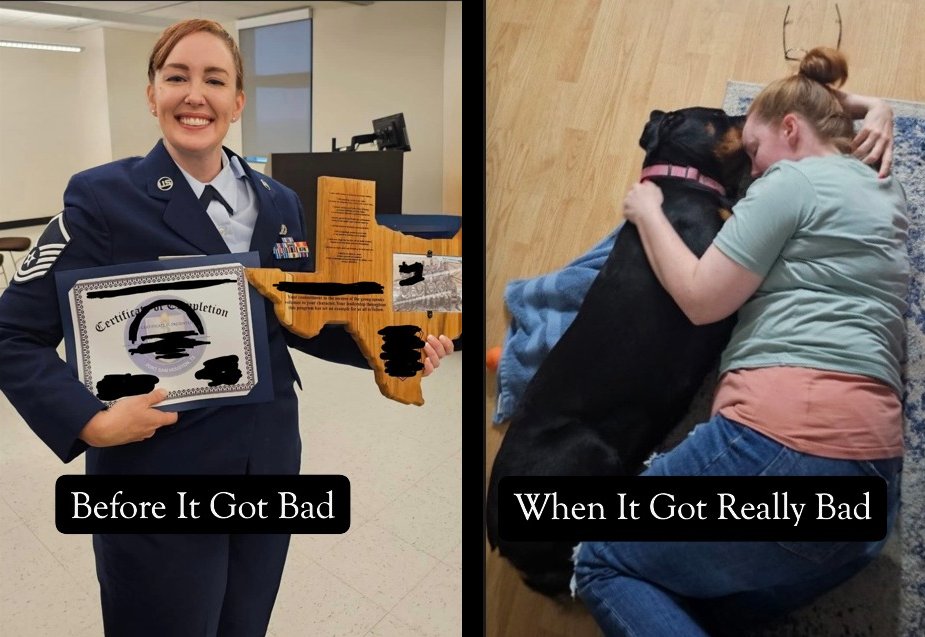
The two pictures for illustration say it all. They are perfect! Thank you for the story. …and SORRY, very sorry for what happened to you. Indeed, you are definitely not alone in that…unfortunately this is literally mass manufactured.
Report comment
Thank you for sharing this. I can hear the depth of grief, anger, and loss behind your words, especially around the feeling that your identity, motivation, and future were profoundly altered over time. I am truly sorry for the suffering you endured.
Thank you as well for your kindness regarding my story. One reason I shared it was because I know many people feel isolated in these experiences, and conversations like this remind people they are not alone.
Report comment