I want to tell you a true story about how a man in his seventies could suddenly get diagnosed with a psychiatric disorder he never had before, prescribed more and more drugs that didn’t work, and end up facing electroconvulsive therapy (ECT).
John (not his real name) is a patient I worked with. His story is, unfortunately, an all too common representation of what so many people go through when they seek help for mental health symptoms in our current medical system. It’s a window into the dark roads that psychiatric medication can lead healthy people down.
John’s life was on track to end in tragedy if he hadn’t had the inclination to do his own research and find answers himself. After a lifetime working as a lawyer, John might have lost it all if he hadn’t found his way out.
Imagine you’ve spent your entire life as a healthy person, seven decades in fact, and suddenly being recommended ECT by the psychiatry department of a prestigious university.
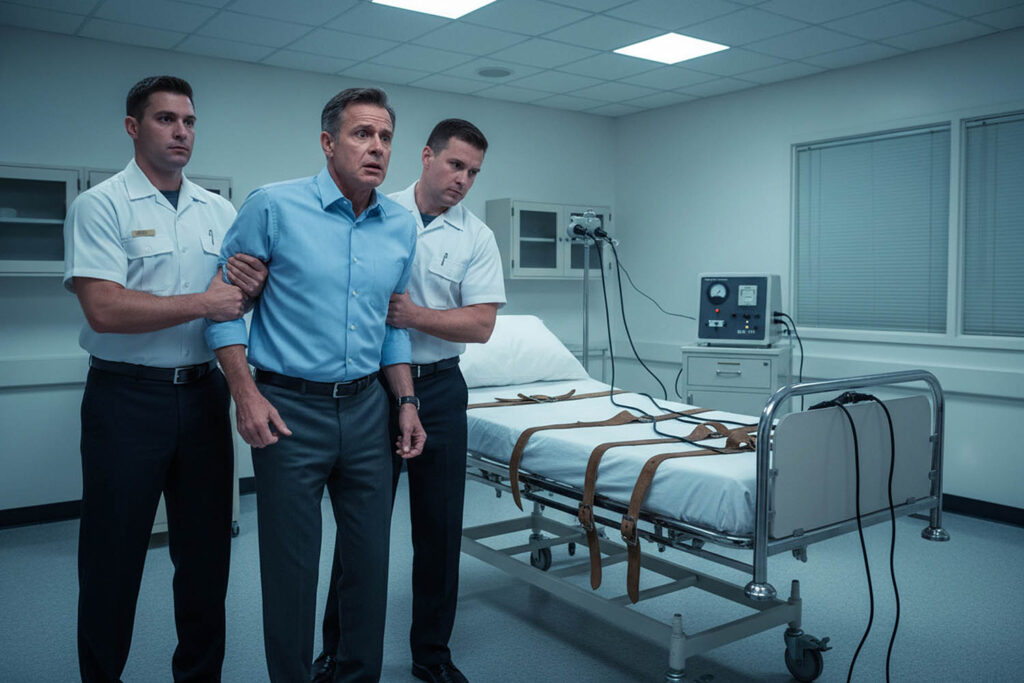
ECT is one of the most extreme psychiatric medical treatments I witnessed as a mandatory part of my psychiatry residency rotations. I dreaded this part of training with every fiber of my being. No part of me wanted to see a person’s head connected to electricity. It is traumatizing to witness. I could not fathom being the one lying on the gurney.
Yet this was the recommendation given to John, prior to our meeting. I’m sharing his story to highlight just how far down the rabbit hole of disrupting a person’s brain psychiatry can drive someone.
I met John in 2024 when he was 72 years old and in the throes of severe, life-disrupting symptoms caused by psychiatric medication withdrawal. He was significantly distressed, bewildered and struggling with intense brain fog, burning skin, numb hands, dizziness, memory issues, poor balance, insomnia and severe anxiety.
It all started three years earlier.
In 2021, several years into retirement, he took a trip to Colorado. He was on a ski trip high in the mountains at 10,000 feet and suddenly started experiencing panic, air hunger, racing heart, increased breathing rate. These were classic symptoms of altitude sickness. He was taken to the ER. In the ER, he was given an Ativan injection and a few tablets to take home to get him through.
He came back home and still felt anxious, restless, and unable to sleep. Just as he was told to do in the ER, John followed up with his primary care physician.
Now, get this. His doctor prescribed Zoloft for what he was calling “anxiety.” This was a bad idea. Zoloft is not an appropriate treatment for lingering symptoms of altitude sickness. Within days, John felt agitated, dizzy, and waves of panic – common side effects of Zoloft.
So he went back to the doctor and told him about his adverse reaction. His doctor’s solution was to try another SSRI.
What the …. are you thinking?!? Use your frontal cortex! This is not an indication to use an SSRI. This is bad medical advice.
John was switched to Paxil. Not surprisingly, things got worse.
Next, he was prescribed Klonopin despite his protests that he didn’t want to become dependent on a benzodiazepine. His doctor assured him that he didn’t have “an addictive personality” and would be able to discontinue it without a problem.
He listened to his doctor. He took the medication.
Six months later, when his waves of panic and anxiety calmed, he stopped taking Klonopin over a few weeks. This should not happen. You should not reduce Klonopin this rapidly. Such a rapid reduction triggered withdrawal symptoms including convulsions, tremors, excruciating pain, chronic dizziness and confusion.
At this point, the doctor proceeded to treat these symptoms as though they were a sign of mental illness. He prescribed everything, including Gabapentin, Remeron, steroids, muscle relaxants, early generation antidepressants, a beta blocker, and reinstated Klonopin.
John tried each medication from his doctor earnestly, following medical advice.
It didn’t end. He was still in a mess.
The doctor was confused and missing the big picture. So he referred John to numerous specialists, including psychiatrists, physiatrists, and multiple neurologists (including a national tertiary care center). He underwent CT scans, MRIs, electromyography (EMG) and neuropsychological testing.
The altitude sickness that caused the anxiety was long gone. But the adverse medication reactions and benzo withdrawal symptoms remained. In fact, new symptoms were added: burning skin, muscle pain, electric sensations, light sensitivity, morning surges of akathisia and panic that sent him pacing the floor for hours.
And treating them as signs of mental illness was sending John farther into the depths of suffering and despair.
After exhausting all the treatment options he was offered, he thought, “Hey, I want to go to one of the top-tier institutions in the country to get help.”
And he did. He went to one of the top 10 psychiatric departments in the country. At this point, he was fully indoctrinated into the psychiatric merry-go-round. Bewildered, dysregulated, confused, looking for answers. More abrupt medication changes. More chaos. Imagine trying to find your way out of this confusing maze all while your brain chemistry has been so disrupted you can barely think straight.
The top-tier university psychiatric department interpreted his symptoms as “treatment-resistant depression” and adjusted doses, adding new drugs, layering interventions. They too missed the big picture. And only made things worse.
When his symptoms grew severe and they were frustrated by his lack of progress, they presented his options:
He could either agree to ECT or they would have him committed to an inpatient psychiatric unit.
What the actual fuck?!?
ECT?!?!?
How in the hell could you be recommending something so extreme for a problem that the medical system has caused?
Where is the sanity in that?
How about negligence?
If I were him, I would have run screaming from that place. But I know he was desperate. He was hurting and just trying to get well. He didn’t have a choice.
Until he started to do some research about his symptoms. He could see that all these treatments were not solving it for him. He needed relief. That’s what eventually brought him to me.
When we met, he was frightened and slow to trust. Of course!!
He had been led down the path to more suffering by multiple doctors … why would he trust what I was saying?
It’s amazing what a carefully taken history will reveal. In our first meeting we talked through the entire course of events and it was clear where all the problems started and why.
I see this all the time: the history-taking and critical thinking aspect of psychiatric care being omitted egregiously. Rushed hospital admissions. Clinic intake appointments only allotted 45 minutes. Drive-by prescribing by the general practitioner. The story, the facts of the events, gets lost in the murky waters of rushed human communication.
And it doesn’t help that we have still not equipped prescribers with the knowledge of how to identify adverse reactions and withdrawal symptoms of psychiatric medication.
I agreed with him. The medications were the problem and the slow path to brain healing required time, patience, and the opposite approach to what the bigwig university folks were proselytizing.
My “radical” advice was to stop switching medications and slowly taper the medication he was on at a pace he could tolerate.
It was hard to convince him of just how slow a safe taper would have to go. And the principles of what brain healing looks like when it’s been disrupted by psychotropic chemicals.
But slowly, week-by-week and month-by-month, he got it.
We slowed everything down. We used a compounded formulation to allow reductions small enough that his brain could adapt without worsening symptoms. We supported his sleep, nutrition, and his daily life. We listened to his system rather than override it.
It took much longer than most clinicians would consider “necessary”. But as the months passed, he began to stabilize and dose reduced. His mornings grew less torturous. The surges of adrenaline softened. His wife noticed he was more like himself.
A year into the taper, he started driving again, something that had once filled him with dread. Months later he and his wife visited their daughter several hours away. Then they ventured further to another state to visit friends. They enjoyed their time. “He drove the whole way,” his wife said proudly, “even through Chicago traffic.”
The man who, at age 72, had once been told he needed ECT was now living his life, his retirement, his relationships. Resuming all the hopes and plans that may have been washed away if he had not had the inclination to ask questions and find answers.
John recently finished his 2-year taper and last month sent me this message:
“[My wife] and I are in [the city] having a reunion with all 3 kids. I feel great! 👍”
Can’t ask for a better message than that.











Kind of shocking that somewhere along the line no one mentioned a lobotomy!!!!!!
Report comment
My answer to your question is neither.
I believe that shock therapy is a crime in an age when we do not let people use the plants and fungi that grow at their very feet. Why should we be forced to potentially damage our brain by a government that denies us our access to Mother Nature? I would rather suffer while protesting the drug prohibition that outlaws my right to heal than to undergo ECT.
My tapering to get off Venlafaxine failed miserably after a year, when my depression suddenly returned far worse than ever. But my answer is not shock therapy. I have decided to live the remainder of my life “on Venlafaxine” just so that I can think straight, that’s just how thoroughly my brain chemistry seems to have been changed by this drug. I think it shows how low the healthcare field has sunk thanks to drug prohibition that their go-to fix for people in my situation is damaging the brain. The FDA won’t approve of drugs that grow at our feet, yet they champion shock therapy. This is absolutely bizarre, and it can only be drug-propaganda that keeps people from seeing it as such.
I think that healthcare officials have a moral duty to speak up against the drug prohibition that has turned depressed people like myself into a patient for life, without yet “curing” my depression — as if depression should be cured in the first place, but rather just symptomatically treated. My idea of a “cure” for depression would not be the same as what a Big Pharma chemist considers to be a cure, in any case.
The government lied and told us that “drugs” fry the brain. How ironic that it is drug prohibition itself that actually forces us to fry brains. Like so many other social evils in America, ECT only makes sense to those who reckon without drug prohibition and how it has outlawed our right to heal.
Report comment
This story is so tragic and such an example of “If it’s not working, do more, try harder.”
I’m glad that John found you and you were able to help him. Thank goodness for psychiatrists like you–they are very few and far between….a rare breed. Many of the same things happened to my mother in the 60s and to me in the 90s. She never recovered, but I did.
Report comment
“the history-taking and critical thinking aspect of psychiatric care” has most definitely been “omitted egregiously.”
“And it doesn’t help that we have still not equipped prescribers with the knowledge of how to identify adverse reactions and withdrawal symptoms of psychiatric medication.”
Why should any industries, who don’t know anything about the common adverse and withdrawal effects of the drugs they unethically force and coerce onto innocent others, even claim to be “professionals”?
As an ethical sales professional, who knew everything about the pros and cons of what I sold (not forced) onto others, I’ll say there’s nothing “professional” about today’s psych industries.
But for those “mental health professionals,” who now claim to be ignorant of the harms of your drugs … I will say Whitaker is correct, the antidepressants and ADHD drugs can create your bipolar symptoms (psychosis, hallucinations, et al), via anticholinergic toxidrome. And the antipsychotics (aka neuroleptics) can create the negative symptoms of schizophrenia, via neuroleptic induced deficit syndrome as well.
In other words, all your beloved “treatments,” mental health “professionals,” are iatrogenic illness creators. And shame on the people who continue to force these neurotoxins on people, who now claim ignorance of what you’re doing. Please stop proclaiming to be ignorant of the intentional harm you are doing, psych workers.
Report comment
As you have noted, the history was omitted. Each provider latched onto side effects as a new psychiatric illness. I imagine that, despite being wary of yet another psychiatric opinion, you won’t his trust by taking a good history.
Report comment
Sounds familiar. I was going through the end stages of a bad marriage at age 37. Naturally I was anxious, depressed, irritable, and had a hallucination or two under my belt. Which is not uncommon, btw. I was diagnosed with “chronic schizophrenia” and started on a long tragic journey through 26 psychotropic medications (including clozapine), hospitalizations, and ECT. The ECT resulted in total disability. I was working at a demanding job for years before my “diagnosis and treatment.” With no problems. After ECT (19 sessions) I could no longer remember the names of people I had worked with the last 12 years. I didn’t know where my mother lived anymore (I was raised there). I often couldn’t find the front door in my own house. I had been an accountant and now couldn’t even decide what a plus or minus sign looked like on a calculator. This continued for years. I divorced, lost my new house, lost my employment, lost my independence and had to live with my parents for 12 years, beginning in my 40’s. Because I was not able to look after myself. The worst thing I ever did: going to a psychiatrist and following their plan. I’m in my late 60’s now, still damaged.
Report comment
Dr G,
Looks like, you too, “missed the big picture”
Studies have shown that altitude decreases Folate, (a decrease of roughly 0.33ng/mL for every 500-m increase in elevation).
So that is obviously going to impact people who have MTHFR mutations since they impair folate metabolism and reduce the body’s ability to recycle homocysteine into methionine, an essential process for blood vessel health and oxygen delivery. Elevated homocysteine levels are linked with poor endothelial (blood vessel lining) function and reduced nitric oxide availability, both of which can decrease oxygen efficiency and circulation. At high altitude—where oxygen is already scarce—these effects can compound the stress on the cardiovascular and nervous systems.
Then your patient was given meds that also alter Folate distribution making things worse.
Report comment
The drug damage issue is multifaceted, but the two main aspects are medical and legal. We have seen the false medical model, but state laws commonly deny your rights, and the end product is loss of your life and gain by medically associated people and businesses. It is common for a court to replace your agency with the will of two licensed physicians. Their motives are not questioned..not ever. An MD can easily cause severe illness and then hide the evidence via commitment. Yes there are state mandated proceedings and these are being ignored. The defendant is drug-disabled and unable to claim the right to defense. Efforts to expose this are disabled when survivors are too frightened to testify. I find no effort to correct the situation. My own FOIA requests are mostly ignored.
Report comment