For more than fifty years, I lived with an eating disorder. Depression and anxiety were frequent traveling companions, so intertwined with the eating disorder that it was often difficult to know where one ended and another began. Together, they formed an ever-present force that kept me functioning, although “functioning” sometimes deserved quotation marks.
What kept me from surrendering to those formidable forces was a strong spiritual connection that had buoyed me since early childhood. I relied heavily on it. It held me in place when I might otherwise have fallen apart, but I didn’t yet know how to engage with it in a way that could consistently lift me beyond simply surviving.
Medication helped, too.
I took antidepressants for more than thirty years, and I want to be clear about their importance. They kept depression from overwhelming me and allowed me to function. At the same time, I felt that they flattened more than the pain. Some of the brighter parts of me seemed to get flattened along with it.
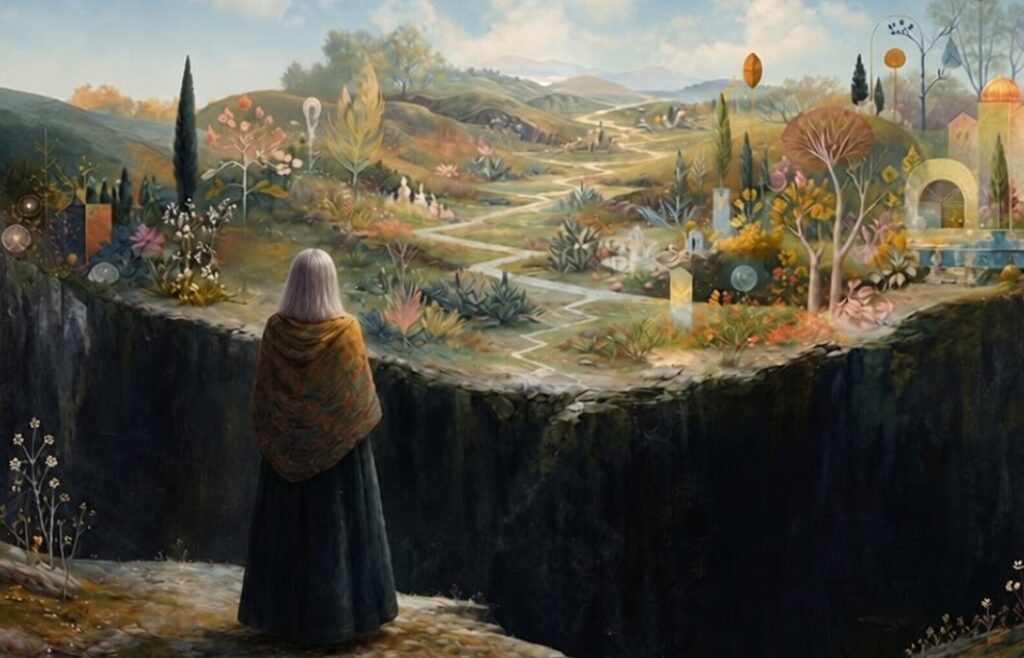
For years, I thought of my depression as an abyss.
I could feel myself approaching it—sometimes slowly, sometimes with alarming speed. Without medication, eventually I would fall in. It was dark down there, and climbing back out could take weeks. I still don’t know exactly how I managed that climb so many times. Each time, I wondered if this would be the time I couldn’t find my way back.
Antidepressants changed the geography. I could approach the abyss and stand at its edge, but usually I didn’t fall in. I might hover there for a few days, looking over the edge, until I could slowly find my way back.
That was an enormous improvement. But I was still organizing my life around the abyss.
Sometimes I thought of depression and anxiety as boogiemen who lived inside me and could leap out without warning, frightening me and occasionally everyone in the vicinity. At least medication gave me a sense of control over symptoms that had previously seemed to have their own agenda.
Over the years, I tried repeatedly to stop taking antidepressants. Each attempt ended much the same way: I became physically ill, more depressed than before, and increasingly engaged with the eating disorder as a way to dull the pain. Eventually, I stopped expecting anything resembling a cure. Managing my illnesses seemed like the best I could hope for.
Then, in the early 1990s, I began learning about the possibility of recovery from mental illness.
I devoured whatever material I could find and slowly began to believe that recovery might be possible for me, too—or at least that I could become much better than I was. Recovery principles and practices joined with my spiritual life, and together they helped me significantly.
Around the same time, I began what would become an eleven-year stint in 12-step groups. They provided another lifeline toward hope while strengthening both my spiritual connection and my aspirations for recovery. My life got better. Considerably better.
And I thought: This is probably good enough. Don’t get greedy.
Then, about six years ago, I began learning about psilocybin.
Now, I know that in the parlance of research, I am an n of 1, and that there are risks with psilocybin. What follows is an account of how, over time, it proved transformative for me. As a well-trained therapist with decades of experience, I’ll be the first to tell you that what works for one person may not work for anyone else. So as you read the next few paragraphs, hold them in the light of me simply sharing my experience with you; I am not recommending this as a magical cure for others to try.
My Journey
Knowing the risks, I approached the mushroom cautiously and eventually had several guided experiences. Nothing changed overnight. There was no thunderbolt, no choir of angels and, unfortunately, no booming voice explaining the meaning of life. I would have appreciated the clarification.
But something did begin to change.
At first, the changes were so subtle that I could recognize them only in retrospect. Psilocybin seemed less interested in helping me avoid the abyss than in showing me that there was an entire landscape beyond it.
Parts of myself that had seemed dormant began waking up. I felt more creative. I made connections between ideas and experiences that I had never noticed belonged together. I could focus better. I became more curious. The energy I had spent trying not to fall into the abyss could be directed toward more interesting and creative things.
I became excited about things. I wanted to learn again. The world seemed to contain possibilities I had somehow stopped noticing.
And I felt more love.
Since the beginning of my fifty-year career in mental health, I have known that love was the key to most things. If I could love the people I served with—not sentimentally, but with genuine compassion and connection—we would both get better. But I wasn’t always able to access or sustain that feeling. Depression and anxiety interfered, and antidepressants sometimes seemed to blunt the very feelings I most wanted access to.
With the mind-opening experiences I had with carefully administered psilocybin, that kind of love became easier to experience and put into action. Love for other people, for nature, for life itself and, eventually, for myself.
That last one took a while.
I remember stepping off airplanes and feeling an unexpected tenderness toward all the people milling around, trying to find their way. Instead of seeing them simply as the people blocking the aisle, standing motionless in inconvenient places, or eating smelly sandwiches, I felt connected to them. They were all trying to get somewhere. So was I.
For someone who had spent much of her life at war with herself, feeling that same tenderness toward myself was no small thing.
There was also a deepening and strengthening of my spiritual connection. I became more comfortable with the mystery that bathes spiritual experience. It became easier to enter an open, receptive state and deepen the connection that had sustained me since childhood. I experienced myself less as the small, worried self I had spent so many years trying to manage and more as part of something much larger and more meaningful.
People may wonder what to call such an experience. Was it neurological? Psychological? Spiritual? Some combination of all three?
I don’t know. And, to my considerable surprise, I don’t particularly need to.
The explanation matters less to me than what followed from it: more love, more gratitude, more compassion, more curiosity, and considerably less interest in fighting with myself.
Eventually, I found the courage to try once again to come off antidepressants. Given my previous experiences, I expected the worst. I knew this movie, and historically I had not enjoyed the ending.
But this time was different.
I was able to stop taking them with relatively little discomfort. I have now been off antidepressants for about five years, with only occasional, brief periods of depression or anxiety.
But perhaps the greatest surprise has been the eating disorder.
It is gone.
Even now, that sentence feels remarkable to write.
After more than fifty years of food, weight, rules, calculations, and judgments occupying an absurd amount of mental real estate, there is finally quiet. I don’t think I fully understood how noisy it had been until the noise stopped.
Apparently, my brain had other things it wanted to do with the space.
I don’t offer any of this as proof of what psilocybin can do, and certainly not as an argument that everyone should use it. As I said earlier, this is one person’s experience. These substances carry risks, and people’s experiences with them can be profoundly different.
But my experience changed me enough that I wanted to understand it. That curiosity eventually led me to become a guide and to think deeply about how psychedelic experiences can be approached with care, wisdom, gentleness, and respect for set and setting.
Perhaps that is also why the commercialization of psychedelics troubles me.
What mattered most to me was never simply a substance. It was everything surrounding the experience: preparation, trust, vulnerability, mystery, connection, and the work of bringing what I discovered back into ordinary life.
Because eventually, no matter how profound the experience, you still have to come home, answer the phone, take out the garbage, and figure out what’s for dinner.
For most of my life, I thought my problems were separate things that somehow kept colliding: depression, anxiety, an eating disorder, and a spiritual longing that helped me endure all three.
Looking back, I see them as much more connected.
Depression and anxiety narrowed my world. The eating disorder, while painful and aggravating, provided a distraction by making me think I could control something if I tried hard enough (this didn’t really work). Spirituality kept reminding me, even when I could barely hear it, that there was something beyond the small world I was trapped inside.
Psilocybin did not create that spiritual connection, nor do I think it simply “cured” three illnesses. What it seemed to do was help me experience something I had understood only imperfectly before: that I could have a much more meaningful and fulfilling life, and I didn’t have to spend it fighting with the strong forces of the underworld.
As that fight diminished, so did the need for some of the things I had used to survive it. Depression and anxiety loosened their grip. The eating disorder, astonishingly, became unnecessary.
And the spiritual connection that had once helped me endure my life became a way of more fully inhabiting it.
It turns out there was a lot more beyond the abyss than I had imagined.









Beautiful article. Congratulations on your progress.
The word “abyss” caught my attention initially. I have a chapter in my book about the Hero’s Journey. My journey had to do with stress breakdown and ego collapse, but the Hero’s Journey is wonderfully flexible for many other types of journeys.
As a statistician, I also got a kick out of the “n a 1” — that is a sample size of 1. I firmly believe that each treatment / approach should be looked at in terms of the percentage of people who find it helpful, the percentage that find it benign, and the percentage that find it harmful. As you mentioned, “I’ll be the first to tell you that what works for one person may not work for anyone else.” In statistics, that is related to combinatorics — that is, finding a good match from a variety of options. There are no “silver bullets” and yet people still seem to seek them.
I have never tried psychedelics, but they do seem to deal with consciousness. Much of the research I have done ties back to the 1960s, 70s and 80s when there was quite an effort to understand different states of consciousness. Stanislav Grof researched possible beneficial uses of LSD to reach the deep layers of the psyche before LSD was banned, even for research.
Thankfully, there is a growing body of interest in psychedelics and consciousness research again.
You mentioned the possible dangers, which is certainly worth considering. Yet in my opinion, that consideration is warranted for all approaches, especially approaches involving chemical substances.
So glad you found something that worked for you.
Report comment
Encouraging story Lori. One question I have, however- as someone who ‘was’ interested in giving the mushroom a go to address the fallout of a ‘re-traumatization’ several years ago, is did it provide you with any insights as to the nature of your abyss, from which translate back to ordinary consciousness, and its relationship between your inner world and your lifeworld experiences (relationships, childhood formations, beliefs, events, et al)?
Report comment