The long-awaited ODDESSI trial – the first randomized controlled trial of Open Dialogue – has at last been published in The Lancet Psychiatry. While this is exciting in and of itself to those of us who have championed Open Dialogue for decades, some have expressed concern that the primary outcome — no significant difference in relapse rate between Open Dialogue (OD) and Treatment-as-Usual (TAU), what is called a null result — will be helpful to those wishing to dismiss Open Dialogue.
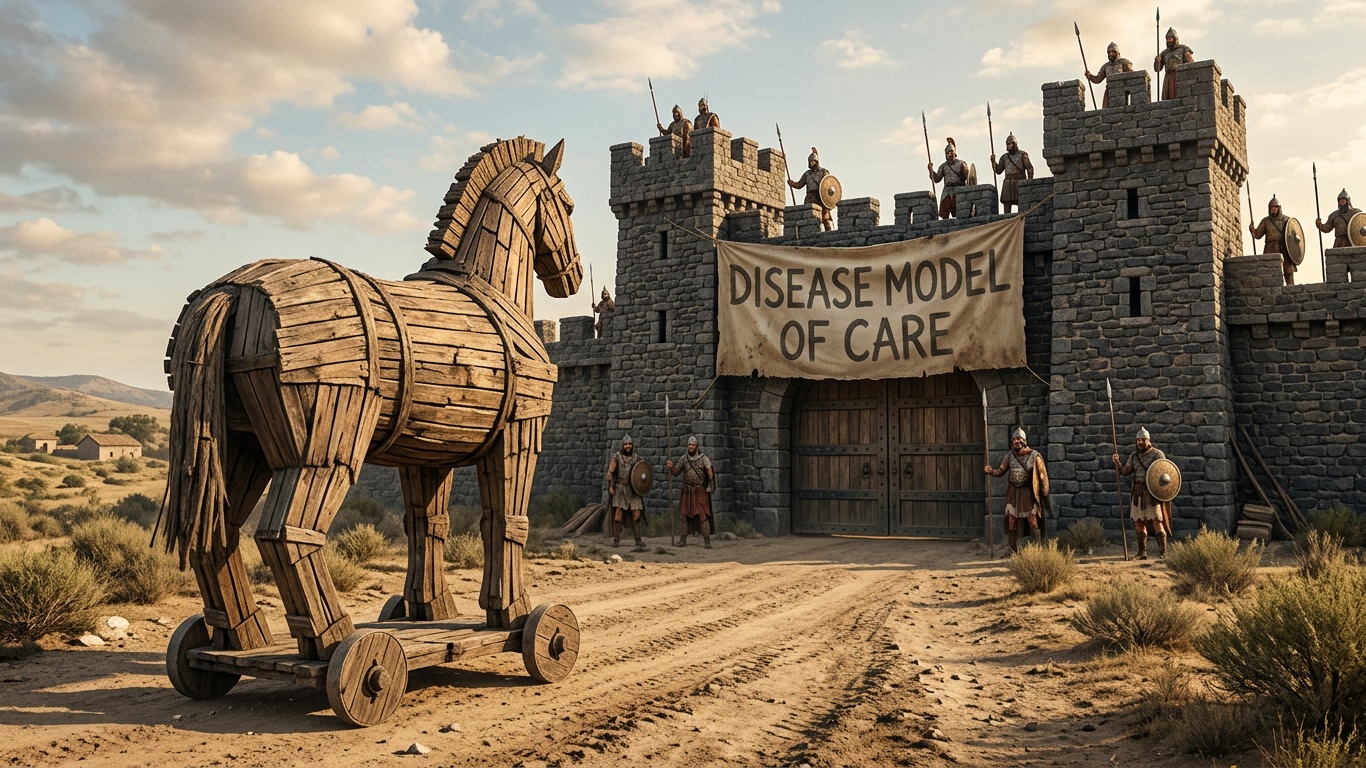
A look below the surface, however, tells — appropriately, for anyone who has followed the twists and turns of the other summer blockbuster, Homer’s Odyssey, on the page, stage, and screen — a more complicated story: ODDESSI is the story of a siege, ending with a Trojan horse, and a long journey home.
It is not cynical to say that study results can support a range of conclusions. This has always been true. In fact, it is the essence of science. Studies suggest their conclusions with the best story they can tell from the evidence they have found — a story that makes sense in the world it seeks to understand and, perhaps, change. This is why there is a bias toward publishing positive results; null results seem lackluster and uninteresting, while a positive result seems to say something new, with numbers about which we can feel certain, and stories they tell about which we can be excited.
The effort to adopt Open Dialogue practices is rooted, from a research perspective, in the reports from Tornio, Finland that told of dramatically improved outcomes for psychotic patients treated with Open Dialogue. The results of these studies called into question the paradigms of psychiatric illness and treatment upon which western medicine is based. According to the mainstream paradigm the reported numbers could not be true, and so they were dismissed as invalid in their study design (e.g; they were naturalistic rather than randomized, drew on the wrong research population, etc.) as well as in their analysis.
This, in fact, is the essence of Open Dialogue as well. In a crisis of understanding, we invite all perspectives, with open minds about what the problem might be, in the hope of gathering all the relevant information and finding a way forward together.
Such is the case with the null result from the ODDESSI trial. Life is not reducible to mere numbers, much as our desire for a clear and certain path forward might like it to be. Life is the story we live, not the numbers that aid in describing it.
This is also the essence of Open Dialogue. ODDESSI’s primary finding can be seen as a Trojan horse: a finding that is interesting precisely BECAUSE it appears to have the same relapse rate as treatment-as-usual. As Tomi Bergström, a clinical psychologist from Open Dialogue’s birthplace of Tornio, and author of the nineteen-year outcomes study that first showed that Open Dialogue’s effects could hold over decades, put it simply when the results came out: this study isn’t the end of a story; it’s a beginning.
However the secondary findings tell a deeper story: less than half as many people in the study were hospitalized with Open Dialogue as under treatment as usual. Reported comfort and satisfaction with the Open Dialogue process ran high: Staff retention held at 80%, against 100% attrition on the treatment-as-usual teams. Whatever other conclusions one might reach from the ODDESSI data, it unmistakably shows that there’s an alternative to treatment as usual that people on both sides of the equation want to be part of.
For me that story begins with realizing that it’s impossible to evaluate the study from within one paradigm: The parity in “relapse” rates between Open Dialogue and Treatment-As-Usual tells an entirely different story depending on whether you regard the criteria used to make a diagnosis as symptoms of an underlying medical disorder – a hypothesized but never confirmed position – or as behaviors or experiences from which there may be something else to learn. “Symptoms” that invite a full range of dialogue about their potential meaning may induce people to reach for support when they need it. The potential benefits for individuals as well as society are broad and deep: from dramatic cost savings to accumulated wisdom. The dramatic reduction in hospitalization is especially important in light of the high rate of suicide [pooled estimates put this at more than 20x the general-population rate, highest in the first month, elevated for a year or more — Harvard Review of Psychiatry meta-analysis, Forte et al.; a 2025 Lancet study addressed involuntary discharge specifically] in the period following a psychiatric hospitalization.
In evaluating the results it’s important to note that although the trial is nominally about Open Dialogue, what was tested specifically was Peer-Supported Open Dialogue (POD). The POD model incorporates Open Dialogue’s principles with peer-supported values and practices, along with mindfulness-inspired awareness. These additions help to cultivate awareness and acceptance, within the system, of the struggles and needs of everyone in it — not only of the person at the center of concern.
Early in my own learning about Open Dialogue, I felt that for it to thrive outside the community whose response to crisis Open Dialogue had transformed — in communities where there were people who harbored distrust if not anger at clinicians, and who did not feel represented in or by a system that purported to serve them — it would need to link arms with peer networks.
Criticism of ODDESSI has noted that network meetings were not the predominant mode of interactions in the study. It is important to note, however, that in the fidelity criteria for the elements and principles of Open Dialogue as proposed by Olson, Seikkula & Ziedonis, it was not network meetings themselves that were listed but a social network orientation: a focus not on finding problems within any one individual, but in the matrices of and between individuals. The same is true of the finding that social network size and density did not significantly change: fidelity was never about how large or dense the network became, but about whether the team and the person in crisis came to hold their situation as belonging to that network — a shift in orientation, not a metric a headcount could capture.
There’s a finding buried in Zindel Segal’s research on cognitive therapy that’s more striking than it first sounds. Cognitive therapy was built on the premise that you get well — your mood improves — by changing the content of distorted thoughts. But when researchers looked inside the actual mechanism — the black box of how that change happens — the mood didn’t begin to improve when the thought changed. It began earlier than that. It was when the person began to recognize that a thought was just a thought — not destiny, not a verdict, not a command. The change began with their relationship to thinking itself, before the thought’s content had changed at all. The cure showed up as a byproduct of that change in awareness.
The Western Lapland team found the same thing, decades earlier, from an entirely different direction — not in a person’s relationship to a single thought, but in a team’s relationship to an entire crisis.
This orientation had arisen quite naturally in Tornio as the clinicians – faced with an overwhelming and overwhelmed psychiatric crisis and treatment system – found that when they took their attention off of finding a problem to diagnose and treat in an individual, and even eventually off of diagnosing and treating social systems, but simply put their attention on fostering the conditions for safe dialogue, crisis situations that might have previously met criteria for psychosis, and then progressed to eventually meet criteria for schizophrenia, instead resolved. The five-year outcome studies found – inexplicably, to the conventional paradigm – that 82% of patients had no residual psychotic symptoms, and 86% had returned to full-time work or study.
This was not the same, however, as not having what might be called, from another perspective, “symptoms.” The difference was in how the symptoms were interpreted; they were not assumed to be in and of themselves a problem. They were only a problem if they in fact interfered with functionality. As Rai Waddingham put it in her own reflection on the study: each “relapse” can be seen as breadcrumbs, leaving a trail I can follow to gain greater awareness of the things that I find difficult in this world and the things that have contributed to my overwhelm.
In my quarter-century of studying, credentialing in, and practicing with the inspiration of Open Dialogue, one of my most important observations is that when people know a conversation is happening of which they are naturally a part, they want to participate. If that is true, then the question becomes — if they are not participating — what is getting in the way. When I have worked with families that are disconcerted by a member’s unwillingness or seeming inability to participate in a dialogue, the focus then turns toward how we can continue to invite – and make it safe – for all members of the family. Eventually, if we were able to do this well enough and long enough, even the most unwilling or antagonistic member would join.
Another of my significant discoveries was what I called the “crisis horizon.” That is, when we came to the time in the meeting when we would agree on when we needed to meet next – meaning; for how long can each member of the network tolerate the unease they felt about the situation as they perceived it — the conversation would turn to a practical examination of the specific fears at play. While sometimes these were very valid safety concerns, which could be addressed from a practical safety rather than psychiatric perspective, what often happened was a subtle shift into realizing that the concern wearing the crisis’s clothes was not the one actually driving it.
In one case, a family was in crisis over a member’s belief that aliens were coming. When we examined the family’s actual fear, what surfaced was this: they weren’t afraid of aliens. They were afraid he wasn’t going to have an IRA. Once named, that fear reorganized itself — real, and worth addressing, but not something we medicate or hospitalize for. The situation was no longer held as a crisis. He went on to turn his belief in the coming aliens into a thriving online business serving a worldwide population who shared his concerns, and the business skills he discovered along the way eventually carried him into other, more terrestrial ventures, from which he still profits.
Perhaps most of all — especially given the justified concern that nobody should be forced into a meeting with anyone they do not want to meet with — I learned that a social network perspective does not in fact require meeting with anyone. It only means an awareness that what we call mental health refers to how meaningfully, how safely, and how adaptively we experience ourselves within our significant social network. Open Dialogue does not prescribe what that network is; it only offers help in and for whatever that network is for any given individual or group of individuals.
I have worked with individuals in which we set up a chair or even circle of chairs to represent that network. We might place an iPhone on a chair – with a person at the other end of that call, or just imagined to be, or a photo of a person, or a teddy bear. I have had people refuse even the suggestion of an empty chair in the room — refuse the idea of it before any chair existed at all. That refusal became the thing to talk about, and what surfaced was not resistance to a piece of furniture but a refusal to accept someone else’s judgment of them. Once that was clear, the work stopped being about what was right or wrong — diagnosable — with the person in front of us, and became about the relationship itself. Whether an actual chair ever made it into the room after that, I honestly don’t remember. The idea of one was enough. Filling it was never the goal — and it turned out neither was the chair.
What happened instead was closer to a dialogical facsimile. I’d ask what the absent person might say to something that had just been said, and what might come back to them in return, building out an exchange between two positions with neither one physically or even symbolically present. Something in the room softened as we did this — not because anything had been resolved, but because a dialogue that needed to happen seemed, in some partial way, to have happened. Nothing was forced, then or at any point. The facsimile was enough to let something real move.
My point is that a social network perspective is not predicated on the particular form of meeting but on the orientation; that no person is an island, even if what they feel is a tide rising around them. This is of particular importance in evaluating Open Dialogue not as a fungible treatment technology but as philosophy and practice in transition from its place of origin to a wider world. Here, peer advocates help address a gap that Open Dialogue had spent a quarter-century bridging in Tornio: earning the trust of a community that had reason to be suspicious of the system’s methods and outcomes. Open Dialogue had invested decades toward learning to divest itself of the power that accrues to people in a helping role. Many have noted that almost everyone in Tornio has had direct or indirect contact with the mental health system, and come to have confidence in it. Outside of Tornio, however, where there was no reason to assume that members of a community would feel ready to trust, peer advocates could help to navigate the divide.
Mindfulness practice – the cultivation of self-awareness that, in addition to helping to achieve a level of self-awareness that aids in being fully and safely present in a crisis – could also be thought of as a form of community-wide peer support: a practice for managing the stresses of being human, with a lineage that goes back for millennia. Together, peer support, mindfulness, and dialogue itself form a broader base for holding psychiatric distress than any one of them could offer alone.
In this context, read fully, what initially appears to be a null result opens the door to an entirely different paradigm of care, based on an entirely different understanding of the problem, as well as of the human experience of which the problem is a part. While some may see the study design as a conciliation to mainstream psychiatry – perhaps necessary but a compromise nonetheless – it can also be seen as a door that lets in a cohort of findings that, once established within the walls of the old paradigm, have the power to change it: half as many hospitalizations mean dramatically reduced costs. Turnover on Open Dialogue teams ran 80% lower than on treatment-as-usual teams, meaning — beyond the direct savings on training and hiring — a long-term retention of experience, wisdom, and morale.
Odysseus doesn’t get home by proving anything. He gets home by telling his story to strangers who decide whether to help him — disguised even from his own wife until the story is told right. The Cyclops, the sirens, ten years lost at sea: nobody asks him to prove it happened. The story is simply held, by whoever is listening, not listening for whether the story is true, but listening for the truth of the story. That is a description of what happens in Open Dialogue.
From a treatment-as-usual perspective, no significant difference in time to relapse is the end of the story — a null result. But an Open Dialogue perspective is a different story altogether, closer to what Tomi Bergström said at the release event: this isn’t a question that’s been answered; it’s a story that’s beginning. ODDESSI’s publication in the Lancet is not an endpoint: it’s the beginning of a dialogue between people who are weary of fighting, and looking for a way home.










Even if we had a perfect society / system & mental health treatment – a small percentage of people would still need access to front end services – psychiatry, hospitalization & medication.
Report comment
What you call “medication” (i.e. toxic substances that disrupt normal brain functioning) is totally inappropriate for diverse states of emotional distress that, far from being discrete verifiable physical conditions, are natural responses to a wide range of severe external circumstances.
Forced confinement in coercive institutions euphemistically labeled as “hospitals” is overwhelmingly traumatic, as one can readily see from the numerous accounts featured on the MIA website by psychiatric survivors with first-hand experience.
When you speak of “a small percentage of people” who supposedly need access to mental health services, can you be a little more specific? Given that the DSM is a scientifically invalid compendium of insurance billing codes, what criteria should be used for this purpose? Or do you take wholly subjective psychiatric “diagnoses” at face value? If so, why?
Report comment
It would be like talking a brick wall – so no.
Report comment
We don’t have a perfecf society but the city of Trieste in Italy has only ten psychiaric beds in an unlocked ward in a general hospital. Everyone else goes to the community centres which are open 24 hours a day. Thats not far from no psychiatic hospital.
Report comment
“The story is simply held, by whoever is listening, not listening for whether the story is true, but listening for the truth of the story. That is a description of what happens in Open Dialogue.”
Well said! It is the difference between being examined as a specimen (for defects, faults or illogic that must be categorized and “corrected”) versus being safe and valued as a fellow human whose thoughts and feelings are respected.
Report comment
It really wouldn’t be hard to create an integrated holistic / integral System of Open Dialogue / Depth Psychology / Healing Homes (comprehensive Healing & Recovery Services) as standard with mainstream services.
Integrate a judicious use of front end services / biomedical / clinical psychiatry with open dialogue / depth psychology / healing homes – with comprehensive integrated / integral health / welfare / social care services & systems.
With a shift away from neoliberal Capitalism more towards a Global Socialist / Green Model & Approach & Global Regenerative Culture
Report comment
I agree such a plan is doable. What would be hard is convincing people who are profiting from the status quo to agree to do it!
Report comment
I think we need to create this oursevles as part of creating a new socialist movement.
Report comment
I don’t actually think it is a null result. The same level of “relapse” with reduced hospitalizations and reduced potential harm from heavy medication use is a positive result. The same result with significantly reduced risk is NOT the same result at all!
Report comment
Nice analysis Kermit – but what the hell is an IRA? A problem in understanding what your alphabet soup means.
Report comment
I think it’s: Individual Retirement Account
Report comment
Would also say
‘In one case, a family was in crisis over a member’s belief that aliens were coming. When we examined the family’s actual fear, what surfaced was this: they weren’t afraid of aliens. They were afraid he wasn’t going to have an IRA. Once named, that fear reorganized itself — real, and worth addressing, but not something we medicate or hospitalize for. ‘
This speaks to the sham diagnosis.
If a person is talking to themselves and doing yoga in a yoga class this is not mental illness, do this in a psych “hospital” you will be seen and recorded as ‘responding to auditory hallucinations’ and well on the road to antipsychotics and a sham psychosis label that will ruin your entire life.
I’m not saying anxiety, depression, psychosis, hallucinations etc do not happen exist they do.
I’m saying the context for ‘misdiagnosis’ in a psychiatric setting is very high leading to a harmful life long label and toxic poisoning by force.
Report comment
That’s well known outside of the USA – not!
Report comment
thank you Kermit great article. The staff retention rate in itself is remarkable. When you factor in urban decay,poverty,crime rates,discrimination of every kind,societal volatility local and worldwide during the research duration I believe that the results are miraculous.
Report comment
Lets say we have a Post Capitalist World of Truth, Love & Harmony – Living in Global Abundance for ALL, Balance & Harmony with each other, nature & high technology – with highly comprehensive health, welfare & social care systems in place for all people.
i think it would eradicate a majority of what currently comes under mental illness / mental health conditions, & resolve the majority of all health & social issues. However, i do think that there would remain a 5% or so demographic of people suffering profound psychological / emotional / biological etc disorders.
Severe mental illness in a small percentage of the population has existed for as long as recorded history, & civilization, with no easy answers of how to address it.
This is the demographic that i am interested in – Not the ‘worried well’.
All the findings point to a highly controversial, in depth & complex picture regarding what approaches are best for the treatment of severe mental illnesses.
Psychosocial Interventions, Recovery, and Mediating Mechanisms in Schizophrenia-Spectrum Disorders: A Systematic Review and Meta-Analysis of Longitudinal Studies
https://www.mdpi.com/2076-3425/16/9/993
It’s Not as simple as the current mainstream biomedical / pharma system / model bad (& mental illness doesn’t exist) & comprehensive psychosocial etc alternatives good, it is far more complex than that – a percentage of people are greatly helped by psychiatry & pharma.
Far more research is needed into Schizophrenia-Spectrum Disorders; from all perspectives to try & ascertain what it happening in it all, from all biological / neurological, genetic & scientific, to psychological & emotional, sociological & environmental & what can be considered to be Soul / Spiritual / Transpersonal areas – all areas of experience & influence from all areas of inquiry in the Hard & Soft Sciences.
i would think it very strange if our Biology / Genetics (& Epigenetics) & brain developmental, functional & structural health is Not implicated (in various degrees & ways, & in some more than others) in cases of severe mental illnesses. My argument & wish would there to be an integration of all areas & lines of enquiry & therapeutic treatment; understanding, help & support, instead of all the Dualistic & Binary ideological argument. i think that all areas / people / camps / ideologies should come together as far as possible in helping to address the plight of the severely mentally ill in society & to help address all health & social issues.
Report comment
You assert that a “certain percentage” of people are helped by psychiatry and drugs.
You further claim that biological and genetic factors undoubtedly play a part in the origin of “severe mental illnesses.”
Once more, you have failed to offer concrete cogent evidence for these beliefs.
What is the exact percentage of clients who have benefited from neurotoxins, electroshock, and psychotherapy in comparison to victims emotionally and/or physically harmed by such dubious “treatments” over the past century?
Lastly, can you cite credible proof in support of your hypothesis that malfunctioning neurons, defective genetics, brain pathology, or other biological causes are likely implicated in the widely disparate conditions mentioned in your comment?
Report comment
You can do the research yourself – the evidence is there – Beyond extreme anti-psychiatry / mental illness denial Beliefs.
Report comment
Could it be that biological changes are a result of events and perceptions of those events. In other words a “normal” human response to a difficult situation. Just a thought.
Report comment
It is being scientifically investigated – however there are a myriad of ways that our biology / brains / DNA / CNS can be damaged & effected; & not just through Environment. i suppose it’s a matter of perspective? Within a Holistic – Mind, Body, Soul, Spirit & Environment Paradigm & what people believe about Truth & Reality. Persoanlly i think that things can go wrong with the human Brian / Biology / Psychology & Emotions & that there is genuine spectrums of Sanity & Insanity, some very obvious.
Report comment
Andrew, you’re absolutely right.
To cite one early but still highly relevant example, the condition labeled as “war neurosis” by German psychiatrists during the First World War, and later called “shell shock” and then “post-traumatic stress syndrome,” is not at all a mental illness but actually a natural response of the human brain to the horrors of warfare.
The same holds true for victims of multiple types of trauma, including rape and incessant bullying. Psychiatry simply pathologizes emotional and physical responses to such harrowing experiences in its desire to be accepted as a legitimate branch of medicine with its own “diagnoses,” “treatments,” and “cures,” which in many cases only exacerbate the original condition.
Report comment
Absolutely really ever right?
Report comment
Marc Cheminas, over many years I HAVE done research on the self-serving pernicious fallacies of the mental health field.
If you choose to dismiss the arguments of such insightful scholars as Thomas Szasz, Phil Hickey, Bruce E. Levine, Peter Goetzsche, and Jeffrey Schaler, you’ll have do much better than labeling them as proponents of extreme beliefs.
Ad hominem slurs and unsubstantiated claims are not a meaningful contribution to this issue. If you are able to refute my criticism of the biomedical paradigm, please cite your own sources of information and your reasons for accepting their validity.
Report comment
You must know as well as anyone else that there is evidence for all positions / camps in all this area. The truth is that we don’t fully know – no one does.
i do know that in my own experience i am stable on medication & incrediubly unwell however i come off it – & i have know a lot of others to be in a very similar position.
Report comment
Hi, Mark,
I think you sometimes mistake the sometimes usefulness of drugs for the potential usefulness of the general practice of psychiatry. Most people here acknowledge that some people find the drugs useful for their situation. This doesn’t address the massive pseudoscience and propaganda people are exposed to by the ostensibly “scientific” field of psychiatry. Psychiatry has to be arm twisted into considering clients PARTICIPATING in decisions about their own care. They promote DSM diagnoses as if they are indicators of biological dysfunction rather than subjective labels about phenomena they don’t actually understand. They actively oppose efforts to ensure informed consent, and twist or deny actual scientific data that threaten their control of the narrative or their bottom line. Many “thought leaders” are corrupted by pharmaceutical company funds and provide biased views as fact. Consider how many people believe that low serotonin causes depression, even though there’s no evidence that this is the case. Or how violently the black box warning on antidepressants was opposed, not because it was false, but because it resulted in fewer prescriptions being written.
Opposition to psychiatry has not that much of to do with the drugs. It has to do with how we look at what is called “mental illness” and how we can prioritize the needs of the clients instead of the needs of the “professionals.”
Report comment
Steve McCrea
i’m not convinced by anti / critical / alternative psychiatry arguments. i’m in the UK as well, & it’s a very different society / system to the the USA. i do Not agree with North American Szaszian Neoliberal mental illness Denial.
i agree that psychiatry & the mental health system needs reform, however i do see a 5% or so percentage of people suffering severe mental illnesses & i think it is a profoundly in depth & complex question as to how best to treat, help, & support them all?
i’d like to see more integration of all the different perspectives & areas mental health goes into.
Report comment
So you are NOT concerned about corruption and the denial of scientific facts that conflict with the interests of insiders? And it is NOT a concern to you that psychiatrists lie to their patients to achieve “compliance,” and that “patient-centered care” is a phenomenon that most psychiatrists seem to find threatening? Do you NOT believe that informed consent is important?
It is a complex question how best to treat and support people with emotional/mental/spiritual challenges. But what I’m raising above has nothing to do with that. It has to do with corruption and dishonesty and manipulation of the public in order to achieve maximum profits. How can different perspectives be integrated if one perspective is opposed to any other perspective that undermines their power or income?
There’s nothing “antipsychiatry” about demanding accountability to scientific norms, nor calling out corruption when it exists. Unless you think opposing corruption and lack of accountability IS inherently opposing psychiatry?
Report comment
Steve McCrea – everything is corrupt – we live under Global Neoliberal Capitalism. You can get a very good idea of some of what i think here –
https://healingsanctuary.proboards.com/
i think that things can go wrong, sometimes seriously at biological, & / or Psychological – Environmental & Soul / Spiritual / Transpersonal levels; & should be addressed as such. i believe that mental illness exists & that psychiatry / pharma & the current mental health systems have some good in treating it all.
i would like to see comprehensive holistic alternatives fully integrated into our medical systems. i do however see a place for a reformed psychiatry, that there is a biology to mental illness, & that the psychoses / neuroses / PD’s have always existed & do very much exist. i don’t see the way forward in mental illness denial & trying to Abolish Psychiaitry / Pharma.
This is what i have been personally camapinging for –
Integrate a judicious use of front end services / biomedical / clinical psychiatry with open dialogue / depth psychology / healing homes – with comprehensive integrated / integral health / welfare / social care services & systems.
With a shift away from neoliberal Capitalism more towards a Global Socialist / Green Model & Approach & Global Regenerative Culture
https://healingsanctuary.proboards.com/board/52/project-plan-associated-documents
i Nothing unreasonable in that position & i see No Solutions in the Binary Anti / Critical / Pro / Alternative Psychiatry / Pharma War.
Report comment
So how does any of that happen without addressing the corruption and the power that opposes our green/socialist model (which I absolutely support)?
Report comment
i think that this Planet is in some kind of Occult Alien Matrix Control System (Dark Iron Prison / Matrix) –
There are many people that think similar.
& is inexorably headed into some kind of End Game / Harvest of Souls / Global Reset; into a Global Fascist Totalitarian State – increasing Global Austerity / War / Fascism & Global Catastrophic Ecological / Civilizational Collapse, mass stupidy / psychosis & possible near term human extinction – i think all this will happen drastically between now & 2030 / 2050.
It’s possible that as a species we transition into some glorious future for all of humanity at some stage, but i don’t think it’s guaranteed. i have chatted with thousands of people on & off line about all these areas & i think that there is something seriously wrong with humanity. As a species we may just be an Evolutionary Blip / Aberation. i’m not sure it matters that much if we die off.
How could we transition humanity & this World into some kind of Glorious Post Capitalist Utopia? Living in Truth, Love & Harmony with each other, Nature & High Technology? i laid out the basic framework for it all in the links on my page that i posted above.
i have been continually slandered, verbally attacked & abused for all these ideas & for suggesting comprehnsive alternatives to a primary biomedical psychiatric & neoliberal Capitalism system.
My simple answer is that given basic ‘normal’ human psychology & behaviour / functioning – i think that we’re Fcuked, the probabilty of a transformed World. society / civilization & system, in the face of what needs to be addressed is probably impossible at this stage.
Report comment
The relapse rates for Treatment as usual and Open Dialogue were the same perhaps because the Open Dialogue group were not given the advantage of an immediate response to their distress. In Finland the phone rings twice and the response from the Open Dialogue team is immediate.
In the ODDESSI trial the participants had already been diagnosed by a medical Doctor before they joined the Open Dialogue team.
In other words you had to have had what Doctors call schizophrenia or some such other debilitating mental health diagnosis before receiving any help from the Open Dialogue team.
You might deduce from this that Open Dialogue is a system of care rather than one of cure.
If we care well for someone who is suffering then they will be more content and lead more beneficial lives and not be a burden on society.
Report comment
I suspect you are right. An immediate response to crisis as opposed to dealing with ingrained problems makes them easoer to resolve. The Trieste model shows similar high rates of non hospitalisation and they have community centres that are open 24 hours a day.
Report comment
“If we care well for someone who is suffering then they will be more content and lead more beneficial lives and not be a burden on society.”
It’s a very big IF – IF we can can give proper care, treatment & resources for all health & social issues. i think as a society / species / culture / civilization; we have a very long way to go with it all.
Report comment
Marc Cheminas, I was struck by a comment in which you conflate anti-psychiatry with “Szaszian neoliberalism.”
I strongly oppose psychiatric myth-making, fraud, and incompetence. I also totally reject the tenets of neoliberalism, which is essentially a rationale for exploitative corporatism. The mainstream mental health system is the venal handmaiden of this corrupt political and economic order.
So what leads you to conclude that opposition to psychiatry necessarily implies support for neoliberalism? Both dogmas are fallacious and abhorrent to me.
Report comment
Do Jeff Bezos and Donald Trump practice “Open Dialogue”? Does the U.S. Governance practice “Open Dialogue”? Can the monetization of thinking convey “Open Dialogue” across the unconsicous to concious discovery of what the human experience can BE and Become?
Report comment
No. Seemingly not. Open dialogue is good politics. Being humble and honest. Giving something of oneself. Laying bare some basic human feelings. Dropping the hierarchy. Being present in the moment.
Report comment
Marc Cheminas, it’s your belief that things can go seriously wrong on various layers of reality, e.g. biological, psychological, spiritual, and transpersonal(?).
Out of curiosity, let me ask you what criteria guide you in deciding how, when, and whether a situation may be going awry and why a certain percentage (which you fail to specify) of individuals whose disturbed mental state necessitates their hospitalization and treatment.
Who exactly is qualified to make these judgments? Would you feel confident in leaving the decision to so-called mental health experts, and if so, which ones? Surely you know that there’s widespread disagreement among them regarding the most efficacious therapy. Lastly, who will bear responsibility if a client suffers irremediable harm resulting from forced confinement and exposure to neurotoxins and electroshock?
Report comment
You need to carefully read back over all that i have written.
i have already answered your questions.
Report comment
Marc Cheminas, you haven’t addressed my questions at all.
So let me repeat: If a number of people, in your view, are in urgent need of confinement in mental hospitals and forced treatment, who is to be entrusted with making that decision? The powers that be, who are protective of their class interests and full of scorn for sundry “losers” and “deviants”? (In this context, it’s worth noting that the Trump administration seeks to institutionalize the homeless).
The historical record of psychiatry clearly shows that it tends to side with those in positions of authority, whether in so-called free market or totalitarian societies. Little reason, therefore, to trust psychiatrists to be objective in deciding which individuals require the coercive measures you deem necessary for the “certain percentage” of the population afflicted with subjectively defined mental disorders.
And if those subjected to psychiatric coercion suffer irremediable harm to their physical health and emotional well-being, who will be held accountable?
I fail to find any serious consideration of these fundamental issues in the vague scenario you have put forward in your posts.
Report comment
Szasz a supporter of neoliberal capitalism
Thomas Szasz’s relationship with neoliberal capitalism is complex and multifaceted. While he was a critic of the moral and scientific foundations of psychiatry, Szasz’s views on mental health and psychiatry have been influenced by his experiences with the U.S. military and his political beliefs. His advocacy for ‘contractual psychiatry’ and his opposition to involuntary psychiatric treatment suggest a perspective that aligns with the neoliberal ethos of individualism and market capitalism. Szasz’s work has been influential in shaping the discourse on mental health and psychiatry, particularly in the United States, where he has been a significant figure in the anti-psychiatry movement.
Thomas Szasz and the antipsychiatry of neoliberalism
https://libcom.org/article/thomas-szasz-and-antipsychiatry-neoliberalism
Report comment
Thomas Szasz does NOT represent the views of all critics of psychiatric mendacity and oppression.
Bruce E. Levine, for example, is a staunch opponent of neoliberal capitalism as well as mainstream mental health practices (or should I say, malpractice?).
Could you please explain what possible logical connection there could be between opposition to involuntary psychiatric treatment and support for neoliberal ideology?
As I mentioned in my previous post, I reject both fallacious and harmful belief systems and see no contradiction in my position.
Report comment
I have read the link you provided in regard to Thomas Szasz’s critique of psychiatric coercion.
In the comments section below that article, Frank Blankenship aptly retorted to the author (in point no. 6) that neoliberalism, far from opposing psychiatry, is actually one of its greatest promoters.
Whatever Szasz’s personal views on economic and social issues may have been, the key arguments he set forth in “The Myth of Mental Illness,” “The Manufacture of Madness,” and “Psychiatry: the Science of Lies” remain as relevant as ever.
Report comment
Joel – it’s a case of respectfully agreeing to disagree – you are at one end of extreme anti psychiaty / Abolishonist / mental illness denial & i am cautiously pro psyciatry / reformist. We are never going to agree on anything, & this argument is very much refelected in wider society.
Report comment
Joel – i was forced sectioned 5 times in the UK & spent around a year in total in high secure units, & at various times i was a danger to myself & others. i have been medicated for 36 years off & on & diagnosed with paranoid schizophrenia. i tried all available alternative recovery & healing approaches with very mixed results.
i can see all sides to the anti / critical / pro / alternative psychiatry / pharma debate. For 20 years i was very anti psychiatry myself, but i changed my mind on it all.
i think that we need a judicious use of front end psychiatric mental health services; however, i would integrate it all with comprehensive recovery / healing approaches. i think that everyone needs to come to a compromise within all these areas.
i hope that answers your questions, & yes i would rather be treated by a competent & trained health professional.
Report comment
Well, Marc, you’re entitled to your views, but considering the dismal history of psychiatry over many decades, the evidence is abundantly clear that its practices have caused incalculable physical and emotional harm to countless numbers of people who accepted the myth of mental illness.
Report comment
i don’t agree that mental illness is a Myth, i don’t agree with Szasz – i think that he has done a lot of damage to the plight of the severely mentally ill. i don’t agree that all psychiatry & pharma has done is harm. The study of mental health / illness is as old as humanity, & has gone through many forms & iterations. Mental illnesses have always existed, & always will exist.
Report comment
Yes, the diverse mental states you pejoratively label as severe illnesses have always existed, but have been perceived differently in particular cultures throughout the world. The examples of ecstatic religious mysticism, homosexuality and so-called prolonged grief disorder immediately come to mind.
You continue to make sweeping assertions about the reality of psychopathology, but unless you substantiate them with meaningful concrete evidence to refute my argument I see no reason to take them seriously.
By the way, you mistakenly believe that I favor the abolition of psychiatry. I do deny its medical and scientific validity, but since the notion of mental pathology is a misleading metaphor and wholly subjective sociocultural construct, this notion cannot be abolished formally through legislation or decrees. Intellectual fallacies can be eliminated only through careful study and exposure of their false premises and harmful consequences. That’s precisely what happened to the discredited hypotheses of phrenology and Lombrosian criminology. Thanks to the pioneering efforts of Thomas Szasz, Bruce E. Levine, Phil Hickey, and other courageous critics, the same fate will no doubt befall the mendacious, corrupt pseudo-science of psychiatry.
Report comment
Joel – As far as i see it all – the contentions / debates / arguments revolve around the nature / definitions of what comes under mental health / illness & best ways of treatment / addressing these conditions / experiences.
One way to resolve all the argument is to create genuinely comprehensive integral / holistic understandings & approaches to all health & social issues & a healthy eco-socialist / Solar Punk Global Civilization.
i don’t think that any specific camp / argument / side / Binary is going to win the argument here. Everyone needs to come to a compromise, look at all the evidence of the nature of mental health difficulties & best treatment approaches, & create a genuinely comprehensive & effective systems of care & support & a balanced & fair society; for ALL Life & people.
Report comment
I don’t think the answer is compromise, it’s commitment to the TRUTH, even if it’s inconvenient. There’s no way to compromise between the Truth and something that’s just plain wrong.
Report comment
Facts are that things can go wrong with our biology / brains / genetics / psychology / functioning. The mian psychiatric Nosology fit the main diagnostic psychiatric classifications. That is the Truth of it all.
Report comment
There is absolutely no biological/genetic cause or even correlation for any DSM disorder that is more than trivial. The psychiatric classifications are entirely socially constructed based on our perceptions of what is and is not acceptable behavior in society. There is no more biological underpinning to any so-called psychiatric “disorder” in the DSM than there is for having a sense of humor or disliking vanilla ice cream. Which is to say, we all have differing biologies but they do NOT map onto DSM “disorder” in any meaningful way. ALL the DSM “disorders” are identified by a subjective list of thoughts/behaviors/emotions that could be caused by almost anything. The DSM itself admits this in its introduction, stating that people with the same “disorder” are not assumed to “be alike in all important ways.” That’s an obscure way of saying that people diagnosed with the same “disorder” may have nothing in common with each other at all. This is the DSM’s own description of its “disorders.” There is not even the assumption that all people with the “disorder” have the same problem, let alone the same cause.
Yes, things can go wrong with our biology. But until it is understood exactly WHAT is wrong and we’re able to identify WHO has this problem, assuming everyone with “schizophrenia” is the same is foolish. Heck, you can have two people “diagnosed” with schizophrenia who have NO symptoms in common with each other! How can both cases be caused by the same thing?
Using drugs to alter brain chemistry can be perceived as helpful to many people, but the idea that this means they “have” a certain “diagnosis” does not follow. It means they find the drugs helpful. This is not a new phenomenon. People have used substances to alter their perceptions and emotions since the beginning of human history. Psychiatry doesn’t have some special understanding of which people “need” which drugs due to their biological differences. Every case is an experiment. Throwing spaghetti against the wall and hoping some of it sticks. It’s not remotely scientific, except to the degree they know which brain processes they are messing with.
Look back on what I said. Did I speak against the usefulness of drugs for some people? Did I imply that psychiatrists are engaged in some nefarious plot to ruin our lives? No. Everything I stated above is simply factual. All verifiable. None emotionally based. Psychiatry does not rest on a scientific basis. That’s just the facts. The Truth of it all.
Report comment
How can one improve the system of learning if one has duly experienced the whole system, while evolving, creating an integration of science with the arts, if the qualities of a system are held in place by the upper most administrator of said system? FYI, the technologies have evolved to afford one to type a response into a flat screen but typing using my fingers is not the same as trying to communicate with the medical professions the real costs incurred from the initial forced drugging. Would Boltzmann, Plathe, Hemingway, Rothko, my nephew and countless others have survived if they had experienced timely intervention with supportive questions/explanations?
Report comment
Marc, what, may I ask, is “solar punk global civilization” and what bearing does it have on the existence or non-existence of mental illness?
Report comment
It’s a Post Capitalist World based on living in harmony with each other, nature & high technology –
Some examples here –
https://healingsanctuary.proboards.com/thread/22721/socialism-barbarism?page=1
https://healingsanctuary.proboards.com/thread/19002/capitalist-realism-solarpunk-reality?page=1
https://www.thevenusproject.com/concepts/vision/
https://www.thezeitgeistmovement.com/mission-statement.html
Within such a World / society / civilization i think that there would be a lot less mental illness.
Report comment
Agreed. How do we bring it about?
Report comment
Steve McCrea
As to reply to your last 2 comments – our science / medicine is not at a degree of development, advancement & sophistication to fully ascertain what is happening in what comes under mental health conditions / experiences, & it is very likely dealing with a myriad of interconnected biological, psychological, environmental & spiritual factors. We are probably another 200 years off a fuller picture & understanding of it all. However i would think it’s likely that these are whole person conditions & that within an integrated / integral sense biology is very much involved (within a whole person perspective).
i have chatted to thousands of people suffering various mental health maladies / difficulties; & a majority of them imo certainly do fit a basic list of criteria for the main diagnostic categories – neuroses / psychoses / PD’s etc – however maybe psychiatry is all more art form / philosophy at this stage of development?
i read & studied a lot of Ancient Tibetan science, medicine & psychiatry, as well as within the Golden Age of Islam, North & South American indigenous cultures, Celtic Druid, & other time periods – they also observed & catalogued the main diagnostic categories as we have – albeit within integral & differential Paradigms.
As for a Transformed World living in Peace & Harmony – i think it’s possible with the right intent – however, i think that we’re going to go through a Global Catastrophic Ecological / Civilizational Collapse first. It remains to be seen within Deep Adaptation what that transitions into?
How do you suggest we Transform the World / Society / Culture / Civilization into something genuinely Advanced & Civilized?
Report comment
I don’t disagree with the complexity of what we call “mental illness.” I’m criticizing the system that in fact attempts to reduce these phenomena to brain chemistry problems.
You’re the one who suggested the solution is to create a utopian environment. I don’t think humans are capable of doing it. Honestly, we need to be voted off the planet.
If it’s an art form, it needs to stop pretending it’s a science. And we’re not going to make much progress when actual facts are intentionally obscured in order to make money or protect professional status.
Report comment
Steve McCrea – there is very little that i fully agree with in any seperate camp / perspective on health & social issues, i think that all the different camps have troubling agendas, & all the competing opinions have problems. Does anyone really know what they are talking about within all these areas? On any side of the debate?
i do tend to agree with going in a direction of the comprehenisve integral models & approaches – fully integrating the hard & soft sciences & all areas of biological / biomedical / neurological – psychological – sociological / environmental & soul / spiritual / transpersonal paradigms – into a individualised whole person mind, body, soul, spirit & environment model, perspective & approach. i think a model & approach that fullly understands the human condition & all states / spectrums of health & illness is a very long way off being acheived. i don’t see any particular group winning the anti / critical / pro / alternative psychaitry / pharma war, or the Left / Right Political Game – The Arguments over whose religion is right, or whose perspectives on the hard & soft sciences is the correct one etc – & i think that humanity as a whole needs to come to a far fuller apprehension, opinion & perspective on the totality of Truth & Reality & the human condition. We are like toddlers crawling across the floor of the Universe & playing in a sand pit.
i see very little that is really constructive in this endless Anti / Pro Psychiatry / Pharma War, & a lot of people used as cannon fodder. It’s all wrong.
Report comment
So it’s not objectively wrong that practitioners of what you acknowledge to be at best an art form pretend they are doing medical science?
Report comment
On one level i suppose Steve – science / medicine / psychiatry is a massive area. There are many different avenues of inquiry, research & discussion.
34 pages of research articles that i collected –
https://healingsanctuary.proboards.com/thread/23046/psychosis-research?page=1
Despite issues with psychiatric Nosology (diagnostic systems), i also think it has it’s uses – it acknoledges that the suffering individual has a serious illness / condition & enables welfare / social security payments & a semblance of social care etc, to be provided, if needed. It also enables people to study these experiences & conditions, from multiple perspectives.
Report comment
We can name things for the purpose of communication without the pretense of knowing things we don’t know.
Report comment
And if you like, I can get into why heterogenous DSM categories actually PREVENT legitimate scientific research from being conducted.
Report comment
What is so wrong about the Psychiatric Diagnostic Classifications / naming systems in the ICD & DSM?
i think that all camps / people in all this area are somewhat guilty of thinking that they know & understand what is going on with it all, while i don’t think that anyone fully does.
Personally i have long accepted & concluded that i have a severe mental illness (a primary biological brain condition) & the diagnosis of paranoid schizophrenia & medication as the lesser of Evils, as well as Dual Diagnosis / Addiction.
Psychiatry has & will survive all the attacks – for the simple reason that some 5% of the Global Population suffer genuine & severe mental illness & need help, care, support & treatment. Can argue what that 5% & the rest of everyone else is experiencing & best ways of approaching all these areas – But to deny it all? – Nah.
Report comment
What’s wrong is that these “diagnoses” give the impression of knowledge that is not true.
Let’s say 20% of people diagnosed with depression get better when receiving thyroid treatment. If we do a study of “major depression,” we group the people with thyroid problems together with the people with early childhood deprivation and with those who are being abused by a partner and those who are recovering from the loss of a relationship and with those who are struggling with the existential question of what they are alive for. Of course, those without thyroid problems don’t respond to thyroid treatment, so thyroid treatment is considered “ineffective for major depression.” But 20% of those people will be OK if they get thyroid treatment! By lumping them together with people who don’t have the same problem, their problem is obscured.
An obvious example is “ADHD.” Did you know that 30% of kids who qualify for the “ADHD” diagnosis no longer qualify if they wait a year to enter school? How are these kids being “treated” similarly to kids who are acting out because of poor discipline at home, or those who are very bright and easily bored, or those in classrooms that are overly rigid? Abused kids are diagnosed at a much higher rate than non-abused kids. How many of them are really suffering from extreme anxiety?
I could go on. But if you can set aside your own bias for a moment and think about what I’m saying, you’ll see that false “diagnoses” that group people together who have very different needs leads to scientific confusion. You can’t do good science without establishing legitimate means to select a group who are actually similar in some way. Research in “major depression” is the equivalent of doing research on the cause of “pain.” Guess what, there isn’t one cause! And the only thing that will “treat” pain in general is drugs. Sane goes for depression. Except that pain relievers work for most of the population, while antidepressants improve symptoms for a minority.
Report comment
Steve McCrea can i ask – what is your personal experience / education / training of severe psychosis?
i have had so many of these conversations with people, & to be Frank i don’t think that many people have / do experience a more severe end of extreme psychosis? Not to deny whatever difficulties & experiences they are having / have had, but the severe ends of Madness – No – very far from it all – & i suppose that this is where so much of the outright denial comes from, it is just not in their frame of reference / experience.
Report comment
I’ve worked in the mental health field, including doing involuntary hospital detention evaluations. Also used to work on a crisis line. So I’ve talked to plenty of floridly psychotic people, and even felt forced to hold a few involuntarily in the psych ward.
I’ve never claimed to be an expert in the area, but I’m not arguing from ignorance either. You are confusing the obvious fact that some people experience psychosis and require help with the idea that psychiatric diagnosis is somehow useful or necessary in the process of helping. As I’ve pointed out before, two people diagnosed with “schizophrenia” can have ZERO symptoms in common. There’s no way all people so diagnosed have the same problem or need the same help. But you don’t seem to understand that I’m not opposing drugs if they are found to be helpful. Drugs can be prescribed without misleading people into thinking we know things that are simply not true. Why do we have to “diagnose” someone with a “disorder” before we’re allowed to help them?
Report comment
Steve – i stand by everythinng that i have said in this thread.
However of course psychiatry is in need of major reform.
Report comment
I answered your question. There is absolutely widespread damage done by the very fact of using DSM labels in lieu of actually analyzing what the difficulty really is.
Report comment
Steve – no one knows what it all is – you are assuminmg again.
Report comment
I’m not assuming anything. I’m observing that claiming these categories are valid when they are only a list of subjective observations PREVENTS us finding out what IS true. It’s one thing to use them to bill the insurance company. But pretending all people who are depressed have the same problem and need the same kind of help is unquestionably false. If we DO actually want to know what is causing what, we have to start by being honest and not pretending to know what we don’t know. That’s not an assumption, it’s the basis of legitimate scientific inquiry.
Report comment
i think that we need the classifications to study it all. & we don’t know the different biological, psychological, environmental & potential spiritual / transpersonal weightings.
i don’t think that you have any idea as to the devastation schizophrenia can cause in the life of the sufferer.
Report comment
The devastation caused by psychosis has nothing to do with what I’m talking about. I have never denied the reality of suffering. I’m explaining to you why classifying suffering by “type of suffering” is not scientifically valid or helpful. I think pain is real and we ought to help people in pain and have treatments for pain, including drugs. But asking the question, “What causes knee pain?” is a scientifically stupid question. There are many, many causes. We should study bruising, ACL tears, meniscus deterioration, arthritis, biomechanical knee misalignment, flat feet, dislocation. If we “diagnosed” someone with “knee pain disorder” and spent billions of dollars researching “knee pain disorder” without trying to establish the different causes and differential treatment, you’d properly think we’d lost our minds.
Better treatment will occur if we stop pretending that all people experiencing the same phenomenon are the same. The DSM itself says it’s not true. The head of the NIMH in 2010 or so agreed completely with what I just said. It has NOTHING to do with pretending people don’t suffer from the circumstances outlined in the DSM. It has to do with actually trying to understand them instead of pretending we do in order to justify continuing the ineffective services that re currently in place. I want BETTER INTERVENTIONS. This will NOT happen if we keep pretending everyone who feels depressed has the same problem. The classifications don’t enable us to study these things. They prevent us from really doing so.
Report comment
i don’t understand your reasoning Steve? Why call anything anything then? Why call “Cancer” Cancer by the same reassoning?
Report comment
You call something “arthritis” because it describes a distinct causal relationship between the condition and the treatment. There IS no causal relationship between “depression” and any specific treatment, because it doesn’t have a singular cause.
“Cancer” is actually a good example to work from. Cancer is an IDENTIFIABLE GROWTH of abnormal tissue. We can objectively tell if someone has or does not have cancer by scans and blood tests and biopsy. However, saying someone “has cancer” is not sufficient! It doesn’t tell us the treatment we need because there are different cancers, and we have to hone it down even further into “colorectal cancer” or “lung cancer” or whatever. Now we’re even better able to break THOSE cancers down by genetic markers and create treatments specific to subsets of a certain kind of cancer.
“Major depression” isn’t even close to as specific as cancer. There is NO test to see who has or doesn’t have depression like there is for cancer. Moreover, there are dozens if not hundreds of potential causes for depression that would require completely different treatment approaches. Would you treat someone who is depressed due to coming home to a violent husband every night the same as someone depressed because they lost their spouse of many years or as someone who is stuck in a dead-end job and feels trapped or as someone who was abused and neglected early in life and learned depression as a coping tool for a bad environment? Yet psychiatrist try to “treat” all of these situations as if the problem is the “depression,” and the solution to make the person “less depressed.” This is very much akin to giving someone opioids for their knee pain instead of treating their arthritis. No one’s saying that pain killers are bad. But we’re not “treating pain” as a “disorder.” Pain is the normal reaction of the body to the arthritic process.
We call things by a name to distinguish them from other things that are different and associate them with things that are similar. “Depression” doesn’t do that. It lumps things together that are different and acts like they are the same.
Did you read the example I gave suggesting a certain percentage of people are depressed due to a thyroid condition? Should we treat “depression” or the thyroid condition? We should be “treating” domestic abuse, childhood trauma, poor work environments, or grief. We are never treating “depression” because it’s a phenomenon, like pain. It’s not a DISORDER or DISEASE that can be treated because it is caused by many different things requiring many different responses. It is not at all like cancer. Cancer is an identifiable, specific, testable problem that we can see, measure and analyze. Depression is a description of a certain state of mind that can have dozens of causes and dozens of “treatments.” They could not be more different.
Report comment
i can fully agree that we need a highly comprehensive integrated / integral / Holistic Model & Approach to all health & social issues – this includes the biomedical / biological. i agree with fully integrating Open Dialogue, Depth Psychology & Healing Homes into Recovery services.
i would like to see more of an agreement on all this –
Integrate a judicious use of front end services / biomedical / clinical psychiatry with open dialogue / depth psychology / healing homes – with comprehensive integrated / integral health / welfare / social care services & systems.
With a shift away from neoliberal Capitalism more towards a Global Socialist / Green Model & Approach & Global Regenerative Culture
https://healingsanctuary.proboards.com/thread/17334/vision?page=1
Report comment
In Open Dialogue it’s not like that. No one person decides whether or not a person goes into hospital. The crux of Open Dialogue is that it is relational and the doubt, anxiety, worry, depression is held by the network, that’s all those who are concerned.
Dialogue is the means by which we sit with all the discomfort that emerges.
Report comment
If there is a problem it’s the word, “schizophrenia”. There’s no such thing. It doesn’t exist, completely fabricated on the basis of symptoms. Symptoms don’t make a disease. Far less harmful for example to talk about the literal experience. Why not discuss the significance of voices themselves. Are they a metaphor for something else? Stop labelling and pontificating about a diagnosis.
Report comment
Highly debatable Andrew, & there is ample evidence that a percentage of what comes under Schizophrenia is a Geneitc / Epigenetic brain developmental, structural, functional condition / illness.
Report comment
Hi Marc – If you google this question “Is Deleuze’s theory of language is that it’s primary function is not the communication of information but to position us relative to each other?” you will get an elaborate “yes”. Bateson and his colleagues saw that 70 years ago – to which he later commented that he had succumbed to academic pressure in publishing that prematurely – before he had an adequate explanation. Bateson saw that if you were being positioned to occupy two social positions over an extended period of time you ran the risk of being driven crazy. Unfortunately at the same time chlorpromazine or thorazine became available – and although governments were warned – asylums began closing – unfortunate people given a medical cosh – and money not poured into developing Bateson’s ideas further. Deleuze’s theory of language can now take us further down that road – I think it explains Open Dialogue. Deleuze is not simple and it will take an army of Deleuzian scholars (perhaps assisted by AI machines) to make an understanding that the average 12 year old can follow.
Report comment