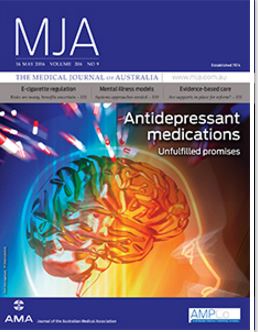
A new article in The Medical Journal of Australia laments that, while antidepressant use continues to climb, the research evidence shows that their effectiveness is lower than many thought. Meanwhile, fewer patients are getting access to psychotherapy.












If people tend to get better over time irrespective of treatment, what’s the point of treatment? We were clearly better of before we started “treating” every time someone feels bad.
Report comment
So the pharmaceutical company will achieve financial health.
Report comment
Too true!
Report comment
What a strange article. It contains numerous distortions, such as:
– the notion that a biologically-based illness called major depression exists.
– it contains the illusion that CBT and Interpersonal Therapy are discrete entities that can be “studied” in the same way one might study a pill. Human relationships do not work in this reductionistic linear way.
– it discusses “the effectiveness of therapy” (to do what?) without any mention of the frequency of therapy, length of therapy, quality of training and experience level of psychotherapists, or setting of the therapy, in any of the studies. This is bizarre to say the least. As if context did not matter, and human relationships (psychotherapy) are something we can make generalized statements about as if they were pills falling off an assembly line into little boxes.
– It keeps using the word “effectiveness in treating” – effectiveness in treating exactly what? Where is the awareness of what people want, their lives, their hopes, their context? Clients are not simply docile targets for our treatments.
– It contains phrases like this, “better targeting of existing treatments towards patients who are most likely to respond to them is probably our best hope for improving treatment outcomes.”
Who really thinks like this about how to understand their fellow human beings? One almost feels as if the author of this article is an emotionless alien come here from a far off star to study these strange creatures, humans.
I guess since news outlets like MJA cannot write about attempts to “treat” people in human terms, there is no other news to report.
Report comment
Haha I just posted this as a comment on the MJA journal website. Of course it has to go to “The Editor” for review. I introduced myself as “Edward Dantes, from the School of Hard Knocks, Professor of Life Experience”. I know it won’t get accepted, but I wish I could be a fly on the wall to see the expression of the poor editor as he reads a dissenting comment from someone who sounds like a real human being, as opposed to one of the psychiatric professor drones.
Report comment
Maybe he’s a committee.
Report comment
I think the antidepressants did worse than just not fulfill promises.
Report comment