When you are in distress, you look for help. When your body falters, you look for medicine. And when someone is searching for medicine, there will always be someone else ready to sell them exactly the “cure” that promises to make them whole again—to stabilize them, to restore vitality, to put them back on their feet.
It can be Big Pharma, a trillion-dollar industry whose innovation pipeline is designed less for the sick and more for the stockholders. But it can just as easily be the alternative medicine marketplace, which thrives on the same human desperation. If there is demand, someone will supply a potion, a capsule, a therapy, no matter how unproven.
I write this not as a theorist but as a man living with severe PTSD. For years I’ve swallowed the pills: Cipralex, Seroquel, benzodiazepines. I’ve clung to them in the hope that one of them, finally, would be the pill—the one that would calm the nightmares, silence the panic attacks, take away the bottomless dread. The one that would let me feel steady in the morning and safe at night.
It has never arrived.
The Industry of Suffering
The cruel irony is that the more common an illness, the more fertile the ground for an industry to grow around it. And PTSD—especially in a country like mine, scarred by war after war — is very common. That means money. That means new “solutions” announced every year, each promoted as a breakthrough.
Recently I’ve seen the push for hyperbaric oxygen therapy for PTSD. It requires patients to quit smoking, but beyond that detail, I have yet to meet a single veteran who swears it healed him. The advertisements are confident. The glossy brochures talk of “neuroplasticity” and “cell regeneration.” But on the ground? Silence.
I’ve read about nerve block injections, claiming miraculous 80% success rates. Yet outside of the company press releases, I have not found a single living, breathing PTSD survivor who tells me it worked for them.
Now the frontier is psychedelic drugs. They are described as “revolutionary.” And perhaps for some, they might be. But I have also seen the other side: trauma magnified, flashbacks intensified, fragile minds pushed further into the abyss. The same substance that might heal could just as easily destroy. It is a game of chance, and the patient is the wager.
The Old Snake Oil
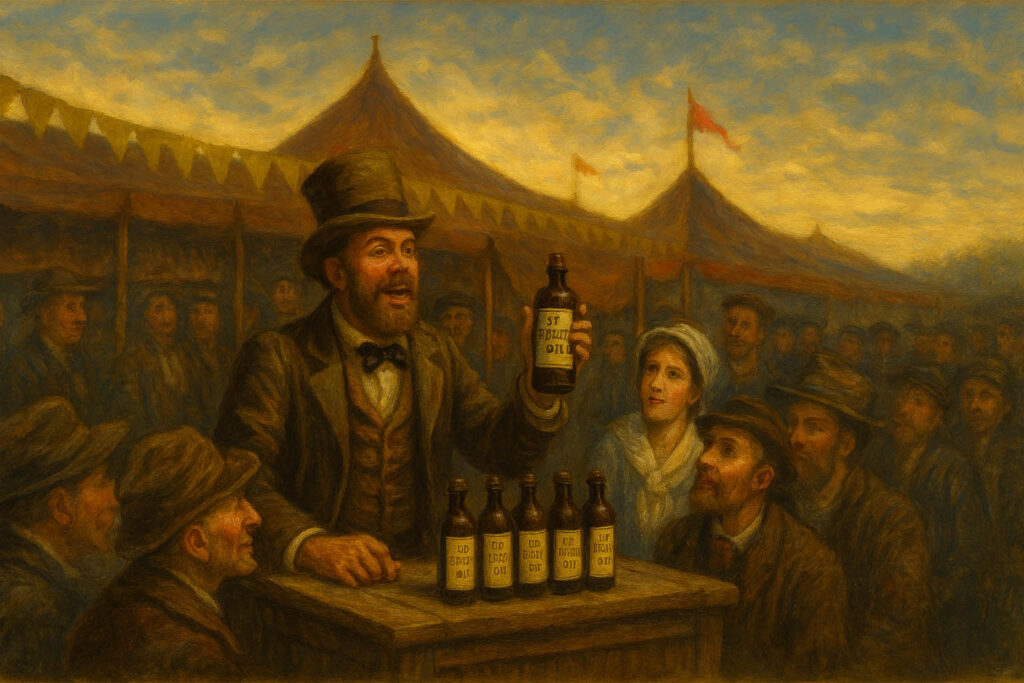
In truth, what we are living through is not new. Picture a village fair centuries ago. A peasant comes into town, weakened by fever, desperate for relief. There is always a man at the stall offering the magic potion, the miracle syrup—a diluted concoction that promised to cure every ailment from colds to consumption.
I have been that peasant. I have bought the syrup. Only today it comes in a different bottle, sometimes stamped with the logo of a multinational corporation, sometimes with the holistic script of a healer.
What have I not tried? Capsules of lavender to soothe anxiety. EMDR. Psychoanalysis. CBT. Healing touch. Magnet therapy. Homeopathy. Acupuncture. Omega-3 supplements. Afternoon cups of green tea. I even gave up coffee. I gave up cigarettes. Yes, these changes are healthy. But when it comes to the terror of a panic attack, they are no more effective than Cipralex—good only until the next trigger, the next spiral into darkness.
The truth is, many of these remedies are just another version of the fairground syrup: comforting, distracting, sometimes useful in the margins, but powerless against the monster that is trauma.
Living Inside the Casino
I have written elsewhere that psychiatry is like a casino. You enter with your symptoms, and the dealer, the psychiatrist—spins the diagnostic wheel. Maybe today you are anxious. Tomorrow, PTSD. Next month, borderline personality disorder. The labels mutate with the clinician, not with the patient.
And upstairs, in the drug lounge, the cocktails change as quickly as the seasons. First the SSRI. Then the stabilizer. Then the antipsychotic “just for sleep.” Inevitably, the benzos. Pull the lever again. Hope the dice land in your favor.
But it is not only psychiatry that is a casino. The entire culture of “cures” for trauma is built on the same odds. The marketplace whispers the same message, whether it is a pharmaceutical giant or a healer with a crystal: This time, we have the answer.
It is a lie as old as suffering itself.
What Actually Helps
I don’t want to be misunderstood. I am not anti-psychiatry. There were moments in my life where medication quite literally kept me alive. I am not mocking those who try acupuncture or lavender oil or hyperbaric chambers. Desperation makes us seekers, and seekers will grasp at anything that promises relief.
But healing, at least for me, has never come in a capsule. It has come, strangely, through other paths:
Through writing, which allowed me to take my pain out of my body and put it into language.
Through art, which gave form to the chaos.
Through community, which reminded me I was not alone.
Through love, which anchored me when everything else was unraveling.
Through long walks in silence, where my body could remember it was alive.
And sometimes, simply, through time.
None of these can be patented. None can be bottled and sold. There is no billion-dollar incentive for “meaning” or “companionship.” You can’t build an IPO around a walk in the woods. And so the system neglects them.
The Endless Search
Every time my mental health crashes and I find myself back in a psychiatrist’s office, I feel two things at once: hope and despair. Hope that maybe this time there will be something different. Despair because I know the odds. Best case, they change the meds. Worst case, they add another one.
And somewhere in the background, I can hear the fairground barker: Step right up, ladies and gentlemen! This is the potion that will cure it all!
I know better now. I know the truth: there is no single potion, no ultimate cure. There are only fragments, partial reliefs, things that help until they don’t.
But still, like the peasant at the fair, I keep searching. Because to live with trauma is to live with the longing for something, anything that might finally quiet the storm.
And maybe that longing itself is part of the illness.









Thanks for this Yishay. The carnival barker! Yes or the travelling medicine show. Neil Diamond’s song! Also Roger’s and Hammerstein’s Carousel and it was taken from an Hungarian tale. The song about walking through a storm and the ending and the beginning with the star taken from the heaven sky. The barker is forgiven somehow.
I think life is trauma and knowing this and using tools found along the way. Though moneys yes we all are easy marks and vulnerable. You might want to read/ see Ray Bradbury’s Something Wicked This Way Comes. It follows your thinking. Also Dandelion Wine is more sentimental but he captures that as John Irving wrote in The World According to Garp the undertow. All sorts of ways art if all kinds. This dialogue is helpful and should be continued. Oh did sideshows end? What tools were used for that and the once big circus shows? Not just casinos.
Report comment
My brother’s friends called my eventual husband the “Neil Diamond dude,” because our first date was to a Neil Diamond concert. I had forgotten about that song, thank you Mary.
My father owed the world one big party, his only daughter’s wedding, which was not what I personally would have chosen as my wedding, but was a putting on the Ritz wedding. But I remember being sad that I couldn’t even have a Neil Diamond song be the first dance song at my own wedding.
I was attacked when I was a young mom, by Holy Spirit blaspheming psych professionals, due to legitimate distress caused by 9.11.2001. I healed, and/or am still healing, Yishay, from psychiatric trauma, with largely the same human experiences as you.
I agree with you, Yishay, psych drugs don’t cure anyone from any kind of legitimate human distress. God bless.
Report comment
Thank you, Mary. I love the image of the carnival barker and the traveling medicine show—it’s such a fitting metaphor for the promises of psychiatry and its potions. And yes, Neil Diamond, Rodgers and Hammerstein, the Hungarian tale—they all remind us how these stories repeat themselves across cultures, always with a mix of illusion and longing.
I’ve read Bradbury, and Something Wicked This Way Comes in particular has always haunted me—that sense of the fairground hiding both wonder and menace. Dandelion Wine, too, with its bittersweet nostalgia, shows how memory itself can be both balm and wound. You’re right: art, in all its forms, gives us language for what trauma alone cannot hold.
As for the sideshows and circuses—I think they didn’t end so much as they transformed. The tools changed: the casino, the screen, even the clinic became the new tents where the public gathers, chasing hope, distraction, or cure. The barkers are still with us, only dressed differently.
This dialogue truly matters
Report comment
Thanks for your kind reply. Art is part of all of this dialogue and you are a wide ranging reader! One almost has to have a trauma lens or perhaps the old magnifier. We would use not only to look but also start that small billow of smoke and then drop it and run away because we sensed there was a power we could not really control with the magnification of sunlight.
Art holds trauma and more and more I think I was picking up on that lens though hidden in clouds. Neil Diamond had Holly Holy which is African American based but powerful. He also wrote Shiloh which still a bittersweet emotion. I as a small child had a friend David and when I got a stuffed tiger he called it the purple tiger because that was the one color at three he was into. We moved away but he was my fist friend. I bet both Neil and Ray trauma from their lives or families lives and they were able to use it well though Ray had some addiction issues and I never thought his writing was as good . So it goes. Theodore Roethke poetry and life much more of the times of multiple hospitalizations and diagnoses and friends just unclear how to help. Oscar Hammerstein after writing South Pacific performed You Have to Be Carefully Taught at the old group of Christians and Jews. It was at the time big but looking back so so much missed.
In my own art work of visual and poetry and words the trauma I saw or felt or had to deal with there. Much of what I wrote was too wild for the times. Even with metaphors my life and experiences still bled outside the margins.
I look forward to your next piece. The other thing is trauma from art. I as a child exposed to cable tv with horror movies and scary films banned after JFK ‘s assassination. Saturday afternoons. I saw the brainwashing scene of the Manchurian Candidate imagined tea party at ten? It was an undercurrent t in my life since my father was a vet. Layers. Recently I realized in my home town Ernie Anderson the father of film director Paul Anderson did a late night weekend show with horror films. However it was late at night so ten year olds usually didn’t stay up that late. But a none control control. And with his horror films he would be popping in and out and the frame was comedy and silliness. Which now I realize oh my he kept the horror from overwhelming! Comedy can do that! So interrupting the scary was a tool to make it less real and more art than real life. I think this also plays a role and I do not think ever discussed. So what shows and films and songs and art were part of your childhood? I never was asked and I bet not many ever.
Report comment
I have to make a retraction. My childhood memory not as exact as I assumed. CBS ( according to Wikipedia abd how would one do further fact checking?) had movies on Thursday nights and it shows the MC film shown in 1965 . So it fits along with some of the other films I saw while my late husband saw in cinemas. It was both Cable and the regular broadcasting networks. And this gets into the realm of free speech and also parenting. So who knows? I have no one to support my memories of what and when I saw just as a preteen it even now parts of that film triggering. I can’t imagine what it was for my father and just blanks so again who knows. Art is so important but it always has an affect. Not to have art because of fear not right either. Dialogue and truth telling and having or trying to have a supportive safety net would be helpful. And as a parent hard. Some of the stuff I let my kids watched I had selectively edited out the horror scenes and then had to deal with all of that ping pong trauma. Banning is wrong educating/ warning / alerting not at all.
Report comment
I think this abuse will only stop once people stop expecting a drug SHOULD exist to “cure” all their problems. Once people stop believing that magic potions DO exist. At best it’s a compromise that usually takes your soul. Why do we think there can or should be a drug to “cure” trauma? I support psychedelics, but not when they’re marketed as another magic potion easy fix, because they don’t work like that. They only really work when you take a more spiritual approach, and I say that as an atheist.
All of this assumes there’s something wrong with the brain that needs correction but there’s just not. Of course no “treatment” is going to work when there’s not actually anything “wrong” that needs to be “fixed”.
I only hope next time you’re struggling that you don’t go back to a psychiatrist because they’re all full of crap and you seem to get it, but then say you’re not antipsych. They have nothing for you but lies.
Report comment
I hear you. The hunger for a pill, a quick salvation, is very human—it comes from desperation as much as from marketing. When we’re broken, we want something to stop the bleeding. But you’re right: there is no magic potion, no chemical shortcut that can erase trauma.
For me, the problem wasn’t just psychiatry’s promises, but also the silence around the wound itself. Trauma isn’t a “disease” of the brain waiting for the right chemical—it’s an existential rupture. No pill can stitch that back together. At best, medication numbs. At worst, it deepens the wound.
I don’t reject psychedelics either, but like you said—they can’t be packaged as another commodity cure. Healing is slower, less glamorous, often found in words, in art, in human connection. That’s not easy to sell, but it’s the truth I’ve lived.
And I get your anger toward psychiatry. For me, I’m not sure if I can wear the “anti-psychiatry” label—I only know that psychiatry failed me. What remains is my voice, and maybe our voices together in dialogues like this.
Report comment
Ah the evils of capitalism; they traumatise you in war then sells quack pills to “cure” the trauma. When will it ever end?
Report comment
Exactly. First they break us, then they sell us the cure to the breakage they caused. War, profit, pills—it’s a perfect circle of exploitation. I don’t know if it will ever end, but I do know we can keep unmasking it, keep telling the truth out loud. Sometimes that’s the only resistance left.
Report comment
It’s not a war when only one side has an army.
Report comment
You’re searching the solution outside of you, instead of trying to activate the healing ability already inside of you.
Trauma is a part of you that needs to emerge and be listened to, not really a monster. If fear makes it a monster, of course accept your fear.
To activate the healing capacity inside of you I advise shamanic transe postures if you have fifteen minutes of time. For instance :
https://www.cuyamungueinstitute.com/articles-and-news/the-bear-posture/
It helped me, schizophrenic, to to cut in four my Seroquel dosage (from 700 mg to 150 daily) with almost no withdrawal symptom. Such postures are the most powerful way to heal I know and it’s entirely free.
Yours faithfully,
Report comment
Thank you, Jean-Philippe. I appreciate your honesty and the generosity of sharing what helped you. I agree that trauma isn’t a monster to be slain but a voice inside us that wants to be heard, however frightening that can feel.
For me, writing has been that posture—the act that allows what is buried to emerge and take form. I believe each of us has to find our own doorway: for you it might be shamanic trance postures, for me it has been words, for others it can be music, painting, or even silence.
The common thread is exactly what you said: turning inward, listening, and trusting that the body and spirit still hold a capacity to heal.
Report comment
Well explained Yishay. You nailed it!
It became true for me that diagnoses got added with every new psychiatrist I saw, and it only took 45 minutes of their time to do so. I know now that not one doctor took a full inventory of my life events, nor calibrated their findings over the next twenty years to any prescribed medication’s adverse effect, polypharmacy, or even supplements that I took. In 1994, I attended a marketing seminar for Herbalife products and was convinced to purchase some Herbalife powders which I added to milk before seeing my first psychiatrist in December 1995. I had been seeing a therapist for PTSD since December 13, 1993. Neither the psychiatrist nor I knew that Herbalife could induce mania. (Chapter titled, ‘Conditions Confused with the Illness’ in the book, ‘Surviving Manic Depression’)
I took me twenty-five more years for me to learn (on my own) that alcohol abuse can worsen or cause anxiety and disrupted sleep. I had assumed the doctor knew best, so I said yes to a prescription of Klonopin in 1995. Four different benzodiazepines later, after multiple dose reductions and rapid tapers my CNS became kindled for a torturous benzodiazepine withdrawal period that commenced in June 2013.
Now, I proudly proclaim that I have every mental disorder one can receive from a psychiatrist (almost). In December 1995, I was diagnosed in order to receive Klonopin (0.05mg). The diagnoses were written as “traits” because at the age of 41 years, they had not fully blossomed yet. (Chuckle) Traits: histrionic, borderline.
Two years ago, an acquaintance of mine wrote me to say, “Anyone can get a bipolar diagnosis.” I added, “All you have to do is be talkative and moody, and have substance use problems that are not addressed nor treated.”
As for PTSD and traumatic events, those are the common causes of mental suffering besides the loss of a loved one(s). Psychotropic medications don’t treat them, that I concur.
Report comment
Thank you, Jane. Your story is powerful—and painfully familiar. The way psychiatry layers diagnoses like stickers, without ever taking a true inventory of life events, feels less like healing and more like bookkeeping. I know that feeling of trust—assuming the doctor knows best—only to discover years later the cost of that trust in our bodies and souls.
What you describe about Klonopin, benzodiazepines, and the long road of withdrawal resonates deeply with me. I’ve lived inside that same chemical maze, believing I was being “treated” while in fact my suffering was only being extended.
Like you, I’ve come to see that the real causes—trauma, loss, the human wound—are never addressed by pills. They demand listening, compassion, and time. And I think our voices, telling these truths, are part of what begins to break the illusion.
Report comment
Desperate longing leads to anxiety. Calm surrender can loosen its grip—especially out of sight of psychiatrists.
No need to tighten the knot when psychiatrists do that for you.
Report comment