The first thing I’ll say about my experiences with healthcare while having an eating disorder is the fact that my eating disorder went undiagnosed for eight years. I think this fact speaks for itself. (And I am not some kind of rare exception.)
Since being formally diagnosed with an eating disorder nearly five years ago, I have had experiences within healthcare ranging from uncomfortable or unpleasant to downright traumatizing. Doctors have downplayed the severity of my eating disorder, questioned or denied its very existence, and sometimes even given me recommendations right in line with disordered eating behaviors—such as prescribing exercise when I was struggling with compulsive overexercise. Outpatient therapy with my so-called “care team” ended in ultimatums and abandonment. Very rarely (if ever) have experiences been positive, or even neutral.
In order to avoid the mainstream mental health system, I decided to take a “DIY” approach to recovery where I would manage the psychobehavioral side of things myself and find a doctor to support me through the physical side. But because of my negative experiences with “regular” doctors when it came to my ED, I made it my mission throughout my recovery to search for a doctor who specializes in EDs. However, every time I’ve scoured the internet for “eating disorder specialists” or “eating disorder doctors in my area”— changing the search input each time—all I would get were eating disorder therapists, eating disorder psychiatrists, and eating disorder registered dietitians. But no physicians (non-psychiatrists).
This confirmed my emerging hypothesis: Contrary to the problem with most mental healthcare, where the biomedical model dominates approaches to psychological suffering, the psychobehavioral side of ED healthcare disproportionately overshadows the medical side. As far as I can tell, it is safe to conclude that there is no real such thing as an eating disorder-specialized physician—not in an outpatient setting at least. If there is, they must be incredibly hard to find. (I would, of course, love for somebody to prove me wrong in the comments by letting me know where all the eating disorder doctors are hiding and how to find them!) It seems as though this kind of thing would only be available in HLOC (if even), making it completely inaccessible to anyone doing outpatient or DIY recovery. If I couldn’t find a doctor who was knowledgeable, then the best I could hope for was finding one who would listen.
“Levels of Care”
I think it’s essential that we talk about the inherent setup of eating disorder (ED) healthcare before getting any further. The several types of treatment offered exist on a hierarchy that presumably correspond to illness severity. These are called “levels of care,” and the more intense ones may be referred to as “higher levels of care” (HLOC).
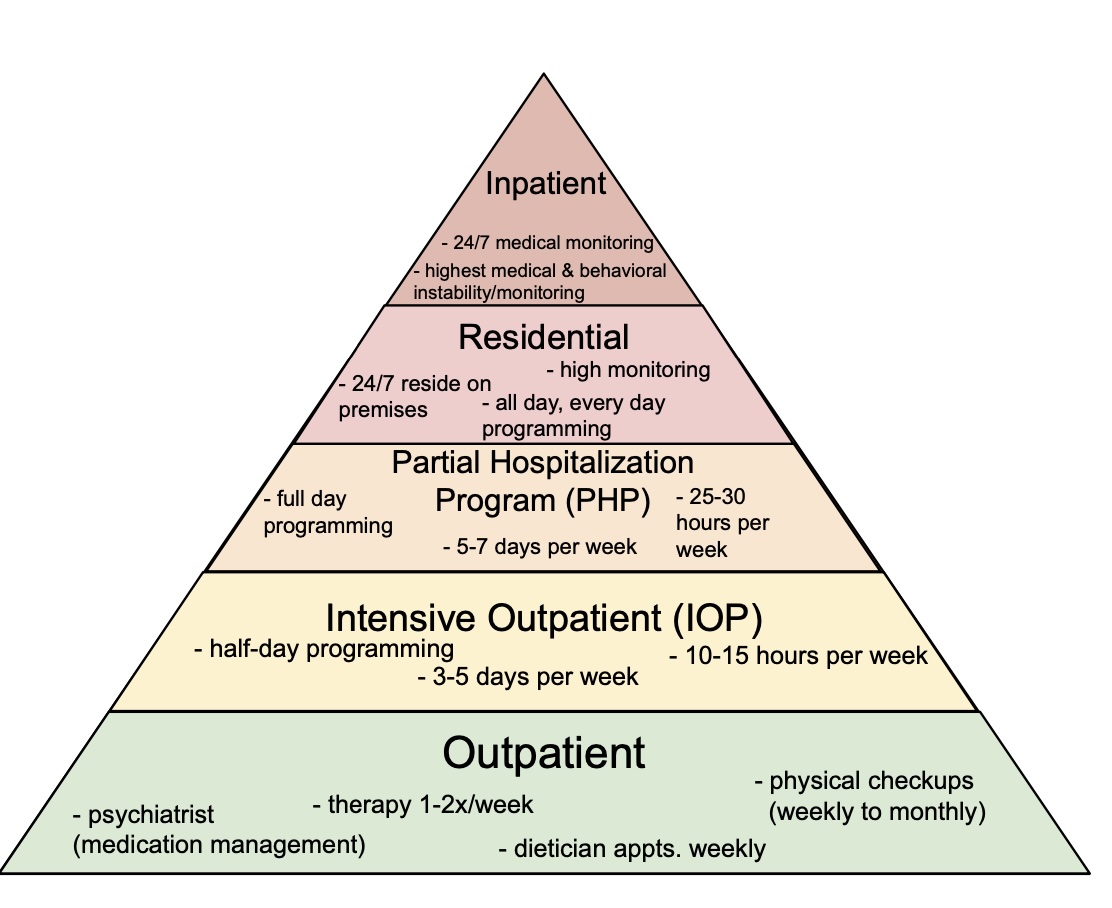
Some of you may already be familiar with these terms, even if you do not have ED experience. This treatment model is not unique to ED treatment; however, it is especially prevalent in the field.
There are several problems with this setup. First of all, treatment tends to get more expensive the higher up you go, so treatment—of any kind, but especially HLOC—is not financially accessible to many people. Second, how does one determine the appropriate level of care for themselves? Well, they don’t; usually someone else does. Upon first glance, it appears that service users get a wide variety of tailored treatment options to choose from. However, often, this choice is not really up to the patient. It is up to some professional to (subjectively) evaluate how “severe” they think their illness is and assign them to a level accordingly.
One way this can play out: A patient seeks care at the outpatient level, attending therapy and nutrition sessions a couple times a week. However, after several weeks or months, they are not making much progress, so their “care team” decides—not only to simply recommend a higher level of care—but to coerce the patient into signing a treatment contract stating that they will be dropped as a patient and referred to a HLOC if they do not make a certain amount of progress by a certain date. The HLOC can, of course, then “reject” the patient if their case is deemed “not severe enough.” Consequently, the patient is left with no care options whatsoever. (This was basically exactly what happened to me.)
Third, this paradigm can cause patients to view symptom criteria as a sort of “checklist” that they must complete in order to access care. This can cause the “sick enough paradox” that I discussed in my previous essays (here and here). Patients are essentially trapped in a bind where they feel they must get worse (to access the care they need) in order to get better. In many cases, patients are led to believe that they are not unwell at all— that their behaviors are “healthy” even—leading to the notorious “denial of illness” so commonly associated with anorexia and other EDs.
Fourth, these “levels of care” are not only meant to correspond to supposed severity of illness and thus, frequency of medical monitoring, they also correspond with presumed “patient instability” and thus, intensity of behavioral surveillance. Meaning that patients may be admitted to higher levels of care on the basis of suicidality or self-harm—not just ED symptoms—and the higher the level of care, the less autonomy, agency, and rights the patient will be permitted, generally speaking. (I’ve heard of some residential treatment centers that don’t allow patients to shower or use the bathroom alone, despite the fact that ED patients are more likely to have trauma histories, including sexual abuse.)
But lastly—and this is the problem I’ve been running into—this treatment paradigm leaves little to no room for a self-determined recovery approach. (Perhaps this is by design.) Again, while there is overwhelming focus on the psychological side of ED healthcare— especially in outpatient settings—there is still an enormous gap in the physical side of it. For anyone who wants to manage the psychological/behavioral side on their own terms and doesn’t want or need therapy, psychiatric medications, or dietician-led “meal plans,” but still wants to know what is going on with their body and needs guidance on the physical/medical side as they recover from a “mental illness” with the second highest mortality rate of all psychiatric diagnoses, there are few to no options.
Under-researched and Undereducated
When finding ED-educated doctors to help me figure out my medical concerns turned out to be a fruitless endeavor, I eventually turned to self-education instead. I know how to read and interpret a research paper; I was a psychology major myself. So, I quickly got to work combing through the search results of Google Scholar. However, this approach quickly proved to have its downsides as well. What I found was that most studies are done on a small cohort of “clinically underweight,” white, cisgender, teenage girls with anorexia nervosa. Studies are typically short-term and done in hospital settings; long-term follow up is rare. Additionally, weight restoration is viewed as synonymous with recovery. (Spoiler: It’s not! More on that later.)
Although I do line up with some of those characteristics—I am white, cis, female, and in recovery from anorexia—I am certainly not represented by all of them. And most people with EDs are not. How are the results from these studies supposed to be generalizable to the majority of people with EDs? For that matter, how are the results from these studies supposed to be generalizable to adults? How can a 4-week or 6-week or even 12-week study tell me anything about what I’m going through now, almost 2 years into recovery, and still experiencing symptoms? How can it tell me anything about what to expect in the future?
I got to a certain point of desperation in my search that I almost decided to order a medical textbook (or several) on EDs. However, even just skimming through the table of contents in the previews of these books, I quickly discovered that they were rife with problems. As seems to be the trend here, around 80% of the chapters were dedicated to the psychological and behavioral profile of EDs, with only the remaining 20% focusing on the physical ramifications and how to medically test and/or care for them. Of that remaining 20%, judging by the titles alone, they didn’t look like they were going to cover anything I didn’t already know.
If what they are teaching in medical school about EDs—the tiny bit that they do teach—is based on studies and textbooks like these, then it’s no wonder why doctors remain so ignorant while certain stereotypes continue to dominate the narrative.
A Deeper Problem
The primary issue I’ve observed in healthcare—in regard to EDs, but also in general—is the inherent weight bias embedded in the field. Systemic fatphobia and medically embedded weight bias go hand-in-hand with poor eating disorder healthcare. While less than 6% of people with EDs are considered “clinically underweight,” and people in larger bodies are at the highest risk for developing EDs, medical providers and the general public alike continue to hold the stereotype that EDs only afflict those who look emaciated. When held in the minds of doctors, these stereotypes create a dangerous self-fulfilling prophecy: If doctors believe that only people who are extremely thin can have EDs, then they will continue to only diagnose and treat EDs in those who are extremely thin, thus confirming the stereotype that only the extremely thin have EDs. And fatphobia/weight bias—including stereotypes like these—affects more than just people in larger bodies: It harms thin people, too. Throughout my ED, I was thin, just not thin enough, according to some doctors at least. My weight—which fluctuated within a range from “normal-thin” to “underweight-thin”—did not necessarily correspond with how badly I was struggling, yet it did reliably correspond with how I was perceived and treated by others, both laypeople and medical professionals alike.
Furthermore, although scientific evidence has not demonstrated a causal relationship between weight and health outcomes, many doctors continue to recommend weight loss for heavier folks, and even praise weight loss in thinner folks as well. On the other hand, there is overwhelming evidence that over 95% of diets fail in the long-term, that weight cycling is a more reliable indicator of poor health outcomes than weight itself, and that weight stigma is more strongly linked than weight itself with many of the chronic diseases that are commonly associated with “obesity.” Meanwhile, what dieting and intentional weight loss efforts do reliably predict are an increased risk of developing an eating disorder. Though I could write an entire separate piece on this alone and how it parallels the issues we see in psychiatry—and I probably will at some point—for now, I will simply recommend the book Anti-Diet by Christy Harrison for anyone looking to dismantle their internalized fatphobia and abolish diet culture.
Another recurring theme I’ve encountered from healthcare providers when dealing with EDs is an attitude of ignorance coupled with arrogance. Ignorance with humility is more tolerable and less outright harmful, and can even lead to positive learning experiences, but ignorance plus arrogance can take on a malignant form. At my first appointment, my current GP validated my experiences by confessing that, yes, many doctors are notoriously arrogant, and yes, they are taught very little about EDs in medical school (any knowledge that is acquired is typically picked up on the job). For this reason alone, she is by far the best doctor I’ve found—not because she possesses any more expertise than previous doctors I’ve encountered, but simply because of her humble admission of unfamiliarity with EDs, and acknowledgement of the medical profession’s proclivity for self-aggrandizement.
Insurance Constructs, Profitability and Liability
There are many more problems in the realm of ED healthcare, and of course, my perceptions will be limited by my experiences. (I have never accessed care higher than the outpatient level.) However, a common problem I’ve encountered repeatedly—and heard from others as well—is that there is too much focus on weight in ED recovery at all levels of care. “But Jasmine,” you might be wondering, “I thought you wanted there to be more focus on the physical/medical side of things?” Yes, but weight does not equal health! Weight, when looked at in context (such as personal history), may simply be one data point in the constellation of health, but weight alone is not the whole picture. Additionally, such an over-fixation on weight in recovery can ironically mirror the illness itself. So why, then, is it used so frequently?
The answer to that question is the same reason why cognitive behavioral therapy (CBT) has gained so much traction in recent years: Because quantifiable results are preferred by insurance companies. Most of us probably know what a “social construct” is, right? Well, I would like to coin another, similar term: insurance company construct. Similar to a social construct, which is arbitrarily dictated by society, an insurance construct is arbitrarily dictated by insurance companies, without necessarily reflecting an objective reality. There is plenty of overlap, of course, between social constructs and insurance constructs: Psychiatric diagnoses are a perfect example. So is BMI (Body Mass Index). The idea of being “weight restored” is another. Like psychiatric diagnoses, this construct is not neutral; it can do great harm.
An over-focus on “weight restoration” in combination with recovery weights typically being set too low and forcing patients to reach these weights too quickly results in high relapse rates, chronicization of illness, and the notorious “revolving door phenomenon.” On far too many an ED recovery forum, I have witnessed others who have recovered from ED lamenting that they are still gaining weight or having symptoms or experiencing extreme hunger despite being “weight restored,” insisting that this means they should be “fully recovered” by now and therefore something must be “wrong” with their body. Under the right environmental pressures, this shame spiral can be the perfect catalyst for relapse. This is a tragedy. Instead of changing our bodies to fit the fantasy of a construct, we should change these constructs to fit the reality of our bodies.
However, unfortunately, I think this is by design, not by mistake. The revolving door phenomenon is remarkably profitable, as keeping patients sick ensures repeat customers. Under for-profit healthcare, there is very little incentive to actually help patients achieve a full recovery. Plus, there is a built-in shield from criticism. Instead of being seen as a failure of the system, it can be conveniently reframed as the nature of the illness itself being just oh-so-difficult to treat. Or better yet, victim-blaming patients as “non-compliant” or “not wanting recovery badly enough,” i.e. “maybe you’re just not trying hard enough!” Many patients, after several treatment attempts, are sold this idea that they have an incurable, lifelong disease that they will never fully recover from, resulting in hopelessness and shame.
In our liability-obsessed culture, it is no wonder why blame—and who gets it—is so important to the system and those who work in it. But acting out of this fear comes with a very real human cost. Much like “suicide prevention” interventions, forced treatment and involuntary hospitalizations can have worse long-term outcomes for eating disorder patients as well. Of course, getting someone physically stable is important in a life-or-death medical crisis, as can happen with EDs. However, often the way this is carried out ends up being traumatizing, degrading, and dehumanizing for the patient, leading to a high likelihood of future relapse.
But carceral practices don’t have to be as extreme as forced hospitalization in order to be harmful. As I mentioned earlier, treatment contracts, which are common at the outpatient level, can cause great harm as well. While being presented as a protective measure for the benefit of patients, in reality treatment contracts serve to protect providers from liability, even if that means betrayal of trust and emotional abandonment for their patients.
What I’ve Learned On My Own
Through my own DIY recovery, though I’ve stumbled upon many obstacles, I have still managed to glean a great deal of knowledge (and perhaps even more wisdom). I will list some of the things I’ve learned below, in case they would be of service to anyone else in similar shoes.
First, doctors are not omniscient or infallible. There are limits to their knowledge, especially when it comes to eating disorders, and trust should be earned, not given automatically. I am the foremost expert of my own body, and I can make my own informed choices instead of uncritically following everything they say. Furthermore, before any medical appointment, I like to come up with a list of specific questions and goals for the appointment. I can also set boundaries if needed, such as asking to be blind-weighed or declining to be weighed at all. If I am getting labs done, I like to remind myself that “good labs” do not always equal good health. The body has many methods of compensating for restriction that allow labs to still fall within “normal” ranges. It doesn’t mean I’m “not sick enough” or that I “should be” recovered by now.
Second, self-education is a powerful tool. Dismantling diet culture, unlearning my own internalized fatphobia, debunking the pseudoscience of BMI, and learning about science-backed anti-diet frameworks like Health At Every Size (HAES) and Intuitive Eating have helped me to tackle these issues at the systemic level rather than just focusing on my own individual “pathology.” (Again, I highly recommend Anti-Diet by Christy Harrison.) Additionally, learning from others’ lived experience with recovery can sometimes be even more helpful than academic reading. It has helped me feel less alone and realize that my experiences are normal, and has introduced me to concepts such as “extreme hunger,” “overshoot weight,” and “set point weight theory.” However, it can also be a double-edged sword, as I’ve learned to be wary of self-comparison; my recovery journey is my own and may not look the same as someone else’s.
Third, my body knows what it’s doing. My body will learn to trust me once I learn to trust it. I’ve shifted my goal from being “weight restored” to being “trust restored.” Overshoot weight—the phenomenon of bodies gaining back more weight than was lost after a period of starvation—is normal, healthy, and usually temporary. (This is part of why “weight restored” is a meaningless concept.) Having “excess” body fat is necessary for healing the damage done by restriction and reestablishing body trust. I must relinquish control over my body’s shape/size/appearance and trust my body’s innate wisdom and ability to self-regulate. It will eventually find its set point weight on its own timeline, without deliberate effort or intervention.
Similarly, when it comes to “extreme hunger,” the only way to “overcome” it is by giving in to it. I cannot control my body’s needs, and I cannot “outsmart” or “trick” my body into being satisfied by less than it needs. My nutritional needs may be different from what’s considered “normal” right now; I’m making up for a deficit. It won’t last forever. Same goes for all other residual symptoms I am still experiencing. There’s no telling how long it may take, but I trust that my body will figure things out in time.
And finally, last but not least: Although the state of ED healthcare is undeniably atrocious, and I am in no way excusing that or trying to find a silver lining, part of what recovery is all about is embracing uncertainty. With that comes giving up the ability to predict or control exactly how it will go. In order to regain trust in myself and my body, I must stop outsourcing my self-knowledge to “experts.” Of course, proper medical guidance would help things be a lot less scary, and a lot safer, too, but not because it would provide me with some perfect recovery “formula” or “roadmap” or “blueprint” or anything. The role of medical care would ideally be a collaborative one, not an authoritative one. Ultimately, recovery is a creative act; the kind of story where you make it up as you go. And I get to be the author.









“Most of us probably know what a “social construct” is, right?”
No.
“In order to regain trust in myself and my body, I must stop outsourcing my self-knowledge to “experts.””
Yes.
Report comment
A social construct is an idea or concept that exists because society as a whole agrees that it exists, rather than being a product of objective reality.
Report comment
This is a fine article but can we stop having “survivor stories” from psychology majors? I came here to get AWAY from the drowning voices of “””experts””” thank you very much.
It does not surprise me at all that there are no eating disorder doctors. It fits with how this culture treats weight as both a convenient and proportional summary of one’s physical health, and also one that’s entirely within one’s willpower to control. Like they completely forget we exist in symbiosis with our bodies, not as the master controller. Hunger exists so our bodies can control us, and it’s not impressive or a show of willpower to ignore it.
Report comment
DS, the second part of what you said is right on target, but the first part is just rude. Anyone else other than psych majors you’d like to exclude? Have you looked at the MIA staff credentials?? They would almost all be excluded! All survivor stories deserve respect. Please show some.
Report comment
Dear Dead soul,
I found the first part of your comment quite upsetting to be honest. I would like to clear some things up.
It seems as though you have assumed that my being an “expert” has given me some kind of platform to share my story of survivorship over “non-expert” survivors. As in, I get to share my voice quite often in other spaces, while “they” don’t. It also appears that you are operating under the assumption that my story being featured on a site like Mad in America – which is presumably intended to elevate the “underdog” voices – is crowding out other, more deserving voices. Am I correct in those observations?
First of all, your assumption that my psychology degree makes me “one of those experts” is incorrect. I do not work for The System. I am not a therapist, psychiatrist, or doctor. My highest level of education is a bachelor’s degree. I only mentioned my degree to establish the fact that I understand how to read research papers and interpret data – something that not everyone gets the opportunity to learn how to do. Would it have made a difference to you if my major was in, say, biology or anthropology instead? My psychology major actually had almost as little to do with the field of mental health as either of those majors. I don’t recall eating disorders – the subject of this article – being covered in any of my classes, though we might’ve spent one or two slides on it at some point. All of the information in this article was gathered through my own lived experience.
Secondly, your assumption that my being an “expert” gives me some platform from which to share my voice/story more than other “non-expert” survivors is also false. Mad in America is the only place I have publicly shared my story. I don’t have a large support system in my personal life either.
That all being said, I do not believe that someone’s credentials or vocation diminish their trauma, or make them a less “authentic” survivor.
I hope that you were at least able to engage with the humanity of my story, as well as the actual content of it, and look past your projections of who you think wrote it. As for the second part of your comment, I completely agree with everything you said. I just wish that you could’ve stated it without the need to undermine my survivorship.
Thank you,
Jasmine
Report comment
When you talk about credentials though, credentials are used to answer the question “why should I listen to you?” Why are we even asking that question? If all survivor voices matter, why don’t they seem to matter equally? Because they are absolutely not represented equally.
The problem I have with the survivor stories on MIA is that the majority of them seem to come from other such people with “credentials”. Psychology majors, psychiatrists, therapists, people who work for organizations and institutions. Even if they’re not working in hospitals doing psychiatry, they generally are doing things that quietly reify the existence of a field of “experts” who help people with their suffering.
And overwhelmingly they show the biases they’ve acquired toward a system they now depend on for survival. Institutions promote the idea that institutions are the answer, but much of psychiatry’s current intractability lies in it being an institution.
This site claims to be about social justice but if we only ever hear from expert-survivors, we’re only going to get more of the same; more institutions, more credentials, more experts.
The only socially just answer is to abolish psychiatry entirely, but that’s not something I ever hear expert-survivors even considering.
I feel this is a direct result of really only publishing stories from people with “credentials”, as though people without are entirely in-credible.
Social justice unfortunately only happens when people get mean, because the problem we face is that people would rather have peace than justice.
Report comment
Dead soul,
This is the last time I will be attempting to engage with you in this thread, as you do not seem to be making a good faith effort to engage with me. You are making a lot of unfounded assumptions about me by lumping me in with “them.” Even after my attempts to dispel your assumptions, it seems like you are doubling down.
I already explained the reason why I mentioned my degree. It is quite a minor detail, and I only briefly mentioned it once. Perhaps it was not relevant enough to include at all, as it did not really contribute much to the narrative. Or, perhaps you’re right; to a different audience member it could give my story more credibility in their eyes. I’m not saying that’s the way it should be – I agree, survivors should have credibility simply by virtue of being survivors – however, it might be true.
I don’t think I got published only because I mentioned my psychology degree, I think I got published because of the quality of my writing and my ideas. I find it quite insulting for you to suggest otherwise. This is my third publication on Mad in America, yet the first time I have ever mentioned having a psychology degree. If you think I only got published because MIA sees me as an “expert,” then how do you explain my previous two articles?
I was a victim of The System throughout almost my entire undergrad experience. I was brainwashed into believing that therapy & psychiatry were innately good, and I was the problem for not getting better. As soon as I woke up to the harms The System had caused me (and so many others), I specifically chose not to go to grad school to become a therapist, as had been my plan. Though my major felt like a waste, I was a second-semester senior by then and it was too late to change it. I am not evil for majoring in psych, nor for having wanted to become a therapist. I genuinely wanted to help people, and still do. I now plan to dedicate the rest of my life to peer support and advocacy.
I don’t necessarily agree with your statement that “social justice only happens when you get mean.” Even if that is true sometimes, I don’t think that all “getting mean” equal social justice. For example, I fear that you have accomplished the latter (being mean), in absence of the former (social justice) with your comments, which have honestly been hurtful. I think you’re directing your anger (however justified) at the wrong person – a person, in fact, who belongs to the group which you claim to advocate for. What does getting mean and angry towards a fellow survivor accomplish for our collective goal of social justice? I have been made to feel as though I don’t belong anywhere, and now – in the one place where I typically feel seen – I feel like I am being called an impostor. Undeserving. Taking up space that belongs to others. The MH System ruined my life, and I have nowhere to talk about it. Where am I supposed to go, if not here?
Look, I don’t have all the answers. You are asking a lot of big questions like I’m supposed to know or be responsible for it all somehow. Like some kind of “expert.” I’m just an ordinary gal trying to survive, I promise you. If I don’t pass your purity test, that’s fine. You don’t have to engage with my work. But I deserve to take up space here, and I will continue to share my voice. I am not preventing anyone else from sharing theirs, including you. Perhaps you could direct your energy into submitting your own blog/personal story.
Mad in America never claimed to be an exclusive “survivors-only” club. Let alone having to be the “right” kind of survivor. MIA welcomes all sorts of people sharing all sorts of views here, the only requirement being that they in some way ask us to rethink psychiatry. Not everyone here is an abolitionist. If MIA is not the space you’re looking for, that’s fine. Go elsewhere. Or create your own.
And for the record, I am a psychiatric abolitionist. Everything about my recovery is a form of resistance in line with my abolitionist principles. I do not in any way “depend on the system for survival.” I have set up my life so I don’t have to. I am neither a worker nor a consumer of The System, and I never will be again.
-Jasmine
P.S. If you actually care about getting to know me as an individual at all and engaging with my work in a respectful manner, then I suggest you go read my other two previously published articles. I think you’d find that we agree on more than you realize, and I actually don’t fit your stereotype at all.
Report comment
An excellent reply to Dead Soul’s critical comment. In any case, I believe that debates on the value of professional “credentials” with respect to the mental health field are pointless, since it is largely the province of subjective hypotheses and arbitrary criteria necessarily conditioned by the mores prevailing in a particular culture at a specific moment in time. Whether or not someone who comments on this website has a degree in psychology means nothing to me; I am concerned only with the logic, truthfulness, and relevance of their argument.
Report comment
Hi joel stern,
Thank you for your support, and I am on the same page as you. To me, it’s a bit of an ad hominem fallacy to focus on someone’s credentials – in a positive or a negative way – rather than the content of what they’re saying.
Thanks,
Jasmine
Report comment
My sibling has weakened under psychiatric care (nursing home). However, this is not healthy weight loss. He/She is losing weight without exercising. The factors causing his/her weight loss are psychiatric medications, irregular eating habits, and the gloomy environment of the nursing home. When we went there, he/she said that he/she could not eat. When we reported this to the psychiatrist and the nursing home… they said that nothing like that was happening and that his/her condition was good. But they were lying.
Yasmin, similar research like yours is important from this perspective. Psychiatrists and doctors do not want to take responsibility for such health issues. They place the blame on the patient. And usually, they do nothing in this health problem. The reason for this, we can say, is the widespread culture of cover-up between mainstream medicine, mainstream psychiatry, and pharmaceutical companies.
Thanks Yasmin. An excellent article on eating disorders….
Report comment
Yildrim,
Thank you for sharing, I’m glad my article resonated with you. I’m sorry for what has happened to your sibling. It is unfortunate that many doctors do not seem to take (unhealthy) weight loss seriously as a health issue.
-Jasmine
Report comment
What a surprising (yet unsurprising) look at the abundance of psychological treatment for ED juxtaposed with a dearth of medical knowledge or treatment.
Report comment
Dear Camille,
Thank you for your comment. I’m glad my article was able to shed some light on this topic for you.
Thanks,
Jasmine
Report comment
A lot of this was covered by Susie Orbach in her books Fat is a Feminist issue and On Eating. Yet nothing changes in psychiatry.
Report comment
Hi John,
Thank you for your comment. I will have to add those books to my reading list!
-Jasmine
Report comment
It’s deeply ironic that eating disorders are classified as mental illnesses when their symptoms are so visibly physiological. The body shows unmistakable signs – changes in metabolism, digestion, hormones, heart rate, even temperature regulation — yet society insists, “nothing to see here, it’s all in your head.” This denial itself exposes how psychiatry functions as a system of cultural control: a way to psychologize real bodily distress and redirect it into a framework that disciplines the mind rather than understands the body.
In much of the world, such a condition would be recognized as physical, an illness of the body manifesting through appetite, energy, and sensory shifts. I would even argue that eating disorders primarily affect the senses of taste and smell, not the eyes, ears, or stored memories. They are not delusions or misperceptions, but real, embodied reactions to food — the body’s rebellion, not the mind’s invention.
By calling this “mental,” the system not only erases the body’s intelligence but also enforces a cultural narrative that separates mind from flesh, as though lived experience must be translated into acceptable psychological language before it is allowed to be real.
I think Dead Soul’s comment about the insertion of “experts” writing about survival makes a valid point. When editors approve pieces on mental health or trauma, they often demand a certain accepted style of speaking — one that aligns with institutional or academic norms. As a result, those without formal training in psychology are frequently excluded from the conversation.
But the irony is that it’s precisely these uncredentialed voices that often see most clearly. Their perspectives come from lived experience, not professional conditioning, and they can lift the veil of polite society that academic writing tends to preserve. That’s what I think Dead Soul was getting at — it wasn’t personal criticism, but a recognition that real change often comes from outside the sanctioned boundaries of expertise.
To truly challenge the system, the outburst of truth must break through the educational barrier — the one that decides who is “qualified” to speak and how they must speak to be heard.
Report comment
Hi Dogworld,
Thank you for taking the time to read my article and leave a comment. Speaking from lived experience with an ED, however, I would like to correct some of your misconceptions.
Eating disorders are, in fact, primarily mental. They do not have biomedical causes any more than any other “mental illness.” From what I can tell, you seem to be getting the arrow of causation backwards. They have psychological causes, but result in physiological consequences. Sure, these physiological consequences can then in turn have mental effects: depression, anxiety, brain fog. But the root source was still psychological – usually trauma/stress, internalized fatphobia, or a mix of both.
Yes, the body shows those “unmistakable signs” because those are the effects of starvation. But the body doesn’t just start starving on its own; the cause of that (self-)starvation is psychologically driven. Otherwise, it’s probably something like a GI disorder or hormonal disorder that’s been misdiagnosed as an eating disorder. (Both of which an ED can cause.) I did not experience “appetite, energy, and sensory shifts” until after I’d already been intentionally restricting for some time, not before.
Additionally, the symptoms are not always “visibly physiological.” As I tried to make a point of in my essay, eating disorders do not have one “look”; you cannot tell whether someone has an eating disorder (or what type) by their weight or appearance.
I am saying this all as someone with lived experience, not as an “expert.” As I said to Dead soul, my psychology major actually had surprisingly little to do with the field of mental health; I don’t recall eating disorders – the subject of this article – being covered in any of my classes (though I’m sure we must’ve spent one or two slides on it at some point). All of the information in this article was gathered through my own lived experience. The reason I mentioned my degree was to establish the fact that I understand how to read research papers and interpret data – something that not everyone gets the opportunity to learn how to do – not to establish myself as some kind of “expert.” I do not (and never will) work for the mental health system.
However, I do not apologize for sounding polite or educated in my writing. Would you prefer if my writing was rude and sloppy? I worked very hard to make this piece as clear and articulate as I am capable of, and I am proud of the way it turned out. Additionally, intellectualizing is admittedly a bit of a coping strategy for me. It is something I tend to do when talking about topics that are difficult/vulnerable/personal to me, especially when I want to be taken seriously – which is honestly further “proof” of my survivorship (not that I should have to “prove” it to anyone) – yet I can see how that could come across like I’m some detached, out-of-touch intellectual who is just speaking from a place of “expertise.”
I believe that strong emotions and “outbursts of truth” certainly have their place, but I decided that this piece was not the place for it. If you would prefer that kind of piece, I suggest you read my previous work here: https://www.madinamerica.com/2025/03/sick-enough-paradox-eating-disorder-treatment/
and here: https://www.madinamerica.com/2025/08/narrative-reclamation/
Or better yet, my “Song of the Week”: https://www.madinamerica.com/2024/04/tunnel-vision-by-jasmine-marshall/
Or “Poem(s) of the Week”: https://www.madinamerica.com/2023/11/self-portrait-as-frankensteins-monster-by-jasmine-marshall/
https://www.madinamerica.com/2024/10/true-story-by-jasmine-marshall/
All of those were published before MIA knew I had a degree. In fact, 2 of them were published before I even had my degree. Again, I am not a psychiatrist, therapist, or doctor, and I do not claim to be an eating disorder “expert.” I only have a bachelor’s degree, like roughly 40% of other Americans.
If you would like any further explanation, I would suggest you read the thread between me and Dead soul, because I am too exhausted to repeat myself here.
But as for “representation,” I don’t know if you’ve noticed, but one of the groups this site lacks representation for most is eating disorder survivors! I bet you could find far more articles written by “non-expert” survivors than you could ED survivors, “expert” or not. This is part of what inspired me to begin writing for MIA in the first place; because I want to fill that void, to bring that representation to the table that I saw was lacking. By sharing my voice, I am not preventing anyone else from sharing theirs, but hopefully, inviting them to do the same. Nobody is stopping other ED sufferers or survivors from submitting a blog/personal story to MIA themselves. I am not in charge of who gets published or not, but I believe there is room for all of us at this table.
Thank you,
Jasmine
Report comment
I appreciate what you say about using intellectualization as a coping mechanism. I do this, too, and it is very much reinforced in certain circles and becomes a safe way to express more radical opinions without being dismissed as a “nutcase.” However, it is unfortunate that such self-protection is necessary. I really appreciate your contributions and am glad you spoke up and clarified your background. It is easy to have prejudices regarding “professions” as well, but we don’t do anyone justice by making assumptions based on something as generic as a degree in psychology!
Report comment
Hi Steve,
I always love reading your comments and am glad to see you here! Thanks for reading!
“A safe way to express more radical opinions without being dismissed as a nutcase” pretty much sums it up – and as a survivor, this safety has been a legitimate concern. Safety in a tangible sense – e.g. being perceived as “crazy enough” to lock up – is less of an issue for me now than in the past, as I’ve gotten further into my recovery & also more selective about who I share my views with. But “safety” in the emotional sense – e.g. getting dragged into a trauma response – about something that’s more than just an intellectual discussion for me is still very real. I’ve learned how to use intellectualizing language, cite scientific sources, and set my emotions aside in order to appear more “rational” and “credible,” but you’re right, it is certainly unfortunate that such self-protection is necessary.
I appreciate the latter part of what you said as well. It’s not uncommon to have a bachelor’s degree nowadays, and psychology is literally one of the most common majors. Regardless, I think it’s a bit of an ad hominem fallacy to focus on someone’s credentials rather than the content of what they’re saying.
Thanks,
Jasmine
Report comment
“They do not have biomedical causes any more than any other “mental illness.” ”
Look at the studies done by Lisa Pan. She found metabolic abnormalities in a large portion of patients with “treatment resistant” depression and suicidal ideation.
Report comment
@Silvia Price – Well, no kidding. Antidepressant drugs are known to cause metabolic abnormalities, and one can only be labeled “treatment resistant” if they have a substantial history of taking psychiatric drugs, so therefore it would make sense that nearly every person in that study would have a metabolic abnormality of some kind… caused by the drugs.
Report comment
As a matter of fact, all her study patients were taking antidepressants. She found metabolic abnormalities in
3 out of 5
21 out of 33
67 out of 141
99 out of 99 in suicidal patients
Antidepressants and antipsychotics lower Folate, Vitamin B12 and Vitamin D….which dysregulates the methylation cycle. In other words, carbon 1 metabolism.
HOWEVER, those 3 vitamins are frequently low in people with different psych conditions BEFORE they start taking psych meds.
So what is the one thing the different psych conditions share that causes low Folate, Vit B12 and Vit D?
MTHFR mutations. MTHFR is an enzyme that works in conjunction with folate and vitamin B12 to convert homocysteine (which is toxic) into methionine, which is an essential amino acid used to make proteins for our body. People who have a double C677T mutation have 25% enzyme activity so they can’t metabolize Folate effectively so it crosses the blood brain barrier. (Dr Pan found low cerebral folate in many of her study patients and treated it successfully with Folinic Acid).
A recent study showed that in 186 psychiatric patients,
77 had normal MTHFR enzyme function
85 had moderate MTHFR deficiency
24 had a severe MTHFR deficiency
Those with a severe MTHFR deficiency had failed more meds.
Under the mental health disorders related to MTHFR deficiency they list Anorexia.
https://pmc.ncbi.nlm.nih.gov/articles/PMC11088868/?fbclid=IwY2xjawUGHTdwZG9mBWV4dG4DYWVtAjExAHNydGMGYXBwX2lkEDIyMjAzOTE3ODgyMDA4OTIAAR40ff8tM7VYEQ10vwXJQQRoSNoNozL-tAGOFz9xqsHMe_GvJM8W7z3GE1FHwg_aem_O7Bs0V3gFbw7CB35J8WhyQ
Report comment
This concept of not being sick enough to deserve care is backwards. I heard someone say to build the dam while it’s not raining or something to that effect. My advice would be to be your own advocate, do your own research and try to resolve as many issues unilaterally as possible. You are already doing those things so you probably don’t need my advice.
Report comment
Hi Davey,
I totally agree – it is backwards! As I was reading your advice, I thought to myself, “sounds exactly like what I’ve been doing…” and then I got to the last sentence of your comment, lol. Glad we’re on the same page!
Thanks for reading,
Jasmine
Report comment
I applaud Jasmine’s dogged search for a medical doctor who specializes in eating disorders. One would think there’d be at least a few who do for a problem that’s become so prevalent.
Ironic that instead she found a surplus of arrogant physicians and clueless therapists who seem to have their own brand of weight-phobia.
She might have saved herself some time and effort if she’d simply taken a moment to consider there might be something deeply disordered in a culture where thinness is idolized.
Report comment
Hi Birdsong,
Thank you for your comment! One would think that… right? The irony is not lost on me!
It truly is our culture that’s disordered, rather than individuals with eating “disorders.” (But that’s a topic for a future essay.) Unfortunately, I was naive & trusting. But I think I learned a lot through the process, however frustrating it was!
Thanks,
Jasmine
Report comment
Thank you, Jasmine 🙂
Becoming your own advocate takes a lot of courage. I was an early “mental health” skeptic but got bamboozled by the system at a vulnerable time. Its “treatments” are traps that turn into money pits.
Freeing myself from the system’s manipulative clutches has been an adventure all its own.
Report comment
While I relate to a lot of this as a veteran of ED treatments, I also think the desired end here is a little muddled. It’s interesting and I think sensible to want to an ED-literate medical doctor if you have documented medical issues as a result of your ED, but there’s also a lot in here that suggests both a) the writer believes the establishment is wrong and not to be trusted and b) that the writer really, really wants more validation from and interaction with the establishment. A and B are sort of at odds with one another, and getting rid of B is kind of key to the whole critical psych thing.
Report comment
Hi Anonymous,
Thank you for reading and sharing your thoughts. You raise some interesting points, and I would like to attempt to address them.
I’ll start by saying that like most survivors on here, my relationship & history with “the establishment,” as you call it, is a complicated one. Some of my feelings and desires are, as you say, “at odds with one another,” that is true. It would certainly be easier – and perhaps seem more “logical” – if things were simpler or more clear-cut, but that is not always the reality.
However, a lot of what I am talking about here is in past tense, though I can see how that would be confusing since my personal timeline is not the focus of this piece. In the past, I certainly desired more of that “validation” & “interaction” from the system, because “diagnosis” & “treatment” were the only way I knew how to understand & approach my experiences. This was before I learned about critical psychiatry.
Now, as a psychiatric abolitionist, I try to live out my values by interacting with the mental health system literally NEVER. This is why, at the beginning of my essay, I established that I am doing “DIY” recovery – meaning without mental health professionals. However, that doesn’t include medical care – true, medical care for physical health issues – in my opinion.
Because the language of psychiatric diagnosis is going to be all that (most) medical providers are familiar with, even us critical psych people have to learn to “code-switch” around them in order to get our needs met. (Furthermore, we have to do this for insurance purposes anyway.) It’s not so much about wanting “validation” for me at this point (though that conditioning runs deep, and I am still in the process of unlearning it) as it is about being believed & taken seriously. It comes down to a simple choice: A) tell them I have an “eating disorder,” or B) explain the entire history of fatphobia, diet culture, and sanism, and why it’s *society* that’s “disordered,” NOT me, every time I see a new healthcare provider. For ease of communication, I tend to go with option A.
Of course, the root issue is embedded fatphobia & diet culture in the medical system, and in society in general. That’s part of the point I was trying to make. If those were recognized (or better yet, abolished), there would be no need for an “eating disorder” label or “eating disorder” doctors. However, that is a topic for another essay (which I will, at some point, write).
You say, “I think [it’s] sensible to want to an ED-literate medical doctor if you have documented medical issues as a result of your ED,” however, I would like to point out that one can only have “documented” medical issues if they have had proper ED healthcare to begin with. Which, most of us have not; that’s exactly my point. Additionally, many of us don’t even know if we have “medical issues as a result of [our] ED,” documented or not, because we have had an ED for so long (since childhood, in my case) and become so detached from our bodies that we are desensitized to the pain/symptoms/issues we may be experiencing; it’s just our “normal.” And some medical issues – like bone density loss, for instance – may show no outward symptoms at all, and require medical testing to confirm.
Although I am, as I’ve mentioned, a psychiatric abolitionist, I also realize that abolition is a long-term goal. Psychiatry is certainly not going to disappear overnight, so I think it can be helpful, in the short-term, to take a “harm-reduction”-type approach to those who are still in its grasp.
I would be curious to hear more of your thoughts. How do YOU think these issues should be addressed? What has worked for YOUR recovery? (If you would like to share.)
Thanks,
Jasmine
Report comment
I agree with Jasmine on so many levels. I was born in the 60s and have used bulimia as a coping mechanism to fit the “norm” that was expected of me at different times in my life, starting as a teenager. Until recently, I also looked to the medical establishment for answers, but when I would listen to my body and intuition, I would reach different conclusions. I have also found the “way out” through my own research and peer support. I am tapering an antidepressant that I have been on for 20+ years, first prescribed for depression and then upped when I disclosed to my doctor that my bulimia was out of control in 2005 (after returning in 2002 from living overseas for 11 years, where I did not have any problem with my ED). My long use of an SSRI recommended for bulimia nervosa did not make me feel better in the long run. One aspect that has become clear to me is the effect of ultraprocessed foods, so prevalent in our society, on the brain and how it triggers my ED. This might not be for everyone, but I feel my best when I abstain from ultraprocessed foods. This doesn’t fit with “Intuitive Eating” which was preached to me by my ED management therapist.
For me, the factors leading to my ED were the criticism of my very athletic father (“suck in your gut”) and the introduction to sugar. I remember as a kid climbing on the kitchen counter to add sugar to my milk. Unfortunately, I grabbed the salt instead! The next stage was getting a car at sixteen and being able to go to the store or through a drive-thru whenever I wanted. My mother also became an active alcoholic during this time – another factor that makes me susceptible to the effects of sugar. I feel my best mentally and physically when I abstain or limit the amount of ultraprocessed food in my diet.
Thanks, Jasmine, for sharing your story and research with us, I will add the book recommendation to my reading list!
P.S. Jasmine – I just read your sick enough paradox article, and want to say EXACTLY! My 25 year old daughter is going through this experience now, trying to be sick enough to get treatment and then being left to her own devices. I hope I am not being that mom.
Report comment
Hi Renushka,
Thank you for your thoughtful reply. I’m really glad my articles resonated with you on so many levels. I am close in age to your daughter, and my mother was born in the 60s as well!
Congratulations for finding your own recovery path, as well as tapering an antidepressant! My personal experiences with psych drugs were negative, they did not help my ED at all either (maybe even made it worse).
I’m glad you feel like you’ve found what works for you in terms of managing you ED, however I do want to let you know that the scientific evidence does not necessarily support some of those conclusions. I know we’ve all heard a lot of fear-mongering about sugar and “processed” foods in our society, such as the idea that these foods are “addictive” because they “activate the same reward systems in the brain as drugs.” However, actual research (non-diet-industry-funded) has shown that in intuitive eaters – people who do not restrict sugar – there is no discernable brain difference in their reaction to sugar. It is only in chronic dieters – people who restrict sugar – that they tend to have this response. It is the deprivation itself that mimics an “addictive” response, not sugar inherently.
This supports the notion that even eating disorders appearing to involve “overindulgence” or “food addiction” or “bingeing” – including BED & bulimia – actually result from restriction most (if not all) of the time. This restriction may take many forms, such as caloric restriction, restriction of certain foods/food groups, or even mental restriction (e.g. mentally labeling some foods as “bad”/”unhealthy”/”off-limits”), as well as things like food insecurity or illness. To our bodies, famine is famine, regardless of the cause. “Binge eating” is the body’s natural protective mechanism to prevent death by starvation – our bodies are highly intelligent! The reason why it becomes a cyclical “problem” is because the guilt from bingeing can trigger one towards compensatory measures, which keeps the body in a depleted state, which then in turn triggers future binges, etc, etc, resulting in the notorious “binge-restrict” or “binge-purge” cycle. Therefore, the most effective treatments for EDs involving bingeing generally start by addressing the restriction first – not the bingeing itself. Otherwise, it’s like putting the cart before the horse.
However, if you notice you genuinely feel better/worse after eating certain foods, that is actually an integral part of Intuitive Eating, not at odds with it. Paying attention to how foods make your body feel is part of an IE concept called “gentle nutrition.” But, I will also say that the placebo effect is a powerful force. To use myself as an example, I spent several months of my recovery convinced that I couldn’t eat gluten or dairy because of an undiagnosed “intolerance.” Confirmation bias and the placebo effect convinced me that I felt worse/had more digestive issues after eating these foods, and felt better/had fewer digestive issues when I abstained. However, once I challenged these beliefs and began reintroducing these foods back into my diet, I found that there was no difference. The main reason for my digestive issues & general feelings of unwellness was actually ongoing restriction & inconsistent eating patterns!
I learned a lot of this information from the Anti-Diet book I recommended, so if you read it too, you’ll see what I’m talking about!
Thank you,
Jasmine
Report comment
I was the psychologist in the team who wrote a paper (the others were “Eve” and the charge nurse of a ward), nearly 30 years ago, that used the narrative therapy style (which is to “externalise” the problem), in a situation where “Eve” (not her real name) was first met in an intensive care ward (with drips and all) because the doctors held grave fears for her life. We divided into 2 teams, which we call the “anti-anorexia” team and the “pro-life” team. The doctors were in charge of the “pro-life” team, they were to continue to monitor her and keep her alive, but they were not to offer her any moral advice. They also had the goal of putting themselves out of business as quickly as possible. The anti-anorexia team took a typical narrative therapy style, deconstructing “anorexia” and celebrating any successes by “Eve”.
You can find the paper here: https://www.researchgate.net/publication/305401964_Anorexia_Tattoo
We used the same approach successfully for a few others whilst I remained at that hospital in the 1990s. It wasn’t always the “anti-anorexia” team; the method lends itself to the team being called by a variety of names depending on the deconstruction of the problem.
Report comment
Hi Nick,
Thank you for sharing this. I downloaded the PDF and will have to make time to read it sometime. Sounds very interesting!
Thanks,
Jasmine
Report comment
Unfortunately, my daughter was diagnosed with ED 4 years ago. She is now 17, and for the past four years (or more accurately, since her diagnosis), she has had an amazing physician who specializes in ED. Her name is DR.DINA PERALTA-REICH. However, I still didnt find a good therapist who specializes in ED.
Report comment
Hi Eri Afik Spensieri,
I’m glad to hear that your daughter has found a physician and had a positive experience. However, I looked up the name of the physician you mentioned, and the only person to come up was a doctor specializing in “Weight Wellness” and “Obesity Medicine.” That sounded strange to me considering the fact that it is at odds with the very foundations of ED recovery. Surely, that’s not the correct person, is it?
Thanks,
Jasmine
Report comment
She is treating also with obesity wich is also ED. And yes,on recovery you must maintain a good balanced weight and make sure that you have enough mussels in your body. Just gaining weight is not the answer
Report comment
Hi Eri,
I would like to take this opportunity to correct some of the misinformation in your reply.
“Obesity” is not an eating disorder, it is a weight status under the BMI (Body Mass Index) measuring system, which is a scientifically inaccurate & debunked method of measuring health.
“Eating disorders” are not called “weight disorders” for a reason. People of all sizes can be affected by restrictive eating disorders like anorexia, including people who fall into the “obese” BMI category. Increasing food intake and gaining weight will still likely need to be a major part of recovery for these individuals, just like it is for individuals in the “underweight” or “normal weight” BMI categories.
It is not true that maintaining a “good, balanced weight” is a requirement for recovery, if by “good, balanced weight” you mean “in the ‘normal’ BMI range,” or “avoiding gaining ‘too much’ weight and becoming ‘overweight’ or ‘obese.'” First of all, as mentioned above, BMI is pseudoscience; some people’s set point weight might very well be in the “overweight”/”obese” BMI category, and that is the weight their body naturally settles at when they are at their healthiest. Secondly, most people with a history of restriction will gain what is called “overshoot” weight in recovery, as I mentioned in my essay. This is a healthy, natural part of the body’s healing process from starvation, and is absolutely necessary in order to achieve a full recovery. Gaining enough fat is crucial in recovery – essential for growth, healing, and tissue repair – and actually trying to just gain muscle, reduce or prevent fat gain, or reintroduce exercise too soon can delay healing and increase the risk of relapse. The body is wise, and prioritizes fat restoration first for a number of reasons.
Fatphobia is a driving factor in most (it not all) eating disorders, and so it is really important to understand that fat is nothing to be afraid of! Especially in eating disorder recovery! I know this runs counter to a lot of cultural narratives – and health narratives – that we’ve all heard. But it is true and scientifically based. I highly recommend reading Anti-Diet by Christy Harrison (as I recommend in my essay) or at least clicking on some of the links in my essay to learn more about these topics. You can also look up the “Minnesota Starvation Experiment” to learn more about the body’s response to calorie restriction, including extreme hunger and overshoot, and this podcast from Mad in America is also a great source of information: https://www.madinamerica.com/2021/10/new-perspectives-on-eating-disorders-an-interview-with-shira-collings/
Specializing in both “obesity” and eating disorders is pretty much an oxymoron, since such fatphobia (and pseudoscience) runs counter to the very premise of ED recovery. Unfortunately, however, it is quite common in our healthcare system, and even in ED treatment spaces. That is part of what I was trying to point out in my essay. Encouraging a fear of “too much” or “the wrong kind of” weight gain in recovery is a great business model for providers, but a poor recovery model for clients, as it is likely to result in high relapse rates and repeat customers!
Unfortunately, I will not be responding to future comments on this thread. I hope that you learned something from my article and our discussion!
Best wishes,
Jasmine
Report comment
My 21 year old son stop eating for 10 day we took him to hospital they did nothing for 5 days than he went to another hospital they done nothing for 10 days so after 25 days no food they put a tube up his nose to feed him and on his second electric shock treatments he started eating and he was good and normal than 10 electric shock treatments he got myacarditis the doctors gave him because they put him on clozapine they took him off it three times he has never had medication before and he has not got schizophrenia and every 3 months he has a tribunal hearing now 7 months in hospital and 36 electric shock treatments now the tribunal hearing said he has another 3 more months in hospital and another 12 more electric shock treatments and back on clozapine and 400mg of amatadinee is is so wrong they let my son come home everyday for 6 hours but not home for good yet all his lumbar spine test came back normal cti mri blood test DNA nerve test good normal and his still good my lawyer said your just experimenting on him now they want to do another lumbar spine test what do you think
Report comment
Racheal, that mixture of potent neurotoxins and repeated ECT is likely to have severe long-term effects on your son’s health. Read Dr. Peter Breggin’s books and articles on this subject if you’re not already familiar with his work.
Did the psychiatrists who have administered these treatments ever discuss with you their potential harm?
Report comment