
I wrote this poem five months after Ginny’s passing:
Waking Up
Every day
I wake up
And remember she’s not there
5 times a night
I wake up
And lose her yet again
Sometimes
In my dreams
She comes to me
It seems so real
And I rejoice
Until I wake up
And lose her yet again
Joy becomes pain
Yet I still want her to come
Even if it’s just a dream
She still loves me
Like she always has
Until I wake up
And remember.
My wife, Ginny, died last April. Ten months ago.

I still cry almost every day. I often wish she were still here. I have dreams about her. I sometimes talk to her as if she can hear me. Things remind me of her, all the time, and when it gets to me, I cry again. It’s hard to get out of bed some mornings. I feel unmotivated, forgetful, and unable to think straight. I’m frequently tired but wake up multiple times a night and have trouble going back to sleep. I move and think much more slowly than normal for me.
I have sometimes wished I were dead. No plans to do anything, more the feeling that my life no longer seems worth living.
It would appear I have a “mental disorder.”
I meet the criteria for “Major Depressive Disorder”: depressed mood, sleep disturbance, loss of energy, cognitive impairment, and thoughts of death. Five of nine criteria for more than two weeks. I’m ill!
In another two months, unless things radically change, I will have a new mental disorder: “Prolonged Grief Disorder”! Here is the description: “A distinct mental disorder where the intensity and duration of grief symptoms are disabling and exceed social, cultural, or religious norms.”
According to the DSM, the “social, cultural or religious norm” for grieving in the USA is a year. Twelve months. Oh, only six months if you’re a child. I guess kids are supposed to “get over it” more quickly. Because they’re resilient, right?
Who decided that and how? We will find out a little later in this piece.
My Love Story
I grew up with a very hard-working, very emotionally distant mother, four brothers close in age, and a father who was away at work most of the time. I learned early on that love and affection were scarce commodities and that I’d better get used to fending for myself. I spent a lot of my early childhood alone, and pretended I liked it that way. But I was miserable and hated myself. I was incredibly shy and terrified of talking to a girl I liked, let alone asking her on a date!
Ginny and I met on our second day of college on a bike ride. It took me five more weeks to figure out she liked me and ask her out. She had to make it pretty obvious. I was pretty dumb about girls!
 Ginny changed all that. She loved me for who I was. She was my safe place, my true love, the person I could count on. We were together for 49 years. Married for 44. Raised three boys, went camping, backpacking, biking, played tennis, ping pong, card games, board games, watched movies together, laughed a lot, cried a lot, snuggled a lot, sometimes argued but always sorted it out by bedtime. We said we loved each other probably five times a day or more. When I needed love and support, I went to Ginny. She did the same with me.
Ginny taught me to have fun. She taught me to love myself. She made it safe for me to love others fully. She was my life.
She died of cancer at age 66.
To say that I miss Ginny is the grossest of understatements. We used to talk all the time about being like her Auntie Til and Uncle Al — riding our bikes around into our 80s, seeing our grandkids have kids of their own, driving our RV around the country, visiting Canyonlands, Yellowstone and other parks around the country, and visiting our relatives on the East Coast (we lived in Olympia, WA). To lose her not only meant losing our companionship. It meant losing our vision of what our future would look like. It meant losing a huge part of my identity. It meant losing a big part of my purpose in being alive.
We never expected that Ginny would be the one to die first. We talked about it often. All the men in my family, both sides, died in their 60s or sooner of heart attacks, except my dad, who survived a heart attack at 40 and changed his lifestyle, and managed to make it to 85. But notwithstanding his amazing recovery story, we both figured I’d die first. On the other hand, the women in her family all lived into their 90s. There was no cancer on either side of the family. I was completely unprepared to still be here when she was gone. That was not how the story was supposed to go!
When Ginny died, I also lost my safe haven. I thought I had dealt with the attachment difficulties I noted above, but apparently, I had set them aside with the idea that I’d never have to deal with them, because I’d always have Ginny, and she’d always love me! When she died, a huge rush of these feelings unexpectedly came back on me with a vengeance. Now I was alone again, just like I was as a child. Fortunately, I’ve learned a lot of skills since then and have a pretty good network of genuine friends who have helped me move through this very painful time. And I was fortunate to find a very compassionate and competent grief counselor who has been seeing me for the better part of eight months now. But I am still alone much of the time, and it is very, very hard. I feel sad, angry, frightened, lonely, and sometimes wonder why I am still here and what it is I’m supposed to be doing. And I get tired. Existentially tired. Exhausted.
So does this make me “mentally ill?” Or am I just a person who misses someone they loved very much, and has to deal with the sadness of moving on alone? And how long am I permitted to take with that? When am I supposed to be “done” with grieving? How long is “too long”?

What is “Normal?”
So what is “normal grieving?” Let’s take a look at some social, cultural and religious norms for grieving around the world.
Here are some examples of what is considered normal grieving in different cultures:
- In Egypt, tearfully grieving after seven years would still be seen as healthy and normal.
- In traditional Vietnamese culture, mourning lasts two years, reflecting the deep respect for the deceased. During this time, family members may wear white or subdued clothing, avoid celebratory events, and offer daily prayers. A special ceremony is held after the two-year mark to signify the end of the mourning period.
- In Jewish tradition, shiva lasts seven days — an intensive mourning period where the community supports the bereaved. This transitions to shloshim (30 days) and eventually a year of saying Kaddish for close relatives. This graduated approach acknowledges that grief changes rather than simply ends.
- Chinese mourning traditions historically prescribed 100 days of intensive grief followed by a three-year mourning period for immediate family members.
- In Victorian England, widows were expected to observe strict mourning for two years, with specific clothing requirements that gradually relaxed as time passed.
- In Greek Orthodox tradition, a service is held on the first day after the funeral, the third day, the 9th day, the 40th day, every three months for the first year, and annually thereafter.
- Many Indigenous American tribes view grief as an ongoing relationship with the deceased rather than a process with a definitive endpoint.
- Similarly, in Mexican Day of the Dead celebrations, grief transforms into an annual reconnection with departed loved ones, suggesting that grief doesn’t end but evolves into meaningful connections that continue throughout life.
As we can see, expected grieving periods and rituals vary dramatically by cultural tradition. These expectations can vary from months to years to forever! So if you come from Egypt, does “Prolonged Grief Disorder” ensue at the one-year point? Or do you have to exceed seven years before you qualify?
How Long is “Too Long”?
Given this wide range of cultural practices and expectations, which is explicitly identified in the definition of Prolonged Grief Disorder above, how did they come up with the supposed norm of one year (and six months for those resilient little kids)? They held a “consensus conference.”
They couldn’t agree on the criteria, so they got together in a big committee, and then they reached a consensus. In other words, one year (and six months for children) is an agreement reached by a group of “mental health professionals” sharing their opinions and arguing about it until they agreed. Kind of like figuring out what movie we’re going to see or where we’re going to go for pizza tonight. Consensus. They might have voted on it.
I also have to wonder who the “stakeholders” were that were invited to the “consensus conference.” I’d bet my life savings there was no one there representing actual human beings who were going through this grieving process themselves.
So as far as I can make out, in two months, if things continue as they are, I will have a new “mental disorder,” because a bunch of psychiatrists got together at a conference in New York and decided, “OK, we’ve decided a year is long enough to grieve. A year? Everyone good with that? Any objections? OK, all in favor, say ‘Aye!’”
I shared this issue with my good friend Laurie, and she brought up an interesting question:
“If it’s a leap year, do you get an extra day?”
This question points out the utter absurdity of these “criteria.” Why would I suddenly stop missing Ginny or wishing she were here at the magical one-year mark? Why don’t people just get to be sad as long as they need to? And these poor kids! Their mom dies, or their dad or their sister, and they’re supposed to be substantially “over it” in six months?
Psychiatry’s explanation for this comes down to “being able to provide treatment” — in other words, to satisfy insurance companies that they ought to pay for services to help these people. From Miriam Solomon’s critique of “Prolonged Grief Disorder” being added to the DSM:
“… prolonged grief has symptoms (yearning for and preoccupation with the deceased) that are not shared by other disorders AND there is a new, targeted, grief therapy, developed by Katherine Shear (2005; 2014) that offers superior relief to those dealing specifically with prolonged grief.”
But why shouldn’t we just provide the necessary services, if desired, and bill the insurance company for an “adjustment disorder” or something more benign that doesn’t stigmatize the grieving process? Or better yet, change the whole approach so that a DSM code is not a requirement to receive “targeted grief therapy” or other forms of assistance?
Drs. Joanne Cacciatore and Allen Frances appear to agree with me:
“It would be preferable if US-based insurers did not predicate payment for supportive grief counselling on a medical code; this would be much more respectful of grievers. Many people, recognising that bereavement can be an intense exogenous stressor, want to leave grief, and grievers, safely out of the reach of well-meaning but intrusive doctors and treatments. Grief warrants strong social support and compassionate connection, not medicalisation.” [Emphasis added.]
The other thing to keep in mind is that most people are not offered Katherine Shear’s “new, focused grief therapy” once they are diagnosed. They are most commonly offered psychiatric drugs to “take the edge off” or “help them cope.” This, to me, adds insult to injury — not only are you telling me my feelings are abnormal and unacceptable, you’re telling me that there’s nothing I can do about them other than to take drugs to make me feel better. (Because that is the goal — to feel better! Not to find a new way to live your life, but to make those “bad feelings” go away. Talk about toxic positivity!) And we also know that such interventions often have unintended consequences that the grieving person has not been prepared for.
What is the US Cultural Norm?
The DSM is mainly used in the USA, so the assertion of one year as the “cultural norm” on which “Prolonged Grief Disorder” is based should be the US standard. But what do people in the USA regard as a normal course of grieving?
According to a recent Mad in America article, a study of grieving people stated that “Nearly every participant (98%) believed their response to loss was normal and understandable.”
I belong to several online support groups, including two Facebook groups for widows and widowers. There was a post recently on one of them about Prolonged Grief Disorder, entitled “Some people get stuck in grief — now scientists think they know why.” The reception from the grieving widows/widowers toward this posting was not very warm!
Some comments included:
- Almost 6 years since I lost my wife, so I guess I must have their disorder. I call it love…
- Grief has three stages…
1. The beginning.
2. The middle part.
3. The rest of your life.
Your person may be gone, but not the love. As long as you love your person, so long will you grieve. Period. Nothing strange, no disorder, just reality. - Prolonged grief happens when someone very close to you passes that you interacted with on a daily or routine basis. That’s why… deep love means deep grief.
- Grief has no expiration date. I’ve never thought “I can’t wait until I no longer grieve for my son or my parents.” I grieve because I love them and I’ll forever miss them being present in my life.
- Grief is the price of love.
- Grief is not a disorder. It’s not getting stuck in grief, we carry grief with us. It becomes part of our lives. We learn to live with it and it’s different for everyone.
- I wonder if any of the scientists doing this research have ever experienced grief! Based on my own grief and all of these comments, seems we all feel like our grief is “normal.”
These commenters were mostly in the United States. This is what our cultural and social norms really are, at least among people who are actually grieving! Not a few weeks, not a few months, not a year — grieving takes however long it takes for that person, and for some, it is a lifetime. It’s not something you get over or move past, like losing that car you really loved or having to move to a new house. A part of you is gone, and you have to learn to create a new life for yourself that includes the fact that they are no longer there. As a wise young man recently said to me, “If your arm were amputated, other people could hand you things. But they can’t give you back your arm.” The grieving person cannot “return to normal.” A part of them is missing that can’t be replaced.
While the Facebook groups of people who are actually experiencing grieving seem to show a complete willingness to accept that grieving is an ongoing process that may take years or never be “done,” the general population in the USA has increasingly been inundated with the message from the mental health system that grieving is a “mental health issue” (hence not something they are qualified to deal with), and that people really should “recover” from grief in a “reasonable” timeframe. Additionally, as there is no formal grieving process generally recognized in the USA, there is a lot of uncertainty as to what IS normal. This often leads to discomfort discussing the subject, and it’s a very human tendency to avoid uncomfortable discussions, because they are, well, uncomfortable! This unfortunately dovetails all too well with recent efforts to market the concept of “Prolonged Grief Disorder” and is making it harder for folks to have simple and honest discussions about what grieving is really like, especially when the grieving person continues to struggle months or even years into the process.
In the next section, we’re going to take a look at how to challenge some of these assumptions and to become more in tune with what is actually helpful to a person who has experienced a major loss in their life.
Grief Education
We all should do our best to provide what love and support we can to a grieving person, knowing that however much we give, it won’t be enough to make it all better. But this support is very much needed and will still be appreciated.
Here are some things we can do that might really help:
- Listen, ask questions, and connect with them. You can’t fix it, but you don’t need to and shouldn’t try. Efforts to “help them feel better” generally come off as invalidation or “toxic positivity” (the need for them to be “positive” in order to make you feel better). Instead, let them tell you how the experience has been for them, and acknowledge them for having the courage to share their feelings with you.
- Expect a wide range of emotions. We all expect sadness, but some unexpected emotions are anger (at their partner for leaving, at themselves, at the world, at God), relief (usually if someone was suffering, but sometimes because of a conflicted relationship), guilt (especially for being angry and/or feeling relieved!), or confusion (Why did this happen? Did I cause it? Could I have prevented it? Did I deserve it?). Really, any human emotion can come up, and all are OK for a person to experience.
It is also very common for mourners to think about dying as a way to escape the pain or to rejoin their loved one in the afterlife. This is normal and not a cause for alarm! Make it safe for them to tell you about what they are experiencing, and do your best to let them know how totally understandable their feelings are. - In almost every case of serious grieving I’ve seen, including my own, an interesting phenomenon occurs. At first, everyone wants to offer their help: “What can I do?” “Call me any time!” “You know I’m there for you!” But as time goes along, the mourner’s support network gradually shrinks. Not because people don’t care, but because people’s lives get in the way, and compassion fatigue takes over, and sometimes it’s just hard to keep hearing that this person you care about continues to suffer and what you have done doesn’t seem to be enough. There is a tendency to stop checking in, to drift away assuming or hoping things are “better,” or to move again into toxic positivity, because it would feel so much better if the person you care about would just be happy again! And this often happens just as the hard reality of the permanency of this loss is beginning to truly sink in. Don’t drift away after six months — they may need more support now than they did immediately afterwards! Take some extra time to check in with them now that the initial outpouring of support has passed.
- As time has gone along, I have sometimes gotten subtle spoken and unspoken messages from some people that this topic is making them uncomfortable and that I need to “be more positive” or “give my pain to God” or “find a way to be happy.” This has led me to be more cautious about sharing what’s going on, as I am beginning to have the expectation that my actual answer to “How are you doing today” is not going to be welcome! So the grieving person, when asked, might say, “I’m doing OK” or “I’m fine,” even if they are struggling mightily, because our culture seems to be telling us that it’s time to be done or at least handle this stuff by yourself now — people are getting tired of it! Don’t accept this kind of answer at face value. If someone says, “I’m doing OK,” please invite them to expand on that. “What’s OK looking like for you right now?” or “I can imagine things are still rough for you sometimes. I’m here to listen if you want to share.” Make it easy for the person to hear that you are OK with them continuing to feel sad or angry or whatever is going on, and that you don’t expect them to be OK!
- Be affectionate, to the degree that the person is comfortable with it. One question often raised on the Facebook support groups is, “Where do you go to get a hug?” If the person was in a very affectionate relationship (as I was), this lack of contact can be very painful, and a well-timed hug or a holding of hands or a firm shoulder grab can show solidarity in a way no words can convey. Of course, some people are uncomfortable with affection from other people for various reasons, and that has to be respected, but for many, the more hugs, the better!
- This is a time when new spiritual realities may awaken in a person. I have had several lucid dreams (where I know that I am dreaming but don’t awaken) where Ginny has come to visit me. Before this, I experienced lucid dreaming once every five to ten years or so. After her death, I experienced lucid dreaming with Ginny five to six times in a few months! In one such dream, I asked her what it was like. She said it was really nice, they had groups and classes and everyone ate meals together, but the best part was that everyone seemed to get along, no one was ever upset with each other.
I truly believe it was her visiting me from whatever afterlife she was experiencing. This has dramatically altered my view of what we are as spiritual entities.
Some might say I’m psychotic for believing this. But it’s common for people to have visitations in one form or another. And it’s very common for people who have lost someone important to need spiritual guidance to make sense of the situation. Don’t be afraid to get into this area of discussion with them, and don’t be surprised if they put forward some new beliefs or difficult questions that they may not have concerned themselves with before. It can be challenging to incorporate the implications of this kind of loss into our spiritual worldview. - And for God’s sake, don’t diagnose them or tell them “you should get some help!” By no means should you expect them to be “done grieving” at a year, or at any given time. Their loss will be with them for the rest of their lives, and there is nothing “mentally ill” about it. It’s certainly OK and sometimes very helpful to get some more formal support, such as a support group or a grief counselor, but everyone is different, and let’s be honest, not all counselors are equipped to really provide the kind of support I’m describing here. So don’t prescribe solutions — ask them what they think will be helpful, and listen carefully to the answers!
Bottom line: it is not reasonable or rational to expect a grieving person to “return to normal.” Normal is no longer possible. The best we can do is to start to develop a new “normal” that includes the painful knowledge that the person we loved so much is no longer going to be present in the same way.
Remember also that grief occurs for many, many reasons besides the death of a life partner. Any time someone appears to be in distress, don’t be afraid to ask and find out what is going on, and keep in mind that grief and loss are often at the bottom of many “mental disorder” manifestations. It’s a big part of what makes us human.
I wrote this poem nine months after Ginny’s death. I think it communicates how regardless of the support one might receive from friends and community, the personal experience of loss remains excruciatingly painful.
Leftovers
You get to have the stuff
Nobody else wants
The bones, the gristle
The skin, the fat
No one wants the chicken’s neck
Or the cow’s hoof
Or the ox’s tail
(maybe in some soup)
You can have what no one has a use for
Your life is leftovers
Just enough to live on
Enough to keep you alive
Though why, no one can say
So you wait for crumbs of love to
Fall from the table
Gobble them up hungrily,
Knowing it’s all you get
You used to have big
Sumptuous meals
All the love you can eat
The good stuff every day
But one day
Somehow
It was taken away from you
Now you are supposed to be happy
With the leftovers
I’m hungry!!!













A very emotional introduction and story. My condolences. (In our country’s culture, when a “family member, acquaintance, etc.” dies, we say “my condolences” to the person closest to the deceased. In Western societies, however, we say “I’m sorry, I’m very sorry.”)
Anyway… Neither mourning nor mental illnesses are related to the brain. You can’t treat something that isn’t in the brain. Therefore, for mainstream psychiatry to portray mourning (including mental illnesses) as “madness” means that psychiatry itself is labeling itself as “madness.”
The real purpose of portraying mourning as “madness” seems to be… probably (as they always do) filling the healthy brains of grieving individuals with toxic chemicals (psychiatric drugs). This includes other biopsychiatric treatments and interventions such as ECT.
The tactic of mainstream psychiatry is: “If people who are “grieving” cannot be treated with psychiatric drugs, they will then call these people “treatment-resistant.” And to aid the toxic chemicals, they will administer electrical shocks up to 420 volts to their healthy brains, etc. If that doesn’t work, toxic chemicals will be administered and ECT electrical power will be increased until the healthy brains are “stopped.” Once the healthy brains are “stopped,” this will then be called “worsening of mental illness,” etc.”
Unfortunately, mainstream psychiatry… seems to be doing this to millions of people worldwide.
As we said… mainstream psychiatry truly has a “psychopathic” spirit. Actually, that psychopathy… resides in the forces that guide /shape mainstream psychiatry. It is they who need to be treated.
I think Steava’s 7-point psychotherapy… would be helpful for those grieving. Not everyone is a professional. Therefore, ordinary, normal people who are grieving are expected to either get through this on their own or will need professional social workers, therapists, etc.
But they certainly won’t need mainstream psychiatrists. Why? “The most dangerous thing you can do in your life… is see a psychiatrist,” says Peter Breggin, the conscience of psychiatry. ” https://www.madinamerica.com/2020/03/dangerous-thing-psychiatrist/ ”
How true, isn’t it? Best regards.
With my sincerest wishes. 🙂 Y.E. Researcher blog writer (Blogger)
Report comment
Thank you for your kind words. I really think anyone can provide good support if they can get away from thinking about how THEY feel and put themselves in the place of the grieving person. And if you can’t easily do that, ask them about it. Or read up on it yourself. But don’t be afraid to say the wrong thing. Just listen instead of advising and it will become a lot easier to know what to do!
Report comment
Beautifully written and deeply moving. Thank you.
Report comment
You are welcome!
Report comment
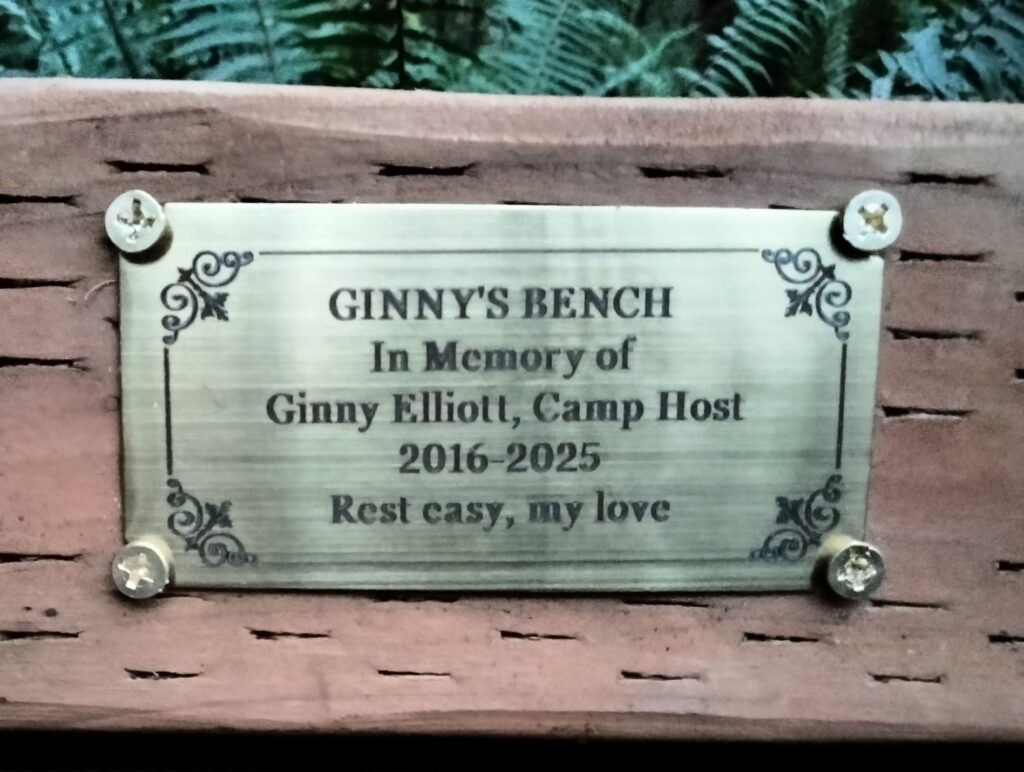
Steve this was so good to see and lovely. The bench is a great idea. I also would like to mention the musical The Secret Garden which deals with death in its story the book by Frances Hodgson Burnett and some of the musical’s song especially one.Thank you and may Ginny ‘s memory continue to support.
Report comment
I remember reading The Secret Garden but don’t recall the story. I’ll have to read it again. I’m very pleased about the bench, that was very healing for me.
Thanks for your support!
Report comment
What a lovely tribute, Steve … my condolences, once again.
I hope you don’t mind if I say that you are very fortunate your true love actually found you, and that you got to spend forty some years, with the love of your life.
But I will also say, my Spiritual journey has led me to believe that we all dream – every night – as one in the Spirit within the collective unconscious … and, of course, the collective unconscious includes the living and the dead. So I do believe you may still be with your love in your dreams every night.
I know that’s not the same as having her next to you in your waking hours, but I’m certain you and she are planning in your dreams how to find one another in your next life, if that’s what you so choose.
And I do believe we are all dreaming up our next lives within the Spirit, as co-creators of reality … so we may all have better lives, happier lives … in the future. I believe it’s good to be one in the Spirit, one in the Lord. God bless.
Oh, and yes, of course I agree. It’s absurd to claim missing one’s loved ones is a “mental illness” … the psych industries have run amok in their medicalization of all human traits and emotions. Honestly, I believe they should learn to live, and let live, instead.
Report comment
Ginny was an incredible blessing in my life, one I took for granted far too often. Even in death, she still managed to make me laugh and assure me that I was doing a good job caring for her. I am sure she’s on some other angelic mission now and I’m sure doing good things wherever she is. But I still miss the hell out of her!
Report comment
Beautiful piece, Steve. Thank you so much for writing this heartfelt essay. Grief is definitely something that needs to be talked about & acknowledged more in our death-phobic, emotion-phobic society. But certainly not swept up under the ever-expanding umbrella of “mental health issues!”
Report comment
Thank you for your supportive comment. It is not easy to open up about these things, but I think it’s so important that we as a society start letting each other know that big feelings like grief are OK to talk about, even if it’s hard!
Report comment
Wishing you all the best and thanx for your personal story. My mother died 2 weeks ago during a simple heart operation through a vain in the leg. I see what it does with my father after being 62 years together. If there is a afterlife I am sure we will join them again in the near future and our wounds will heal.
Report comment
62 years is such a long time! He’s got to be in agony. See what you can do to be there for him. I know men, especially older men, have often been trained not to talk about feelings, but whether or not, it’s still good to spend time together in person or on the phone if you can. And I don’t know if he’s a person comfortable with touching, but if so, that’s a great unspoken way to show your support if he isn’t ready to talk.
Hang in there. He’s lucky to have you!
And be sure to take care of yourself, too. How has losing your mom affected you?
Report comment
Steve
Such a wonderful testament to the power of human empathy and love. It stands in such a contrast to the cruelty we see around us. Your experience and expression of love with Ginny reveals the very best qualities of the human species.
In these times of enormous political chaos and existential crises in the world, the importance and value of close loving relationships cannot be measured, and it makes their loss even more difficult to bear.
Carry on! Richard
Report comment
Thank you, Richard!
Report comment
An absolutely brave and wise exploration of grief Steve McCrea! I am very grateful that you had the courage to so honestly write this story, especially, perhaps, your admission of the attachment wound from your childhood, and thus, its highly significant role in your relationship with Ginny. I’m grateful for your sharing this important piece of your grief, on two fronts. One, I’ve lived that scenario in my own very different way, and far, far more importantly, because your unpacking that dynamic showed just how asinine it is to “standardize grief”! By so beautifully depicting the contrast between your relationship with your mother and family, to that with Ginny, you gave a master class on how one’s individual experiences and relationships can never be reduced to surface level atomized objective values. Which begged the obvious question for me: what kind of person sits on a board/committee, and “votes” to standardize grief for the rest of the human race? The only fair answer I could glean, is someone who doesn’t have the faintest idea of what grief is, or is otherwise delusional that they do! But when I further considered that answer, I was struck by the implications that the psychiatry profession has, over many, many years, rendered significant grief to significant human populations. Perhaps, then, psychiatry might consider attending to its own prodigious unaddressed grief issues before weighing in on those with the character and courage to attend to their own grief; people like you and the wise people you’ve quoted here!
I wish I had some magic words here! But, of course, there are none, and I’m not going to risk trying to conjure any! It appears you’ve got many a friend and fellow travelers, so I just wish you well as possible on your grief journey Steve.
Report comment
Thank you, Kevin! Your words were very moving to me, especially at the end. Made me cry, actually! You really do “get it!”
Report comment
Very Humbling. Thank you Steve!
Report comment
I was struck by your astute observation that the “psychiatry profession has, over many, many years, rendered significant grief to significant human populations”. So true and yet these are the people we turn to for grief “help”.
Report comment
Thank you for sharing this sentiment, George! Perhaps grieving my unwarranted psychiatric childhood has bequeathed me an insight or two? Which begs the question: if grieving aides in a “transformational process”-arguably a non-negotiable intrinsic feature therein, how in the bejeebus could such a “process” have a timeline? It doesn’t, of course, and, as with Steve, I wish you the strength necessary to carry you forward throughout your “timeless” grieving process…
Report comment
My wife died of cancer last April at the age of 67. Her mother lived until 96. Her last name was Elliott. Never in a million years did we think she would die before me. We both found each other at 45. Second chances. Lynn was a tri-athlete, Ironman competitor, ran and lifted weights, vegetarian, never smoked or did drugs, the occasional glass of wine, she had a BS in Health/Education, she was a Life Coach. The most positive and energetic person on the planet. This whole business of pathologizing grief frustrates me to no end. According to DSM-5-TR I’ve got 39 days to get my shit together. What a farce. My own brother told me at 8 months that “that’s a long time to grieve”. Sisters have told me I “need help!”. A friend of 60 years said “Everything happens for a reason”. I have since learned who is safe with my grief, and surprisingly it’s not who I thought it would be. I too belong to two private FB groups for widows/widowers and we are aghast at what pressures society (family and friends) puts on us to get “better”. Validation in these groups is so helpful. Strangers – Who’da thunk. Dr. Donna Schuurman, EdD, FT has a podcast called “The Dangers Of Pathologizing Grief” https://www.dougy.org/news-media/podcasts/the-dangers-of-pathologizing-grief-dr-donna-schuurman-edd-ft. She is so very intelligent and well spoken, like you. Everything you have articulated in this article resonates with me. Thank you for sharing.
Report comment
Hi, George,
I am truly and deeply sorry for the loss of your life partner, and I think you know I’m not just saying that! I know just how rough it is!
You hit on a number of the kind of crappy things people say to suggest you are wrong for grieving as you do! Maybe you can show your brother this article and ask him to rethink whether 8 months is a “long time to grieve!” And “everything happens for a reason?” REALLY? So what was the “reason” this happened? Because God wanted to torture me? So I can learn how to deal with loneliness and loss and get practice crying every day? Because I did something to deserve it? WTF kind of “reason” do they think it happens for?
I also use FB widow/widower groups as you saw – maybe we will run into each other? I also found that total strangers have often provided the most quality support. I have a joke that when I feel shitty, I head down to Trader Joes and wait for someone to ask me how I’m doing. And I tell them the real answer, and they are usually amazingly supportive! I call it “Trader Joe’s Therapy!” My bank tellers were also reliably supportive in my darkest moments. Sometimes support comes from unexpected quarters!
Oooh, 39 days, better get on your horse, George! I think I’m down to 36 myself. The race is on!
I’m glad the article resonated with you. It makes me feel like it was worth it to share that vulnerable stuff if someone else is comforted by it. And by all means, share it with those who think this “happened four a reason” or whatever – maybe they can get a bit of a clue!
I’ll have to check out Donna Schuurman! Thanks for your kind words!
Report comment
Steve, I really feel your deep pain and grief. I am so very sorry you lost your lovely wife Ginny to cancer. I feel deeply for Ginny if she endured cancer treatments as it is often brutal on the physical body. It’s hard to witness a loved one go through that and not be able to do much to alleviate adverse effects. You had such a wonderful life together for 49 years and it sounds like she was your soul mate in the truest sense of the word. Because you had such depth to your love and connection with Ginny for so many years, you may grieve for a very long time, maybe for the rest of your life.
Thank you for writing and sharing this deeply personal and important essay Steve. It sure shows how absurd psychiatry is when they are judgmental of normal emotions and of how long they allow a person to have normal emotions when dealing with tragic life circumstances. Psychiatry expects people to act like programmed robots instead of humans.
My heart goes out to you, take good care,
RIP Ginny
Report comment
Thank you for your kind words. I’m glad the article moved you. It is quite ridiculous to expect someone to be “over it” on a certain timeline!
Report comment
You’re welcome. You are not alone, and your words made me feel the same. I cry every day, sometimes a few times a day. I might have one day where I don’t, but I know that just means the next day will be a bad one. For the record, I also struggle with big regrets regarding taking her and my life with her for granted. Pave paradise. Thank you for being honest and putting that out there.
Report comment
It is my pleasure, George. I had regrets at one point about wishing I’d worked to get her checked for cancer sooner (there were signs but she didn’t want to go to the doctor) and like you said, taking the beatuful life and the beautiful wife I had for granted. I remind myself that I can’t go back and that she wouldn’t want me to be filled with regrets, and that has helped.
Hang in there – I won’t say it gets better, but I do think we get more used to it!
Report comment
Thank you so much! I have been fighting this Grief is normal battle for my entire career (MSW/LICSW class of 91)- do some people need extra help and outside support? Yes many- grief pathological- occassionally but there is always a reason why that usually pre-dates the death. Grieve away! Say their name! Lay Flowers! Make a Shrine; go the grave very morning to say good morning- just don’t release balloons.
Report comment
Beautifully said!
Report comment
Ginny looks like an absolute riot, almost as riotous as her better half, and as though she managed to get riotouser and riotouser her with the years, in spite of or because of him.
Just sayin’.
Blessed be the riotous.
Thank you, Ginny, and thank you, Steve, and not least for reminding me to remember that my own unspeakably and indescribably better half…that it’s never too late to remind her to treasure me more…while I am still around to haunt her.
When (Dr) Mona, 70, told me her pal had lost her husband and solemnly observed:
“It’s HARD – losing a husband!”
and I agreed; “Yeah, the f**need keep coming back,” Mona laughingly agreed.
But gentlemen insist on “Ladies first!” I reckon, reminding me once more of that old romantic, Elbert Hubbard, and of the freakishly romantic tales of the sinkings of the Titanic and of the Lusitania…and of why I consider the two Eckharts the most romantic male writers in history that I know of.
All my love, Steve and Ginny and family, and much, MUCH more.
Tom.
“You can have absolutely anyone and everyone, and absolutely anything and everything you want, and infinitely more, too as soon as and as long as you do want it.” – The world according to Tom.
Thank you, Ginny, for giving us Steve.
Report comment
Thank you and bless you, Tom! What a lovely way to start my morning!
Report comment
You are completely correct that grief should not have a specific time frame. When my mother died, 3 months later I was at a doctor appt, and I started crying when I told the doctor about my loss. She looked at me, expressed her condolences, and then suggested I go on an antidepressant. I was incredulous. “No thank you,” I said, “Isn’t it normal for me to be sad right now? I don’t want to stuff my sadness down into my psyche. I need to feel it!”
I am so sorry about the loss of your dear wife. I hope things get lighter and more hopeful for you as time continues to pass.
Report comment
Thank you, Ruth! That is appalling – three months in and they want to give you drugs? Did she agree that three months was pretty normal to feel sad???
Report comment
so beautiful, i have to save it, so true
Report comment
Thank you!
Report comment
Thank you, Steve, your story of grief is a story of love. While your Ginny is gone, you are blessed to have shared such a remarkable love. I grew up in a Greek Orthodox family and as you have noted, there are clear protocols in regard to grief and it is a greatly respected process, implicitly it is ‘normal’. When I was a child, widows wore black for many years and sometimes forever;modern Greeks no longer do but the other observances still hold. Imagine my surprise, when I trained in psychiatry and discovered that so many of my family were, in DSM terms, mentally ill! I learned to speak the language of DSM to get through my training but reverted to my mother tongue as soon as I escaped, and it has helped me to understand people far more than the DSM ever did. Best wishes, Carolyn
Report comment
Thank you for your kind words, Carolyn. It is really quite baffling how the DSM just pathologizes any kind of strong emotion! I guess we’re all supposed to be Stepford Wives.
I am indeed very, very fortunate to have had such a great love for so many years. I know that many people never experience this kind of a bond, and it is just the best thing in life. Unfortunately, it makes it that much harder to deal with the loss. As one of the Facebook commenters said, “Grief is the price we pay for love.”
Report comment
Everything you said is so true. Calling grief a disease. Pathologizing it. Then medicating it.
I lost my only son to suicide two years ago. No, I’m not going to just get over it like I caught the flu. It’s more like I had my arm amputated. Bleeding stops eventually, but….
Since SSRIs strongly contributed to Joey’s suicide, I avoided that kind of “help”, hid my depression from my doctors, avoided therapy. Support groups were a lifeline.
(Eventually, I started therapy for another issue.)
Thank you for telling the truth about what psychiatry is doing to those who grieve.
Report comment
You are welcome. I am SOOOO sorry what happened to your son! And the denial that they had anything to do with it…
The amputated arm is an excellent analogy. We will never be able to function as we did before. It’s not something we “get over.” It’s something we have to somehow integrate into our lives, and it’s not easy!
Report comment
I am glad for grief. It keeps me focused on how things went wrong for my child. It tells me I was not crazy about how horribly she was treated , and we her parents as well. It tells me i was a fool to forget that humans are predators, how ubiquitous is evil, the love of money that turns high achievers into betrayers of children and families.
Report comment
It is important to remember. I think they want us to forget.
Report comment
Yes, thankyou, Steve. My first inclination was to list all nefarious reasons to pathologize grief, but I wasn’t feeling up to it, so I “brought it home”.
Report comment
Wow, great article, thank you so much! I’m so sorry for the loss of your wife.
It is crazy that one year is supposed to be enough for grief. That’s ridiculous, especially if you’re dealing with a complex loss, or sudden, unexpected loss, an untimely death.
I lost my dad when I was 12. He died by suicide. That’s a hard loss for anyone, but especially a kid.
I felt what you said, exhausted, existentially exhausted. That’s a good way to put it. That exhaustion followed me into adulthood. I think back to the counselors that I saw during those years. They weren’t effective at helping me. “Her grief process is latent,” they said. they were right. I buried my pain, “split it off” and was unable to access it.
Of course, it blew up all over everyone in adulthood.
Report comment
“Her grief process is latent.” How’s that supposed to be helpful?
I think suicide is particularly difficult to deal with. There are so many conflicting feelings that come up! I am fortunate that Ginny made it as easy as possible to say goodbye. But life is just not the same, and it kind of feels like an ongoing battle.
I’m glad you related to the article. Thanks for sharing your experience with me, and I am so sorry about your dad. Wish I could give you a big hug!
Report comment
Thanks. Now, in my 30’s, I’m finally moving through and past it. But the void will always be there.
Funny thing, just today I went to a webinar about prolonged grief. Katherine Shear was mentioned. Apparently she’s done alot of research with prolonged grief. I was like, gee, glad doctors are finally catching up to reality.
Report comment
Like you said, there’s no way to replace that arm. We can learn how to live without it but we can’t make it like it never happened, and that seems to be what the psych professions are asking us to do.
I would love to hear what Kathleen Shear has to say about the subject. It would be lovely if they really did have an APPROPRIATE plan to help, especially if they can make it accessible to everyone instead of just the privileged who know about it and can afford it!
Report comment
I very much appreciate your sharing this Lila! It’s my belief that unaddressed losses and traumas during ones childhood, can take myriad forms that easily comport to many psychiatric diagnoses; ergo depression, anxiety, attention issues, addictions, and more. No new there! But like the venerable DW Winnicott said, there are only two things that go wrong in childhood, things that happen that shouldn’t happen, and things that don’t happen that should happen. I think its the latter where grief gets buried, losses that happened before a child even comprehend what they’ve lost, much less understand their loss sufficiently to grieve! Anyway, good on you for doing the work now, of which will no doubt will come back to you in some exceptionally unforeseen heartful ways.
Report comment
Thank you
Report comment
This is a thoughtfully written and deeply insightful article. Your examination of how grieving has been medicalized sheds light on an important and often overlooked issue, inviting readers to reconsider societal expectations around loss. The clarity, depth, and nuance in your analysis make the piece both intellectually engaging and emotionally resonant.
I especially appreciate the warmth and empathy woven throughout your writing—it honors the very real experiences of grief while encouraging reflection and understanding. Thank you for offering such a compassionate and thought-provoking perspective on a profoundly human process.
Report comment
Thank you, Jacqui!
Report comment
Steve, I keep coming back like a bad penny, as My better half would say. I offer apology; I was not able to accurately read “this” story until today nor recognize you as the author because the title was too daunting. It hits a nerve. MOST of all, your tribute to Ginny and testimony of your relationship confirms and expands upon what I have noticed about you from earliest exposure; you are a special person, really decent and amazing. Ginny found a gem and you likewise. You and Ginny have been speaking love and truth to us all. So uplifting. Thank you.
Report comment
Oh, gosh! Thank you, Carol! I was a very, very lucky man to have found Ginny so early in my life and to recognize what a gift she was! She made me a better human being in so many ways. I’m sorry that you can relate so well to the story – it is a criminal shame how grieving people are being “treated” as if there is something wrong with them!
Report comment
Your wife was an amazing person and don’t you ever forget that love never nobody should ever tell you you have to forget or get over it. Love is prayer and it’s precious. It’s something that should be cherished not shunned. I am so sorry for your loss. Truly, I have mine as well. I think we all do. I just think some people hide it better than others or maybe they really didn’t have true love maybe think about that one! Again sorry for your loss of a great love affair. Everybody’s like you’ll date again it’s like if your dog dies they say oh go buy a puppy each person each pet is different. They have feelings and that’s all there is to it. Some people just hide it better than others. A love one who is gone should never be forgotten and those dreams that you have about them are signs from heaven that they still love you.
Report comment
Thank you for that, Cecily. The idea we have to “hide it” is what I am most trying to attack in this piece. The green “Ginny” armband was something I started sporting in the last month or so to remind myself AND others that Ginny is still very much on my mind and that I am grieving her loss every day, 10 months later. It’s actually helped me because I can feel the pressure and remember I have her name with me so I don’t have to keep thinking about her, it’s like I’m taking her with me everywhere I go. At first I was going to do a black armband, but then I thought of Ginny and thought, “Nah, she’d want something colorful and bright!” So I used the color she used to wear for her soccer uniform.
And I think the idea of somehow “replacing” her with a new person is pretty awful! Not that she’d mind at all if I fell in love with someone new, she would rejoice for me if I did, but it would not be anything like the same. I’ve often thought of the Job story, where at the end, God replaced his wife and kids and animals and all and he was supposedly restored to the state he was in before God and the Devil made their bet. I thought, “Wow, I don’t think that would work, to just replace the people he lost like buying a new car or house or something.” He’d still be devastated!
No one should ever have to hide their grief, especially from “professionals” wanting to make it go away so THEY feel better!
Report comment
What’s this green arm band business?
Report comment
It’s a memorial arm band. Something to remind me or others that I am still grieving. I would have gone for black, but I don’t think Ginny would have liked that as much.
Report comment
Awesome.
Report comment
Steve, thank you for sharing. You could have been speaking for a lot of my own experience in describing so well both your struggles and search for meaning. I think that’s in part because your reflections relate to the nature of human experience in general, a state of being or becoming we’re not so free to feel in the social conditions which have come to heavily determine how we experience ourselves.
We’re robbed of our ability to be authors of our own lives when claims upon our consciousness by agencies of authority, like medical ‘science’, turn our subjectivity into objects of control – to such absurd lengths as defining quantitative measures like periods of time for qualitative dimensions of personal experience (e.g., grief) made into problems to be solved by specialists (e.g., grief counselors). Professional monopolization of meaning under expert knowledge serves the capitalist system’s commodification of all life, including human nature, converting all (intrinsic) values of living into market exchanges and monetary worth alone. (See, for example, John McKnight’s The Careless Society: Community and Its Counterfeits.)
Precapitalist traditional cultures which you mention were not without their abuses of control, as history of institutional religion abundantly demonstrates. Nevertheless, communal contexts preserved more humanly scaled autonomy, agency, and action by which personal (spiritual) meanings belonged to a human commons. In a much more imperialistic manner, modern sciences of social engineering serving the capitalist system reduce us to atomized units of production and consumption within far more institutionalized machinery of control without intermediary of communal relations. Now we must go to market to pay for attention and care which once belonged more naturally to everyday human associations.
An increasingly universalized state of human alienation among lonely crowds without real relations has come to define our captivity as sentient beings, so much so that we are now being marched into a techno-totalitarian (anti)society where our primary relationship will be machinery like AI manufacturing us as robotic slaves. No wonder the loss of a loved one can become a crisis of survival when living has been so emptied of meaning and value on any other terms than the rule of profit and power over all.
We are relational beings through and through, in need of mutual connection for meaningful living. It’s love, not some sentimental but a fundamental condition of being human, which makes it all worthwhile. Keep the spirit of love, in all its depth and mystery, as the light that still shines through the darkness.
Report comment
Alienation is the exact right word. We are taught that somehow how we are is wrong or inadequate or that our experienced don’t matter or are problematic and nee to be “fixed.” The need for connection is primeval and the saddest part is how little that need is respected in our society and culture.
Thanks for your kind words!
Report comment
They just want us all to act like robots like we have no feelings think about it. The Indians praise their ancestors even the ones they never got to meet because they wouldn’t be here if it wasn’t for them and if you lose a great friend, a trusted friend who respected you and you respected them, and they always looked out for your best interest and never tried to harm you but only try to do the right thing. That’s a one in 1 million. Why should you ever forget that person but they wanna wash that out of everybody’s memory why all their great teachings and love that they gave you and caring you’ll take those memories with you for the rest of your life. Why do they wanna wipe them out? It just is no common sense. Again sorry for your loss. You were a lucky person to spend time with her and your dreams are connecting her with you. Everybody should just look at that your dreams and even daytime memories about your loved ones and the advice they gave you and the caring and sharing and trust they’re still looking out for you from afar. It’s true wisdom and don’t take that love ever for granted or their advice they’re trying to guide you. They’re trying to still be nice to you in a kind way. Just remember that breath deep. I just recently lost my son and I’ve lost some other family members and you know what I’ve never forgotten any of them nor should you or any of you. It’s wrong to say that you have to.
Report comment
I totally agree with one of the post up above and you the grief shouldn’t just be swept under the rug or just “GET OVER It!!!” I get a text a text from a relative less than a week after my son died tragically wow and then wants to tell me I’m embarrassing to her because I’m not getting over it. It hasn’t even been a week. Wow what they expect from people these days, but it wasn’t her child then it would be different! When it’s not their immediate family or if it doesn’t affect their life, they just turned around and tell you to get over it. It hasn’t even been a week. What is this world coming to? Lord only knows
Report comment
Hi, Cecily.
I cannot begin to imagine what it is like to lose a child, let alone to lose one tragically. Perhaps you are a greater, more courageous soul than I am to have undergone such loss.
The loss of pets has been enough almost to destroy me, although, strangely and MOST thankfully, the loss of my parents in old age left me feeling peaceful and grateful more than sad, like their great gracious last gifts to me, magically blessing me.
And I feel far, far closer to both my parents now than ever while they “lived.”
I believe they do live on, eternally – and both within me and outside of me, if that makes any sense.
You ask
“What is this world coming to?”
There must be thousands of tens of thousands of accounts of people’s “near death” experiences on the Net. Perhaps millions among us have already had such experiences, and an ? exponentially growing number will?
Once we figure out the right questions and how to pose them, the answers have a habit of popping out, don’t you find?
Don’t you find it’s like, whatever about all the other beings in this world, we each inhabit many, many worlds all at once, and we can access and dwell in any of them at any moment simply by adjusting our attitudes, our thoughts, our hopes, our dreams, our wishes, our prayers – or our degree or acceptance of what ALREADY IS…?
Just wondering if this may be what one person meant when/if he suggested that
“In my Father’s House are many dwellings….” or however he may have put it, exactly?
Peace and comfort and love and ever more of it to you.
And thank you for such heartfelt sentiments, so beautifully expressed!
Tom.
Report comment
Less than a week a loved one dies another relative is yelling at you get over it. Wow I haven’t even seen that relative in years then they’re like oh you’re not getting over it then it’s going to embarrass me wow we live in completely different states for years hardly see each other or talk. I called her to let her know what happened with my son and his sudden death!And then that’s what I get wow!
Report comment
Steve, that was a wonderful, thoughtful, and moving article. I am so, so sorry about Ginny.
–> Would it be okay if I quoted parts of your piece, with attribution, of course, at an upcoming presentation / panel discussion on grief at the school where I work? Probably, I’ll talk about the multicultural angle in particular, but I have to see who the other panelists are.
Since my last post here, (I think, I might have posted one during recovery) something very strange happened: I died. By that, I mean that my heart stopped for 10 minutes while I was in the ER, and I survived with no cognitive impairment (which is possible, albeit desperately unlikely if trained staff is giving you CPR and transfusions — the SCA was due to hemorrhagic shock.)
My odds of survival were under 5%, and of surviving with no neurological impairment were under 2%.
I was in the ICU for 5 weeks, and recovery was six months.
In addition to other losses I’ve suffered over the decades, we can add the loss of my former self, for whom comfortable illusions about life and death were possible. I sometimes feel that one reason folks ask us to ‘get over it’ is because they don’t like thinking about the end of their own lives, which is what they are reminded of when someone else is grieving.
I always knew that I would die someday, but… I didn’t accept it on a visceral, animal level. There was still part of me that believed, “Well, it’s true that about 117 billion people have lived on this planet at one time or another, and they all died, but I still think the sample size is too small. I could totally be the first guy.”
So maybe 18% of that guy– Catalyzt V1– is gone, and now there’s Catalyzt V2 superimposed on the remaining 82% of V1.
Another part of it is that I was AWARE that I was dying, as many people are– no visitations by relatives or anything, but a red tunnel, a sense that I had to maintain physical and corporeal integrity. And I did have to let go of everyone– grieve for the people I loved who would survive– and I knew that if the doctors, and my own, efforts to resuscitate me failed, my wife, my friends, my pets– they were lost to me forever.
While that was deeply sad, it was survivable. My thought was, “Well, in one way, this is easy, because there are no ‘decisions’ I have to make. The best course of action for me and for them is absolutely clear, and in this way, my problem is simpler than any other I’ve ever faced. I just have to maintain physical and psychological integrity, try not to die. And I can start by trying to find the lower half of my body, because I can’t feel it at all.” And so I worked on that, and eventually, it worked.
It’s a strange situation that I find myself in now, very mixed. On the one hand, existential despair is deeper than it ever has been– I know dead is dead. And yet… in another, I’ve become more appreciative and accepting of life than I was before (and I thought I was doing okay with that before this happened.) In some strange way, I now have something different that doesn’t make me mourn less, or make it hurt less, but contextualizes the hurt in a way that makes it easier to feel joy at the same time as the despair.
Just as one example: I get just as sad thinking about the day our senior dog will leave us, yet there’s something ELSE that’s present. I’m with him every moment that I’m with him. I feel like he’s aware of me in a way that he wasn’t before, either. And nothing takes that away– this moment, right now, that I’m writing this post? It’s unassailable. It’s something that can’t be erased at some level, even if no one ever remembers you, me, the other people posting, Robert and this website, etc.
I still feel like I’m not describing this well, but maybe I’m getting a little bit of it across. I remember reading Yalom’s “Existential Therapy” for CEUs during my first license renewal; Yalom– who I respect enormously– kept saying that confronting existential givens helps us achieve some more authentic mode of being or, you know, whatever the f*ck.
And years go by, and I would re-read the book and think, “Yeah, really? I’m waiting for that more authentic whatever! It’s been five years! You said it would take a while, sure, but Irwin, any time soon is good! How about right now?! Because your book made me totally frickin’ depressed and I feel like I’m getting nowhere with this! I miss my parents! I even prospectively miss people who haven’t even died yet, perhaps more than I did before I read your damn book. This has gotten me exactly nowhere!”
Incredibly, 10-odd years later? I may be beginning to see what he was getting at.
Bless you, man. Thanks for being a great partner to Ginny, for honoring your wife with this article, and for the work you do moderating this forum. It’s deeply appreciated.
Report comment
Wow, thank you for making my evening! I am honored that you would want to use some of my work in another context, and of course it’s fine with me, but I do thank you for asking. I figure anything I put on the internet is “public domain” and I had to decide that I was willing to have that experience before I started writing.
I actually think I DO get the gist of what you are talking about – when we have to face our own mortality, our awareness of the present moment increases and I think we can learn to value each moment we have more highly. And illusions about permanently continuing life come crashing to the ground.
I guess I’m not so sure that your experience says to me that “dead is dead” – if you recall the lucid dream I had where Ginny came to visit, she made it clear that something else was going on after death in the world of the Spirit. Of course we all have to draw our own conclusions on that, but my current belief is that she was really communicating to me what to expect after death, and honestly, it sounded pretty cool!
I really appreciate your describing your brush with death. You might not believe this, but I found it oddly comforting. I have an open heart surgery coming up in a week and a half, and though the odds of survival are MUCH greater than what you faced, it has most definitely brought me face to face with the possibility of my mortality. It is good to know that we still have a choice even in the interim state of not life/not death to choose to rejoin the living. I will keep that very much in mind as the operation approaches.
Thanks again for your very kind words. Best of luck with your presentation, and if you have anything in writing you can share, I’d love to see it!
Steve
Report comment
Steve: In regards to your open heart surgery. My well wishes for your speedy recovery. (and blessings and prayers, too, of course!!! with the kindest, highest vibrational visualization surrounding your precious, loving Light Body and physical body!!! Yes, I wax Metaphysical : ). why hide it? In regards to Ginny. She looks so fun & cool & smart! Notice I am speaking in the present? It’s because I agree with you. In my opine: her coming to you in your dreams is EXACTLY Ginny. Telling you how it rolls on the other side of the veil. It is my opinion. One that I’m O.K. with. Take care, precious one. Thanks for all you do speaking for the oppressed who have not found their voice. Or only parts of it. I am a fan. Still can’t get over how you have all of the scientific studies memorized & shazam! just lay it on the reductionists as you are wont to do. SMILES AND BLESSINGS! ~Snowy Owl (Paige)
Report comment
Thank you, Paige! You totally made me cry. I needed to hear your words of wisdom. Whatever happens, I know Ginny is with me in the spirit world. I am 100% sure she was visiting me. It’s good to know I’m not crazy for thinking that!
Thanks for your love and support. It means a lot!
Report comment
Steve, just read about your upcoming open heart surgery. It must be only days away now so keeping you in my thoughts and prayers for all to go well and for you to have a complete recovery. I know it would be hugely comforting to have Ginny at your side but I believe she will still be there with you in spirit and watching over you. Take good care, Sending heartfelt best wishes.
Report comment
Thanks for that! If prayers make a difference, I should be good, because I’m getting lots of them!!!
Report comment
Dear Steve,
A brave and beautiful piece of writing. A year is no time at all. Sending you love from Australia.Go gently at your own pace. I truly believe the dreams are blessings and manifestations. I’m not religious in any way but convinced these are messages. My best friend still appears in my dreams 5 years on with advice, always at times when I need her pithy response the most. Love Kx
Report comment
That’s so cool! We all could use pithy advice from the hereafter! I appreciate your validation of my experience. And you’re right – I’d say that a year in, I’m just beginning to grasp the idea of living a life without her and how I might make that possible. But it can never be anything like the same life. It’s almost like having died myself and been reborn in a life I never meant to be living. I’ve been given many gifts but it is still exquisitely painful. And I believe that’s how it is supposed to be.
Report comment
Thank you! Everything you have written about loss and grief is absolutely real. I love my hunee Mike, still! After losing his battle to cancer two years on, I still talk to his photos (I have a photo in each room so I can see him or talk with him), I’m sure the psychologists would have fun with me haha. I am not psychotic, nor am I delusional; I just miss my bloody husband. And you are right; people don’t really want to hear how much I miss Mike. Instead, I say I’m good thanks, then I leave. It’s easier for both of us, because their awkwardness is energy draining now lol. Anyway, I just wanted to say, I enjoyed reading your story, it was real and I totally resonate. Thank you from New Zealand.
Report comment
Thank you! I’m glad it resonates with you. It’s true, it’s usually not even worth trying to explain things to those who don’t already get it. Makes them uncomfortable and wastes my time and energy. But I’ll be damned if I keep quiet to make them feel better! If they ask me how I’m doing, I tell them! If you don’t want to know, don’t ask!
Report comment
We will definitely be praying for you, Steve, and for selfish reasons, too. You have become very real and loved!
Report comment
Thank you, Carol!
Report comment