I often mention that I was the only one of Catherine Smoral’s grandchildren to see her alive. I was six years old, and the visit to Willard State Hospital was a bad experience for all four of us who were there: my mother Anna, my Uncle Tony, me, and my grandmother Catherine. The three of us who came from Syracuse were all shocked at the physical and mental condition of our mother and grandmother. Our visit upset her, and we spent a very short time there before being asked to leave.
My grandmother was born in Poland in 1884. She emigrated to the U.S. in 1900, and in 1902 she married my grandfather, Karol Smoral. They were married at Sacred Heart, a beautiful Polish church that still stands on the west side of Syracuse. They were a happy couple who went on to have nine children, a happy and healthy brood. Karol bought his own home on Morgan Avenue, and a family burial plot at Sacred Heart Cemetery not far from it. In the early 1920s, disaster struck the household.
I received, I believe from Ancestry.com, a copy of an article from the Syracuse Herald from the early 1920s. This is how it read:
SMORAL FAMILY WOES CULMINATE IN COMMITTAL OF EIGHT TO INSTITUTIONS. Mother and Son Are Sent to Willard. Six Younger Children to Various Orphanages. Father Died in December.
Mrs. Catherine Smoral and son Stephen, 15, were committed to Willard. Until death delivered its first blow at 107 Morgan Avenue, the family of Karol had something resembling happiness. The mother, who had been in a State Hospital before, had been returned to her family apparently cured. Stephen, then the oldest child, was of working age at 16. The children were sufficiently nourished and progressing. When Karol died, his wife became melancholic, and their son Stephen succeeded her as both mother and father of the household. The burden of being both mother and father broke him down. An investigator from the International Institute found the family nearly destitute. The son Stephen had been employed in a laboratory, but conditions for work were made impossible.
Awaiting his transfer to his new home, Chester drugged himself [he was a year and a half old at the time] with some chocolate he was given by someone in the courtroom. He smeared himself with the chocolate . . . Welfare workers are working to find him a home in a Polish family. The four girls had been all dressed up for the trip and were quiet. They had been weeping.
No matter how many times I see or read this article, I get emotional. It encapsulates the reason I wrote the book. I have a lot of trouble with it. First, it is inaccurate, and it tries to make those kids into clowns instead of marveling at their courage. Perhaps what bothers me most is the comment early on that the family had “something resembling happiness.” Who in the hell was that reporter to make a judgment like that? That’s my family he is talking about. How did they make this family tragedy a front-page story, and why did they try to turn it into some semi-comic farce? Every time I reread it, I would like to hit that reporter right in the face. But at the time, maybe mental illness and sudden death were subjects for fun and light-heartedness.
His name was never Chester. His given name was Vincent, and his nickname was Chet. I get upset about his “drugging himself” on chocolate when he was a year and a half old. He may never have had chocolate until that day. I always admired him. He became a scholarship athlete who went to college and was the first member of the Smoral family to graduate, and he was an excellent role model for his children.
Then there is the way they described the girls, all dressed up but weeping. Those girls were about six, eight, and ten years old. They had just lost both parents, their home, and probably each other, and the newspaper noticed that they had been crying. This was my family they were talking about. They should have had the sense to commend those children for holding up so well. A lot of children could not have, and I wouldn’t have blamed them. This article encapsulates all of the sadness in this whole story.
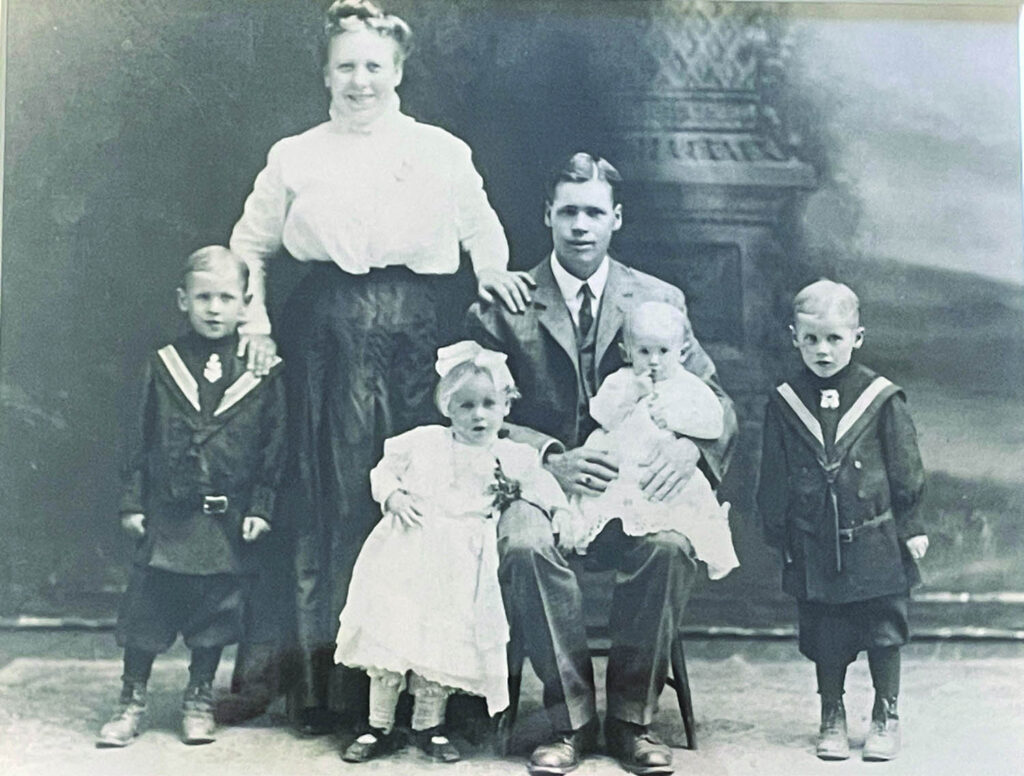
I got over the visit to Willard pretty quickly. My picture of my grandmother faded after a short time, and I became immersed in the process of growing up. I talked to my mother about her mother at times, but she always seemed reluctant to go very deep in these conversations and often changed the subject. She had been hurt by something that happened with a family of distant relatives who used her as their housekeeper, but she was happy remembering her mother’s love of singing Polish songs to and with her children.
It was a long time before the subject came back to us with any depth. My father died of cirrhosis of the liver in 1956, and in 1957 my mother learned that her mother, Catherine, had died at Willard State Hospital. I was living at my mother’s, preparing to go back to Syracuse University after three years away in the Army. I have no recollection of my mother or any of her siblings going down to Willard for a burial service, but I may have been too tied up with my own concerns. I do know my mother began to make inquiries about how to bring Catherine’s remains back to Syracuse.
I found out later, in my own inquiries, that burials of patients at Willard were unceremonious. The remains were buried in an open field near Willard and identified by a small numbered aluminum cap placed in the ground where the person lay. The field was not maintained very well, so finding a grave could be very difficult. This became a major point of contention for Willard families, and several years later the New York State Assembly passed a law making it much easier for families to look for their deceased loved ones. What exactly that bill did, I do not know.
In 1975 the company I worked for, Xerox, transferred my family and me from Rochester to its corporate headquarters in Stamford, Connecticut. In one of my biweekly phone calls with my mother, she told me she had successfully moved her mother’s remains from Willard to Syracuse. I was amazed. It had to be a difficult and expensive process. I didn’t ask her about the details, but she was very happy it was done. The burial plot Karol had bought at Sacred Heart Cemetery had passed to my mother.
In 1979 Xerox transferred me back to Rochester, and a short time later I drove into the cemetery to visit the Smoral plot. It was a little run down, to say the least, and I couldn’t find a gravestone for my grandmother. As soon as I got home, I called my mother to ask about it. She started crying and told me she had used all her money moving her mother’s remains, but she was saving her spare money and would buy her a stone as soon as she could. My heart fell, and I cried too. I asked why she hadn’t called me for help. She said she didn’t want to bother me; she was trying to do it herself. I quickly convinced her it was our problem and that I would help.
The following week I took a day off, drove to Syracuse, and bought a new gravestone for my grandmother, and one for my sister Betty, who had died at six from a ruptured appendix. Betty was two years older than me. My mother had had her mother’s name engraved on the back of Betty’s stone. That is why I couldn’t find it.
Today, in the Smoral plot in Syracuse, all with legible gravestones, lie my grandmother and grandfather, my mother and father, my older brother John and his wife Kay, my sister Betty, and my uncles Steve and Joseph, both children of Karol and Catherine.
I know how much this meant to my mother. She started working outside the house when I went into first grade and worked until she was 64, most of that time on the assembly line at G.E. She worked extremely hard and never complained. She never had an extra dime, partly because of my father’s drinking, but when I first started college, if she had a dollar she would give me half of it. She was kind, soft-hearted, and intelligent, and anyone who knew her loved her. I was lucky to have her as my mom, because I would have gone nowhere without her.
The next big event in my grandmother’s story and mine came after I had retired from Xerox and joined the faculty of the Rochester Institute of Technology. There were always old newspapers around, and sometime between 1995 and 1998 I picked one up. The first article I looked at said that Willard was closing, and that a trove of residents’ personal belongings had been found in the attic of one of the buildings. They were going to put the items on display, and if you could prove a connection, you could take an item home.
I immediately ran to my office to call Willard. I wanted something of my grandmother’s to keep and to remember her by. A rosary, a prayer book, an umbrella; my mind started racing. When I got through, they told me the attic exhibit had closed a week earlier. I called again the next day to ask whether there was any way to go through what remained for something, anything, of Catherine Smoral’s. A very nice young man who had worked on the exhibit told me there were few things left, but he would carefully go through them and call me within a week. He did call. He had found nothing, and he was sorry, because it seemed to mean so much to me. It did mean a lot to me, and so my quest for information on Catherine through New York State began.
I never thought it would be so difficult and frustrating. Probably the hardest part of the whole journey was dealing not only with the Office of Mental Health but with the entire political structure of the state. I was directed to the New York State Office of Mental Health in Albany. Many of the calls I made and the letters I wrote are included in She Was Here. Almost from the first call, I noticed an adversarial tone in our exchanges on every subject. The Office of Mental Health seemed to have a separate department for saying no, and I believe I was misled by them several times.
I wanted to know the reason for her hospitalization. I always thought it was a bad case of depression, considering the disasters in her personal life, but I don’t think her death certificate mentions depression. Perhaps it had a different definition and meaning back in 1920. More importantly, I wanted to know how she was treated while she was at Willard, and that was almost impossible. Asking where her treatment records could be found produced a lot of answers, none of them accurate. I eventually found out through the internet that the records had been sent to the state hospital in Binghamton. I called the records section there and spoke to a helpful young woman who said she would look them up and let me know when she had sent them. I heard nothing for almost three weeks, so I called again. A less friendly woman told me the first had left, with no mention of my earlier call, and no, she didn’t know where she had gone or how to reach her.
After giving up on the Office of Mental Health, I started writing to every New York politician I could find: Governor Cuomo, Lieutenant Governor Hochul, Senator Gillibrand, Senator Schumer, and my local representatives, State Senator Funke, State Senator Brouk, and Assemblywoman Lunsford. Out of all of them, I received one letter, from Kathy Hochul when she was Lieutenant Governor, telling me she had forwarded my letter to the Office of Mental Health. One of my state senators’ aides did listen. She sounded ready and willing to help, said she would call back in ten days with a progress report, and kindly gave me her personal phone number to call anytime. After three weeks I called, and the number had been disconnected. I never heard from that office again. No one else replied in any way.
Someone at the Office of Mental Health mentioned that there was a statute on the books sealing the records of Willard patients. I never chased that one down. But suffice it to say, New York State makes it very difficult to get information about relatives who were sent to Willard. When I first started collecting what little I could from the state, I came across a website run by a woman who had a close relative at Willard, just as she was announcing that after six years she would no longer continue it, because of her problems with the state.
I retired after thirty years at Xerox. I was lucky enough to have a very successful career, and I really enjoyed my job and the people of Xerox. Then I joined the faculty of the Rochester Institute of Technology and spent another ten good years in its College of Business. During my time in Rochester I was asked to serve on at least nine community boards, all not-for-profit organizations, among them Highland Hospital, Rochester Blue Cross/Blue Shield, the Rochester Institute of Technology, the Memorial Art Gallery, and St. John’s Senior Communities.
When I retired from RIT in 2000, I really did want to retire. I had a good friend at RIT named Jim Papero who thought otherwise. He was on the board of an organization called East House, which I had never heard of, and for six months before I retired he ran a campaign, sometimes a little hard to take, to get me to join him. Almost to quiet him down, I agreed to have lunch with Jim and the CEO of East House. Greg is a hard guy not to like. When he told me about their mission, which was to help people recover from a mental illness, a substance use problem, or both, and that their mission statement was to MOVE LIVES FORWARD, he had me.
I was on that board for several years and was chair for a period. It was my most meaningful and worthwhile board experience. We treat our clients as people who have temporarily fallen off track, and we help them back on. I met several of our clients and heard their stories of recovery, and I couldn’t help but think of my grandmother as a client of East House rather than of Willard. We have made a lot of progress in dealing with mental illness, but we need a lot more, a lot sooner.
My lovely wife Susan and I were married for 63½ years. She died in September 2024. We were blessed with a long and loving relationship. She was always supportive of my attempts to learn more about Catherine Smoral and to find a way to honor her. She never saw or read my book about Catherine, She Was Here, but I know she would have loved the book and would be proud of how I have it displayed in our living room.
My oldest grandson, Matthew, an entrepreneur in Brooklyn, and I have always been close. He came up to spend a weekend in Rochester about a year after Sue’s passing, when I had been thinking about selling the house we had lived in for 28 years. Sitting on the kitchen table was a sheaf of papers I had collected in my search for Catherine’s background. I didn’t mean to leave it there. Naturally, he asked me what was in the folder. “My grandmother’s history,” I replied. When I told him I hadn’t figured out what to do with it, and that I might have to destroy it, he jumped up and said, “You’re going to forget her like everyone else.” I asked him what he thought I should do. His immediate response was, “Write a book for her.” As soon as he said it, I committed to doing it.
Thank you again, Matthew.