Therapy, in its crazy way, by emphasizing the inner soul and ignoring the outer soul, supports the decline of the actual world. Yet therapy goes on blindly believing that it’s curing the outer world by making better people. We’ve had that for years and years: “If everybody went into therapy, we’d have better buildings, we’d have better people, we’d have more consciousness.” It’s not the case.
—James Hillman
We know—we know—that the future our imaginations were promised is not the future that awaits us. This summer, more than any previous, is our evidence. As I write, fires rage across the American west, bombs drop on children, surveillance architecture is daily being constructed outside rural convenience stores. In our hearts, if we look, the knowing of where we really are is clear.
For many in the West, the future has long been a source of secure attachment. It has been our god, a shining destination justifying the sacrifices of generations. All the brutality of history has supposedly made sense through the lens of progress. We’re going somewhere amazing. Utopia has been just around the corner with every technological advance, asking for just a bit more patience, a bit more sacrifice, a bit more relinquishment of our humanity—just enough so that when the robots take our jobs, the foretold dawning of endless leisure will arrive as prophecy fulfilled.
For many, this enculturated fantasy of the future has been the bedrock of busy lives, unconsciously justifying cycles of overwork, burnout, and addiction. For a brief window in time, for some, it seemed true that children could build better lives than their parents and that technological advances did indeed improve the quality of life for a majority of the populace. However, here at the logical conclusion of an infinite growth paradigm, driven by technological development that has greatly outpaced our moral or spiritual development, we are left to contend with the starkness of reality.
Anytime you’re gonna grow, you’re gonna lose something. You’re losing what you’re hanging onto to keep safe. You’re losing habits that you’re comfortable with, you’re losing familiarity. That’s a big one, when you begin to move into the unfamiliar. You know, in the organic world when anything begins to grow it’s moving constantly into unfamiliar movements and unfamiliar things.
—James Hillman
As I discussed in part one of this essay, we are at a collective threshold that in another cultural context would imply the need for a “rite of passage.” As Peter Kingsley describes in his book Catafalque: Carl Jung and the End of Humanity, the mythic energy fueling our collective stories has withdrawn—our society is like a ship at sea, moving forward without propulsion, carried only by its remaining inertia. Soon, the density of the water will have its way.
Rites of passage are about growing up. They are designed to activate our latent soul capacities, allowing us to rise to moments of change and loss, ultimately pointing back to the fundamental uncertainty of existence. These ceremonies intentionally confront us with the facts of life—birth, transformation, and death—with the aim of engendering our surrender to a larger order. True adulthood is marked by the capacity to live in ever deepening levels of complexity, holding nuance, paradox and change with open hands, neither resisting nor clinging to easy answers.
As eco-depth psychologist Bill Plotkin has expressed through his eco-centric developmental model (presented in his book Nature and the Human Soul), mainstream western culture is an expression of arrested development at the adolescent level. Look around—the values of ego strength, material accumulation, competition, hubristic certainty, and tribalistic social organization dominate the discourse. It’s all about speed, growth, victory, dominance, knowledge, vitality. The developmental values of healthy adulthood—humility, community, cooperation, surrender, service, death literacy and wisdom—have not yet been embodied on a collective level. As a result, we cling to a future that only exists in the illusory linearity of our underdeveloped psyches. As the promised future and our capacity to attach to it falls away, we face the daunting task of discovering what remains, and where our security actually comes from.
Stubbornly insisting on life can result in its opposite. The frantic desire to ward off death can actually invite it. Conversely, if you wish for life you must be prepared to welcome death. If you demand life, you must accept that death is a part of life, its dark half, without which no life, no experience, no living meaning, no poetry, no love is possible.
—Andreas Weber
I spent many years in exile—from my body, my heart, my community, and earth herself. A traumatic psychedelic initiation at 19 ripped my hands from the security of my just-forming adolescent identity. In a single night, the future I thought I was moving toward disappeared. For nearly a decade, I moved in the world without a sense of ground beneath my feet, wandering through anxiety, depression, and addiction, desperately seeking some sense of belonging. While I was lucky to have a solid family and to have been raised with relatively secure attachment, I knew after such a rupturing experience that I couldn’t remain regressively clinging to their psychological structures or the identity I generated from them. I was terrified, but I understood that I had to let go. Forward was the only way.
This hellish chapter finally ended at age 28, when I mustered the courage to attend my first wilderness rites of passage program with the Animas Valley Institute. It was a crisp February morning in Joshua Tree National Park and the facilitator, Brian, had invited us to go “wander the land and let yourself be guided to a being that feels like a nurturing, generative adult,” and to “have a conversation with them.” Although I struggled to intellectually comprehend what he meant, some intuitive part of me knew.
Standing from my chair in the group circle, I turned my body in a circle, listening for the direction I was being called. As I came around to the west, I felt a tug in my belly from beyond the beige cactus-dotted hill I was facing. Instinctively, I started walking.
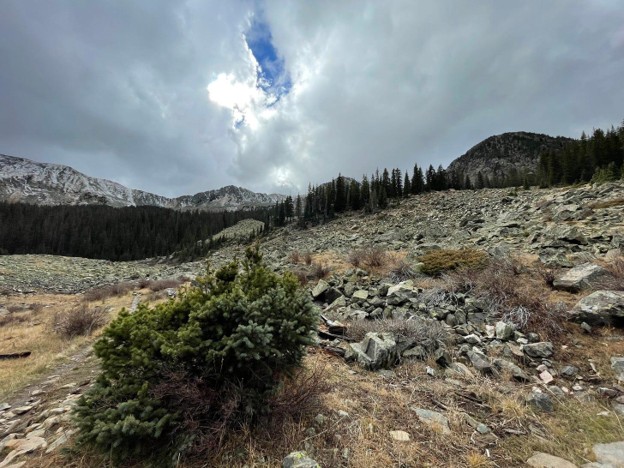
As I crested the hill and looked down the other side, the urgency in my belly expanded into a mixture of anxiety and excitement. Something was actually happening and my body recognized it. Dropping down the other side of the hill into a small valley, I noticed a dry arroyo and realized it was where I was being called. As I approached, my mind went silent. When I reached the arroyo, without knowing why, I knelt down and then prostrated, pushing my forehead into the dust and stretching my hands forward, palms up. Immediately, the grief arrived.
Like those first drops of a rainstorm, the tears dripped slowly, and as they hit the sand, the full force of the storm revealed itself. I wept and wept, saltwater pouring from my eyes into the long-parched earth. Initially, they were tears of grief for all the loneliness and trauma I’d been carrying, lament for the years of wandering without meaning or belonging. But at a certain point, they transitioned to tears of gratitude.
Words can’t convey it, but as I cried, I felt myself being truly welcomed home for the first time in my adult life. In that moment, I realized that my first and most primary belonging is and always had been with the earth. The arroyo kept taking me deeper, energetically opening itself to hold me in its wide embrace, communicating in some mysterious transpersonal way the truth of my irrevocable belonging to this wider body. I knew then that nothing could take this from me—that I am tied, like every other earth-bound being—to seasons and cycles of death and rebirth. I knew then that my decade-long winter was finally over.
When I am among the trees,
especially the willows and the honey locust,
equally the beech, the oaks and the pines,
they give off such hints of gladness.
I would almost say that they save me, and daily.
—Mary Oliver
In re-reading what I just wrote, I see that it sounds outlandish, even to me. That in itself is an indicator of how much of our intuitive, imaginative capacity we’ve lost. For the vast majority of humanity’s time on this earth, we lived in participatory relationship with the world. Visionary experience was so common as to be expected. Societies dictated their decisions based on dreams and prophetic events and variously accessed forms of trance, all of which emerged through and from the earth. In fact, these capacities are one of the most beautiful things about us; we have the ability to be in conversational, imaginal, somatic relationship with a four billion year old self-organizing system that leans toward sentience. Our current paradigm writes this off this “an accident.”
Before the advent of the written word, which incrementally moved our species toward a left-brained, analytical way of knowing, we lived largely in the holistic present, orienting to natural seasons and cycles with the reverence and attention we now pay to our Google Calendars. The mythologist Martin Shaw says that “our culture is three days deep, because it only takes three days in the wilderness for it to start washing away,” revealing the wholeness of our embodied selves beneath the noise of our minds. Through my personal experience and those of participants in the many wilderness retreats I’ve attended and guided, I know he’s correct.
There’s a lot of talk in therapy land about “attachment” these days. Instagram has gotten ahold of it, and it seems like everyone has a hot take on what to do with avoidant partners, how to create unshakable security with yourself, and the five easy steps to secure attachment in your relationship. What mainstream psychology (and Instagram) almost always miss is the fact that we are not the individuals we think we are, and our attachment needs run much deeper than our minds. There’s soil beneath our feet made of billions of decomposed trees providing more physical, emotional, and spiritual security than a lifetime of “self-regulation” ever could. We just need to remember how to access it.
Earth, isn’t this what you want? To arise in us, invisible?
Is it not your dream, to enter us so wholly
there’s nothing left outside us to see?
What, if not transformation
is your deepest purpose? Earth, my love,
I want it too. Believe me,
no more of your springtimes are needed
to win me over — even one flower
is more than enough. Before I was named
I belonged to you. I see no other law
but yours, and know I can trust
the death you will bring.
—Rilke
A lot can happen in a clinical setting. Simply having compassionate, attuned relationship with another human, as Carl Rogers pointed out, offers significant healing potential. However, there’s only so much connection and wholeness available within the 55 minute, highly boundaried, mostly indoors, often online medical model of healing. The tenderness and depth of our souls are shy and suspicious of speedy things, and as we know, the capitalistic engine of the insurance industry is oriented almost entirely to efficiency. In this setting, it’s difficult to access the slow and mysterious rhythms of the terrestrial psyche that come alive through earth connection.
And yet, the clinical paradigm is most of what we currently have. It’s what insurance pays for (for now) and where most of us turn when our lives aren’t working. Week by week, we open ourselves to a stranger doing their best to offer unconditional positive regard, a stranger who is asked to do this 5 – 7 times a day, 4 – 5 days a week. As one of those strangers myself, I like to think I have a lot of empathy available, that I am most often showing up in a “healing” way for my clients. Even so, the care and attunement I have to give are limited and fluctuate depending on what’s going on in my own life. Regardless, at the end of each work day, I am spent.
My work as a wilderness guide feels very different. At the end of a program, while still tired, I am often invigorated and enlivened, cracked open and tender, clear in my knowing and whole. There are several reasons for this, the most important being that we are outside for 4 – 12 days at a time, co-regulating with the natural world and each other.
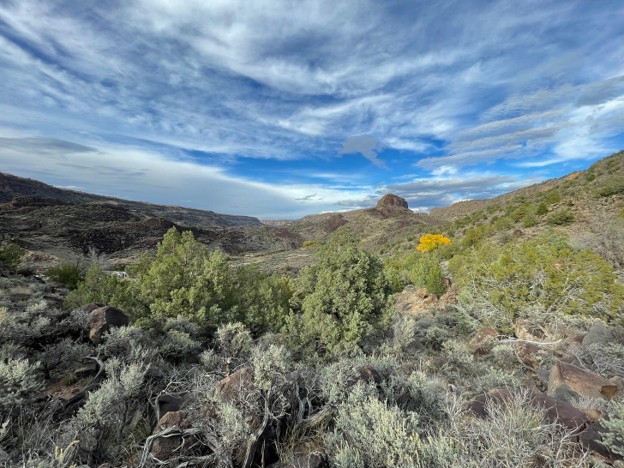
For participants in these programs, much of the work happens in solitude, with many hours a day spent engaging contemplative practices out on the land. The invitations for these “wanders” differ, but they all involve placing the land at the center, slowing down, feeling their bodies, speaking the truth out loud, intuiting the responses they may receive. They are encouraged to listen, walk, and speak with all of their capacities, rather than just their minds. Sincerity, intention, and longing are the central ingredients, and when participants can focus on what is most real, most hurting, most in need of change, the earth, impossibly, responds. Many of them have never done this before, and some (like I was) are highly skeptical about “speaking to the land.” I have yet to meet a single participant whose skepticism survived the experience.
In engaging with wilderness rites of passage work for the past decade, I have come to recognize that the truth at the heart of the mystical experience—that Love is always available—is central to participating with the earth in this way. As a guide, my job is not to be a healer, but a mirror, reflecting the magnitude and magnificence I perceive in the stories the participants share in our circle after they’ve come back. Simply being expressed and witnessed, at the soul level, is the medicine. Souls are inherently whole and beautiful, and when the clouds of trauma and persona finally burn off in someone’s eyes, soul is there, obvious as the noonday sun.
the war of the worlds hangs here, right now, in the balance
it is a war for this world, to keep it
a vale of soul-making
the taste in all our mouths is the taste of power
and it is bitter as death
bring yourself home to yourself,
enter the garden.
—Diane di Prima
What I am proposing in this essay and this essay series feels audacious, especially for someone still holding a provisional license. And yet, these feelings have been growing in me for almost two decades, in which I’ve been in my own personal therapy most of the time. I’ve had the opportunity to do my inner work within the clinical setting (and have experienced major healing there) as well as outside it, in silent meditation retreats, men’s work, ancestral explorations and earth-based intensives and vision fasts. Becoming a therapist has actually only strengthened the convictions I had already formed.
Through all of it, I’ve gotten to pull therapists, teachers, gurus, and facilitators off the pedestals I had them on as their humanness, flaws, and quirks became apparent. The ultimate message I have come to, over and over, is that the truth we’re searching for can only ever be found within our own selves through the sincerity of our willingness to look. All the rest are just mirrors and soul friends, walking with us for a time until we’re again at the center of our own self, with our own next right step, which no other can truly know.
And so from my own place of sincere and humble incompletion, I’m going to audaciously claim that clinical therapy itself is in dire need of a rite of passage. The paradigm it was born of is dying, and the future that paradigm orients us toward is vanishing with it, revealed in its emptiness as a frantic and delusional flight from terrestrial reality.
The earth is an emergent being, constantly shapeshifting to meet changing conditions, dancing through the unfolding present to remake itself in every moment. We are that earth, and we have access to that nonlinear intelligence in every cell of our bodies. Our minds will never understand it, and that’s why it feels like grace when we make contact with it. An earth rooted therapy will, and does, depend on this grace more than any particular intervention. And that’s why it’s a major threat to the medical model—mystery laughs in the face of causality’s pretense.
The paradox from this perspective is, of course, that the more we let go of the false security of certainty, the more securely attached to life we actually become. May it be so.