This is not a post I wanted to write. I wanted to be able to go through my psychiatric admission patient file and affirm that healthcare providers definitively met their duty to the standard of care, and hewed as closely as possible to their Hippocratic oaths — within reason, of course. I wanted to be able to affirm that any initial feelings I had of betrayal and victimization were likely just figments of an overactive imagination, and potentially even evocative of a budding persecutory delusional disorder, and I should do my best to banish the thought.
But I can’t.
As the documents slowly trickled in from my family physician (because the hospital never provided any to me directly, despite my pleas), those feelings only deepened. Something monstrous really did happen to me in April of 2026. Doctors didn’t just breach the standard of care, but brazenly, maliciously, perhaps even gleefully continued to traumatize me, time and time again. This was not care. This was its evil twin: harm.
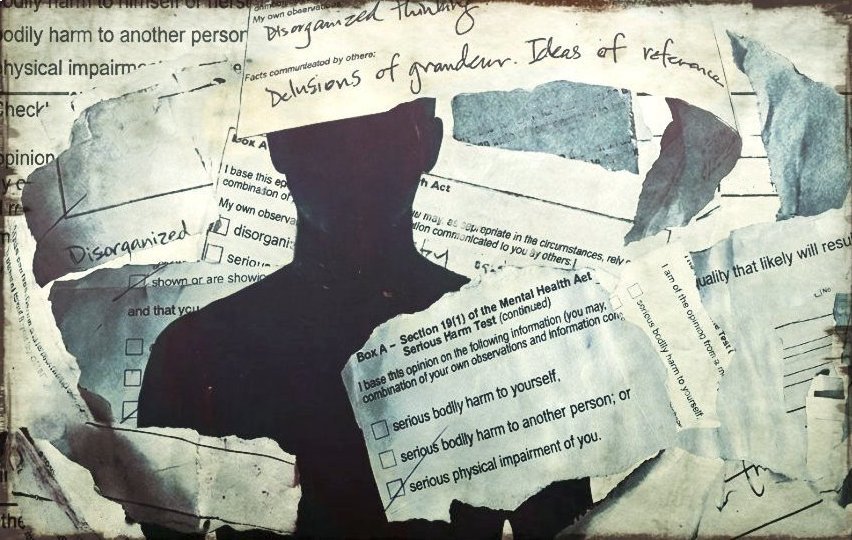
My first inkling that something might be amiss with my patient record was when I lay half-dead on the floor of a cold room, having been freshly injected with what I now understand to be a powerful antipsychotic drug, and my Form 42 (which informs a patient in writing that they are being detained at a psychiatric facility for a mandatory assessment) was carelessly tossed in by the doctor like some throwaway, rubber-stamp formality to be dispensed with without explanation
He checked two boxes where he indicated that he believed I was suffering from a mental disorder, and that I had:
1) shown a lack of competence to care for myself, and
2) this lack of competence would likely result in serious physical impairment of me.
That’s very odd, I thought. I had a good job, a lovely wife, two amazing daughters I saw off to school that morning, and I drove myself down to the emergency room asking for a sick note for work. Was I really among what the French call “les incompetents”?
And who exactly was he to judge, anyway? He never physically examined me. Actually, come to think of it, he never once spoke to me. So, all of a sudden, I am being deprived of my freedom and drugged against my will because a physician who never once entered the same room as me believes I’m in such a degenerative mental state that I can’t eat, dress myself, or tend to my own wounds? No. That didn’t sound right. There must be some misunderstanding.
It’s worth noting that in the entire lead-up to my being hauled out of the psych room by six security guards and then administered Haldol on an emergency basis, no one once told me what particular ailment they believed I was suffering from. Sure, a mental health social worker shoved a pill in my face and told me to take it, but since she didn’t tell me what it was or what it did, I refused. It only became clear much later, when I reviewed my records, why everyone I encountered seemed so scared of me. I was deemed to be in “psychosis” (which apparently a lot of people seem to associate erroneously with the term “psycho” — thanks, Hitchcock).
I really didn’t understand how the physician made this assessment, so I resolved to get the ER consult note. When it eventually came from my GP (again), rather than being clear and elucidating, I found that note to drip with scorn, derision, and vague non-descriptive psychobabble that made it seem as if he had actually made a real investigation into my condition, when he clearly had not.
The title of his ER note? “Chief Complaint: Bizarre.” Okay. That’s a pretty good title… for a work of medical fiction. That’s supposed to be a space where the doctor writes what the patient was complaining about on that day — not a space to cheekily slander the patient’s presentation. I told triage that I was simply looking for a sick note for work. Once again, I found the doctor inverting the typical power dynamic that I had come to expect in the Canadian healthcare experience.
This had all started a few months earlier when I shared with my family doctor some traits of mine that I thought might be consistent with ADHD: traits like executive dysfunction, forgetfulness, and binge eating were just some of the classic indicators I felt underscored the need for more focus in my life. She largely agreed with the self-assessment, but instead of sending me to an occupational therapist or psychotherapist, she started me straight away on Vyvanse, 30 mg. For a while, it was great: I was more focused at work, and became a more attentive father to my children. But things took a turn for the worse when I went away for a work trip in the days leading up to the event.
While on this trip, I came across several startling signs that something was seriously amiss in the provincial government’s regulation of the highway transportation industry. I won’t go more into it than that, but let’s just say that the level of corruption I personally witnessed jeopardized thousands of lives on my province’s roadways, and I resolved to try and stop it. I also discovered several new tax loopholes that people involved in this corruption were exploiting, and I was determined to try to interdict them as well. Two days later, I’d be involuntarily admitted to a provincial psych ward.
When I returned to the office, I found out that the unit I was assigned to would be severely diminished in its capacities. Instead of increasing scrutiny of certain tax records, a top-down edict had been declared that our unit would effectively do the opposite, and cease serious scrutiny of the various schemes we were looking at. I immediately thought about becoming a whistleblower regarding this upside-down approach, and was also thinking about going to my member of provincial parliament to address the highway transportation issues. But first, I needed some real time and space to think about what I was going to do, and plan my next moves. And so my idea to obtain a work sick note from my local ER was born. Big mistake.
Back to the ER note: what comes after the title is not much better. Incredibly vague terms are bandied about like “disordered thinking,” “ideas of reference with people watching,” and “paranoid thoughts” — things I never told the doctor, nor anyone else for that matter. And yet the ER note made it seem as if he himself had made those investigations. He also did a bit of CYA, saying that I had refused a physical examination.
I reject that statement in the strongest possible terms. That doctor avoided me like the plague, and never once made any attempt at conversation. It was as if he knew what he was going to do from the moment I walked in. With him, it was Haldol first, questions later.
In fact, the doctor made no real effort to abide by the terms of the Health Care Consent Act either — he certainly didn’t ever tell me what he was injecting me with, nor did he make any effort to gain consent from my would-be “secondary decision-maker,” my spouse, whom they were keeping in a separate room (probably so as not to traumatize us together). I had brought my wife and then called my mother-in-law to come to the ER because I had a sense of foreboding that something awful might happen to me, and that I needed them to keep me safe. Ultimately, however, when my wife started to feel a little dizzy, they led them both out of the room, leaving me alone.
The first time I knew what drug I was “administered with security assistance,” it was two months later upon consulting my ER note. On the day of the event, I had no idea what was in that syringe. It could have been anything. I thought I was going to die. This kind of cowboy behaviour doesn’t just show clinician ignorance, it evinces real intent to harm. Mens Rea. Malice aforethought.
So I kept pushing for the documentation that authorized my detention to see if some good reason had been articulated to so brazenly abrogate my Charter rights (the fundamental protections guaranteed by Canada’s constitution).
And when I finally received it, six months later (once again through my GP), I was not impressed with what I saw: seven words of extremely vague psychobabble symptomology without reference to any facts or events — just rank aspersions cast about my character and condition. Under his own observations, the doctor simply wrote “disorganized thinking,” and under facts relayed to him by others, “grandiose delusions” and “ideas of reference.”
I’ve since been able to ascertain that a well-executed Form 1 should relay real facts and answer a lot of the same basic 5W1H questions (who, what, where, when, why, how), in a way that’s similar to an indictment. Examples can include “patient screaming and attempting to punch orderly” or “patient yelling at nurse and running after her down the hall.” Mine contained no such details. Only the vaguest possible psychiatric terms, potentially describing a rationale for ascribing a ‘psychosis.’ I still have no idea where he got “disorganized thinking” from — particularly since he never spoke to me or examined me, nor did my loved ones ever relay to him that I was suffering from “grandiose delusions” or “ideas of reference.” They explicitly reject both those terms and really anything on that form. As far as I know, the doctor just decided to pluck those terms out of thin air.
All of this wouldn’t be so bad if it weren’t for the fact that after being psychiatrically processed, and CT scanned, and subjected to all manner of Geneva Convention mistreatment under drug duress, a resident psychiatrist did confirm the existence of a ‘psychosis’ and put me on a path for powerful, lifelong antipsychotic drugging. This wasn’t based on any auditory or visual hallucinations, or really any kind of thinking that was tremendously disorganized. No, it was because I told them that through my work, I had uncovered some far-ranging tax avoidance schemes that could potentially destabilize the nation’s tax base. This was apparently the extent of my delusional thinking and sufficient grounds to confirm a psychosis.
Would they say this about a lawyer’s case? Or a police officer’s investigation? No. But for some reason, “thinking tax stuff might be important” is enough to certify a delusional disorder and continue psychiatric drug therapy, maybe forever.
Later, the same resident would also invent fabrications in my patient file that I was “full of energy” and “needing a lot less sleep” — things I really don’t ever remember telling them. I now know that these fabrications are the classic indicators of bipolar disorder.
This is relevant because an outpatient psychiatrist would later diagnose bipolar disorder on the strength of these fabrications, as a justification for continued antipsychotic treatment.
This is not a trivial matter. Antipsychotic drugging comes with serious risks and side effects. I felt drowsy, had anhedonia, gained a lot of weight, and generally couldn’t concentrate at work.
After talking with my family physician I am now off of the antipsychotics, but the PTSD and trauma disorder remain. Some days I wake up extremely angry, other days sad, still others I get concerned that these doctors are still doing this stuff to other people like Nicholas Jordan Wagter (the Canadian biophysics researcher who gained viral attention in May 2026 after being involuntarily detained under British Columbia’s Mental Health Act). I’m just lucky I was able to break free. If I didn’t have my family behind me, I’m quite sure I would be pacing an asylum solitary cell for the next 20 years, otherwise.
Some days, I really feel as though I was the victim of bona fide crimes. Fraud (fabricating medical records), battery, administration of a noxious substance, false imprisonment… serious stuff that if these doctors didn’t have the cover of a white coat, they wouldn’t get away with. I have been advised that it wouldn’t be wise to legally pursue this, because cops will just default to “the patient is clearly crazy” and I might actually get a ticket back to the hospital (police can issue mental health forms too).
I have a reason to think that at least one of the doctors involved has a certain level of support in these efforts, which means it might be more systemic in nature than just targeting my own person. Unlike 99.9% of ER doctors in town, he has no patient reviews available, which raises suspicions that he’s having his online image massaged and curated by outside parties.
This flip side of this is that the one Facebook post of him through the hospital’s foundation site has literally dozens of generic “great doctor” and “well deserved” comments (some anonymous person made a donation in his honour to the university hospital’s foundation — not normally an accolade that deserves that level of plaudits).
The combination of these two indicia is fairly compelling evidence that his online image is being massaged by someone. Who that is, I have no idea but they probably are not local.
In the end that’s what bothers me the most about my experience. How “through the looking glass” foreign it all was to me. “Sentence first!” the Queen of Hearts bellowed to Alice….
As a student of history I know for a fact that this is exactly how political psychiatry works in dictatorships. Wouldn’t it be nice to have your critics summarily locked up without jury trial, away from lawyers, because their thoughts have been deemed sick, “disorganized,” delusional?
I am confident my doctors completely and totally abandoned their Hippocratic Oaths, and their behaviours that day were more in line with certain terror states than the Canadian healthcare system.
I am terrified that I won’t be the last patient to get subjected to this treatment — and I fear that perhaps the second time, I won’t be so lucky as to be released after three and a half days of “swearing never to have delusional thinking regarding tax schemes.”
As much as I try, I will never be free from this experience.