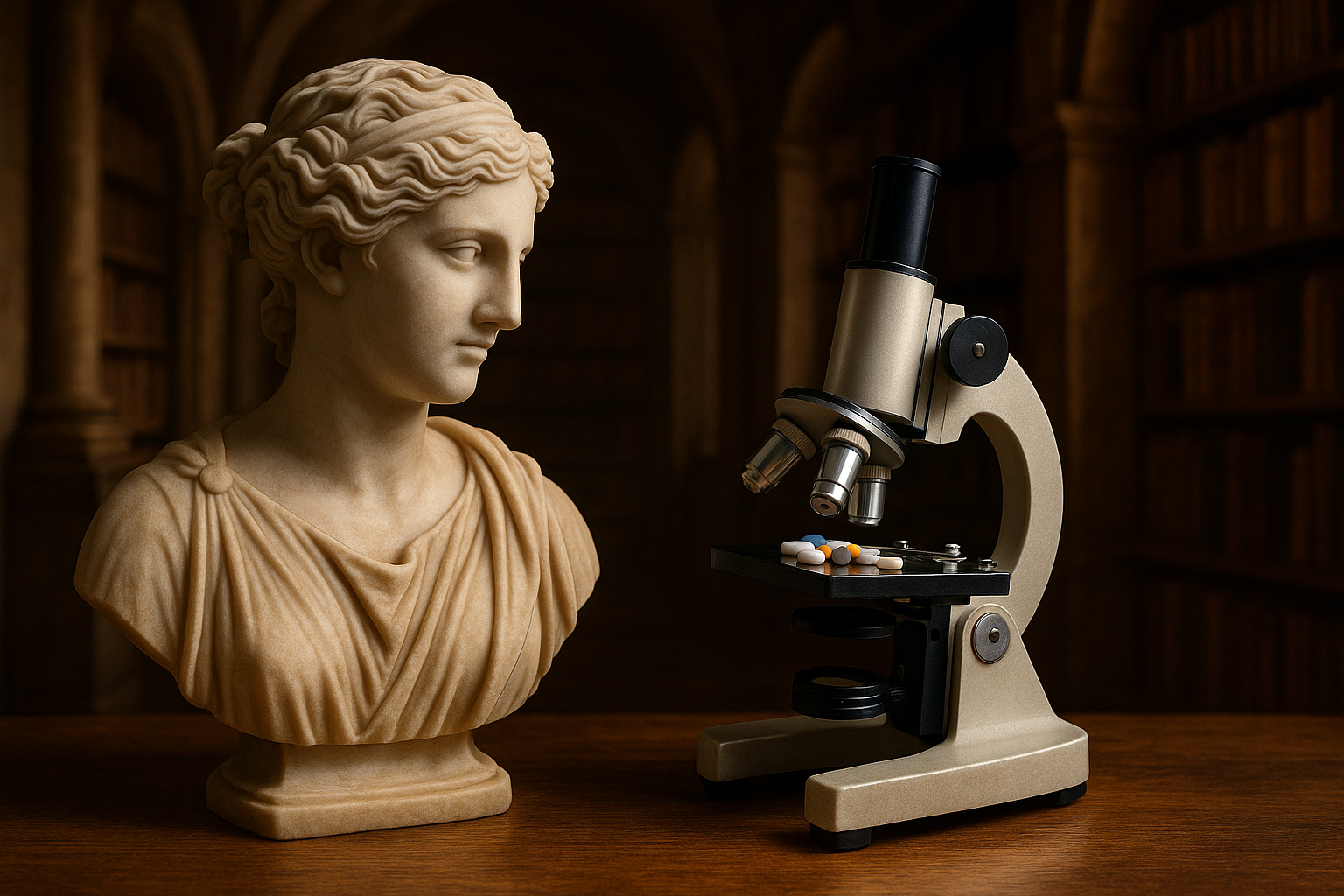
A review article in the journal Pharmaceuticals proposes a new field of Pharmaceutical Humanities as a way to bring lab science into dialogue with ethics, history, and the lived experience of people who rely on medicines.
The authors, Mita Banerjee, a professor of English and linguistics, and Thomas Efferth, a professor of pharmaceutical biology, both at Johannes Gutenberg University Mainz, contend that many of today’s most pressing health crises cannot be solved by biomedicine alone.
They draw on Thomas Kuhn’s theory of scientific revolutions to suggest that pharmacy is at a turning point, where technical advances no longer match the complexity of the problems at hand. Drug discovery continues to accelerate, yet cancer, neurodegenerative illness, and psychiatric conditions remain largely resistant to treatment, while addiction, environmental damage, and social inequality widen.
Their proposal is to place scientific evidence and human meaning side by side. By bringing narrative competence, cultural knowledge, and ethical reflection into pharmacy, they argue, clinicians can better respond to the opioid epidemic, engage fairly with indigenous medicine, and improve everyday encounters at the pharmacy counter. The goal is to ensure that medicines work not only in the lab but also in the social worlds where people live and seek care.
They write:
“Because patients can benefit from all these diverse treatment approaches, we propose a stronger focus on the inclusion of non-interventional therapies rooting in non-classical pharmaceutical, interdisciplinary fields into natural science-based and drug-based interventional pharmacy by establishing the Pharmaceutical Humanities as a novel discipline.”
This proposal builds on wider currents across the health sciences that have turned to the humanities to counter the limits of reductionism. The medical humanities have shown that medicine and culture cannot be disentangled, highlighting how language, history, and social worlds shape both sickness and healing. The psychological humanities have argued that mental disorders cannot be reduced to brain disorders, insisting that meaning, narrative, and cultural context are indispensable for understanding the human condition. And the psychedelic humanities have cautioned against the rapid medicalization of psychedelics without reckoning with their ethical, social, and historical complexity. Pharmaceutical Humanities enters this broader landscape by asking pharmacy to recognize its own cultural and narrative dimensions, and to treat medicines not only as biochemical objects but as part of human worlds.