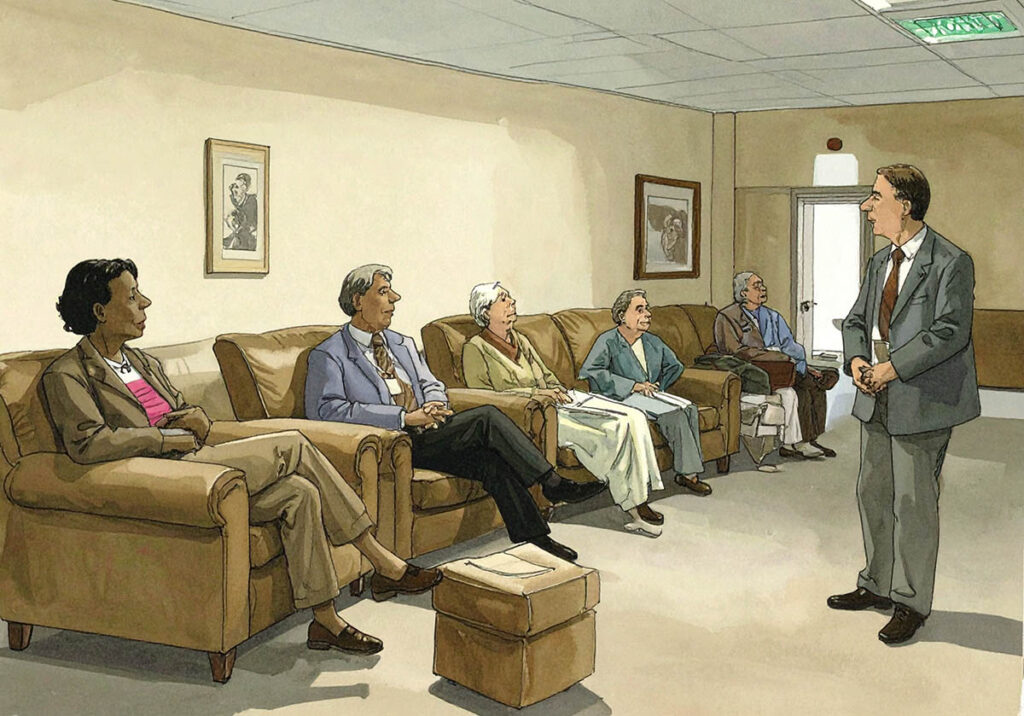
Picture this. A lounge on a psychiatric ward with standard leatherette beige sofas and a couple of armchairs for good measure. Half a dozen inpatients sat around chatting, waiting for the creative therapist to come and start the session. Some look outwardly animated, others slump in silence, wrapped in the blanket of their own thoughts. The room is still in that strange way hospital rooms are: a mix of sterility and humanity, resignation and restlessness. In comes said creative therapist, who then asks the most normal, innocuous question that we all utter several times a day: “How are you?”
Most inpatients respond with the standard reply that we have all been taught to give: “Fine, thanks.” To me, this is the strangest question someone can ask in a psychiatric ward. This is an event that actually took place when I was an inpatient, not that long ago. However, I decided not to give the standard answer and replied honestly with some non-standard swear words. It was said in jest, and as a room we all laughed at the absurdity of it all together.
However, this absurdity persisted with me and became the basis of the article you are now reading. There is something about our everyday language that is completely enmeshed with society’s rules of etiquette, which doesn’t quite fit the psychiatric system. It says a lot about the socialisation of etiquette and language when individuals who are so mentally unwell that they are an inpatient on a mental health ward still answer the strangest question to ask in a psychiatric hospital with what is equally the strangest answer. Even the choice of words used to describe where we are—“mental health ward” versus “psychiatric ward”—carries its own connotations.
Did you notice I switched terminology earlier? Which phrase sits more comfortably with you? “Mental health” feels more delicate, milder, a little less stigmatised. “Psychiatric” communicates clinical, maybe even frightening. The labels themselves shape how we interpret the same environment. Language is not neutral.
We adhere to social scripts set out for us during childhood and carry them with us in all circumstances. It was unlikely that we would have the context for a social script for answering, “How are you?” in a psychiatric hospital. Instead, our social scripts tend to be overgeneralised and feed into our socialisation as children and adolescents. This question is almost ritualistic in scope, a reflex gesture when greeting someone. Social scripts are predictable, shared patterns of behaviour; a guidebook to social situations. In turn, the script requires us to simply reply with a non-committal “Fine, thanks”. The function is not to exchange real information but to signal recognition, acknowledgement, and a willingness to engage. Linguists refer to this as a phatic expression: communication that is less about content and more about establishing a relationship.
Inside a psychiatric hospital, the social script doesn’t fit the situation. The location itself undermines the entire premise of the question. Inpatients are in a hospital specifically because they are, by definition, ‘not fine’. The usual response then feels ridiculous and disingenuous. But, to say the truth, perhaps “I’m suicidal” breaks the unspoken rule that the exchange of conversation is intended to be light and socially lubricating, not a revelation of the very reason one is an inpatient. The discord exposes the fragility of social scripts.
The sociologist Erving Goffman described interactions in what he called “total institutions” such as prisons, care homes, and psychiatric hospitals. In these environments, the day-to-day performances we depend on in the outside world don’t work in the same way. In ordinary life, “How are you?” is part of the performance of being a socially competent individual. In institutions, however, language becomes stripped of casual function and instead is absorbed into bureaucratic systems. Words become tick-boxes, data points, entries on a chart.
Comparatively, patients in physical hospitals are rarely asked “How are you?” in the same sense. They are asked, “What’s your pain level today?” or “Are you managing to eat?”—questions that point directly to measurable, observable aspects of illness. Psychiatry, meanwhile, lives in the space between the measurable and the ineffable. And so the awkwardness emerges: the same casual question becomes charged with diagnostic weight.
The world of psychiatry has a whole separate language that shapes mental health settings, including psychiatric hospitals. “How are you?” becomes shorthand for ‘I need to tick this box’ as opposed to genuine curiosity. That is not to say that mental health professionals don’t care, but that for a patient to receive treatment, boxes must be ticked in relevant categories for diagnosis. The broader psychiatric lexicon is equally revealing. Terms like “service user,” “patient,” “client,” “high functioning,” “treatment-resistant,” or “remission” each carry layers of meaning, and often stigma.
Take “high functioning,” a phrase I intensely dislike as an apparently “high-functioning” autistic woman. It flattens out complexity, ignoring the reality that one can be academically successful and simultaneously unable to cook dinner, overwhelmed by the sensory chaos of a supermarket. The problem with this is that language constructs reality, and we all take part in the performance of social constructionism as described by Goffman. Therefore, language becomes even more critical.
From a social constructionist perspective, the strangeness of “How are you?” in a psychiatric ward does not lie in the words themselves but in the meanings attached to them. Language is never neutral; social norms, professional frameworks, and power relations shape it. Once admitted to hospital, a person is no longer just an individual but a “patient,” a role constructed through psychiatric discourse. Their words are filtered through diagnostic categories, risk assessments, and institutional priorities. What might be a casual greeting outside becomes, inside, a clinical tool—its meaning shifted by the very structures that govern the ward. In this sense, the problem isn’t just the question but the way psychiatric language reconstructs reality, often reducing human complexity to something legible for charts and reports.
It’s also worth considering why the question is being asked in the first place. Outside in the ‘real world’, “How are you?” is a throwaway expression, ritualistic rather than inquiry. Inside, however, its purpose is murkier. Is it a genuine attempt at connection, an opening to conversation, or is it simply a procedural requirement disguised as small talk? In psychiatric settings, every question carries weight: it might be risk assessment, a diagnostic probe, or a way of measuring whether the treatment plan is “working.” Patients learn quickly that their answers can have consequences, which changes the dynamic entirely. What looks like kindness on the surface can, in practice, function as surveillance. To ask “How are you?” in this environment is not neutral—it is bound up in power, policy, and the uneasy marriage of care and control.
Then there is also the double bind for patients if they are too honest. It could potentially trigger an intervention, but then again, if the patient is not truthful, they could stay invisible.
If the standard “How are you?” falls flat in a psychiatric setting, what might work better? It doesn’t need to be complicated, but it does require looking at things from a different perspective. Rather than relying on reflexive small talk, mental health professionals could ask questions that acknowledge ups and downs and show genuine interest in how someone is truly doing. Something as simple as, “How’s today compared to yesterday?” can feel more honest and human. This is a deceptively simple change, but it opens space for nuance. It recognises that mental states shift hour by hour, day by day. A patient may not be “fine” or “unwell” in any definitive sense, but they may be feeling worse than yesterday or even better. By formulating the question comparatively, it eliminates the pressure to provide a definitive judgment on one’s overall state of being.
Another helpful alternative is, “What’s helping you get through right now?” This gently queries and encourages patients to reflect on their own resources and coping strategies. This may include medication, therapy or both. For others, it may be the comfort of music, talking to a loved one, or perhaps the structure that the ward’s daily routine provides. It’s not about focusing on malady, it’s more about acknowledging the resources we lean on—the small things that, even in our lowest moments, can help us stay constant.
Equally valuable is the question, “What feels hardest today?” Unlike “How are you?”, which implies a tidy, socially acceptable response, this question validates struggle. It assumes that hardship is present and creates a space for it to be communicated. It doesn’t ask someone to pour out their whole life story, or to shrink their pain into a neat clinical phrase. It provides that space to be honest about what feels hard in the moment.
Even gentle openers like “What would make today a bit easier?” or “What do you need more of right now?” can make a massive difference. They look ahead without adding more pressure, emphasising that people still have some say in their care and that even minor modifications can make a difference. They invite collaboration between the patient and mental health professionals rather than compliance.
At the heart of all these alternatives is one principle: they move beyond surveillance. They resist turning the patient into a data point for a form. Instead, they treat conversation as relational care. They affirm that the person in front of you is more than their diagnosis, more than their risk profile, and more than their “functioning” label. They emphasise that communication can itself be care, especially if we are ready to ask different questions, and more importantly, to really listen to the answers.
As human beings, we find comfort in routine and familiarity. Despite the strangeness of asking the question “How are you?” whilst in a psychiatric hospital, it is familiar like a habit, thus comforting. It is the same phrase spoken at bus stops, in offices, and at the school gates. It connects the patient, however briefly, to the wider social world from which hospitalisation has cut them off. There is a duality in how the question is both frustrating and reassuring at the same time. Albeit flawed, being asked the question at all is still a human connection. Being asked “How are you?” is sometimes less about the content and more about remembering that the individual is still a person worth asking. Even if the reply is part of a social script, the ritual still matters.
If we zoom out, the psychiatric ward simply makes visible what is true everywhere: much of our everyday conversation is absurd if taken literally. “We must catch up sometime” rarely means we will. “I’ll give you a ring” often means nothing of the sort. The difference is that in psychiatric settings, language is loaded with consequences. The wrong word can mean medication, confinement, or discharge. Words that in the ‘real world’ mean politeness inside become instruments of power.
Ultimately, asking the question “How are you?” whilst in a psychiatric hospital feels strange because it exposes the massive gap between everyday etiquette and authentic lived experience. It highlights how the words we use daily out of habit can feel hollow when spoken in the wrong context. However, even with its strangeness, this fundamental question holds value. It is evidence that someone is trying to reach out.
Perhaps, we should be asking the question with more genuine care, rather than stop asking it altogether. Possibly, this will open the way for more authentic and congruent conversations. A way of care on the ward that sees the person and not just the patient. Because sometimes it isn’t the question itself that is meaningful, but the active participation of another human being reaching out.










Vikky great beginning of a dialogue about vocabulary and the layered meanings of words especially those used in care situations. Just using care situations I don’t know but expands to any unit where people are not independent .
I think greeting should be explored before the how. How one responds to a hello is important. Alternatively a good morning or other time of day also can speak or not speak volumes.
I have found that many folks don’t know what to say including staff. Some people on the street don’t know how to communicate and or acknowledge disabled folks or those who look like possibly in need of shelter or who pandering. Most folks advert their eyes away from not to.
I think it’s these issues of otherness like them , those instead of we/ us that has steamrolled since the beginning of this century.( in some cases not all- racism and sexism and abelism around for a long long time but there was a moment in time when one could hope for better abd solid change) The improv yes / and approach is helpful not only in comedy but everyday life in again multiple levels.
The visual of patients sitting and being approached by a unknown staff is indicative of the lack of therapeutic milieu and the concept of team. The other concept is in regard to children and damn sorry for that but Maria Montessori concept of letting people led or patients lead and support folks follow. Child Life created after Wirkd War II by Emma Plank kind of had that concept as well and if we had adult life staff also a difference again in any care type of unit. A good research area is what were the units like for WWI and WWII vets? What support did they have? It seems to be a wide variety of interesting alternative therapies quashed.
Also volunteers. In my past as a patient no volunteers and if a student poorly trained. If one wants to check out a nursing home or assisted living I was told to check know they interact with the community. The monthly calendars were one sign to check. Also even if poorly trained or supervised how many students of all professions ( nursing, medical, social work, psychology, OT, PT , Recreational Therapy, Art Therapy, Horticultural Therapy, Movement/ Dance Therapy, Music Therapy/ Film , Poetry and Book Therapy) are working in unit? Youth is inexperienced but sometimes they can see things elders cannot.
So the visual of sitting down versus engaged in activities so telling Thanks for this.
Report comment
Totally agree and great article. I’ve hated the question how are you since childhood for anything more than superficial interactions. It felt that any kind of lying was a further betrayal of my self.
Report comment
I’m not sure changing the language will fix the problem.
The problem as I see it is that staff are programmed to see patients as less than human and they will do anything to avoid real connection. In my experience they rarely ask how you are except in a clinical assessment context. Because they really don’t want to engage.
This is a structural and systemic problem- it is built into the psychiatric system. Changing language like “mental health” is designed to conceal the structural violence of the system, by superficially meeting changing public expectations. This does not to make the system more humane.
Report comment
I think the language reflects the underlying values and purposes, rather than the other way around. If MH “professionals” generally viewed their clients as human, changes in language would naturally occur to reflect that.
Report comment
Yes exactly, psychiatry loves changing the language – but the old associations just attach to the new language. Because the attitudes are structured into the model.
I don’t think it’s possible to have genuine dialogue when one person has the power to lock you up and use force against you. When patients are forced to say what the clinician wants to hear because they are terrified of the consequences of being misunderstood, mislabelled or coerced.
Report comment
Too true! I used to work at a crisis line and talked a lot to people who cut on themselves for comfort and a feeling of control. They were NOT suicidal, not even close, but they were mostly afraid to tell their therapists about what was happening or how they were feeling for fear of being locked in the psych ward. They chose the crisis line because they could remain anonymous and not have to risk losing their rights simply because they told someone what was going on in their lives. There is no such thing as “involuntary treatment!”
Report comment
Well, since we no longer live in a society where anyone has any privacy, due to the internet, and a lot of illegal marketing practices going on there. I will say, there is such a thing as illegal “involuntary treatment.” And it’s a systemic problem.
Report comment
Yes! That is not discussed in the article or in my previous reply. But enforced treatment makes a huge difference. Though voluntary is just or almost as bad because there is no treatment only containment by chemicals. For the general population there is such a lack of knowledge and this creates more ability for the forces to be to continue as is.
We just don’t have any true support structure for those in crisis . A bit here a bit there huge cracksvthstvmanybfalk into and never come out.
Report comment
Psychotherapy “diagnoses” and “treats”, but it doesn’t provide the lived experiences that truly heal. Healing often comes from engagement with life itself — from joy, risk, connection, and challenge. Sitting in a therapist’s office (or psych ward) merely provides a lived experience of being “diagnosed” and “treated.” It’s no substitute for raising hell, laughing until it hurts, dancing, exploring, or confronting the world directly. (Maybe Randall P. McMurphy was on to something?)
Fun, freedom, and the unpredictability of life are not things therapists are certified to provide, and they are not commodities money can buy. But they may be the raw material of recovery.
Report comment
The only use a therapist may have is to help the client find such engagement, joy, risk, connection and challenge. There is no secret wisdom to be shared. It’s about living life and doing what we need to do. Talking only helps if it gets one living again! And a degree hardly qualifies one to be capable of helping find that inspiration. Help is wherever we find it!
Report comment
“Fun, freedom, and the unpredictability of life are not things therapists are certified to provide, and they are not commodities money can buy. But they may be the raw material of recovery.”
I agree, Dan.
“The only use a therapist may have is to help the client find such engagement, joy, risk, connection and challenge. There is no secret wisdom to be shared.” I agree, Steve.
But sadly, my so called “psych” industry “professionals,” and their pastoral “partners,” were elder easily recognized malpractice and systemic child abuse covering up lunatics, by DSM design. Who had delusions of grandeur they were Jesus or God, while having no clue about who I am. Not to mention who the third aspect of the Triune God is, since they were all Holy Spirit blasphemers.
“It’s about living life and doing what we need to do. Talking only helps if it gets one living again!” I agree. “And a degree hardly qualifies one to be capable of helping find that inspiration. Help is wherever we find it!” Again, I agree.
Thank God for my friends, who helped me when I had the misfortune of dealing with my Holy Spirit blaspheming, gas lighting, inappropriate coerced and forced anticholenergic toxidrome attempted murdering, “psych professionals,” … who are now trying to proclaim ignorance and innocence of their, and their industries’, sins.
I’m quite certain the Triune God is not nearly as stupid, as the mass murdering, scientifically “invalid,” Holy Spirit blaspheming, elder, DSM deluded, too paternalistic, “psych professions.”
Report comment
Freya thank you for your comment. “Everyone wants the truth until you tell it to them.”
Report comment
Haha! Thank you!
Report comment
In the psych word, you spend most of your time with working class stiffs. I found much better luck communicating with “orderlies” than with the professional staff. Being an anti-racist on a ward with many Black workers was also a boon.
Report comment
Great article and I like the suggestions of alternative questions that might be preferable. On my inpatient journey the word ‘ fine’ was loaded ……. “Yes I’m fine, ‘f***ed up, insecure, neurotic AND emotional’ all said with deep meaning
Report comment
It’s not just in an asylum where the question how are you is depleted of meeting, it seems to be generally everywhere the case. Everybody says how are you doing in order to actually avoid interaction with the person. They might have mentioned something prior superficially that only sufficed in order to say something rather than to communicate something so if the dog had been taken to the vet, they might talk about that and the dog got better. Or the dog didn’t get better and then oh I feel so sorry for you would be the response. But if anybody really has the need to talk to another person and goes around with everybody acting friendly because this is proper etiquette, whether it’s at the store, or a social institution like a church, and then you have psychiatry and psychology where again it’s not to actually allow the person to space to talk about themselves it’s in order to diagnose them: just about anywhere, if you don’t answer appropriately or even take how are you doing as a realistic question, you’re going to have problems with people. It’s game theory: if you actually respond in a manner that is honest and communicates, then you’ve lost supposedly because this is held against you that you’re not okay. What does this say about society in general that you have to go around ignoring what’s really going on? It’s game theory: what R. D. Laing proved. When he noticed that patients labeled as schizophrenic when recovered, whatever that’s supposed to mean, but then “recovered” and went home they would relapse. So, he devised a questionnaire to see what level of game theory was going on in normal domestic situations. What he found out is that in normal “sane” society everybody was manipulating the other person and not really being honest but doing things and saying things in order to manipulate the other person. So in reality what was pointed out is that a person who is quote unquote schizophrenic its simply honest in comparison to the general public. Now what does this say about everybody going around asking how are you doing? Or that if you’re too honest in the general public in society that you going to end up being called schizophrenic because you’re not playing this game theory and you’re not communicating things in order to manipulate people or to fit into this society? Or what does this do to somebody to realize that whatever non-violent behavior they exhibited that if instead they’re not playing this game, that they can be manhandled physically abused have their freedoms taken away and put in an asylum forced on treatment that statistically has only caused more of the problem and creates the very scientific phenomenon that is said to be healed called a chemical imbalance; and unless they learn to be manipulative and dishonest all that will happen again. And this is called sanity by a society that plays game theory ignoring what’s really going on scientifically and statistically. What does this say about any real understanding that’s going on in such a society regarding honesty and emotions and cognitive ability? Just like the principles of dadaism, might this show that what’s called psychosis or even chaos has more Harmony and form than the rules one is supposed to follow in order to be sane?
In other words: “how are you doing?” but don’t actually tell me, it would offend all of the compromises I’ve locked myself into, and it scares me to step out of this box, I might have to stop acting like a programmed robot that calculates the profit I’d get from a society based on such superficiality.
Report comment
Visiting a psyche ward reminded me of Waiting for Godot, asking the characters in that play, “How are you?” Would be assessed fruitful as asking staff and patients/prisoners on a psyche wards.
Report comment
I guess we could follow the example of Muslims. They have a response to the question “how are you?” which is al hamduliilah (all praise be to God).
Maybe psych patients could respond to “How are you?” with “All Praise be to the Psychiatrist”? It would demonstrate your compliance and that you had been suitably Stockholmed enough to return perhaps some of your human rights?
Report comment
Having worked on wards at a State Hospital in Illinois, I found most mental helpers knew little about causes of mental instability in patients. They knew to process the program despite what a person needed. They treated symptoms rather than causes which can be complex and complicated. They were never trained that what the mind thinks in its learning, its intentions, and reactions to trauma shapes a person. They never perceived that thinking leads to behavior and thus to emotions. The hospital was a place of storage of humans rather than a place of healing.
Report comment
I know what you are saying, but they don’t really treat symptoms, either. When someone has dissent, and you suppress their dissent, that’s not treating symptoms.
Report comment