A new open-access consensus statement in EcoHealth argues that human health cannot be understood apart from the ecosystems people inhabit. The authors propose “Ecological Medicine,” a framework that treats health as an interdependency between humans, other species, and the environments that support them.
Led by psychiatrist Michael Makhinson, the Ecological Medicine Working Group brought together 73 experts from medicine, public health, ecology, psychology, Indigenous studies, and other fields. Using a structured consensus process, they developed a definition, set of priorities, and practical implications for a connectivity-based approach to care. The authors write:
“Adoption of a connectivity-based health framework which expands the current biomedical model to multiple levels of inter-connectivity and recognizes profound interdependencies between human beings, other living elements of nature, and the natural environment, would be beneficial to human health and to the health of the biosphere.”
The statement offers a conceptual blueprint for reorienting health care away from isolated individuals and toward networks of relationships. For mental health in particular, the authors argue that distress and resilience emerge within webs of connections to self, to other people, to other living beings, and to the land.
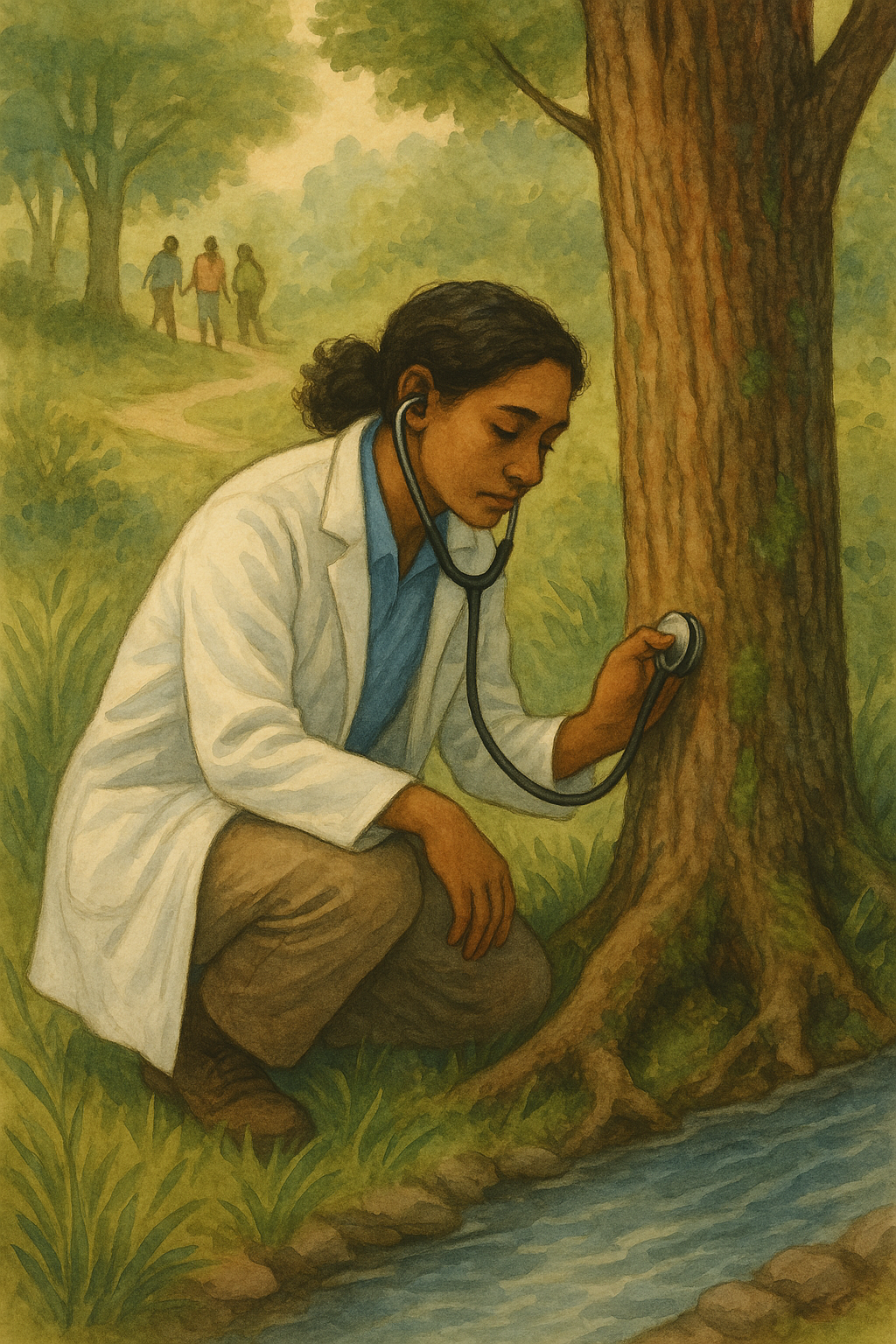
The central purpose of this discussion was to address the limitations of contemporary biomedical views of health by proposing a model grounded in interdependence and ecological reality. The authors argue that well-being cannot be meaningfully separated from the multispecies, multisystem environments in which human life unfolds. The working group, composed of a multidisciplinary team, proposes that a connectivity-based framework, termed Ecological Medicine, more fully captures this complexity by recognizing that wellness emerges through dynamic relationships among individuals, communities, all other living systems, and the Earth’s ecological systems. This approach reframes health as a property of relationships rather than an attribute of isolated individuals.
Methodologically, the consensus group employed a structured, iterative process drawing on expertise from ecology, psychology, medicine, systems science, Indigenous knowledge, and environmental health. Through collaborative analysis, conceptual mapping, and multiple rounds of Delphi-style consensus, the researchers identified the fundamental relational layers that shape human wellness.
Their methodology was intentionally relational and ecological, emphasizing cross-disciplinary dialogue as a means of modeling the interconnected system the framework seeks to describe. They write:
“Relationality is a view that humans and other lives and processes are defined by their connections, with the connections being at least as important as the things that are being connected; the connections themselves are more instrumental in defining a system’s behavior than the individuals.”
Human health, they write, “cannot be understood, examined, or improved fully without relationality.”
In this view, focusing on an individual in isolation produces “a grossly incomplete understanding” of the larger network of which that person is a part.
The group centers inter-connectivity as the key concept. They identify four primary layers of connection that shape health:
- Connection to self.
- Connection to other humans.
- Connection to animals, plants, and other living kingdoms.
- Connection to natural and built environments.
To flesh out their framework, the authors draw on the concept of relationality. They describe it as the view that “humans and other lives and processes are defined by their connections,” and that these connections are at least as meaningful as the things being connected.
In practical terms, the “patient” is not only a body with symptoms but a node in a dense web of relationships:
- Inner life and self-connection.
- Family and friends.
- Companion animals and local plants.
- Microorganisms, soil, and water.
- Neighborhoods, workplaces, and other environments.
- Spiritual and cultural belief systems that give meaning to these ties.
The group connects this view to work in interpersonal neurobiology. Psychiatrist Daniel Siegel is quoted as writing that “our mental lives emerge from beyond simply the brain in the head and involve the whole of the body; and mind also emerges within our relationships with people and the whole of the planet.”
They also point to philosopher and psychiatrist Iain McGilchrist, who argues that relationships may be more fundamental than the things related, and to research on awe, oxytocin, forest communication, and the Gaia hypothesis as examples of relational thinking across disciplines.
Crucially, the authors note that relationality has long been central to many Indigenous knowledge systems. Studies with First Nations communities in Australia, Mohawk communities in Canada, and other Indigenous nations emphasize health as inseparable from land, kinship, spirit, and right relationship with the Earth.
These perspectives, they argue, challenge reductionistic, individual-focused, human-exceptionalist models of health and highlight how ecological and colonial harm fall disproportionately on Indigenous peoples.
In keeping with the multidisciplinary approach, the group also drew on the work of Nicholson and Dupré (2018), whose concept of “process-focused biology” challenges the traditional notion of fixed, bounded individuals. In their account, biological systems, including human beings, are dynamic, continuously changing, and fundamentally relational. Rather than viewing organisms as discrete entities, Nicholson and Dupré argue that living systems emerge through processes of interaction with their environments and with other forms of life. This perspective directly supports the group’s ecological medicine framework, underscoring that wellness arises not from isolated internal mechanisms but from ongoing participation in multispecies, multiscale processes.
While the working group offers a compelling conceptual model, the authors acknowledge several limitations. First, Ecological Medicine remains an emerging framework, and the current discussion is primarily theoretical rather than empirically tested. The relational and multispecies dimensions of wellness described in the model require further research to establish specific mechanisms and measurable outcomes. Additionally, much of the evidence supporting relationality comes from diverse fields—including ecology, neuroscience, Indigenous studies, and systems science—which makes integration complex and sometimes uneven across disciplines. The group also notes that the framework may be challenging to operationalize within existing biomedical and clinical systems that are structured around individual-level diagnoses and interventions. As such, this model should be understood as an evolving foundation for future empirical, clinical, and community-based work rather than a prescriptive or fully developed alternative to current practice.
The working group’s ecological model contributes to a growing re-examination of how mental health is defined, supported, and constrained within contemporary systems. By positioning wellness as an emergent property of relationships, within the body, between individuals, and across human and more-than-human communities, the authors challenge the dominant biomedical assumption that mental disorders originate solely from internal dysfunctions. This ecological framing situates mental well-being within broader social and environmental conditions, including community cohesion, ecological stability, access to nature, and the quality of relationships with other living beings. In doing so, it aligns with a larger shift toward relational and systems-based approaches across multiple fields.
Many existing nature-based interventions already reflect aspects of the ecological model described by the working group. Practices such as forest bathing (Shinrin-Yoku), horticultural therapy, and ecotherapy have gained international attention for their capacity to reduce stress, support emotional regulation, and strengthen a sense of connectedness with the living world. Outdoor-based mindfulness programs, nature-assisted psychotherapy, and green exercise interventions have similarly demonstrated benefits for mood regulation, attention, and overall well-being. In some clinical and community settings, therapists incorporate therapeutic gardening, guided nature walks, or animal-assisted practices as adjuncts to traditional care.
Other writing has argued that it is not just urban “greenspace,” but encounters with wild, unpredictable landscapes that can unsettle familiar stories about mental illness and open new possibilities for meaning.
Analyses of Indigenous healing traditions have challenged the foundations of Western psychology, showing how many communities understand mind, suffering, and recovery through relationships with land, ancestors, and more-than-human relatives. Reporting from South Asia has likewise argued that justice for Indigenous peoples requires centering land rights, cultural continuity, and collective forms of care rather than importing narrow clinical models.
Ecological Medicine takes seriously the idea that health is produced by social and environmental conditions, not just individual biology, and calls for clinical, educational, and policy changes to reflect that. As climate disruption, biodiversity loss, and social fragmentation intensify, the authors argue that health care must learn to see people as participants in living systems rather than as isolated cases. Ecological Medicine invites a shift from treating symptoms within individuals to cultivating conditions in which people, communities, and ecosystems can all flourish.
****
Makhinson, M., Pollack, L., Hallowell, R. et al. A Consensus Statement for Ecological Medicine: Moving Toward Connection-Based Medicine. EcoHealth (2025). https://doi.org/10.1007/s10393-025-01757-3











Cool, psychiatrists have some nice words. Wake me up when literally anything actually improves for psychiatry’s current and future victims.
Report comment
We’re social beings, in relation to all living beings. We don’t need a degree, and technical trade language, to know this, experientially, immediately.
But we live in a social system that denies this possibility. From an early age, we learn to live in fear from relations of power over us. Interpersonal and communal associations, insofar as these are characterized by mutual care and dignity, are replaced by institutionalized organizations like industrial schooling, training us in command-and-obey, reward-and-punishment attitudes and behaviors. This basic child abuse, socializing us into adult abuse of the ‘real world’, leaves us unreal, alienated from ourselves, others, the sheer wonder and goodness of sharing in life.
Exiled from participating in the great mystery of being, we sense something out of true with how we live, and try multitudes of means to make our way, wounded in our humanity and seeking healing and wholeness. But the ways of the world are about exploiting lives of many for benefit of few, and we suffer and struggle all the more under ‘the way things are’.
Medicine is thoroughly invested in this organized crime against humanity. It promises health care to extract value from us, reduced to the bottom line of cold, callous calculations of cash. Whatever redeeming features it retains remain within its own institutionalized violation, violence, reducing relations to market transactions, and inauthenticity that keeps us alienated.
We’re social beings, and real therapy lies beyond professional practices that keep us imprisoned in individual, isolated limits upon our humanity, captive consumers of capitalism. It not only enables escape but alternative ways of being together beyond the way things should not be, to realize a new world within the shell of the old. Real therapy is revolutionary.
Report comment
I recently read a Substack article critical of how often psych practitioners blame problems in a marriage on a wife’s own personal psychology.
One commenter sagely added, “Maybe you’re not anxiously attached, you’re just in the wrong relationship.”
Report comment
Thank you important article. Indigenous people have always known that the relationship to the Earth(a living being)impacts our own mental and spiritual health. We spend so much time in enclosed spaces. It’s all a relationship. I’m glad psychiatry is catching up, just hope Makhinson isn’t trying to take credit.
Report comment