I remember the time I took my very first antidepressant pill. I was just eighteen years old, still in high school, living with my parents. I remember being so nervous as they sat me down at our kitchen table, looking at me with their sad, sorry eyes.
I remember thinking it felt so wrong, expressing concern that it was going to change my personality, numb my emotions, and inhibit my creativity and artistic expression. I remember being told that these were unfounded fears, that I only felt that way because of “the stigma,” and that it would actually do the opposite: restore my creativity and help me get back to my “old self” again. I remember them convincing me I had a diseased brain, that they were so worried about me, and persuading me to just take it. They made me feel so guilty. It wasn’t about me, it was about them. I knew I wasn’t getting up from that table until I took that pill. Once I did, they patted me on the back for “doing the right thing,” saying that it was truly necessary and only temporary, after all.
I was the one who had asked to go to the doctor to get diagnosed, just a few days prior. So it felt like it was my fault that it led to this. I didn’t want a diagnosis to be put on meds, I wanted a diagnosis in order to validate the pain I was in and to be taken seriously by the adults around me. Because apparently, my parents did not perceive me as a reliable narrator when I expressed it to them myself. I’d been telling them for years, yet they were always dismissive and disbelieving. When they wouldn’t listen to my words, I would show them — by cutting myself or not eating. At worst, they wouldn’t notice; at best, they would absolutely freak out, unable to understand why I would do such a thing. Even then, they still refused to acknowledge the emotional pain itself, let alone address its causes; they only wanted to squelch the symptoms.
The doctor had assured me (and my overly controlling mother, who still insisted on coming to my appointments) that these “medicines” were “safe and effective.” They were not “addictive” and therefore would not cause withdrawal; it would be as easy to stop as it had been to start. Side effects were “mild” and “extremely rare,” meaning that they wouldn’t happen to me. In fact, he explicitly instructed me not to read the packaging insert or look up side effects on my own, as it might cause some kind of psychosomatic placebo effect. (He didn’t mention that the desired effect might be placebo as well.)
He did ask what was going on in my life at the time. I explained that I was stressed because of school and uncertainty about my future. I was applying to colleges and felt an immense amount of pressure from others’ expectations of me, yet conflicted about what I really wanted. I wasn’t sleeping enough, I wasn’t eating enough, and one of my close friends had just attempted suicide. Any one of those things alone could’ve been enough to understandably warrant the distress I felt (and that was only the tip of the iceberg). Yet, he diagnosed me with depression and anxiety “disorders,” insisting that I had a “chemical imbalance.” He did not make any connection to my mother’s behavior either: coming to the appointment with me, answering questions on my behalf, and talking over me almost the entire time.
A month later, I had a follow-up appointment with my doctor, mother in tow. I had been clear that I didn’t want to be on medication long-term (that had been part of my hesitation), and I was reassured that it would just be a temporary “boost” — for perhaps one to three months — and as soon as I felt better, I could stop taking it. So I entered the doctor’s office that day determined to prove that I was “better” already — regardless of whether this was true or not. In reality, I felt… about the same. It didn’t seem to have helped or harmed me. No, the drug had not instantly transformed my personality like I’d feared it would. I still felt like me. For now, at least.
However, my plan backfired. I succeeded in seeming “better”; that was not the problem. The problem was that this improvement was interpreted as “evidence” that the drug was “working” and therefore I needed to stay on it.
I tried to backpedal. I confessed that, well, actually I didn’t feel that much better, I really felt about the same. But my mother disagreed. She insisted that I seemed so much better, that I was back to my old self again. Was I? The doctor agreed; I did seem more cheerful this time. I tried to push back, to which my mother replied, “Well maybe you just can’t see it from the inside, but from the outside, you seem a lot better.” Huh. That’s interesting. I thought this medication was about helping me feel better. Then why would someone else’s external opinion of the way I’m feeling matter more than the way I’m actually feeling on the inside? But maybe they’re right. What do I know? Outnumbered by adults in the room, I submitted, overriding my own instincts and handing over my trust to authority figures.
As others had doubted me, I learned to doubt myself. Maybe they were right. Maybe I really did need medication. After all, I wasn’t one of those people who got on antidepressants without trying anything else first. I had already been in therapy for over a year and saw three different therapists during that time. I exercised every day and ate stereotypically “healthy.” I had a loving family. I did extremely well in school, had friends, and was active in many extracurriculars throughout high school. On paper, I was doing everything “right.” I had no “reason” to be depressed. Yet I still was. Maybe a pill was the missing piece.
Nevermind the fact that I’d been begging my mother to take me to a therapist for emotional distress since around 8th or 9th grade, yet she only started taking me once I’d developed a nervous habit of a skin-picking “disorder” that affected my appearance. Nevermind the fact that my “healthy” eating and exercising were actually an undiagnosed eating disorder (which our culture doesn’t seem able to tell apart). Nevermind the fact that despite having friends, I still felt lonely among my peers, and that despite their apparent warmth and supportiveness, my family was riddled with dysfunction — of which my overachievement was actually a symptom. Nevermind all that; it doesn’t count. It’s just a chemical imbalance.
I had thought that getting a guy in a white lab coat to sign off on my pain would make it “official” in the eyes of my parents. Because he’s a “professional” — obviously he knows more about me than I know about myself from a twelve-item questionnaire or whatever — so even if they didn’t listen to me, they would surely listen to him. Little did I know what it would eventually lead to. Little did I know that it would eventually have the opposite effect; now my pain was “official,” sure, but it was the opposite of validated. Because it was pathologized, it was no longer legitimate pain from a legitimate cause; it was a disease from within me. There was nothing externally to address; I was the cause.
The diagnosis I had sought to help me would instead betray me, blame me, scapegoat my faulty biology. Yet at the time, I naively believed that it would make my pain “valid.” Though I resisted the idea of being medicated at first, there was some kind of appeal to it on a symbolic level that I couldn’t quite put my finger on. I have real depression, I could now tell people. I have to take medication for it.
COVID-19 hit. Extended spring break turned into lockdown. The world was in chaos. I missed my friends. I was scared, angry, confused, sad, and lonely, crying all the time. The summer was filled with family conflict — screaming matches and meltdowns — with nowhere to escape to. I worried about starting college amidst a pandemic. What does this mean for my future? I wondered. Will I even get to go to college this fall? I asked my parents, yet it became clear to me that they didn’t know what was going to happen either. No one knew.
Luckily, school was back on campus that year. But most of my classes were online, so I spent the majority of my freshman year crying in my dorm room alone. I kept feeling progressively worse, and despite the obvious connection to circumstances, my doctor continued to raise my dose higher and higher. Within a year, I’d gone from the lowest dose of Zoloft to the second highest. He asked if I’d like to try the highest dose next. But what if that dose doesn’t work? I wondered. Then we’ll have nowhere to go from there. I declined. If it hadn’t been working thus far, then what reason did we have to believe it was going to work at the next dose? Maybe it just wasn’t the right drug for me.
I switched to a new psychiatrist at the end of the school year. She put me on Lexapro, then Abilify in almost immediate succession. I don’t remember tapering off Zoloft whatsoever. I was also prescribed Wellbutrin for a brief period, though I don’t remember if I ever took it. It was a tumultuous summer. I was in eating disorder treatment (reluctantly) and self-harming regularly. My family was dysfunctional as ever. Even my friendships were rocky.
Soon enough, I couldn’t cry anymore. I became completely numb. At first it felt like relief, but then the blessing became a curse. The pain was still there, I just couldn’t access it. Unable to feel, there could be no release. I felt so far from myself. Cutting became my new way of crying. Before long, all I could wear were long sleeves.
Life was feeling less like an opportunity and more like an obligation. My life wasn’t mine, my body wasn’t mine; it was theirs. First, my mother’s, my dysfunctional family’s; then doctors’, therapists’, and soon enough, seemingly everyone’s. I was merely a vessel for carrying out other people’s desires, feelings, goals. The drugs enabled this. Gradually, they carved out what little sense of self was left in me and rendered me empty, making room for other people and their agendas. It was the perfect grooming for a string of emotionally abusive relationships throughout college.
Going to my psychiatrist’s office was a nerve-wracking experience. I was always several minutes late, because I’m always several minutes late to things I dread. I didn’t even know why she made me so nervous. Maybe because she asked the same surface-level questions every appointment, and it stressed me out trying to guess the “right” answers. Or maybe because she didn’t listen. At least my mother didn’t come with me anymore.
“I think I’m feeling a lot better. Maybe I don’t need to be on so much medication anymore. Could I go down a dose in one of them?” I’d ask sheepishly.
“Oh good, then they must be working,” she would reply. “But I really don’t think that’s a good idea. You’re doing well because of the medications. It wouldn’t make sense to take that away, now, would it?”
It was a familiar script. But was that true? Was it the medications? How could we be sure? Couldn’t it have been the new friendships I had made or the new job I was enjoying? Couldn’t it have been the social belonging or the sense of purpose?
“Besides,” she would continue, “you’ve got too much at stake! Your scholarship, your future! You wouldn’t wanna go off the rails and throw that all away now, would you?”
“No, but…”
“I mean, you’re not having any side effects, are you?”
I wouldn’t have known if I had. How could I without informed consent?
“No, I don’t think so,” I’d answer carefully, “but I do feel kind of emotionally numb. Like I can’t really cry anymore. I don’t feel happy, I just feel… nothing.”
“Oh, well that’s normal,” she’d assure me, scribbling nonchalantly on her clipboard. “It’s just that you’re so used to feeling at the extremes, that you’re not used to what ‘normal’ feels like.” She put her hands out in front of her, gesturing, “Your emotional bandwidth used to be like this, now it’s like this,” bringing her hands closer together. “It means the meds are working, you just need time to get used to it.”
“Oh okay, I understand.” I smiled politely, squirming in my seat. I did not understand. But thank god our fifteen minutes were almost up.
“Alrighty then. Here’s a prescription for another refill. See you in three months. You can make your next appointment when you check out at the window.”
And that’s how it would go. Every time. There were two options: go up a dose (if I’m doing poorly), or stay at the same dose (if I’m doing well). Going down in dose or getting off a medication was not an option.
When I realized that I had spent my entire college experience medicated so far, but hadn’t gone a single semester without suicidal feelings, I knew something was off. If these meds were actually working, shouldn’t I be feeling better by now? Sure, I didn’t feel sad anymore. In fact, I didn’t feel anything. To me, that was worse. I felt uncreative, uninspired; what was life without my art? Though the drugs may have reduced my “depression,” they had only amplified my desire to die. The numbness itself was a driving factor.
I’d tried therapy. I’d tried medication. I’d tried different medications at different doses. I’d tried meditation, yoga, breathing techniques, self-help, journaling, and more. I exercised daily. I volunteered in my community. I sang in the choir, joined clubs, tried new hobbies. Nothing seemed to help. Yet there was only one thing left I hadn’t tried.
I’d only attempted to quit my medications one other time. My parents found out within a week and took me back to my psychiatrist to restart them. Yet I continued to contemplate it, like forbidden fruit.
But this time was different. First of all, because it was unplanned. I had gotten way too drunk at my friend’s twenty-first birthday party, and skipped my meds the next morning because I was too hungover to hold anything down. I’d skipped doses before, no big deal, I’d just take them the next day. But the next day came and went, and I did not take them. Then a few days passed; I still did not take them. Before I knew it, a week had passed. For some reason, I still could not bring myself to take them. Each day it was like a challenge: Let’s see how many days I can go without my meds. I’d been meaning to do this for a while, and finally, it seemed like the perfect opportunity.
At first, I felt no different. Maybe I really didn’t need them after all. However, I was nervous about my upcoming psychiatrist’s appointment the following week. How was I going to explain this to her? I hadn’t told anyone yet.
I ended up telling the truth — even the part about getting drunk and being hungover. I braced myself for her reaction.
“Well thank you for telling me that,” she said. “I’m not mad; you’re not in trouble!”
I breathed a sigh of relief and laughed nervously. Okay, see? That wasn’t so bad after all…
“But let’s get you back on those starting tomorrow, okay? Just half a pill of each for the first week, and then up to a full dose after that.”
Immediately, my spirits sank. “Wait, but why? I’m feeling fine without them…”
“Well, ’cause you might be feeling fine right now, but in the long-term it’ll increase your risk of relapse. The medications help you stabilize in case of another depressive episode.”
“Okay, but when can I get off them?”
“Mm, there’s no telling,” she shrugged. “Everybody’s different. Some people have to be on medication for life.”
“Are you saying I’ll have to be on medication for life?”
“I mean, I don’t know. You might. But I don’t have a crystal ball; I can’t tell the future! Let’s just stay on them for now, though, okay?”
My head was spinning in disbelief. Don’t have a crystal ball?! I thought. You’re a DOCTOR! Aren’t you supposed to KNOW this stuff?!?
I thought back to my very first appointment when I was prescribed just 25 mg of Zoloft. It’s a temporary fix, they promised me. Just for one to three months until you feel better.
How the hell did I get here?
How did three months turn into three years turn into the rest of my life?
It dawned on me for the first time that I’d been misled and betrayed. They’d never had any intention of getting me off those drugs, from the moment I started them. I smiled, thanked my psychiatrist for her time, and walked out of that office for the last time.
I didn’t resume taking Abilify or Lexapro the next day.
(To be continued…)











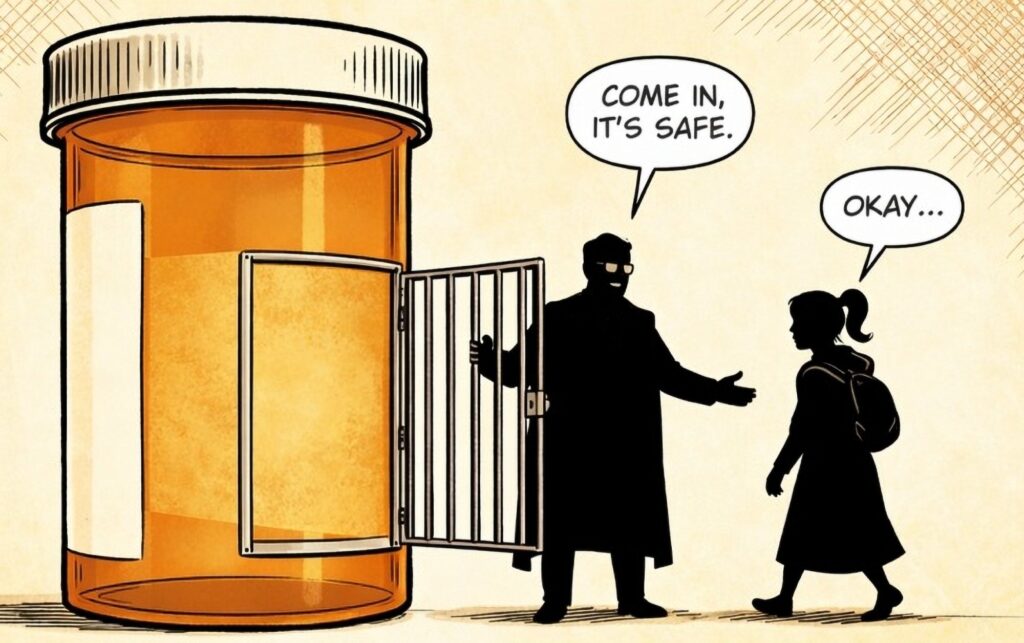
Your story is important and you’ve done a great job telling it. Thank you. Can you share where that fantastic cartoon comes from?
Report comment
Hi Gretchen,
Thank you for reading & thank you for your kind words!
Normally, I prefer to create my own artwork, but I didn’t have time on this one. So I told MIA my idea, and I believe they executed it using an AI program they typically use.
-Jasmine
Report comment
Fabulous. Thanks for letting me know.
Report comment
You have perfectly captured the strategy by which marketing and sales techniques are used to pull you into a cycle that as you correctly observe they had NO intention of bringing to an end. Getting worse means you need MORE DRUGS (never less or none), but getting BETTER means THE DRUGS ARE WORKING, so still never less or none! Clearly no way out of this cycle. I’d be very interested to hear others’ experiences on this line, as this is very much what I have observed happening to many, many people I have known, both personally and professionally. It’s a win-win for the doctors and the drug companies but a lose-lose for the poor clients!
It is also telling that these so-called professionals could not see the obvious staring them in the face (your mom’s smothering behavior), and that nothing YOU said seemed to have any value or importance in their evaluation.
Well done for making the courageous decision to stop despite the intense pressure to continue!
Report comment
Thank you for your kind words, Steve! I always enjoy reading your insightful comments. I would also be interested to hear others’ experiences with this pattern, as it seems to be a common one (though not talked about nearly enough).
Report comment
Yes, its marketing, not doctoring.
Report comment
I resonated with your story, Jasmine. As I read it I thought, it is the neurotoxin worshipping psych workers, who are the insane people … not the innocent people, especially children, who they fraudulently claim to be “helping.”
I had to run some errands, prior to commenting, and heard these music lyrics on the drive:
“… She was the one with the broken smile
“Now that it’s done, she was the one
“She was the one that was worth my time
“Now that she gone, I know that I’m wrong
“She was the one with the broken smile
“Now that it’s done, she was the one
“She was the one that was worth my time
“Now that she gone, I know that I’m wrong ….”
And I was reminded that the “mental health” workers claim a smile, to be a “grimace.” They take good traits, and turn them all into flaws in their patients, and former patients – who are smiling, because we’d escaped the insanity of the mental health system.
Thank you for sharing your story, Jasmine. I hope your escape journey, albeit likely bumpy, has gone well, and you’re smiling too.
Report comment
Thank you for your kind comment. I, too, resonate with song lyrics, and so I really appreciate you sharing those. Do you know the name of the song? I’d love to look it up.
By the way, there will be a part 2 & part 3 to this story, probably coming out sometime this week, so stay tuned for that!
Report comment
Jasmine, you went through a lot at a crucial time in your life without the proper support and guidance you had every right to expect from the adults in your life who, unfortunately, really weren’t interested in anything you had to say that didn’t validate their entrenched points of view.
But you turned things around! Not easy to do in culture that implicitly teaches us to bypass our own intuition. Congratulations for following yours 🙂
Report comment
Thank you so much, Birdsong! I really appreciate your kind words & will try to take them to heart. It’s been a rough journey, and still isn’t over yet.
By the way, like I told Someone Else above, parts 2 & 3 should hopefully be going up sometime later this week, if you’re interested in hearing the rest.
Report comment
I’d love to hear more of your story, Jasmine — the remarkable clarity of your lived experience crystallizes conversations about a system that fails far too many.
Report comment
Thank you, I really appreciate hearing this kind of feedback. By telling my own story, I also hope to give voice to the stories of so many others.
Report comment
Hi Jasmine, Thanks for sharing your all-too- common story of misadventures in psychiatry. I was really stunned by the ignorance of the psychiatrist’s comment that feeling nothing was normal. What an awful way to live! I remember telling my doctor that I couldn’t feel and that I felt suicidal, and he told me the only way out was ECT. That was 30 years ago. One would hope that by now doctors would understand that emotional blunting is a negative sign rather than a positive one. Kudos for your courage. Can’t wait to read more of your story. Im sorry you went through such a nightmare.
Report comment
Hey Ann, for some reason my reply to you showed up at the bottom of the queue as an independent comment, instead of as a reply under your comment. Just wanted to let you know!
Report comment
Wow! Had it happened to someone else, would we be hearing about it so lucidly? So very clear. Took me straight back to similar conversations I had prior to trying Lexapro. Looking forward to Part 2!
Report comment
Thank you, Dan, I really appreciate this comment! Parts 2 & 3 are up now, if you wanna check them out!
Report comment
Jasmine your story was infuriating and I am so sorry. It made me an old social worker check out old readings on adolescence and human development. Either the professionals you encountered were never taught properly. or miseducation but it was malpractice.
I was lucky enough to be exposed to professionals that were imperfect but had some saving graces of kindness and compassion and wide knowledge on human development. I experienced my during my trauma years the utter lack of help and support when needed.
Some names to check Peter Blos, Rubin Blank, Marian Woodman. No human or group have all the answers and now between the corporatizing of all healthcare and only use of chemicals and rigid group classes not much true help for anyone in crisis. For this area all of us have been the canaries in the coal mine with this sector of health care. I am glad you survived and are doing this work. Andrew Sullivan just published an opinion piece in the NYT he is so so pro DSM and use of chemicals but in a weird way he does have sone heart left. I would love to have you and others try to dialogue with him and perhaps he could open his eyes to a more wide way of thinking on all of this.
Report comment
Thank you so much for your kind & thoughtful comment, Ann. I’m really sorry you went through all that as well, and glad you seem to have found a way out.
Report comment
Thank you for this very compelling piece Jasmine. It’s very well written and really shows how the mental health system gaslights, disempowers and demoralizes people who had hoped to receive support navigating life’s difficulties and support in making decisions they instinctively know are best for themselves. When talking to a psychiatrist you are ‘damned if you do and damned if you don’t’ when it comes to anything you share with them. If you try to explain some of your difficulties they will usually twist your words into whatever they want it to be. Or they ignore it and act like all context of a person’s life is totally meaningless. If you don’t share or explain much, well they will just make up some narrative that suits their biases and whatever label(s) they plan to put on you. I am so glad that even though you were so young you were able to rise above this misleading and biased ‘information’ and get yourself to a better place. I look forward to Part 2 and 3!
Report comment
Thank you so much for reading & leaving this kind & thoughtful reply, Rosalee. “Damned if you do damned if you don’t” definitely describes how I used to feel all the time. I hope you find value in Parts 2 & 3 as well.
Report comment
Chapeau Yasmin, I am thrilled to see how, despite your young age, you have observed so well, listened to your intuition, and gained more and more clarity. I am very excited to see how things will continue.
I am writing from Europe, and I am appalled at how the entire field of medicine is increasingly courting psychiatry. This goes beyond protecting colleagues. It includes the conviction that psychiatry is simply good.
A short story: I was sitting with the head of dermatology at an elite university with severe physical pain. It was clear that the pain was related to histamine. He referred me to psychosomatics so that I could better cope with the pain. I told him that I had a living will stating that I do not allow to be treated with drugs or to receive psychiatric diagnoses. He ignored this statement and continued to say that psychosomatics was separated from psychiatry, which is nonsense; it is one department with one head. He went on to say that child and adolescent psychiatry in particular was outstanding. His gestures and body language showed me that it was clear who had the knowledge in this case.
What is also important in particular is that the legal requirements of the patient are simply ignored. They do not tolerate any dissent and are increasingly reverting to the medical totalitarianism of the early 20th century. This is very stressful for patients but I think, you know what I’m talking about.
Report comment
Hi, thank you for leaving this comment! I’m so sorry you had that experience. That’s ridiculous that the doctor tried to convince you that “psychosomatics” were separate from “psychiatry.” Sounds like he definitely didn’t know what he was talking about! I’m really glad you asserted yourself & didn’t fall for it though.
By the way, Parts 2 & 3 are up, if you want to continue reading! I hope you find value in those as well.
Report comment
I felt very angry reading about your family’s behaviour towards you as well as the medical professionals. Very well-written article.
Report comment
Jasmine, this is such an articulate, insightful look into exactly how the psychiatric system operates to undermine its victims and give them drugs instead of support. Most of all, it highlights that people operate in systems, and if you happen to be the “canary in the mine” person within a system who wants to call out its dysfunction, look out because psychiatry will not recognize what is going on. YOU will be singled out for treatment (drugs) as if the problem was you. As you were. Psychiatrists are programmed to see only categories of “illness”, not people people struggling to survive and succeed in difficult environments. Congratulations on seeing through it all.
Report comment