
As a child, the system failed me. I was mercilessly bullied in elementary school. I had almost no friends for many years, and it imprinted on me that I was not adequate. I tried very hard to conform to the other children, but no matter how hard I tried, I was not accepted. On the first day of sixth grade, the few friends I had been able to make decided I was not “cool” enough. I was alone, frightened, and friendless.
At some point, I stopped trying to make friends because I thought it was pointless as I had been rejected so many times. In fact, I likely tried too hard. I was not given therapy or adequate coping resources as a child. I knew I needed help, but I had no idea how to get that help. I was never given permission to talk through my feelings and always felt I had to hide. I felt like nobody understood me, and I gave up on myself.
Throughout elementary school, my internal thoughts were “nobody likes me, everybody hates me,” but nobody talked to me about my feelings, so nobody knew quite how much I was struggling until I started to self-harm at age 11. At that point, other kids began to see me self-harm, although I covered the scars with long-sleeve shirts around my parents and teachers. My friends were at a loss, and disconnected. Other tweens had no idea how to react to such open self-harm. Once I started, it became an obsession, and I did not feel I could stop.
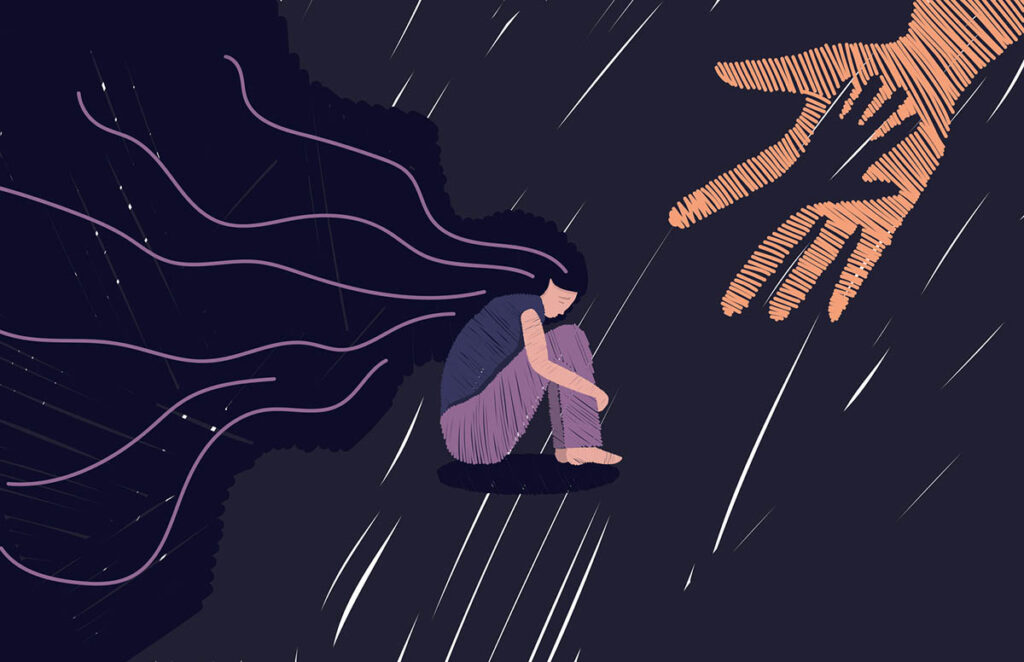
This continued until, at age 16, a teacher noticed. She called my mother and said that she thought I might be suicidal based on the self-harm. I was not a part of that discussion, but my mother came and asked me if I was suicidal. At that point, I had not even contemplated suicide. I denied any thoughts of suicide. However, once it was suggested, I started thinking about it. I could not give up the thought. Like self-harm, it became an obsession.
I heard a song from M.A.S.H., “Suicide is Painless”, and it made me think that suicide would be the easy way out. I bought sleeping pills and took a handful. I panicked, and I called a friend. The ambulance took me to the hospital, and charcoal was used to make me throw up. For a long time, I thought I was a failure because I did not succeed in committing suicide that night. I felt I had to be perfect in everything, suicide included. It took me many years to forgive myself for that attempt and to be glad that I survived.
In fact, my suicide attempt was a cry for help, but the help I needed was not that to which the system pushed me. I agreed to be admitted to a psychiatric hospital where, instead of healing, I became more suicidal. The other teens in the psychiatric hospital encouraged each other to find ways to self-harm to deceive the staff. I was watched 24/7 because I threatened to use dental floss to self-harm by wrapping it around my neck. I wanted the attention, but the kind of attention given in the psychiatric hospital was not the kind I needed to heal. Instead of being heard in the psychiatric hospital, I was told that what I needed was psychiatric medications and that I would be in and out of psychiatric hospitals for the rest of my life.
Nonetheless, while I was in the psychiatric hospital, I continued to achieve. I took the PSAT and I was awarded National Merit recognition. My parents supported me leaving against medical advice. I firmly believe psychiatric hospitals are not therapeutic. It took me a long time to mentally overcome the life sentence that mainstream psychiatry handed me at age 16. I thought I was forever damaged.
I returned to school after my suicide attempt, but I was overwhelmed. I told my parents I just could not continue in the pressured environment because I was on the verge of collapse. I desperately needed a break. I enrolled in correspondence school. I completed my homework, though it took hours each day, and I volunteered my time at an elementary school.
As I applied to colleges, I was afraid that my suicide attempt and hospitalization would make it so I would not gain admission. My parents agreed that I should cover up what had happened. Would Stanford have admitted me if they had known that I had been in a psychiatric hospital just two years prior? It is hard to say. I did not want to test it. I hid my past because I feared the consequences.
At age 20, while at Stanford, I was overwhelmed by the pressure. I was given one pill of Klonopin from a friend. I became very agitated and I did not understand what was happening. I went to student health. They did not know what to do with me. The University did not think I was safe staying in the dormitory. They insisted that I stay in the psychiatric hospital for one night. I agreed to go voluntarily. Nonetheless, the paramedics came and strapped me to a gurney. I resisted with everything I had as I had stated I would go voluntarily and saw no reason for force, nor did those at student health. My mother flew out that day and we stayed in a hotel for several nights thereafter.
I firmly believe I had an autistic meltdown with high anxiety. (My neurologist changed my diagnosis to autism spectrum disorder on May 5, 2026, in my medical records. I intend to have a neuropsychological exam to further confirm the misdiagnosis, but multiple physicians have agreed that autism is the correct diagnosis.)
Instead of investigating other options such as therapy or feeling I had permission to take a year off from school to take care of myself, I was labeled as having bipolar I and urged to continue my studies in order to graduate on time from Stanford, when really there would have been no issues with taking a year to concentrate on healing.
I firmly believe that I never met the requirements for bipolar I disorder based on my medical records, although some of the criteria were satisfied. Yes, I had a distinct period of “abnormality” and persistently elevated expansive or irritable mood, lasting at least one week. However, my records at no point indicate “mania.” There is no mention of inflated self-esteem or grandiosity in my records at the time of the diagnosis, nor is there a mention in the records of decreased need for sleep. I was admittedly more talkative than usual, although there is no indication that my thoughts were racing. The only mention of pleasurable activities that had a high potential for painful consequences in the records reflect that I had a “buying spree” when I went to Ross and bought two skirts for under $100, which is hardly diagnostic.
Further, the DSM-IV required that “The mood disturbance is sufficiently severe to cause marked impairment in occupational functioning or in usual social activities or relationships with others, or to necessitate hospitalization to prevent harm to self or others, or there were psychotic features.” However, my records indicate I did not have suicidal or homicidal ideation, nor were there psychotic features, so this required element could not be met. Further, a “marked impairment in occupational functioning” was not established as I graduated on time from Stanford, graduating with distinction and departmental honors. I did take one quarter off, but at that point my mother had breast cancer, and taking a quarter off at Stanford was a right freely exercised by any student who wanted a break for any reason without question. Thus, the diagnostic label of bipolar I disorder was never satisfied.
The doctors rushed to a diagnosis and a label, instead of treating me as a person. Once I was told I had bipolar I disorder, I looked it up and acted the part. My parents were frequently a part of my sessions with psychiatrists, and I did not feel I could speak openly about my thoughts at those appointments. I did not trust the psychiatrist and I panicked at every appointment. Had I had a psychiatrist I had trusted with my thoughts, I would have felt safe in expressing what was truly happening. I did not believe I had a voice or a choice.
At the time, I trusted mainstream psychiatry, and my psychiatrist told me at age 20 that a little pill could solve my problems. I was quickly prescribed various antipsychotics, including Haldol, none of which were effective. I wanted an easy and quick solution so that I would not have to take time off from school. Like so many others, I knew nothing at all about the detrimental effects of psychiatric medications when I started taking them. How could I have? Nobody bothered to tell me. Therapy was not even suggested at that time.
I experienced numerous side effects due to antipsychotics, including blunting my personality, making it difficult for me to concentrate, and making me gain weight. Because of these side effects, my doctors kept switching me to other drugs, before I was finally given clozapine (clozapine for bipolar is an off-label use).
At 25, I became physically disabled by tardive dyskinesia, a side effect of antipsychotics, although a more recent evaluation states that it is tardive dystonia, which is in the same family. I was a teacher, but I could no longer stand in front of a classroom because I was too physically disabled. I therefore decided to go to law school. I graduated from Rutgers at age 29. I then practiced as a medical malpractice attorney. I also practiced as a Social Security disability attorney. I saw time and time again that people were denied benefits because they did not wish to use psychiatric medications—instead treating their anxiety with coping techniques like using ice packs or breathing through panic attacks.
Eventually, I resigned on short-term disability. Although I am not currently practicing, my bar has never been in jeopardy and I will maintain my bar.
I have a power of attorney, a legal document, saying do not commit me to a psychiatric hospital for any reason, unless I am a danger to others, although I suspect it would not be respected by an emergency room. I have never been a danger to others. Instead, my preference would be that my mother or my best friend be called in the event of a mental health emergency. I believe that when a person is struggling, they should be seen as an individual and shown compassion.
Recently, my psychiatrist decreased my antipsychotic dose far too quickly. I became a complete insomniac on the last night of my bad taper off antipsychotics. I was desperate, but I held out a month. I was urged to take other antipsychotics, and I refused. I finally agreed to take benzodiazepines for insomnia. Although they initially helped, very quickly my tolerance grew and my insomnia increased. No psychiatric medication helped my insomnia.
I am now in benzodiazepine withdrawal, despite following the directions of my doctor and taking medication exactly as directed.
I now speak publicly about the detrimental effects of psychiatric medications that took my physical vitality for 20 years when I was disabled by tardive dystonia, that changed my personality, and that diminished my mental acuity. The side effects of psychiatric medications are often not fully disclosed by psychiatrists. Many people would not take psychiatric medications if the risks had been fully disclosed in advance. I know I never would have.
I did not go public for attention. I went public because I did not want anyone to suffer the way I have, which is unnecessary. Had my mainstream psychiatrist provided truly informed consent, I would never have ingested benzodiazepines. True informed consent does not merely mean signing a piece of paper. It means having a transparent conversation about the risks of a psychiatric medication before physical dependency results. I don’t believe anyone should ingest benzodiazepines for more than the recommended two to four weeks, except in some extreme cases, given my experience.
When people decide to step into the public eye with a deeply personal story, they do not always fully understand the risks they are taking. Suddenly, their story belongs not just to them, but to the world. When I went public, I did not completely comprehend what that would mean. I tell my story without shame in the hope that others will not suffer as I have. I went public because I feel I have a message and a viewpoint that few others could offer. There are many who disagree with my positions, and the topics I discuss openly are not frequently addressed publicly. As a result, people sometimes do not know what to say to me.
Without complete transparency, consent cannot be considered truly informed. While silence may feel safe, it keeps us immobilized. I advocate for patients to report psychiatrists to the medical board because psychiatrists also make mistakes, as can any doctor. Reporting psychiatrists is easy and not traumatic because it can be done anonymously. I have filed a lawsuit against my psychiatrist for failure to provide truly informed consent. Unfortunately, few attorneys are willing to take these cases. I intend to keep moving forward, speaking my truth in the hope that future generations do not become stuck in harmful mental healthcare patterns.
I filed not for revenge or with the expectation of a monetary reward, but rather to prevent this psychiatrist from taking as much from anyone else as she took from me. This is traumatic for me, but it is something I feel obligated to do as a medical malpractice attorney. It is difficult to litigate psychiatric malpractice cases. However, if an attorney takes the case and believes it to have merit, the client often has to do little else besides appear for a deposition. No qualified attorney will take a case for which there is no expectation of success because of the significant expenses. If a case is taken on by an attorney, this means that the likelihood of success is fairly high. Thus, I believe that individuals should reach out to counsel to have their cases evaluated if malpractice is suspected. The trauma of being deposed may be far less than the expense of remaining silent.












Attorneys have had some of the best luck holding Psychiatry’s feet to the fire.
I wish we could get to the point where just offering a drug to someone for their “mental disorder” would be seen as a violation of their basic rights.
Report comment
Thank you, Larry. My hope is that patients receive complete and accurate information about risks, benefits, and alternatives so they can make truly informed decisions about their own care. Informed consent is a fundamental patient right.
Report comment
I am working on the “alternatives” part of this picture.
We need both practitioners and the general public to KNOW that alternatives to these pills do exist. We are up against vested interests who don’t want that to happen. If a patient thinks that taking a pill is the only real choice they have, many will agree even though they are told about the risks.
Report comment
You seem to be someone who is somewhat comfortable with the system. Apparently it never hurt you too much. So many others have had very bad experiences with the system. If it’s trauma you want, the system can often deliver.
But recognizing that one “has a condition” is – for me – not the point here. A lot of us have things about ourselves that bother us.
The DSM – and similar systems – get used to put people in boxes and get insurance payments. Then a certain range of drugs and other treatments are indicated according to the box you are put in, but normally no one helps you to get OUT of the box. They prefer you to stay there. But that’s not what YOU want, normally (although some use their “boxes” for identity purposes).
Meanwhile, there are a whole bunch of practitioners working hard every day to help people out of the “boxes” they don’t want to be trapped in – whether or not that “box” has a specific name. Right now those practitioners are forced to work outside the insurance system, as it is doctor -controlled and therefore a bit of an exclusive club. If we are going to allow psychiatrists and psychologists – with their poor results – into the system, why not allow everyone else? Some would prefer not to mess around with insurance paperwork, but most of the treatment system set up for “common people” totally relies on insurance payments for its survival.
Report comment
Larry were you replying to me or Ellen because I don’t think Steve published my comment as it says, “is awaiting moderation” If you can see my comment that is the comment I wanted removed because I didn’t feel it related to the topic. If you were talking to me, I’m not totally comfortable with the system, I have had my share of terrible treatment, and I have also had good therapy as well. I don’t agree with a lot of it. Maybe I just have lucked out recently because a former psychiatrist almost killed me by cutting me off cold turkey of a benzo and told me if I get into withdrawals to go to the Er. Well, I did that and was called a “drug seeker” after a while because ERs stopped giving me bridges to tide me over. Not one psychiatrist at the time would deal with benzos so I was up sh*** creek until I landed at UCSF Er by luck getting a great intern who admitted me to the medical unit to start a taper. I was in major withdrawals & only 1 out of 5 Er’s I went to helped me. Besides that, I managed to find an amazing psychiatrist who did help me and only suggested a medication if I wanted it. At first, I thought they were all destructive, but I realized not all of them are. I don’t everything about the insurance game, but I know that I got reimbursed a certain amount by submitting to the insurance with the Dr’s letter. But I was paying giving checks upfront. A really good psych hospital at UCSF (being serious) that helped me took my insurance. But it wasn’t easy for everyone to get in. They had a screening process. I do wish healthcare wasn’t part of a business.
Report comment
I ran into a violation of “informed consent” 3 days ago, that is different than benefits / risks for a specific treatment or diagnosis. I want to share. I am so gullible!
I declined the blood draw, on the basis that it had been drawn just 6 months ago, and nothing had changed. I had a copy of the labs with me. I’m healthy. The new to me FNP told me that the CDC recommendation was for a blood draw every 3 months. I have had low thyroid for 25 years. This has never been the case. Is the CDC even in this business? I called the provider on their lie. The provider defended their lie. I still declined the blood draw. That is an invasive procedure and I have the right to decline.
Driving home, I pondered the new to me dentist who, 18 months ago, that told me it was State Law, that I would have to submit to root planning. I literally felt threatened and fled that office. That is a very invasive discretionary procedure. I get to decide. And I get to fire the offending dentist.
These are facts easily verified by A.I. There is no CDC recommendation, and there is no State Law. These people, masquerading as Healthcare professionals, were lying. Trust is destroyed by lies. If they would lie to me about this – what else are they lying to me about?
I thought, more generously, that perhaps these people just cited an incorrect source. After all, they have so much to remember?
A.I. says some practitioners do this.
That’s nuts!
What I learned from all of this is what I am looking for is “ shared decision making”.
I had no idea that this was not the standard, the norm!
Harkening back to my days of forced, by the gang of 8, submission to their bootie shot (and then they bill you for involuntary detention, though you have broken no laws) … Back then, a particular healthcare conglomerate kept telling me that I had to do what they said, or I would die! That was 20 years ago – so not true! Drug and symptom free for 9 years now.
Be careful out there folks. Psych is not the only discipline that violates “informed consent”. We all must be imagining a more perfect world.
Report comment
Yeah, isn’t it kind of indicative that so many psychiatrists are OPPOSED to “shared decision making,” like it’s some sort of radical and dangerous new idea?
Report comment
Finding a lawyer to take one’s case is really difficult, if not impossible, even when one has medical evidence of motive (complex iatrogenesis to cover up easily recognized malpractice, and medical evidence of child abuse), and when one can medically explain the psychiatric malpractice (anticholinergic toxidrome poisonings).
I do hope more lawyers actually start taking such cases against the psychiatrists.
Report comment
Yes, we have found this to be true in Sacramento.
But there is also the legislative part of controlling Psychiatry, and we’ve had lawyers help with that.
Report comment
Thank you for reading and commenting. One reason I chose to tell my story publicly is that many patients feel unheard when they believe they have been harmed. Regardless of one’s views on treatment, informed consent and patient autonomy are fundamental rights.
Report comment
Ellen, thank you for taking the risk and telling your story so this others can see it’s not just them, they really ARE being mistreated and abused! I wish your story were an outlier. Unfortunately, it is extremely common, maybe even the expected result.
One issue I want to raise is the issue of “misdiagnosis.” I try really hard never to use that term, because it grants the unstated proposition that SOME people really DO “have bipolar” and therefore merit the “treatment” that was so destructive to you. It’s not less destructive because someone “meets the criteria” for “bipolar.” The criteria and the “diagnoses” themselves are a huge part of the problem!
Keep on telling your story. People need to hear that this is what standard psychiatric “treatment” looks like. And it’s not pretty!
Report comment
Thank you, Steve. I appreciate your thoughtful comment and your support. I understand your perspective regarding diagnosis. In my case, I use the term “misdiagnosis” because I believe my experiences were better explained by other factors, but I agree that informed consent and patient safety matter regardless of diagnosis. Thank you for taking the time to read and engage with my story.
Report comment
That wasn’t quite what I said. I’m saying it’s impossible to be ” misdiagnosed” because the diagnoses themselves are so arbitrary and subjective that you could “meet the criteria” for half a dozen “diagnoses” and still get no different treatment regardless of what labels they choose to apply to you.
I understand that YOU identify with the ASD label, and I fully support your right to label yourself any way that makes sense to you. But I don’t want to accidentally give credence to the idea that THEY get to label you or anyone else with anything, even if someone “fits the criteria,” because the criteria are nonsense and true informed consent would include the clinician admitting that the only real meaning of their “diagnoses” is to get insurance reimbursement.
Report comment
Thank you for clarifying. I agree that the diagnoses are arbitrary and subjective. However, I actually have had an ASD diagnosis changed in my records, so I do view it as more than self-identifying. Yes, “diagnoses” are often essential for insurance reimbursement.
Report comment
What a practitioner writes in your notes, or anyone’s notes is not proof of a mental diagnosis. It is their heuristics, default, tendencies and habits, aligning with codes, item numbers, DSM/ICD labels, insurance requirements, that best serve their income revenue while legal, if questioned and or audited.
If my teacher gave me an F after marking my history essay, and I sought a second teacher’s assessment, who then gave a C, what would that leave me thinking? Maybe a third assessment by a third qualified person, will rate my essay an A?
They are all history teachers, all working from the same books pe se.
A psychiatrist will not for minor matters of opinion, undermine a fellow psychiatrist (this applies to all medic professions), but will offer a possible alternative, usually with similar criteria, but different enough for a new diagnosis.
You didn’t want the label of bipolar, but you accept the label of autism. It’s truly irrelevant what your notes say.
Many people refuse all labels, and have to live with whatever is written in their notes, whether true, accurate, or not.
Bipolar doesn’t receive individual funding; ASD does.
Having taken drugs for such a long time, (or even after just a few months), not a single person knows what those drugs are, were, and have done to any human beings.
The DSM/ICD money manuals, the contents of which are agreed to by consensus, not robust scientific evidence (because there is none), are meant to serve the purpose of making diagnosis uniform and easier.
If you read the signs and symptoms given in the manuals, after a few pages, everything sounds the same or similar, sans one or two rare exceptions (that actually do have a biological cause).
It is possible and plausible that the side effects, adverse effects, including neuro-psychiatric, of psych. meds and related drugs, are what DSM/ICD diagnostic manuals have turned into illnesses, disorders, disturbances, et cetera.
Grab a handful of the air around you and analyse it. Its guaranteed to have oxygen and nitrogen.
Psychiatry has to dish out a diagnosis in order to enable and or receive payments. Certain drugs are known to induce or “unmask” bipolar signs and symptoms.
The words “induce” and “unmask” cannot rigorously be tested nor evidenced.
“Temporal cause” is almost impossible to prove.
Diagnostic overshadowing and cacade prescribing are common practices. Drugs given for the symptoms produced by the drugs (substances, treatments, therapies) originally given, and then the drugs given for the new or exacerbated symptoms caused by the drugs given for the symptoms caused by the drugs given, … !
This would be classified as Criminal activity under any other framework, yet the psychiatrist has legal authority to give out as many drugs (treatments) as they want (in reality they are guessing and experimenting) until one “works”. However, what is being done is scrambling the brain, and stressing all internal systems and organs. Presentations become “different” and this different is then labelled and given a diagnosis according to what the drug is legally approved for. If drugs are used off-label, some sort of peer consensus will be available.
This type of business is encouraged by their professional Associations, and also approved and backed by Regulators.
Not giving full disclosure for obtaining informed consent is a strategy used for many reasons that have been approved.
We should expect: At visits, if given a prescription, as a minimum “must” (mandatory, compulsory) the prescriber ought to give a copy of the current Product Information (PI). But again, the costs, administrative burdens, and added mental load, entitles the prescriber to not have to perform such menial, unnecessary duties.
Filling a prescription provides yet an other opportunity to be given the PI. Alas, to save costs, the manufactures rarely include them in the product’s package. They used to, but to save money, Regulators no longer require its inclusion. (Are the Regulators independent!?)
One can ask the pharmacist for a copy of the PI. They might look annoyed (now it is their costs and their time being taken advantage of), but they cannot refuse. Though they can instead try to get away with a bit of a chat, usually about allergies, having taken the drug before, and any special and specific instructions for taking the medication (this too is part of their Standards and is a requirement that has to be evidenced).
Lastly, before filling a prescription, (provided there is no catastrophic urgency – and psych. meds are known to take one to two months to “work”), a search for the manufacturer (original or generic) and the current PI for the specific drug, should give enough information to guide a decision.
Notes, even when contemporaneous, only contain what the person writing, dictating typing, puts in them. A great deal if time, effort, legalities, and very specific training for students goes into the how-to of notes, and documenting – It is given priority and depth, along with the how-to of running a business for success.
AI transcripts are meant to be checked by the practitioner, but why would they spend focused time on doing that. ?
ASD is almost always treated per se, with drugs. ASD – its classification (used to be “mild” “moderate” severe”) changes to find funds, funding, grants, donations, claims, and anything else that means more money for some.
If you look through all the side effects, adverse effects of all the drugs, substances, that you have been prescribed over the years, ASD signs and symptoms will be in the mix.
That you managed with perseverance, with enduring family supports, and with commendable results in your studies, to get to a position of elite employment, demonstrates more about you and your family and the healthier inputs along the way, than any diagnosis, verbal (planting the influence) and then written, that in essence represents a rabbit being pulled out of a magician’s trick hat.
Some people like having a diagnosis, a label, a connection to the people who write scripts, fill scripts, form like-minded support groups, …, as it creates predictable encounters.
It’s often very difficult to let go of stories and narratives that have been groomed to form part of our identity.
We can learn to discern, to not co-opt, to not absorb, to say our piece, to say “no”, to ask for alternatives, and options, …
If we spent just half as much time with our children, partner, dear friend, genuinely caring family, in quality togetherness, as the time we spend visiting (and paying) doctors, specialists, and buying pharmaceuticals, the world would be a better place.
For those of us with no close connections, we can rely a little bit on nature, the sun, the birds, the ocean, the green, the blue – the sky is always a shade of blue; and it’s amazing.
How many tens of thousands of dollars do we put in these experts pockets, when what they have to offer are known poisons and toxins, with known harms.? They don’t check for any possible physical causes. They just prescribe a fix for thoughts. Interesting. First do no harm.
Best,
Report comment
Thank you so much for your comment and your incites! They are very inciteful! I agree, the process is very individualistic. However, I would disagree that ASD is a condition generally treated with psychiatric medications. Co-occurring conditions often are, but ASD generally is not. I appreciate your support!
Report comment
This is such a good point Steve. It’s what I’m thinking every time I read that word.
Report comment
“misdiagnosed” ?
“underlying mental illness”
“unmasked”
“not diagnosed”
A favourite: “genes”, “genetic”, without testing or other viable evidence.
Every word used in this industry has at least more than one other meaning, explanation, interpretation, definition, application. Nothing is straightforward. Words are taken out of their original intention and context, and applied ad lib.
Each exogenous drug, substance, treatment, therapy, alters cells (genes, or their parts; DNA, … ) – Mimics, alters, stops, accelerates, interferes with in some way or another. The vast majority are synthetic, synthetics, engineered.
(Those mandatory vitamins and minerals added to our cereals, breads, – synthetic.For those of us not requiring an added DAILY dose or two or more, of vitamins and minerals, maybe we are being exposed to too much of an artificial thing).
Cells being perturbed by an exogenous drug, substance, treatment, therapy, becomes “the patient/person is perturbed. Other interchangeables: observed (research, science, experiments, …) CELLS are disrupted, disturbed, disorganised, dysfunctional, induced, modified, and dozens more, become transferred into labelling a person with presentations of the same characteristics that are produced by drugs et cetera. The exogenous drugs’ actions and mechanisms (never fully known) inflict a stress state (at least while being taken) on human systems and organs that interferes with each individual’s normal baselines (homeostasis). This stress state becomes known as a person who is stressed and who cannot cope!
Stopping the drug/s is rarely considered. The person lacks skills, or resources, or education, or … .
None of this sounds particularly appealing outside of essential and emergency situations.
What will become of those infants, babies, toddlers, children, adolescents, who are growing up in an era of being equated to a cost, given the cheap treatment of drugs, and left to fend for themselves. Giving Mind-altering known poisons and know toxins, are prioritised over the functional supporting of parents, families, along with the over-promotion of two-income wage earners, along with the fast food readymade meals industry, along with the alcohol industry that is heavily advertised and promoted even though research clearly identifies its direct causes to diseases, illnesses, cancers. And that no amount of alcohol intake is safe.
What type of society has been deliberately and intentionally created.?
Maybe you have some other examples.
Safe doses of radiation or irradiation. Safe doses of herbicides, pesticides, growth promotants.
The death certificate for the majority of elderly in aged care institutions reads the same “heart failure” – think about it!
Drugs, drugs, drugs, innovation, innovative drugs.
“Unintended” is the legal out word for side effects, adverse effects, of drugs, substances, treatments, therapies, with known and published risks and harms.
Product Information (PI) is perpetually attended to by medical, legal and other experts. Each litigation loss for pharma, has them rewriting the wording to lessen chances of and opportunities for future litigation. That’s the priority, the financial priority, shareholders priority. Safety is incidentally attached.
Report comment
Right you are….
Report comment
This is my exact story down to grade 6 except my ASD diangosis came two years ago. Thank you
Report comment
I am glad my story resonates with you. I think my experience is all too common.
Report comment
Ellen, thank you for sharing your story and speaking out on the harm psychiatry inflicts with bogus labels and toxic drugs. I applaud you for filing a lawsuit and really hope it will be successful! My brother lost his life at 40 due to the toxicity of psychiatric drugs he took exactly as prescribed for temporary grief following his divorce. I also had a very damaging experience with a young psychiatrist I was told to see during cancer treatment for “help with sleep meds” after chemo drugs and steroids caused sleep issues (as well as other adverse effects) Too much to describe the depth of the harm here but it involved being subjected to a medically/legally defined “assault and battery.” A lawyer told me I had a strong case on that issue but the psychiatrist had unbeknownst to me, put 4 major psych labels on my medical records and because of these labels no lawyer was willing to take a chance on my case. Another huge obstacle is in Canada there is an organization called the Canadian Medical Protective Assoc (CMPA). This is a large group of lawyers who are funded with taxpayer dollars to provide free legal representation to doctors. The CMPA has accumulated a war chest in the billions to “protect” only doctors and this situation is referred to as a David and Goliath battle for any patient trying to sue a doctor for malpractice. That is if the patient could ever find a lawyer willing to go up against the CMPA dollars. Psych labels on a person’s medical records make it very easy to be harmed by other types of medical doctors as these other doctors know psych labels mean you will have little to no credibility or recourse.
Report comment
It is a given that a Doctor’s source of income (lifestyle) will not be taken away from them, when no case against them meets defined legal Standards for certain defined actions.
Doctors using cocaine, if caught, are ordered to attend approved Professional Development course, and promise to not use cocaine again. Such a practitioner could be a neurosurgeon, or … ?
The Doctor who molests a person under the guise of examination, could be an eye surgeon. They too are ordered to a Professional Development course, and promise to never do such a thing again.
Practitioners literally have to disable, mame, injure to the level of incapacity, or kill, before they are fairly and justly held responsible and accountable. The higher the status, the more protected they are.
The general public despondency, depression, anxiety, disproportionate anger, is created by situations that do not follow The Rules, and exacerbated by ad hoc Rules formulated for some.
Truly sorry for all the unwanted, unnecessary, unwarranted, and unreasonable “burdens” that are foisted upon those (any age, any demographic, any place of origin, any gender), when they simply, in good faith, went and reached out for a tiny bit of authentic genuine guidance, and they end up with cheap pharma drugs (that significantly and substantially costs the consumer) in their system, and scraps of disjointed faux “care”. Albeit charming, friendly, personable, faux “care”.
Report comment
Vee
It is so true….”faux care” and do not forget “compassionate” so very compassionate.
Report comment
Thanks you so much for your support! Filing a lawsuit was one of the most difficult things I have had to do, but I feel very strongly about the case. There is so much mislabeling!
It is very unfortunate how much mislabeling goes on. Being labeled by doctors makes it so easy to be harmed by other types of medical doctors as doctors see you have a mental health condition.
Report comment
And again, I will reiterate that ALL psychiatric labeling is “mislabeling,” and serves primarily as a means to make money and exert power over clients/patients. You may identify with a particular label, and that is your right, but no one else has the right to do that for you, IMHO. Allowing labeling allows all the other things that happened to you to be justified and prevents any level of accountability, since exactly NONE of these labels is objectively verifiable or falsifiable. So they can say whatever they want, and if their “treatment” is a disaster, say “Oh, she was misdiagnosed!” It’s a bunch of crap, and the DSM makes it all possible.
Again, not criticizing YOUR identification with that particular label. I’m saying that getting the “right label” has absolutely no correlation with getting anything approaching helpful treatment. I’d say the reason you are getting better help now is because YOU are more empowered, not because they finally got the right label on you!
Report comment
I agree! Getting a proper label does not mean you get helpful treatment. It is so difficult to get the proper treatment no matter what. Unfortunately, insurance requires labeling. The DSM is basically made up, in my opinion!
Report comment
Not just your opinion, they literally agree on these “diagnoses” in committees! Can you imagine voting on what criteria to use to diagnose cancer???
We’re on the same page here!
Report comment
So important to make this distinction Steve! All psychiatric diagnoses are mis-diagnosis. And all psychiatric patients are victims of lack of consent – not only because the required legal standards are routinely ignored – but because the research is inadequate and biased, and because all diagnoses are false and unproven. So meaningful informed consent is impossible.
Of course any legal action is valuable in challenging the malpractices of psychiatry – so thank you for taking action Ellen. I would love to see many more actions but many psychiatric survivors are impoverished and disabled by psychiatric mis-treatment.
Report comment
There are organizations – such as CCHR – that accept reports of abuse. If enough reports are received about a specific doctor or practice, the organization might launch its own legal action against them.
Report comment
I checked out your website after reading this, and noticed that it indicates you’ve made dietary changes that have helped your healing process. What were they, if you don’t mind me asking?
Report comment
I have started eating much more healthily. I do not eat much added sugar. I eat high protein and lots of colors – fruits and vegetable.. Low preservatives, higher calories. Nothing artificial. However – I allow myself treats every once in a while because nobody is perfect!
Report comment
I’m sorry that you went through all of that Ellen. I was misdignosed myself in a hospital in Australia in 2002 with schizoaffective disorder. No solicitor will accept my case because it happened so long ago. I only realised I had been misdiagnosed because I was told that I don’t have any symptoms in 2023 and the time of discovery is up in two more months. I feel that doctors should at least be reprimanded for the mistakes they make. Antipsychotics have been destructive to my mind, body and general well-being for 26 years. I am disassociated from my entire family, sexually dysfunctional, unemployed and technically homeless in a boarding house during a housing crisis. This is the result of the treatment not an illness.
Report comment
I am so sorry that you were misdiagnosed. There are far too many misdiagnoses, and I wish there were more attorneys who would take these cases. Unfortunately, there are very few. I agree – all doctors, including psychiatrists, should be reprimanded for making mistakes. In the United States, it is an easy process to report a psychiatrist, and I have done it twice this year. So many issues are the result of treatment and not the original issues. I wish you only the best.
Report comment
“Misdiagnosis” is a highly problematic term in psychiatry, as there is no way to objectively establish who “has” or “doesn’t have” a particular diagnosis. As a result, legal action is almost impossible, because it is almost impossible to prove misdiagnosis when diagnosis is utterly subjective. The answer begins with rejecting ALL psych “diagnoses” as fraudulent and instead focus any legal action on the actual impact of the intervention compared to what was promised. Diagnoses are intended to obfuscate the fact that these people don’t have any idea what they are doing.
Report comment
I agree that legal action based on a “misdiagnosis” is almost impossible. However, as a medical malpractice attorney, I firmly believe I did not receive fully informed consent, such that I can file legal action. There are valid reasons for which legal action can be taken and there are cases in which it is successful.
Report comment
I agree, failure to provide informed consent is the most vulnerable place to attack psychiatry. They really have no leg to stand on.
Report comment
All the legal actions I am aware of that were successful have been based on real harm, not “misdiagnosis.” I don’t know if that is a valid charge, even in the field of regular medicine, though it happens widely in that field, too.
Report comment
I agree, there has to be real harm. In my case, as the lawsuit alleges, I became intermittently suicidal. My monetary damages were extensive, and my emotional distress is severe, to which my therapists will attest. I will take the case to trial, if necessary, because as a medical malpractice attorney I know the law. I’m in the Dominican Republic right now, choosing myself first, which is the cardinal rule!
Report comment
Larry and Ellen, I have found out erroneous psychiatric ‘diagnoses’ do bring real harm. These labels are the reason harm gets layered on via being subjected to stigma, discrimination, mistreatment, denied health care services for physical health issues and the toxic drugs that cause dependence/physical harm. During cancer treatment I was sent to a psychiatrist under the guise it was for “help with sleep meds” for sleep issues caused by chemo and steroids. Unbeknownst to me, 4 harmful psych labels were put on my electronic records. When this came to light my family doctor was shocked and totally disputed these labels. She asked me if I had been informed I was being ‘psychiatrically assessed’ and if I gave consent to be ‘assessed’. I had NOT and didn’t even know an ‘assessment’ took place as it was me mostly explaining to the psychiatrist how challenging the cancer treatments had been.
I have recently read this type information –
“Informed consent must be obtained before any psychiatric assessment, ensuring that the individual has the capacity to understand the information provided, can make an informed decision, and gives consent voluntarily without coercion. This process is crucial for respecting the rights and autonomy of patients in mental health settings.”
I don’t know if this might apply in your case Ellen but just wanted to mention it.
Report comment
I appreciate your clarity Steve – this is such an important point! – the psychiatric mindset is so embedded that it seems inconceivable to some (including in the legal system) that we are not talking about real things but concepts. Psychiatric diagnostic concepts have achieved an unquestionable mythical status. A status based in the equally unquestionable idea that human experience and behaviour can be divided into kinds which are categorically different in some way. Psychiatric and cultural categories like sane/insane or pathological/normal – are purely conceptual value-based binary oppositions, which have no external referent of any kind. It does my head in how powerful these kinds of concepts can be! I use “mis-diagnosis’ to emphasise that they are all “misdiagnoses” – but I forget that’s not how others understand psych diagnosis. And, as you explain, this misuse of language needs to be clearly challenged because it is what is used as the spurious justification for denying our human rights, including the right to bodily autonomy and choice – and subjects us to dangerous physical interventions – with or without our consent.
Report comment
I completely agree! Psychiatric diagnosis are mythical! There are so many dangerous misdiagnosis! Such an awful system!
Report comment
Though I agree completely, including that the answer begins with rejecting the ALL psych-diagnoses, I also think that there should be an organized mass movement to replace the word “diagnoses”, with, for example, “designation” (psychiatric designation). To my mind, any honest, save effective attempt to reframe psychiatric diagnoses for the disingenuous vacuous signifier that it is, cannot be accomplished without leaving the psychiatric linguistic reservation.
But with regard to the word “diagnoses: I’m now reading a book dedicated to the “diagnosis crisis’ in Medicine (The Elusive Body: Patients, Doctors, and the Diagnosis Crisis). So, even when it comes to ‘scientifically proven’ medical conditions, making the correct diagnosis is very often difficult and rife with trial and error, and, collectively, at a cost to many lives, quality of lives, and no small amount of needless adverse personal and social consequences. The book asserts that most medical schools have no curriculum to teach critical thinking process, of which lead, specifically within the larger now antiquated paradigm of medical training, ‘cognitive errors’ in diagnostic processes, including framing and availability biases and many others. My point here is that “diagnoses’ is a highly challenging process even in fields of ‘specialized’ medicine dealing with real physiological conditions. So, my question is, how is it even possible to provide a correct diagnosis from a compendium of manufactured diagnoses conferred by the vote toll of a ‘select committee’? The answers within this context are so troubling, that I wonder if I am in some way delusional or otherwise a complete idiot.
With regard to the word designation: I would urge readers to read an article by Paula Caplan, titled APA Doesn’t Care About Weaponized Diagnosis. Caplan highlights one women who, with 8 others, sued the APA for blatant psychiatric malfeasance (the case of the 9 litigants was dubbed the ‘DSM 9’). Surprise, surprise… the APA didn’t find any misconduct. I use Caplan’s story as an example of shameless psychiatric designation, ergo the institutional accountability befit a banana republic run by the Three Stooges. (Why is this PMC bullshit to pervasive today?) But my larger point is that psychiatric diagnoses are not disprovable precisely because they are unscientific designations steeped in and obligated to serve a myriad of institutional, economic, professional, and political (i.e., dehistoricizing subjects to accommodate the former) forces. And my guess, now that an entire generation of psych-professionals have been indoctrinated and credentialed to the dictates to the DSM and medical model, save overly ambitious and ideologically incentivized neuro-everything ‘theoretical frameworks’ (an epistemological marriage made in hell if there ever was one, save construction of), there is effectively no one home (critically thinking psycho-socially literate clinicians) to do the hard work that is at the root of the “majority of people’s” struggles and suffering. Worse, as clinicians increasingly offer psych-diagnoses, people are increasingly coming to identify with them, and are a great cost to their own mental health, save reality itself. One can’t but wait for AI to wade in (sarcastically speaking, at least).
Report comment
I completely agree! Diagnoses are made up by a committee! Once someone is diagnosed, that diagnosis stays with them for a lifetime. It is so hard to overcome a diagnosis that was really just made up by a committee. So unfortunate!
Report comment
To imply that people can be diagnosed reduces us to objects to be judged reducing all of humanity.
Well let’s try that on for size.
How would you say humanity is doing? Are we flourishing, reaching the pinnacle, the apex of our species.
Report comment
I agree. I do not like being diagnosed! Not a good dynamic for me!
Report comment
It is difficult to “resonate” with a diagnosis attached to your name….Hi I am Pot Head think of me what you will just leave alone.
Report comment
I understand what you’re saying. My point wasn’t that a diagnosis should become someone’s identity. Rather, it can help explain experiences and guide appropriate support. A diagnosis is a tool—not a definition of a person’s worth or identity.
Report comment
“To imply that people can be diagnosed reduces us to objects to be judged”.
I think this statement has not received the attention it ought to.
God is my judge. Not – overwhelmingly, people who are college educated, in what has become a secular society.
Evidence: Have you ever dropped to your knees, on a locked ward, where you are being forced (by threat of violence to your person) to accept medication that you know, at a minimum, you are going to have to go through withdrawal, to rid yourself of?
And what happens?
Another fake diagnosis – psychotic.
God is my judge.
My body is not a machine.
My soul belongs to my maker.
Thanks for pointing out this judgement thing.
Report comment
Thank you for reading my article and for sharing your experience. I’m glad that line resonated with you. Regardless of our individual beliefs, I think every person deserves to be treated with dignity, compassion, and informed consent in their healthcare.
Report comment
In your wildest dreams who would you allow to “diagnose” you.
The psychiatric terms ( diagnosis ) are being quickly introduced into our conversations…ie. oh that is Larry, he gets angry, he has PSTD. Carman has some funny/strange behavior, she must be boarder line personality disorder. Tod yelled at his therapist, he has anger issues due to his oppositional defiant disorder.
They have made it easy for us to label each other.
This would be a good time to rid our conversations of all analytical descriptions of people and especially ourselves…
Report comment
In the medical world, a “diagnosis” is supposed to lead to a successful treatment with the ideal result that the disease goes away completely.
But seeing how badly Psychiatry has misused the word, it might be time to reject it.
It doesn’t even work that well in regular medicine.
My girlfriends’ lung doctor was recently heard to complain, “I don’t know how to treat you without a proper diagnosis.”
Good therapy involves finding techniques that will address the patient’s concerns.
In electronics and may other types of repair, an extensive investigative step is required to find “root cause” for the problem. It is acknowledged that many different causes could manifest similar problems (“symptoms”). In therapy, the true cause of the problem is often not discovered until therapy is well underway. The therapy is not intended to treat symptoms; it is intended to locate the true cause of those symptoms, and hopefully then handle it.
I think many branches of Medicine (mostly those dealing with chronic conditions) have experienced so many failures in treating patients that the doctors have become hopeless, and throw around “diagnoses” as cover for the fact that they haven’t a clue.
Until all those failed doctors decide to leave Medicine, or find some way to stop failing, they will invent goofy crutches to convince themselves (and patients) that they know what they are doing.
Report comment
I completely agree – diagnostic labels are something that are fabrications. However, unfortunately, for insurance purposes, they can be necessary.
Report comment
You’ve mentioned this fact about a hundred times now (I exaggerate).
Insurance companies must be part of the problem. They have to pay the doctors, so they want to know the doctors are being sensible. But if they cared about patients, they would stop funding most harmful drug therapies, forcing the doctors to try something else. My impression is that most medical insurance companies are run by doctors, for doctors.
In the field of mental health, there are some very good therapies out there. They don’t use diagnoses, but they work. That’s because the diagnosis does not actually arrive until the patient discovers it, which is usually towards the end of therapy. That’s how mental health works; when you finally discover what is causing your distress, you feel better.
So the medical approach isn’t right for this activity. And if insurance is going to pay for care, then it should pay for what works, not for failed treatments based on “diagnoses” that can’t really be supported. I am more or less convinced at this point that the system does not want people to get better; all it wants to do is keep doctors paid.
Report comment
Unfortunately, I personally have found no therapy covered by insurance that does not require a diagnostic code. If you have, that’s terrific news!
Report comment
But…did you get my point? Why are insurance companies asking for diagnostic codes for mental health treatments when that doesn’t make any sense?
They are putting the cart before the horse.
Of course, we could broaden the code to something like “mental health complaint” and that might handle it. But the problem is that the insurance companies want to treat mental health like body health and you can’t.
A doctor can turn in a diagnosis like “broken leg” and get paid to take x-rays and set it and so forth. But the therapist would be interested in WHY the person broke their leg. Can he then issue “broken leg” as the diagnosis and get paid to perform therapy to determine why the person broke their leg? In a sane society, yes, that therapy would be paid for. And if the therapist was successful, the person might never break their leg again. But insurance companies want therapy to work like medical treatment, which it doesn’t even remotely. So why do they ask for diagnoses in order to pay for therapy? My conclusion is that they care more about doctors than they do about patients.
Report comment
perhaps we are asking the wrong question…..how about an insurance company that covers the whole gamut….what ever makes your life more possible to endure.
Report comment
Yes, I think that would be a saner way to handle insurance.
Report comment
I completely get your point, but I am also personally familiar with how insurance companies work. They also assign a code for a broken leg. Changing the coding system I do not believe is within the realm of possibility.
Report comment
Well, it troubles me that you think that. Ellen. Of course I know they have a code for broken legs. That was my point; they need codes for everything! But mental health cannot work that way.
And, assuming we keep some kind kind of insurance system, they will need to change their “coding” system big time. It is causing needless hardships.
Report comment
I think we’re actually closer in our views than it may seem. My point was that, under the current insurance system, coding is necessary for reimbursement. Whether that system should be changed is a separate question, and I agree there are important conversations to be had about whether current diagnostic frameworks create unnecessary hardship.
Report comment
Ellen,
Autistics have high rates of MTHFR mutations (42% in one study) which are known to sometimes cause severe reactions to one dose of a med or supplement. Like what you had with the klonopin.
I think you can increase your chances of winning your suit if you look at the Vitamin deficiencies the meds you took can cause. For example, anytipsychotics cause low folate, VitB12 and Vit D….and those same vits are frequently low in people with autism and Bipolar disorder. Deficiencies can cause all sorts of problems, (like high homocysteine which can cause insomnia).
So did your doctor check them before they gave you antipsychotics and while you took them long term? MTHFR mutations can lower those same 3 vits, were you informed?
Low Vitamin D can affect the absorption of Folate and Vitamin B12 and can increase toxic drug levels.
Let me know if you want sources.
Report comment