“The relevant question in psychiatry shouldn’t be what’s wrong with you, but what happened to you.” — Jacqui Dillon
For over twenty years, I lived in what I now call mental hellness, which isn’t a disorder in the DSM, although I suspect it would fit better than a few things that are.
Like many stories that pass through mental hellness, mine didn’t start with psychiatry. It started with life’s stresses, the kind that build slowly and then quietly take up too much space.
Life was happening, and not in a gentle way. Work, kids, and responsibilities carried the ordinary pressures of adulthood, and I saw what I was experiencing as part of that, not as illness. I didn’t think anything was terribly wrong. I thought I was keeping things moving under stress, as people do, until my body, apparently less committed to denial than I was, made itself known.
I started having heart symptoms serious enough for my family doctor to send me to a cardiologist. Naturally, I assumed there was a physical explanation to be found. Something concrete and nameable. Something that, once identified, would be fixed.
The cardiologist ran the usual tests, listened, observed, and then told me it was supraventricular tachycardia, episodes of a racing heart that can feel terrifying when they hit. I was prescribed a beta blocker to slow things down, and at the time it seemed simple enough: heart problem, heart pill, problem solved.
But the conversation didn’t stay with my heart. She also suggested that what I was experiencing might not be cardiac at all, but psychological. More specifically, she suggested I might be depressed and recommended that I go back to my family doctor to explore that.
It felt like a reasonable next step, though I remember doubting the depression framing. I thought I was stressed, not depressed, but said I would consider seeing my family doctor. What I didn’t grasp then was how much could enter through a step that seemed so ordinary.
Only much later did I circle back to a different question. Beta blockers come with their own effects, including fatigue, emotional flattening, and symptoms that can begin looking suspiciously like what later gets called depression, which left me wondering what exactly was unfolding in my body before psychiatry ever laid a hand on the story.
When I returned to my family doctor, I expected we would spend more time talking about what the cardiologist had found and what supraventricular tachycardia might mean for me. I was curious what had passed between them, doctor to doctor, and whether it pointed to something still worth understanding about the heart symptoms themselves. I thought that was where the conversation would go.
Instead, the conversation moved almost immediately to depression, and the tone shifted. There wasn’t much curiosity about what was happening in my life, and not many questions about context, stress, or environment, despite the fact that this was how I understood what I was dealing with.
I was told that what I was experiencing was depression, and that depression was caused by a ‘chemical imbalance’ in the brain. It was explained in a way meant to be reassuring, simple, easy to accept. Like insulin for diabetes. Like something measurable and manageable. The message was clear: This was a biological issue, not something tied to what was happening in my life, and the solution was psychiatric drugs.
There was comfort in that explanation at the time. What I didn’t understand then was how quickly that framing would narrow everything that came after. Once the word depression entered the room, it began organizing the story.
What followed was over twenty years inside a system that labeled, medicated, and escalated without stepping back to ask what had led me there in the first place. I was heavily drugged, subjected to electroshock, hospitalized repeatedly, and moved through a system that called itself care, even when it often didn’t feel like care.
Much of that time now exists in my memory as fragments. There are stretches I cannot reliably access, events I remember only in pieces, and periods so blurred they almost feel borrowed from someone else’s life.
Nine years ago, I started tapering off psychiatric drugs with the help of my wife, who is a naturopath, and the psychiatrist I was seeing at the time. Seven years ago, I took my last pill and ended my relationship with psychiatry, despite being told I would likely need both for life.
What followed wasn’t the deterioration I had been warned about. It was something else entirely, though not easy or linear. Tapering was brutal at times, physically and mentally demanding in ways I had not been prepared for, and recovery came slowly, through a hard-won return of memory, clarity, and selfhood.
That matters, because recovery can be awkward evidence when the prognosis was lifelong illness.
But recovery did not answer everything. If anything, as memory returned in fragments, it sharpened certain questions. At some point, the question stopped being how I felt and became much more direct:
What had actually happened to me?
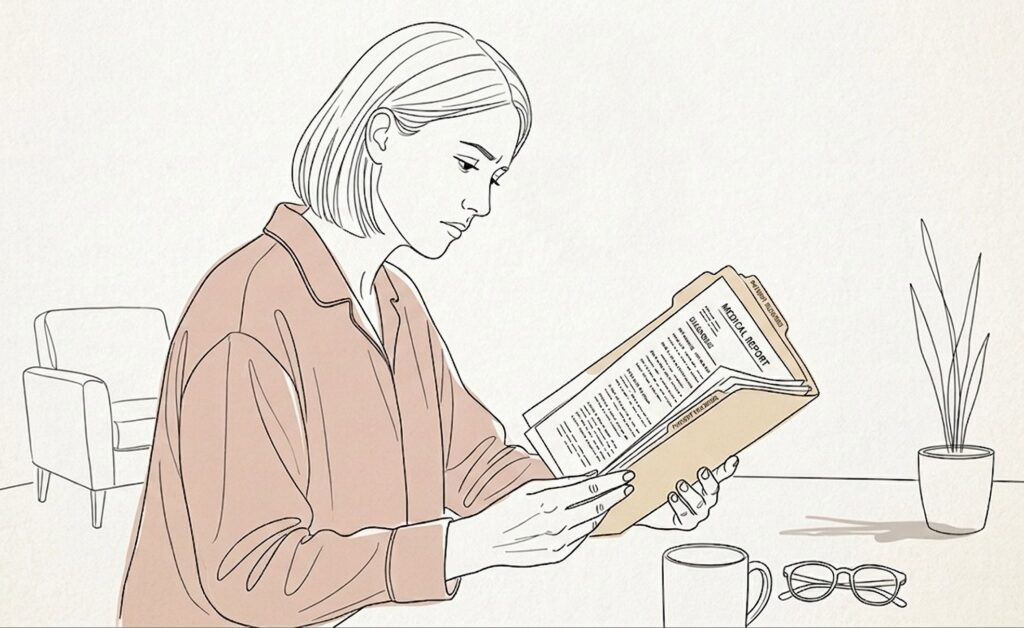
That is what led me to my medical records.
I had thought about requesting them for years, then avoided it for just as long. Then the pandemic arrived, and with it, time enough to stop postponing. I made the calls, filled out the forms, and set the process in motion.
While waiting for the records, I journaled about what I expected to find and what I feared I might uncover. Reading those entries now, what strikes me most is that I still believed the framework I had been handed. I referred without hesitation to “my mental illness.” I described electroshock as treatment. I was writing as someone still inside the story.
What eventually arrived was over two thousand pages of my life written by other people. A version of me translated into clinical language, filtered through diagnoses, observations, and decisions. And it was through those records that the scale of it finally came into focus.
Five psychiatric labels.
Twenty-one psychiatric drugs.
Thirty-nine rounds of electroshock “therapy.”
And, to my shock, documentation showing eight suicide attempts.
I knew there had been attempts, but I had no idea there had been that many until I saw it in my records. I now see those attempts as responses to profound injury, including what heavy drugging and electroshock were doing to me. Seeing it laid out on paper felt like discovering an inventory of damage. It was an astonishing amount of intervention for someone who kept getting worse.
Things began to shift as I started reading more, not only my records but the broader history and claims of psychiatry. What I found didn’t align as neatly as I had expected, especially when I realized there were no tests confirming what I had been diagnosed with. No scan, no marker. Nothing concrete behind the certainty.
Going through those pages, it was hard to separate what I had lived from what they had written about me. The words on the pages were written in such confident language, and the conclusions were clear, but the outcomes didn’t always match.
As I look back at all that happened to me, I’ve come to see my story not simply as personal history, but as a reason to question how the system can turn normal human emotion into disorders of the brain.
How often are people labeled and drugged when what they may be carrying is trauma, stress, grief, or simply the strain of being human? That might be one of psychiatry’s cruelest tricks: convincing people that their humanity was the malfunction.













Hi Jules,
As a former Mad in America editor, I have read so many stories of psychiatric overtreatment and harm that began like yours… with a small problem that was blown out of proportion by the mental health system, with devastating consequences.
Can you share a bit more about how you accessed your medical records, especially those from decades ago? I would like to do the same thing for my own writing project and I’m not sure of the steps and how to ensure results (versus being stonewalled). I think it’s important for everyone who has ever been in the mental health system to be able to do this.
Thanks.
Report comment
Hi Miranda,
Thanks for reading and asking questions.
For me it was really easy to get them. I just called the hospital, my primary doc and the two psych docs that ‘treated’ me and requested them. I was able to access my records as far back as 1989. They were in hardcopy format, so I had to pick them up. One of the docs was going to charge me, but then didn’t. There was no charge for any of them. If I remember correctly, it took a few weeks to get them all.
Legally, they have to allow you to access them. There are some records that can be withheld. For example, if it puts the patient ‘at risk’, or for legal reasons, but I don’t know much about that.
I also think it’s important for everyone in or out of the mental health system to be able to access their records.
I wish you luck in your pursuit – keep me posted!
Take care. Jules
Report comment
Years ago and decades ago, many psychiatric facilities charged me 50 cents per page. Considering that i was always placed on court-ordered “treatment” for refusing to take psychiatric medication, I was kept in the psychiatric facilities for much longer periods of time than people not court-ordered to “treatment.” The costs that I paid for medical records amounted to thousands of dollars. Decades and years ago, I also had to pay what amounted to was thousands of dollars for transcripts of any and all hearings of court-ordered “treatment” that i wanted appealed. Fortunately, the system has also since changed for that, and i have been able to qualify as a Medicaid recipient, with the help of advice from the supervisor of the public defender’s office, to have the costs of the transcribing of transcripts for appeals covered.However, when i represented myself with my public attorney on standby and advising and appealed myself with my public attorney advising, I still had to pay for the very costly transcribing of the entire appeal transcript myself, if i recall correctly.
Report comment
Sorry you went through all of that. I don’t think there should be a charge for our medical records. Why does everything have to be a money grab?
Report comment
In my opinion, it wasn’t just a money grab, but it also served an highly effective deterrent and a way to further do harm to us. Due to the high costs of such, I only requested some of the records that I had wanted and only agreed to pay for some of the transcripts for only some of the appeals i wanted. And, there were thousands of dollars for which i paid for transcripts of appeals, for which the mental health public defenders refused to appeal claiming that there weren’t any appealable issues. Most of the mental health public attorneys only considered state law issues and not any federal laws nor any international laws even when I asked them to consider such.
also, i want to clarify that in my previous above post, when i referred to the public defender’s office, i meant to type, and should have typed, mental health public defender’s office.
Report comment
Great question! But when are we not living in a mental health system known as LIFE? Even “To LIFE”? Being born in Little Rock, became somewhat of a different journey for reasons, unspoken requiring now even understanding understanding [sic]. And the challenge to retrieve all of my records, including the commitment court papers can occur when requested. The difference in public versus private hospitals and what is required by law is an access question and the idea of risks, for which those who committed to writing about the state of one’s behavior while a patient can hide the concept of risks in the decision making process of the organization and the various individuals. But who is responsible, when on the letterhead, a Governor’s name is listed. While a human is not a machine (See Adin Steinsaltz in conversation with the head oncologist from Harvard), one probably ponders at time where is governor in the human being? The chase for an algorithm only distorts the unique space we enter in the altered state. And if this is a science, then how to contextualize our experience as an experiment shaped first by the thought flow and what or who intervened to help us move our being to a more encomopassing plane of understanding?
Report comment
Psychiatry often presents itself as science, but lived experience doesn’t always fit neatly into diagnostic categories and paperwork.
Report comment
I was also relatively easily able to get my medical records – and I do recommend all do regularly read one’s medical records. I do believe it’s really easy to do, because that is what is legally required.
But if one regularly reads their medical records, they’ll sooner know when they’re dealing with an unethical doctor … which is important to know.
Report comment
Hi Jules – I’ve been following you on substack and I’m looking forward to the book.
A little like the commenter above i’ve read about and heard from people, so many similar stories. All important and need to be known.
I’ve also worked in the industry for many decades, across various sectors. Its saddening to me just how little interest there is in services in discussing the lack of evidence for all aspects of the therapy industry and the various harms is can and does cause.
It seems that once something is in a guideline like NICE then its somehow beyond questioning and all you need to do is just follow the guideline and stay in your lane.
Report comment
I may have hit report comment…so first an apology! To stay in your lane though when one witnesses while being court-ordered, the man who beats himself into the plastered wall in seclusion. Then taken over the medical center where he would die. To find or create the space for healing mah not happen in the hospital. For even while a call to the family minister would occur, the response was “Haven’t they changed the rules?”.
And no visit really ever occurred. Questions abound and to begin to study the creation of the large instituions, Doretha Dix, Beers, Anton Boisen or Ruell Howell requires some effort to find or borrow the early books on “The System”, not in a pejorative way but rather to gradually explore what is happening within and outside of the self.
Sadly, prevailing laws on the books may be edicts, when most may not be able to follow the letter of the law or even travel in the assigned lane. To seek out the P&A represenative to a hospital may be helpful, because learning how to hear, hear the other is a bit of a challenge when one’s mental resources are being challenged to work harder to explain, when the systems of care may not even have the listening skills.
I would enourage somehow the c/s/x to consider creating a new, better highway and not just texting/emailing but a way to get to the stationary station where we could enjoy each others company, insights, hopes and dreams!
Report comment
What you’re describing highlights a gap that doesn’t get talked about enough. The space between policy, paperwork, and what happens inside institutions. In crisis situations, “staying in your lane” can stop making sense very quickly. That gap deserves scrutiny, not silence.
Report comment
@topher That’s a concern I’ve run into repeatedly. Once something makes it into a guideline, it can take on an aura of unquestionable truth. Yet evidence should always be open to scrutiny, especially when real people are experiencing harm. The conversation shouldn’t end with “it’s in the guideline.” That’s where the conversation should begin.
Report comment
Wow Jules! You really captured so many intersections of psychiatric violence, not to mention violations of medical integrity and competence (the beta blocker factor alongside the bullshit “chemical imbalance” lie.). But that’s the great thing about psychiatric diagnoses: you throw a little shit at the wall, and, whoala, you get a diagnostic masterpiece sold as a Pollack. Like so many MIA personal stories, your story captured perfectly what C.S. Lewis wrote 80 years ago:
“Of all tyrannies, a tyranny exercised for the good of its victims may be the most oppressive. It would be better to live under robber barons than under omnipotent moral busybodies. The robber baron’s cruelty may sometimes sleep, his cupidity at some point be satiated; but those who torment us for our own good will torment us without end, for they do so with the approval of their own conscience”.
I would just add to Lewis’s use of the word conscience, that there is little of it among far too many of today’s mental health clinicians, who otherwise seem content to keep the trains running on time and the ever-necessary pills dispensed to their cattle car passengers. But, then, when you’ve been educated to be a clog in a neoliberal Darwinian machine, being human is not only the most radical of affairs, at some point it becomes the most unrecognizable affair. That you had the courage to take back your humanity, is not only proof of your innate strength and humanness, its also proof that mental health treatment and ‘care’ was never on offer from the ‘experts’ to begin with.
Report comment
I think there’s a real thread here about how systems of care can shift into control when they’re driven by procedure, liability, and compliance over lived experience. At the same time, I’m careful about collapsing everyone working inside those systems into a single category. Both the harm and the complexity are real.
Report comment
I completely agree that it is misguided and wrongheaded to suggest a universality of people into a single category. Thank you for pointing out my oversight here! Upon rereading my post, I can see the thrust in having intimated as much. My intention, however otherwise poorly articulated, was to criticize the ‘generalized DSM bio-medical model of psychiatric diagnosis/treatment’, of which, effectively, systematically foreclose the kind of therapeutic relationship that give voice to lived experience, while conversely mitigating harm and fostering substantively reparative processes (i.e., relationship in every domain of ones life!).
Report comment
Jules,
Thank you for sharing your compelling story. I am so sorry you endured this nightmare and had your life sidelined for 20 years by the corrupt madness of psychiatry. I am glad you were able to finally taper and are now slowly putting the missing pieces together. The amount of people who have been seriously harmed by psychiatry is truly staggering. Psychiatry exploits people who are dealing with life stressors and simply experiencing normal human emotions.
Psychiatry hopes people will remain silent about the harm because once psychiatry puts their bogus and derogatory labels on someone the person is usually stripped of any credibility and faces stigma and dehumanization. The more people who share their story the better!
Report comment
Thank you for reading my story. The fact that psychiatry takes normal human emotions and turns them into ‘disorders’ says a lot about how psychiatry is run. And yes, more people need to share their story.
Report comment