Back in the early 2000s, my parents had me involuntarily hospitalized several times. I got the whole psychiatric smorgasbord: strapped to a gurney when I was perfectly able to walk, injected with medications against my will, spoken slowly and loudly to like I was incapacitated. I got the works, except for one hallmark experience of forcible treatment: I was never restrained because I didn’t do anything to endanger anyone. When people ask me why I didn’t kick or punch the nurse administering the shots, I don’t have a good answer. I’m just not good at violence.
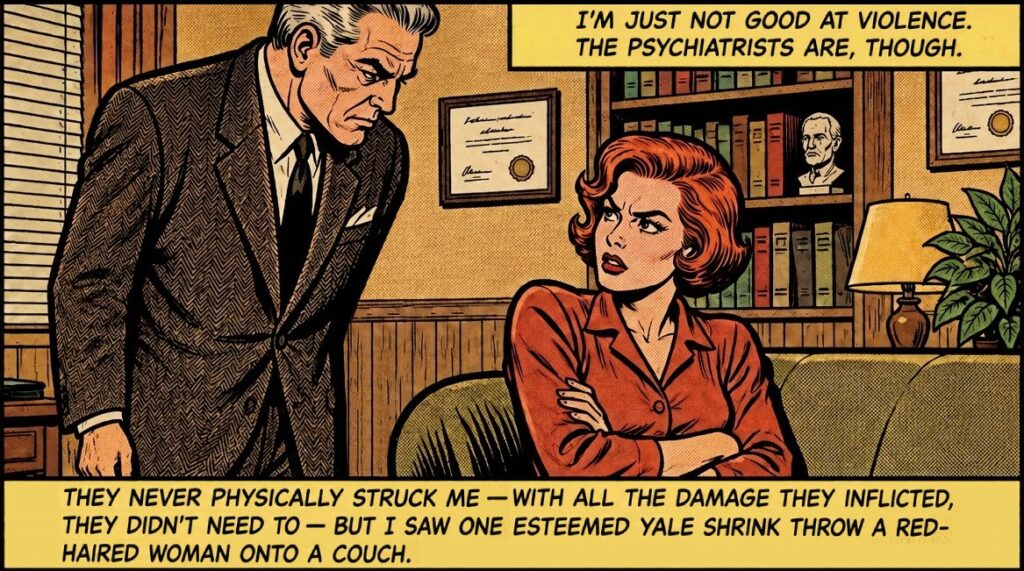
The psychiatrists are, though. They never physically struck me — with all the damage they inflicted, they didn’t need to — but I saw one esteemed Yale shrink throw a red-haired woman onto a couch.
Because I criticized the system and I wouldn’t agree to debilitating regimens of medications, I was labeled as having no insight into my own illness. That’s worse than any diagnosis they can muster. To them, I was so ill that even the most severe psychiatric interventions would never help me. One famed Columbia doctor told my parents to abandon me, like leave me stranded there in New York, because I was terminally mentally ill.
He was just one example of psychiatry’s total divorce from the healing arts. One NYU psychiatrist left a message on my parents’ voicemail calling them “pieces of excrement” because they supposedly hadn’t paid his bill, only to call three minutes later to say in a pleasant lilt: “Never mind, I found the check.” Or the Fifth Avenue psychiatrist who wore women’s eyeglass frames (but not in that accidental and ironic way George Costanza did on Seinfeld) and told me I should become a firefighter because I had muscular thighs.
Cross-legged, I sat in front of Barnes and Noble’s psychology rack and picked out books by prominent critics of modern psychiatry whose titles told my story: Peter Breggin’s Your Drug May Be Your Problem, and Antipsychiatry: Quackery Squared, The Manufacture of Madness, and Psychiatric Slavery by Thomas Szasz.
The books confirmed what I had surmised. We’ve buried trauma with diagnostic codes. We’ve medicalized feeling too much or not enough. We’ve pathologized normal responses to abnormal situations. I refused to see any practitioner who worked within these constructs because they’re contrived, and designed to accomplish several goals that don’t include my health.
I refused, that is, until a jury convicted me of several crimes after a trial that has become a minor legend in the history of criminal justice in Connecticut, and I couldn’t stop crying. I went to a psychiatrist who wore a “Four More for Gore in 2004” political button on his jacket. It was 2007.
He wrote a prescription for Wellbutrin, a pill I had never been prescribed so its novelty intrigued me and goaded me into swallowing it. It didn’t make me less depressed; it gave me tiny seizures. But I did stop crying, and it put my ulcerative colitis into remission, an unexpected bonus.
I continued to take it throughout over six years in prison, meeting every six weeks with a psychiatrist who struggled with English, so conversation was a challenge and abuse either constant or impossible — the language barrier never let me know. When I left, a condition of the four years of probation awaiting me was that I had to get “mental health treatment as required.”
I dutifully surrendered myself to the Midwestern Connecticut Council on Alcoholism. I didn’t have a substance abuse disorder; MCCA treats low-income people, and I had nothing when I came home.
”I’m not doing group therapy or 12-step stuff. So I guess whatever you’re going to have to do to send me back [to prison], get it started now,” I told the intake worker. I was willing to do more time to avoid the psychiatric industrial complex.
Once they realized I was serious, they were floored, but they accommodated me, and found me individual therapists who made me skittish but at least I would only disappoint one person and not an entire room with my contrariness.
First was Cheryl. I really liked her but she was disciplined by the state for going furniture shopping with a client. I couldn’t tell from the licensing order if the furniture was meant for an abode that they would share, which would be a whole different kind of misconduct.
Then it was Rona, who was unproblematic. She winced every time she handed over a urine cup because she knew there was no risk of the sample coming back ‘dirty’ (containing illicit substances) but she was required to test me because of my probation. Rona then fled the organization, and Ted was assigned to me.
A licensed clinical social worker, Ted was 14 years my junior. But even for his lack of life experience, Ted seemed wise. He had already gone grey at 29 and I think I let that pass for wisdom. Like Rona, Ted offered to sign a statement for the court saying I was stable and didn’t need to come anymore, which was the kind of permission and clean bill of mental health that I had sought for over 15 years, in order to be released from a system that I found criminally oppressive. But I rejected it.
“No, let’s keep going.”
Ted diagnosed me with generalized anxiety disorder. At the time, I believed that he was helping me but that wasn’t why I stayed. I continued in therapy, not only at MCCA but following Ted to private practice, because the regular appointments flattered me that I was the right kind of ill — the approvable kind of ill, to interact with a system that had once rejected me. Telling people I was in therapy made me self-satisfied, even proud. No insight? Doctor, please! I have so much insight I double up on appointments. Remember: only healthy people know they’re sick.
I relied on Ted’s advice a lot. So much so that I let him lead me deeper into the mental health system. He convinced me to see a psychiatric nurse practitioner for my prescription; for five years prior my internist had written the scripts for me. But eventually, that nurse, Michael, reminded me of why I once recoiled at the mention of psychiatry.
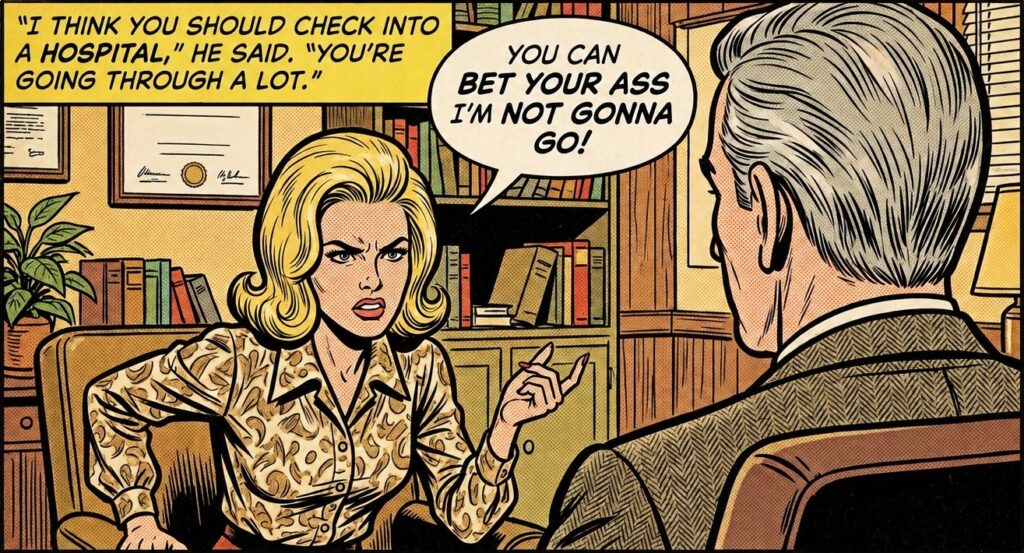
“I think you should check into a hospital,” he said. “You’re going through a lot.”
Them’s fighting words for me and he knew that.
“That’s not the standard for hospitalization. I am not psychotic. I’m not even upset. No danger of hurting myself or others. What are you talking about?” I asked him. He didn’t have an answer.
I left the Zoom. Wait until I tell Ted, I thought. My trusted advisor.
But Ted was in lockstep. He explained that I could get respite from my stressors: the death of my father, and caretaking for my mother whose lung cancer recurred a week after his death.
“Okay, so what happens when the stressors don’t go away while I’m in this hospital? How would that help? You’re not making sense,” I said.
“So are you going to go?” he asked, like he didn’t know me or my history.
“You can bet your ass I’m not gonna go.”
“Okay, then. Goodbye.”
That was the last time I talked to Ted, after seven years of weekly sessions, over 350 hours of his guiding insight into myself; self-reflection that doctors had promised I would never have.
Months later I learned that Ted’s wife served him with divorce papers in an out-of-state rehab. Then I discovered online reviews of Michael describing him as the “worst experience of my life,” and realized that he and Ted were involved in pushing some useless app onto patients. Michael even responded to one patient’s negative review by describing the hallmarks of borderline personality disorder — an attempt at outing her diagnosis, a blatant HIPAA violation in my book.
I got my records from Michael and found notes on physical examinations he allegedly conducted on me. The blood pressure readings, the monitoring of my “gait” never happened, couldn’t have happened because my check-ins unfolded over Zoom meetings. He also wrote that I was studying for a CPA exam, a unique goal for someone convicted of financial crimes. To this day, I’m unsure whether he believes those notes are true or he knows they are complete fabrications.
Then I was in crisis, not psychiatric but epistemic. Have I developed discernment from an addict? Were my breakthroughs facilitated by someone who was drunk or high the whole time? Whose medical records are these? Why would anyone want to become an accountant?
I returned to rolling around in antipsychiatry except rather than a bookstore, this time it was Reddit threads; the world had shifted from books to social media since my last foray into antimedicalization. The experiences of those who’ve survived hospitalization, involuntary medication, expand and collapse in an accordion of comments that are almost conspiratorial. Sometimes they’re downright kooky.
And I agree with every last one of them.
Frankly, I’m a tad uneasy about siding with Scientologists and calling it sanity. Blaming psychiatry for the September 11 attacks is deranged — but so is bullying patients and calling it care. Maybe that’s the last trick the system plays on you: making the people it hurt seem too embarrassing to stand beside; a patient who doubts her own allies is a patient who keeps coming back.
That’s why I’m gone for good.