Finishing my work day, I head home. I think about quickly changing clothes and going to the gym. I care about my health and value fitness. Yet, work was long and in the back of my head I know: I can always go tomorrow. As I turn the corner onto Skidaway Rd, I pass a large gas station. Unbidden, my mind rapidly recalls the food waiting in my kitchen. Nothing I’m particularly excited about. I don’t have ingredients, really. Only ready options like cereal, chicken cutlets, some packaged Risotto. I don’t really know what I’d do with groceries because beyond sauteed chicken and spinach or milk and cereal, I don’t actually know how to cook. I make a quick turn into the parking lot, jump out and am back in my car heading home with some hot chicken tenders. How convenient and delicious, I think.
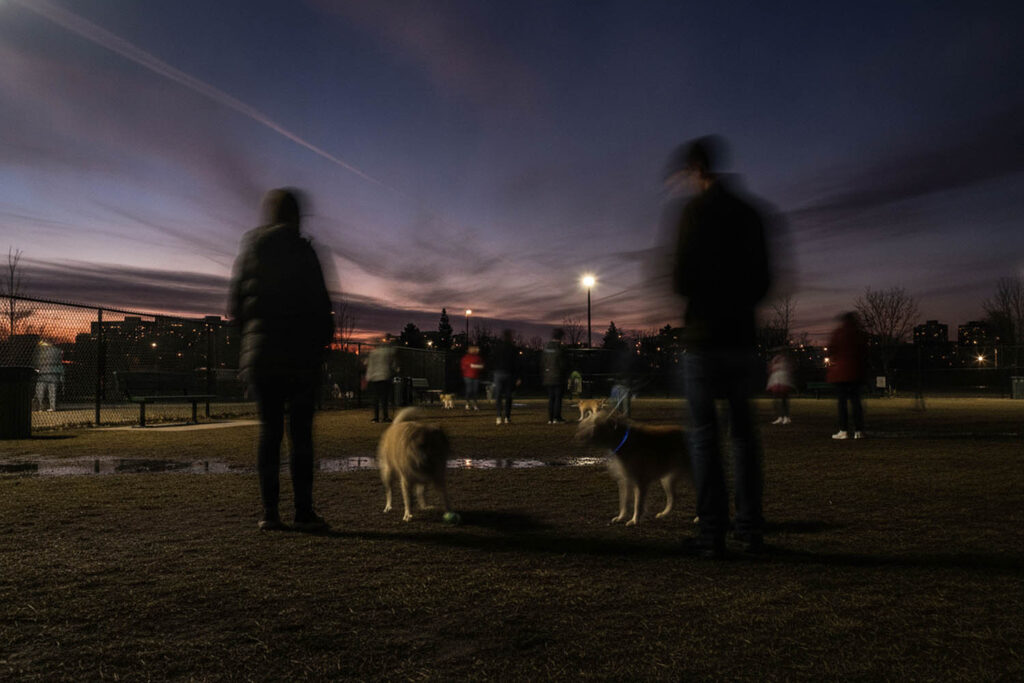
It’s just myself and my dog at home these days. His needs are the only ones outside my own that place demands on me. So, after finishing my chicken, which I share with Petey, I put on some comfortable clothes and drive him to the dog park. I reflect on the strangeness of this obligation. There are so few left that haven’t been outsourced. I’m glad to be going, though. The dog park is one place I see people regularly. I look forward to seeing them. I used to work in person at hospitals and saw people there, but Covid changed that. I’ve worked remote ever since. Sometimes I consider it a blessing, but more and more, I miss those people, the opportunity to put on the clothes I like, the obligation to navigate numerous relationships. It seems I don’t need those clothes very often anymore, nor the skill I learned in social situations, scripted though they may have been.
But the dog park forces me to interact. While I’m there, chatting with these people whom I’d otherwise never have met, we get on the subject of the future. Waymo is brought up. Self-driving cars. I say, “Once they see the data on accidents by self-driving cars beside accidents by human drivers, I’m sure they’ll feel obligated to insist we all use self-driving cars. The safety data will be undeniable.”
So, we sit quietly with that for a moment, thinking the same thought: we like driving, and we’ll likely lose it. Of course, the argument in favor of letting AI drive is clear: fewer accidents, fewer injuries, fewer deaths. But we all see what we’ll lose as well. Controlling the car, a feeling of freedom and vitality from maneuvering effectively. Someone says, “They probably said the same thing about horses when cars came along.” A quick question to ChatGPT brings back a volume of quotes from the early 20th century. One said, “The pleasure of driving depends on the lively communication, the give and take between man and horse. It is a kind of conversation carried on by means of the reins and bit” (The Horse: His Breeding, Care and Treatment, 1917). I read it aloud and we fall silent again. I look at the dogs, thinking How long till I don’t need to come here?
The point is that progress removes the conditions that made skills, relationships, meaning, and purpose necessary. With many solutions, a valued part of life ceases to be required. The problems that were solved deserved solving; the cost of solving them went uncounted. When a condition that repeatedly demanded a capacity disappears, the capacity may never develop, may weaken, or may survive only in displaced form.
As far back as the advent of writing, some cultures were wary of what might be lost when knowledge was moved outside the people who carried it. Caesar wrote that the Druids deliberately refused to commit their teachings to writing, despite using writing for other purposes, partly because they believed reliance on it would weaken learning and memory. Plato raised a similar concern in the Phaedrus: that storing knowledge in external marks could leave people with the appearance of knowing. It’s easy to imagine their concerns around diluting the richness of their shared symbolic world.
We’ve all noticed the vitriol in our online social media interactions. When I think of the jibes and blunt angry language, I can’t help but think of the social dexterity I first noticed in films from the 1930s and 40s. The movies made it visible to me, but the capacity wasn’t invented by screenwriters. Contemporary etiquette books devoted entire chapters to learning how to talk, disagree and move comfortably through complicated social situations. Whatever we think of those rules now, they demanded skills I never learned: how to disagree, criticize, repair, read signals, insinuate, bargain, negotiate or manage conflicting loyalties. Perhaps conditions still exist in more isolated contexts where these skills remain essential. I wouldn’t know. I’ve never needed to use them. Not when I could withdraw, remain silent, lose my temper, vent to a sympathetic ear or simply isolate.
Some losses are easy to notice because we can remember the condition that preceded them. People who worked in offices before Covid know what remote work replaced. People who drive know what autonomous cars may replace. But most of the conditions that shaped human capacities disappeared long before any living person could notice their absence. The social dexterity I first saw in those films from the 1930s and 40s, itself mostly lost, may be only a surviving fragment of capacities produced by much denser relational worlds. Interdependent communities, orally carried knowledge, repeated dependence on neighbors, routine contact with animals and the natural world, physical danger requiring actual courage, and roles whose failure materially affected other people had already been eroding for centuries or millennia. Yet, we tend to experience whatever world we inherit as normal, so only the most recent subtraction is visible.
Life seems empty in so many ways while all we notice is a vague sense of loss. Because we tend not to notice just how many conditions were removed by solving practical problems or how the things we may miss only existed because of those conditions, we can be prone to a story that locates the loss within us, believing in a personal failing where much of the cause may lie outside us.
This is where we might ask: How do I fix this? I don’t feel purpose or meaning, I’m lonely, I can’t remember so much that I probably should be able to. Why didn’t I know what to say that time? Dating? IRL? How? And where do we turn? There are friends, spiritual leaders, podcasts promising analysis—What’s Wrong With Young Men? comes to mind—but, for most of us, our go-to is the therapist. If only we could understand how we’d failed, what we missed, who we are, perhaps some of these would return.
Unfortunately, therapists and theorists are not exempt. They develop in the same ecology as we do. Clinical work is simply one place where the consequences become unusually visible. Therapy inherited this mistake. Without awareness of how roles, traits, capacities, skills and vital psychic processes can fade when they are no longer forced into existence by the structure of life, the default is to explain a deficit as being within the client.
Capacities and traits emerge when we are put in situations where they become necessary. They do not exist within us independent of context. If we begin to ask “why don’t we need this skill or feeling anymore?” alongside “why do I feel this way?”, we may effectively remove a substantial civilizational blind spot.
Counseling recognizes context in so far as it is visible, yet most of the context addressed here is not visible. Even where context is recognized, it is likely to be seen as operating on a fully capable individual because it generally lacks a model of context as a production system for human capacities. Thelen and Smith’s dynamic-systems account of development (1994) comes close to this model, treating capacities as taking shape in response to what a situation demands instead of waiting inside the person. However, in twenty years in mental health, I have never heard that premise treated as foundational. This essay takes their account a step further and argues a radically different standard: capacities come into being only when context calls for them, and no account of what we can do, be and feel is complete without that premise.
So, we go to therapy with a need which we may even accurately identify as a result of modern life. The therapist may identify it that way as well. A therapist can say, “Your loneliness makes sense because modern life is isolating.” However, while the observation may be present, rarely does it become the focus of the work in session. Then the available tools are likely to be: work on attachment patterns, challenge beliefs, tolerate vulnerability, practice social skills, clarify values, increase behavioral activation, grieve losses, improve communication, join recreational communities, date differently, etc.
Those can all be useful.
But they do not address what is often driving the problem:
What human capacity or form of relationship used to be continually produced because the surrounding ecology made its exercise necessary, and what happened when that necessity disappeared? Mental-health paradigms are not equipped to recognize capacities that were never produced because the environmental conditions that once produced them disappeared. What we inherit as normal can still be historically strange. Without that awareness, cultural gaps can be mistaken for individual dysfunction.
A person may arrive in therapy saying they have no purpose, cannot tolerate conflict, do not know how to form relationships, feel empty or incapable, cannot remember what they think they should, or simply do not know what to say to other people. The mental-health system has an enormous vocabulary for locating causes within the person: attachment, avoidance, distorted cognition, trauma, personality, depression, anxiety, executive dysfunction, low self-esteem, deficient coping skills, maladaptive schemas, social-skills deficits.
For example, a client presents with a feeling of emptiness and lack of purpose. Through the course of therapy, the work focuses on why they do not experience fulfillment in their lives. A therapist may identify roles from which the person might reasonably be expected to derive purpose: a job in which people rely on them, family members, friends and partners who may need them. This places the client in a difficult position. They begin to wonder: “Why don’t those things fulfill me? What’s wrong with me?” Meanwhile the therapist explores interiority, asking “What part of you feels unseen in the life you’ve built?” This is intended to lead towards greater permission for the individual to allow a suppressed authentic aspect of their personality.
But what if what they want to see in their life is simply not called for? What if their life does not need them to be courageous, unbending, or capable of expression in relationships which are partially oppositional? They may be angry at their insurance company, city council, or the retailers who pass tariff costs along to them as the buyer. In the past, they would have stood face to face with their insurer, community leaders or vendors and related, negotiated, debated or haggled. In those experiences a part of themselves capable of doing those things without becoming enraged, allowing the relationship to collapse or meekly acquiescing was able to exist. However, these are complex systems now, mediated by online portals, receptionists, automated call prompts. People don’t have the opportunity to engage with the corporations and systems which affect their lives. Similarly, a vendor in a town center had to be heard over the crowd and hold a stranger’s attention long enough to sell. That took cadence, patter, quick wit, and a speaking voice people remembered. Advertising took over the work of getting noticed, and the person who once got to express their personality out loud no longer can. This leaves a void, a sense of lost agency which might have felt purposeful to someone in a previous era who engaged the people these large systems have replaced.
We also live in a world of simulation. Modern life increasingly offers imitations of capacities that earlier life required people to enact directly. These are not meaningless; they are insufficient. The person may still identify with courage, seduction, conflict, mastery, danger, sexuality, endurance, loyalty, charisma, or competence, but the contexts that would require those capacities in embodied, reciprocal, consequential ways have been replaced by symbolic or low-contact substitutes. The result is a loss of practiced agency which may show up as depression, anxiety, social avoidance, low confidence, dysregulated anger, shame, loneliness, loss of purpose, sexual frustration, and identity diffusion. The image of the capacity survives, but ordinary life offers fewer situations in which the capacity has to become real.
The simulated versions of lost capacities may show up as possible solutions. Training in combat sports may appeal because it provides something similar to real courage and risk. Ropes courses rehearse collaboration and teamwork which may have been inevitable when communities worked together to solve a local problem. Retreats, Burning Man, and ayahuasca trips to Central America may offer partial contact with communal life, ritual, nature, altered states, and belonging. Video games allow vicarious experiences from building to war, offering simulated craftsmanship, danger, mastery, and glory.
Simulation is not empty. It works partially because the organism can generate internal relational states from symbols, stories, imagined reciprocity, and identity. But partial stabilization can mask chronic relational deprivation. A person may experience simulated courage without living in a world that requires courage; simulated community without dense interdependence; simulated intimacy without proximity, duration, touch, and reciprocal obligation. Simulated relationships such as fandom, political identity, gaming partners, or imagined closeness with celebrities can stabilize sufficient relational states without meeting full human relational need. They are not nothing. But they can leave us with something chronically phenomenologically insufficient. No wonder we seek counseling.
Looking back through history, the real things appear clearly once we know where to look. Craftsmanship was essential to being even partially self-sufficient. Dating, a common everyday part of life that’s only now fading from regular skillsets, taught charm, charisma, tact, courage, sensuality, and restraint. Maintaining relationships face to face with every service now handled online demanded nuance, disagreement without rupture, seeing other points of view. Is it any wonder life is unfulfilling for so many? When so many capacities have fewer legitimate arenas, the self can remain emotionally attached to capacities it rarely gets to practice.
One visible example is the current confusion around young men and masculinity. Lost, seeking role models for a type of manliness which a fully bureaucratic civilization no longer requires: the warrior, adventurer, explorer, protector who is virtually obsolete in a world which must be managed, not conquered. They still see models of that type of man in our films and TV shows, in fathers, grandfathers, history books and statues of bold men astride a stone steed, sword by his granite hip. Is it any wonder that some men who have large platforms and are equally lost in search of this archetype market a vision of manhood and are received so readily? The point is, whether it’s seeking a masculinity that’s less common, lacking meaning, being lonely, a lack of sufficient agency, blunted interpersonal skills or feeling that important aspects of one’s personality have no expression, mental health consequences of this kind of cultural loss are very real.
There is another loss: the loss of co-regulation itself. People require deep connections capable of delivering co-regulation to process emotional states that cannot be resolved in isolation. This requires intimate collaboration to navigate complex feelings: sustained attention, contingent response, proximity, shared emotional expression and enough time together.
Yet, our modern world requires us to be where we’re expected and to be ready to perform regardless of how we feel. To maintain these properties we must restrict emotional expression, limit acceptable contexts for co-regulation, learn to associate vulnerability with weakness or failure and privatize emotional processing. We’re taught to “keep it together,” to accept a week off from work for bereavement, to feel shame at expressing how we feel.
So, co-regulation becomes infrequent or inaccessible, emotional processing is displaced into isolation and relational needs are only partially met. Coan’s Social Baseline Theory describes what follows: when support from others is unavailable, regulating oneself demands more effort and physiological stress response increases. Higher-intensity expressions like breakdowns or crises are treated as pathology, while lower-intensity forms are normalized as baseline functioning or pejoratively minimized as “the worried well.” Seeking therapy is the primary, culturally normalized option for all of these kinds of distress.
Therapy, however, can go on for years, working on distress that only partially yields because part of the solution would require a role, relationship, or ecology no longer available. The desire for deep, interdependent community may be reframed as codependency. The absence of sexual activity may be seen as asexuality, insecurity or poor social skills. Emotional dysregulation becomes poor distress tolerance, but some dysregulation may not be a failure of self-regulation. It may be the expected result of insufficient access to co-regulation.
For clinical mental health, the first task is to accurately locate the problem. It may lie within the individual. It may also lie within the ecology the individual lives in. Awareness of this should become part of the foundational context for understanding a client.
Therapy can help identify where modernity has removed access to a needed aspect of life. It can help the client grieve that loss, normalize this form of distress, continue depth work where distorted beliefs have formed around the mislocated distress, and explore ways to reclaim what might reduce the original suffering.
As for where to look, what is sometimes called the analog movement may suggest a direction. At its core, it can be better understood as a search for consequential participation. While we cannot simply restore hardship, neither can we subsist on simulation. Some substitutes only let us rehearse a capacity; others put us back in situations where people genuinely depend on what we do, outcomes matter, and walking away carries a cost. A ropes course can rehearse cooperation. A volunteer fire company requires it. A retreat may evoke community. A co-op in which other members depend on your shift makes interdependence consequential again.
Meeting in person restores exposure, timing, bodily presence, eye contact, awkwardness, repair, and social consequence. Playing outdoors restores risk, sensory activation, contact with nature, physical coordination, and unprogrammed discovery. Joining a co-op restores interdependent collaboration with real-world stakes. Building a house for Habitat for Humanity restores craft, cooperation, usefulness, and meaning.
For the clinical fields, incorporating the unmet needs of an overly streamlined world into models of pathology could increase efficacy by establishing that some distress may make a new kind of perfect sense. The person is not always failing to adapt. Often enough, they are registering, accurately, what adaptation has cost. Insecure attachment, deficient social skills, vigilant threat monitoring—I’ve learned the language, and none of it names what’s actually missing from my life. I still don’t know how long I’ll need the dog park or be able to drive there using my own hands—but I’m grateful for both obligations. They’re ways of participating in a world where opportunities to act keep falling away.