A new article in Incarceration argues that involuntary community treatment can operate as a dispersed carceral system.
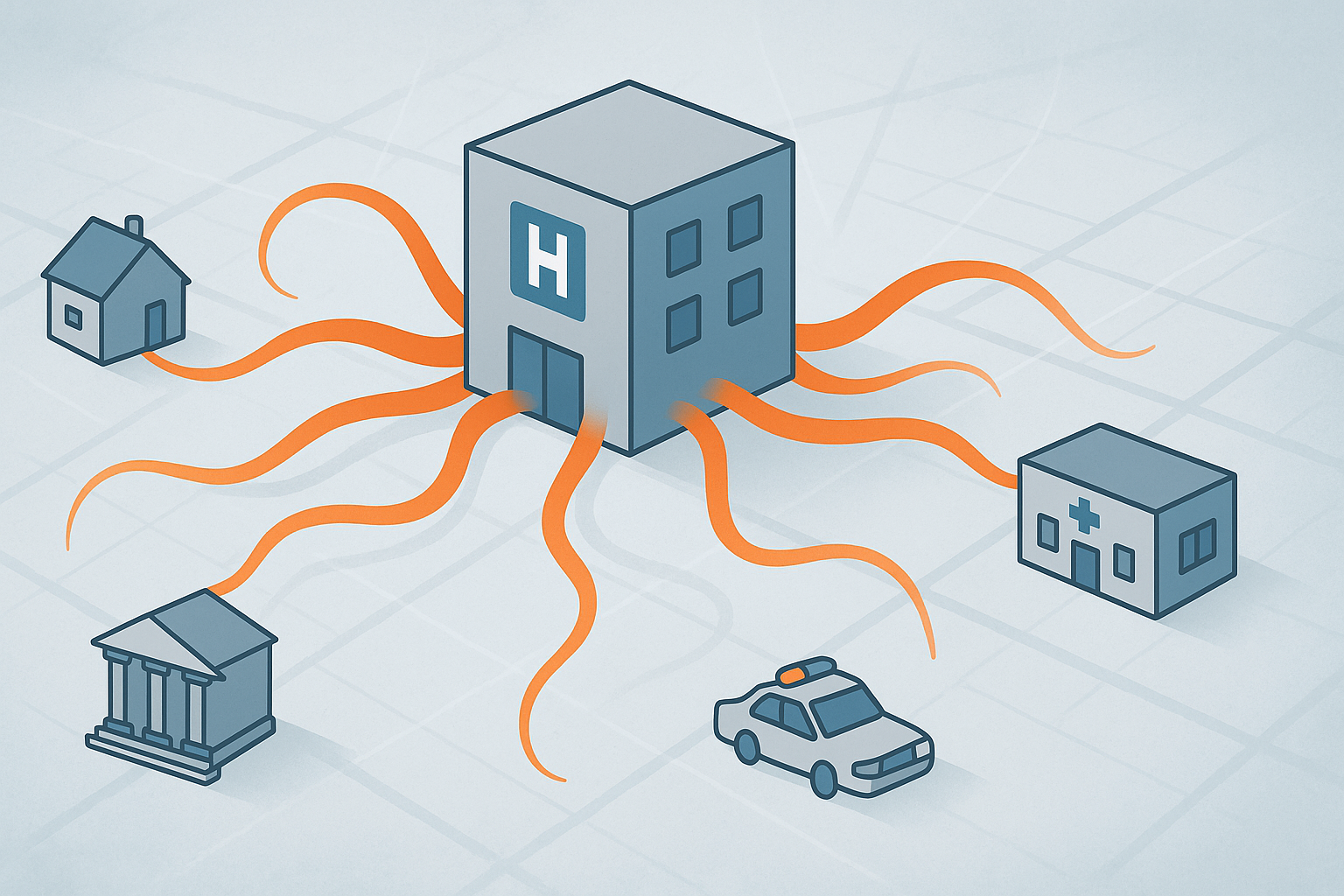
Sociologist Panos Karanikolas maps what he calls the “psychiatric circuit,” showing how Community Treatment Orders (CTOs) couple medication mandates with surveillance, coerced mobility, and routine police involvement.
Drawing on interviews in Victoria, Australia, the paper describes a pattern in which people live outside hospitals yet remain governed through legal orders, check-ins, home visits, and the ever-present threat of recall to inpatient care.
“Psychiatric circuits’ is my offering to abolitionist knowledge and discourse that seeks to understand and resist the full spectrum [of] carceral violence, including that which occurs within systems that exist ostensibly to deliver treatment and care,” Karanikolas writes.
The circuit, Karanikolas writes, “plays a pivotal role in the wider carceral landscape and acts as a threshold to the criminalisation and policing of people deemed ‘mentally ill’.”
What looks like care, he argues, relies on “psychopharmaceuticals to sedate,” “surveillance and coerced mobility across a multiplicity of sites,” and “transcarceral” transfers into police and family-policing systems.
CTOs, also called “assisted outpatient treatment” or “mandatory outpatient committal,” authorize forced psychotropic drug use (most often via long-acting depot injections) while a person lives in the community. They are now common in Australia, New Zealand, the United States, Canada, and the United Kingdom, and are often presented as “less restrictive” than hospital detention. The article challenges that premise, arguing that CTOs embed carceral logics in ordinary settings and “enlist patients into both punitive movement and immobilisation.”
The analysis lands at a politically charged moment. In July 2025, the White House issued an executive order urging expanded civil commitment as a homelessness response, a step critics say conflates poverty and disability and risks more coercive psychiatry in the community. Several legal and policy groups warned the order would criminalize homelessness and encourage forced treatment in the name of public safety.












How about MIA takes the “social justice” off the tagline and let’s not focus on what a good system would look like, let’s start from the assumption that our current system is the best one we have and will ever have, and then let’s spend thirty years doing “research” to figure out exactly why and how it’s a eugenics-tinted, capitalism-defending, colonialist torture industrial complex.
And let’s just keep doing that forever, letting people keep getting tortured while we sit around trying to “prove” to psychiatrists that not only are we actual fucking people, but that our words have any value, and that they’re just torturing and killing us.
And then when they still refuse to listen while they quite offensively psych-splain the DSM’s necessity to us, let’s give all the deference to the “educated” “professionals”.
Garbage website is just defending psychiatry and pretending it’s neutral. WORSE THAN NOTHING. THIS IS ACTIVELY SMOTHERING PROGRESS.
Report comment
I was involuntarily committed in 1989 and again in 1990. I haven’t talked to a psychiatrist in about seven years. But thanks to the lithium I was prescribed for my “Bipolar” I’m facing dialysis and a possible kidney transplant. As part of the transplant protocol they want to undergo a psych evaluation with either a psychiatrist or a psychologist.
Report comment
That sucks, Chris. I’m currently dealing with an insane computer and phone hacking psychologist, who was pissed at me, because I wouldn’t sign the most appalling thievery that I’ve ever read.
Thankfully, I’m still able to comment here, hopefully, but MiA should be aware of the fact that I’m no longer able to have any privacy on my emails, computer, nor phone.
So at the moment, know I may no longer be able to comment on MiA, due to a criminal, computer hacking psychologist.
I have to head back to the Apple store, but many thanks to a local police officer, who got me back on my computer. But my psychological computer hacker seemingly has likely hacked back into my phone and computer, so I’m no longer currently able to get into basically my email accounts, nor computer in the future.
Report comment
Family members think that because I went on to have a family and a career that I must have gotten the help that I needed. On the contrary, the things I’ve achieved in life are most certainly inspite of psychiatry not because of it.
Report comment
What super sucks is that what you describe could easily be passed off as delusions of persecution, except that psychiatrists really are that awful sometimes because the profession attracts so many cop types. And like cops, they have a presumption of truthfulness and qualified immunity to do basically whatever they want. So I could believe it.
Report comment
That sucks, Chris. I’m currently dealing with an insane computer and phone hacking psychologist, who was pissed at me, because I wouldn’t sign the most appalling thievery that I’ve ever read.
Thankfully, I’m still able to comment here, hopefully, but MiA should be aware of the fact that I’m no longer able to have any privacy on my emails, computer, nor phone.
So at the moment, know I am not being able to access my MIA account, due to a criminal, computer hacking psychologist.
Report comment
I increasingly get the impression that physical medicine is rolling out the red carpet for psychiatry. Television in particular is placing psychiatry in an unbearable spotlight and portraying it as indispensable in all situations of life.
So I’m not at all surprised that compulsory treatment is on the rise again. I’m writing from Germany and I’m currently learning that nothing has changed and psychiatry has learned nothing.
A few months ago, a study on the effects of electrosmog on the human body was conducted at a prestigious German university. I wanted to participate, and the leading physician sent me the study design. The experiments should last three days. Two of those days, I should spend several hours filling out psychiatric/psychological questionnaires. I had expected everything, but not that they would also appear in the electromagnetic/physical field. I am not paranoid; on the contrary, I am well grounded, but they really do appear everywhere, even where you would not expect them.
This is exactly how they justify their coercive practices. Everything is self-evident and self-empowering. They are simply there because they know how the rest of humanity should be, feel and behave.
Unfortunately, I suspect that psychiatry will become an increasingly significant problem. Nevertheless, it is important to name things and point out what they do.
Yes, I know very well, 80 years later we are starting all over again.
Report comment