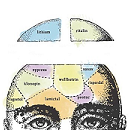
Wouter Kusters was a panelist on the Mad in America webinar “Madness, Mysticism, and the Reenchantment of Psychology” on February 4th. It was there that I discovered him, and what a fantastic discovery it was. I have just finished reading his monumental book A Philosophy of Madness: The Experience of Psychotic Thinking. This 738-page book, published by the MIT Press, is destined to become a classic that will be read for generations to come. It is of interest not only for people concerned with psychosis and the thought patterns of psychotics, but also for those fascinated by God.
God may not exist, but man’s relationship with God certainly does exist, and that is what mysticism is all about. There are five books that I consider to be essential reading for all theologians and lay people interested in God. They are William James’s The Varieties of Religious Experience (1902), Evelyn Underhill’s Mysticism (1911), Paul Tillich’s three-volume Systematic Theology (1951, 1957, 1963), Karen Armstrong’s A History of God (1993) and Kusters’s book.
If I had to choose one book that I would recommend above all others, it would be Kusters’s. He demonstrates breathtaking erudition and everything that he says is fascinating, especially for people who have been psychotic themselves. However, his major advantage over other writers about mysticism is that he himself has been psychotic and was hospitalized twice for psychosis, the first time in 1987 at the age of 21, and then again in 2007.
Kusters is also a philosopher who studied philosophy at the University of Utrecht. He is thus uniquely qualified to make comparisons between the thought patterns of psychotics and those of philosophers. Never once does he make a value judgement about the philosophers and psychotics whose thinking he analyzes. They are all perfectly valid from his point of view. It is not an insult to say that a philosopher is similar to a psychotic nor is it a compliment to say that a psychotic is similar to a philosopher.

I was drawn to this subject because of my personal history of psychosis and mysticism. I have always considered myself to be a schizophrenic mystic and now Kusters has coined a better designation for someone like me: a mad mystic. The word “mad” has two meanings in English: “crazy” and “angry”. I am both crazy and angry, so I prefer “mad mystic” to “schizophrenic mystic”. I am angry at psychiatrists for having driven me insane and having pushed my friend to suicide simply because they suffered from the delusion that homosexuality was a mental illness. After one year of psychiatric torture, in the summer of 1963, I had my first schizophrenic hallucination. It was a Beatific Vision. I saw the Kingdom of God in all its splendour. I was just seventeen years old, and I had to figure out all by myself what the difference was between a Beatific Vision and a schizophrenic hallucination. I solved the problem by promising God that I would never doubt the veracity of my vision while recognizing that for everybody else my experience would remain a meaningless hallucination. Fervently believing what no one else believes is obviously a form of insanity, but I had no choice. I was especially frightened by the possibility of spending my entire life locked up in insane asylums. Of one thing I was certain, and that was that my psychiatrist, with his conversion therapy, had driven me insane and that therefore I should never trust any psychiatrist. I still consider this to be good advice for anyone struggling with mental problems.
One of the challenges of psychosis is the realization that no one is capable of understanding us. We are condemned to live alone with our memories and out delusions. The wonders of my visions and the horrors of my voices are ineffable. Kusters emphasizes this isolation often in his book. While reading him, I had the certainty that I had at last discovered someone capable of understanding me, but Kusters lives on the other side of the Atlantic and I will probably never meet him. He did, however, make me realize that two important aspects of my psychosis are shared by schizophrenics everywhere. The first one is the urge to write, the yearning to put the visions and delusions on paper so that the world can benefit from our experience. He says: “When a psychoplanatic writes, he soon feels spiritually connected to other writers near and far, and senses contact with the world’s great minds and fellow seers” (p. 629). This is exactly what happened to me on March 27 and 28, 1965. On March 27, I wrote a 27 page essay about my Beatific Vision for Paul Tillich, the world’s most famous theologian, who was to give what turned out to be the last sermon of his life the next day at Harvard. I gave it the title “The Phenomenological Proof of God.” It was a detailed account of my vision, supported by references to poets, philosophers, theologians and mystics like Tillich himself, Edmund Husserl, William Blake, Aldous Huxley, Friedrich Schelling, Karl Jaspers, Blaise Pascal, Saint Teresa, Walt Whitman, Plato, Aristotle, Emmanuel Swedenborg, Arthur Rimbaud, Martin Buber, Rainer Maria Rilke and Gotthold Lessing. This essay has been published in my book What Rough Beast. As far as I know, it is the only published account of a Beatific Vision that exists.
I presented my essay to Tillich early the next morning in the Hotel Continental, next to the Harvard campus. He gave me the most ecstatic smile I had ever seen and told me, “Send it to me when you have finished it.” I thought that I had already finished it, but Tillich wanted more, so I went back to my room in Adams House and wrote another sixty pages, on my typewriter, in one day. What I wrote before meeting Tillich was coherent and profound, but what I wrote after meeting him was total insanity. It was my attempt to inform Tillich of how I would save the world when I became the Messiah. Something has gone horribly wrong in the meantime. The world needs a Messiah now more than ever, but no one has thought of me as a likely candidate.
Another aspect of my life that I share with other schizophrenics is what Kusters calls “detachment.” Until reading him, I had no idea that my own detachment from society was characteristic of schizophrenics. Kusters says: “’Detachment’ is the term I use to refer to the first step taken on both the mystical king’s highway and the madman’s dead-end street. Extricating yourself from earthly worries, not clinging to earthly goods and passing fancies, refusing to let yourself be swept along by the uncertainties of fate and society, being unattached, free from binding ties and desires – these are a few of the more general connotations of detachment” (p. 173). Leaving the United States forever and going into permanent exile at the age of 22 was certainly a radical form of detachment, just as was my renunciation of American citizenship in 1974 at the Irish Embassy in Bonn when I became a citizen of Ireland.
As Kusters says, “What is the point of proving yourself to others?” (p. 173). What I value most dearly, namely my mystical raptures, you are unable to understand. All types of competition seem senseless to me. I detest ostentatious affluence and conspicuous consumption and all the other evils of America’s consumer society. Life is ever so much more beautiful in the forest of Québec.
Another realisation that Kusters and I have in common is the distinction that we make between the philosophers’ God and the mystics’ God. The philosophers’ God is an intellectual conjecture that inevitably ends in atheism. Religious people say that God is both omnipotent and infinitely good. There is obviously a contradiction here since an omnipotent merciful God would not allow evil to triumph. In today’s world, this means that God would not leave humanity’s fate in the hands of three convicted criminals.
The mystics’ God, on the other hand, is a spiritual force that overwhelms the mystic and changes him forever. My Beatific Vision came as a total surprise. God was not at all what I had ever imagined Him to be. Reality was turned upside down. God became the only reality since only He was eternal. You and I and everyone else are not real at all simply because we are so ephemeral. Soon we will all be dust in the wind, but God will continue to permeate and transcend all being.
Blaise Pascal made the same distinction between the philosophers’ God and the mystics’ God during his ecstatic vision. He wrote: “Dieu d’Abraham, Dieu d’Isaac, Dieu de Jacob, mais non des philosophes et des savants”; “God of Abraham, God of Isaac, God of Jacob, but not the God of philosophers and scholars.”
According to Kusters, Saint Thomas Aquinas had an “extraordinary experience” (p. 13), undoubtedly a mystical ecstasy, after which he refused to write any more. Aquinas said: “All that I have written seems like straw to me, compared to what has now been revealed to me” (p. 14). He characterizes the God of philosophers as being “straw” who was obliterated by his experience of the mystics’ God.
Friedrich Nietzsche also shows the opposition between the two Gods. His most famous sentence is “God is dead”. He thought that humanity had killed God. Nietzsche enjoyed shocking and provoking his readers. Of course God cannot die, since he is the Eternal. Whatever is eternal is immortal. The greatest irony of modern philosophy is that Nietzsche, who had announced God’s death in 1883 in Also sprach Zarathustra, had a mystical rapture in which God revealed himself to Nietzsche and which was published posthumously in 1908 (Ecce Homo). He wrote: “Alles geschieht im höchsten Grad unfreiwillig, aber wie in einem Sturm von Freiheits-Gefühl, von Unbedingstsein, von Macht, von Göttlichkeit“; “Everything happens involuntarily to the highest degree, but as if in a storm of feeling free, of unconditionality, of power, of divinity” (my translation). In other words, Nietzsche, who had announced God’s death, was overwhelmed by a mystical experience in which God revealed Himself.
My master, Paul Tillich, also made a distinction between the philosophers’ God, Whom he called “the God of theism”, and the mystics’ God, Who is revealed during a mystical rapture. He writes: “When the soul leaves the body, it must pass over many spheres where daemonic forces rule; and only the soul that knows the right and powerful word can continue its way to the ultimate depth of the Divine Ground (The Shaking of the Foundations, 1948, p. 61).
This is just one of many instances where Tillich alludes to his own experiences as a mad mystic. Unlike Kusters, he never admits that he had been psychotic. To do so would mean that his readers would realize that much of his theology was based on madness. He could not take such a risk and thus had to camouflage his references to his own psychosis. I started reading Tillich in September 1963, just one month after my Beatific Vision. I soon had the feeling that Tillich had had a similar experience. For example, he says that God reveals Himself while remaining veiled. This sentence means nothing to normal people, but to a schizophrenic like me it was proof that Tillich had also had a mystical vision, which most psychiatrists would consider to be a schizophrenic hallucination.
Tillich’s biography does indeed reveal that he was hospitalized twice for psychosis, once in 1916 and again in 1918, when he was serving as a Protestant chaplain for German troops in Lorraine. One can read Tillich’s books and every time that the word “demonic” appears, one can replace it by the word “psychotic” without changing the meaning of the sentence. Psychosis was indeed central to Tillich’s life and theology, but he could not say so openly. However, in the Paul Tillich Park in New Harmony, Illinois, there is a granite slab bearing these words: “Estranged and Re-united. The New Being. Paul Tillich.” “Estranged” obviously means “psychotic.”
Thirty years after Tillich’s death, his secretary at Harvard, Gace Calí, published her memoir Paul Tillich First-Hand: A Memoir of the Harvard Years. In this book we find the following amazing conversation. “’You know, Paulus,’ I said hesitantly, ‘I’ve often wondered how you have kept from becoming schizophrenic.’ At my words, he bolted upright in his chair. ‘But that’s just it – I am’.” (p. 20). This one sentence confirmed everything that I had suspected about Tillich for so many years. Tillich was a perfect example of what Kusters calls a Mad Mystic.
To say that many great theologians, religious thinkers, philosophers, poets and mystics were mad is really not new at all. The Bible contains many examples of holy men being considered crazy by their contemporaries. When Jewish wisemen and rabbis saw Isaiah running naked through the streets of Jerusalem and shouting messages coming from God, they said that this was proof that Isaiah was a true prophet of God. In the Old Testament we find these words: “The prophet is a fool. The spiritual man is mad.” (Hosea 9:7). In the New Testament, Jesus’s friends had this to say about him: “He is beside himself” (Mark 3:21). Likewise: “Paul, thou art beside thyself; much learning doth make thee mad” (Acts 26:24).
This is what I believe. I believe that religious faith is good for mental health. I am profoundly convinced that it was my steadfast faith in God that enabled me to survive the horrors of psychiatry, the horrors of schizophrenia, the horrors of insane asylums, the horrors of Thorazine and Stelazine and the horrors of life in twentieth-century America. Psychiatrists told my parents that they should sell their house since they expected me to be hospitalized forever. But I had a secret resource, and it was my faith in God’s mercy. I had read the entire Bible, I had had a Beatific Vision and Paul Tillich had given me his blessing. My soul was alive with the psalmist’s words: “I shall fear no evil, for Thou art with me.” I have now spent sixty years without once consulting a psychiatrist or taking psychiatric medicine. If I could do it, then so can you.
In today’s materialistic world, people, especially psychiatrists, often overlook the salutary value of religious faith. I am not aware of any famous psychiatrist who thinks that faith in God is better than pills for living in this vale of tears. I do not envy people whose lives have been so easy that they have never needed to pray. I believe that faith in God is a gift from God and that it should be shared with other people.
The Hungarian American psychiatrist Thomas Szasz claimed: “If you talk to God, you are praying; if God talks to you, you have schizophrenia” (The Second Sin, 1974, p. 113). Of course this statement is ridiculous. Any church contains people whose religious enthusiasm makes them feel that God is speaking to them and yet they have no symptoms of schizophrenia. Szasz was an atheist. I find it hard to understand how someone who says that God does not exist thinks that God can talk to schizophrenics.
When people say that Jesus saved their lives, they are admitting something that is true for them and profound at the same time. Religious faith does not have any dangerous side effects or withdrawal agony and it costs a lot less than visits to psychiatrists and psychiatric pills. Try it some time.












Amazing testimony! Praise be to our Lord and Savior Jesus Christ. God bless you Robert.
Report comment
Thank you, dear Cody.
Report comment
The subjects of religion, mysticism, spiritual experiences, and spiritual reality are profoundly confused on Earth, and probably in most other places.
I was raised an atheist, and had no particular ambition to get clarity on these subjects. But when I began studying Hubbard’s work in 1981, I got it anyway.
There are several facts of life that any system of thought claiming to be based in “truth” must deal with:
1) We are immortal spiritual beings, and do have access to our experiences.
2) We are forced on Earth to reincarnate; at least most of us are.
3) There are spiritual (psychic) abilities that most of us have lost, but can be regained. These generally speaking can only be practiced with a degree of ethical discipline.
4) There are evil beings on Earth and in the universe who wish to hide these truths from us, in the hopes that this will hide their own secret and highly unethical activities.
Though most of us have experienced “madness” in ourselves or others in some form, when an unethical being accuses us of being “mad,” this is almost certainly with criminal intent, and with no intention to help.
Thus, “madness” gets wrapped up in all these other subjects and potentially gets confused with all of them.
In ancient India (or perhaps Tibet), the truth of reincarnation was revealed to the people (supposedly by some visiting ETs) and became widely taught. This knowledge resulted in some new and surprising healing modalities, some of which have survived to this day. But that did not protect Tibet or India from mysticism, deceptive teachings and practices, and pretenders.
Most people on Earth today have not been able, or have not bothered, to sort all this out. Religious belief serves as a refuge for them that at least gives them some spiritual agency. Most religious teachings today are full of falsehoods. Yet they survive and serve a purpose on Earth. However, the threat of evil and its many deceptions has never been greater, and hangs over all of us. In some parts of the world, it has fully arrived. And that is a very sad thing. If we do not improve our understanding of the situation, and act on that understanding, we could be the next ones to see our nations, our cities and our lives destroyed. And that would be a great insanity.
Report comment
Thank you for your life and learning…you bless me. I am reminded about responsibility for ourselves and the words we use, since we are many with our own unique interpretations of the ongoing issues. Since we sometimes react suddenly and strongly to the behaviors and verbal expressions of others, keeping our thoughts under cover until they have had time to mature is always a good idea (but not always under our immediate control).
Although I do not actually think reincarnation is a reality, I have had personal experience making this a possibility. The mystic experience is mind-expanding even without psychedelics.
God is good! Oh, that other souls possess the peace available in Agape. LCC
Report comment
God is good and He is merciful. I have often thought that I am the reincarnation of the theologian Paul Tillich. For the past 61 years he has been smiling at me and encouraging me.
Report comment
A nun, psych RN, fine artist-multiple venues, Catholic writer and poet… I’ve also promoted a new term for people of our ilk: “terminally-misunderstood” (actually a moniker of my friend, Ryan Layne Whitney-of YouTube fame, a highly-gifted keyboard artist and author).
I am in the process of organizing a new religious institute to facilitate education and treatment by both professionals and peer councilors for like minded/souled persons open to exploring their own depths. I’m hoping this will put a dent in decreasing the AI use. The most salient issues are both cost as well as personnel, but I’m relying on Providence and hard work. Increasing the receptivity of current psychiatric providers is tantamount, so careful supervision of my mouth and wordings is my hope…
Letha Christina Chamberlain
Report comment
I’m glad to hear our webinar got you more interested in Wouter’s work! The intersection of madness, philosophy, and mysticism is very rich, as some of us know from personal experience. Wouter does a better job than most of putting that into words!
Report comment
I am hoping that his earlier books will be translated into English so that I can read them.
Report comment
In times long past, I understand, “schizophrenics” were the spiritual foundation for primitive communities. These people would seem to be smarter than much of today’s presumptive societies. Much in the way of “treatments” today are not only power hungry but negligent of doing the research so easily accessible now. We also see how “providers” simply do not do an adequate job of listening deeply often due to the pressures of limited time and lack of motivation. I can only refer to Pope Francis’s “synodal way”- a form of “deep listening” that is probably one of the few interventions that can really reach the hearts of the disenfranchized. Now Pope Francis is being ostracized for his important vision… even by Church hierarchy. Beats me!
Report comment
“The world needs a Messiah now more than ever,” I agree. And the mental health industry’s job is to “maintain the status quo,” for their religious “partners” instead.
Just an FYI, I believes the Triune God loves all, including the LGTBQ communities … God loves all.
Report comment
The greatest challenge for any Messiah would not be bringing peace to our miserable world but rather avoiding being locked up in a mental hospital by psychiatrists.
Report comment
So true, He would be … and that comes from one whose medical records show proof I was drugged up because a former pastor “thought she was the second coming of Jesus.”
Report comment
Hello Letha, As Kusters emphasizes so often in his book, mystical experiences are ineffable. They cannot be expressed in words. No amount of “deep listening” will compensate for the fact that the person listening simply cannot understand what happens in a mystical ecstasy. It is a secret that we mystics have to take with us to the grave. For example, the word “ecstasy” does not appear once in the Bible. Ecstasies are described or alluded to, but the word itself is absent, according to my Bible concordance. In Kusters I have found someone who might be able to understand somethiing of what seeing the light meant for me. However, if I were to meet Kusters I think that the best way for me to communicate with him would be non-verbal. It would consist of having a hug. God bless you.
Report comment
Thank you, but it is well-documented in Catholic writings that there ARE differences qualifiable in “medical emergencies” and mystical experiences. Yes, of course God loves all of us; after all He created us for Himself. He forgives anything, but whether or not we will receive this forgiveness is up to us. Immorality results when the choice of the better path is forsaken. God does not want us to be robots… if suffering was not involved we would be wimps, unable to learn and grow because we would be like rebellious children. Many are afraid of emotions, never learning how to transform strong emotions into useful behaviors. Many, as well, think life should be a bed of roses. Human accompaniment is critical in most situations of this sort.
Perhaps you have not had the experience of human comfort measures. I’ve been a psych RN for fifty years, as well as being a survivor. I work to change the status quo. Thanks again for your consideration.
Report comment
Thank you for sharing your experience and your wisdom with us. I have been blessed with much human comfort. Love and faith are what saved me.
Report comment
Thanks for your generous and spiritful article Robert!
And indeed, we are ‘on speaking terms’, so to say, but for that we need no more than ‘silence terms’ 🙂
Have fun and inspiration with my book, and I indeed would also welcome when my other (earleir – 2004) book would be translated and published in English
Report comment
The washing of the feet… (Holy Thursday)
Join in this journey
to the bright golden light.
Fear not darkness (God’s outer aspect).
Warmth and peace reside
if you are open to the signs.
Dear Savior come nearer
to Your precious children.
Let them not languish
in the prisons of satan.
Fill the inner holes-
waiting for Your grace in their souls.
The star of Bethlehem,
golden and with a long tail has risen
from Earth’s horizons…
north, south, east, and west.
They come seeking
Your promises.
These flocks of Yours
have sought throughout the ages
fulfillment-even those imprisoned
or in confinement. Until today, a marker,
I surrender- the Sun peeks out…
How I love Him-forever!
Be with us I plead, dear and loving Father.
From a new manuscript called “Set Captives Free” copyrighted today
Report comment
A lovely poem! And so appropriate for Good Friday.
Report comment
I forgot: some of the mystics recognized by the Church have written accounts of their experiences i.e. St. Catherine of Sienna, St. Teresa of Avila, St. John of the cross, St. Padre Pio…many others… Take a dive into these beautiful conversations.
Report comment
Of course I have read many Catholic mystics and saints. Do you know the book Mysticism by Evelyn Underhill? It is a compendium of writings by many mystics including the Catholic saints. But I am a Protestant and therefore not always in agreement with Vatican theologians. I know that Catholic theologians insist that their saints were not mentally ill. But, when all is said and done, the opinions of theologians about mysticism, like those of psychiatrists, are unresolved questions.
Report comment
Mother Church has lots of suggestions, including that of theologians of all types. There are basic beliefs that are non-negotiable. Theologians are a “work in progress”, gifting us with deeper understandings that grow as we meditate in duo with the Scrptures. I grew up a devout Methodist (a denomination known for fellowship). My mother in particular loved Jesus so much she gladly gave me up to Catholic religious life. Both parents were honored in the solemn vow liturgy (the feast day of Joaquin and Anne, the parents of the Blessed Virgin-and my birthday, too).
An archbishop on reading some manuscripts of mine asked me if I am Magisterium or magisterium. He could have been testing my humility. I didn’t have the chance to answer (of course I am magisterium with a small M.)
Report comment
Dear Sister Mary Christina of the luminous mysteries, I do hope that you will publish your story.
Report comment
On this while Christ is in the tomb… I want to pass on “hope”.
Underhill’s book is wonderful, but I read it decades ago, deep in acquiring knowledge.
I can’t even use the word “mad” because of the baggage associated (even in humor).
We are all unique and precious to God, deserving respect and dignified treatment for various kinds of “crosses”. My life’s work is culminating in making massive shifts in the status quo of psychiatry… involving much documentation… I’ve been told I am the right person for the job, but spiritual warfare is intense, and I am elderly. God has implanted me where I need to be…
working on a local level first. I have the resources I need… Providence provides!
Report comment
Dear Letha, I want to wish you a happy Easter. I hope some day to learn more about your religious experience and your struggle with psychiatry. May the Lord make us instruments of His peace. With best wishes, Robert
Report comment
You are gracious, Robert. The story is so complex and dense. I can say I had an encounter with Jesus at the age of about one year. I have a distinct memory of it…. I was standing up in a wooden crib, holding onto the top. I documented all of my younger life in a book published under the title “What Must I Do?”, originally called “Virginity Reclaimed”. I didn’t want prurient interest… so I renamed it. It is extensively documented by much research in Church saints and doctors. I don’t know if you can find it…. Most of my work is not available but is on Amazon, including my first imprimatured book, “Wait, Beloved, for Darkness’s Gift” which I saw was selling for close to $300. There are lots of other manuscripts, including.those already imprimatured but not published.yet. All work is given to Mother Church because of her great generosity to me. I have much work to do yet before I “cross the veil”. I pray God provides the strength and energy to do all… Not fearful of death, but wanting to do all I can as Spouse of Christ and servant of Him and God’s precious and unique children. I am 77 y/o, two perfect numbers, an auspicious year of life. Sending prayers to you in this Monday of the Octave of Easter ( the church time of the death of papa Franciscus).
Report comment
Many thanks to Robert Dole, PhD, for praising the original, important pathbreaking A Philosophy of Madness: The Experience of Psychotic Thinking (Christiaan Wouter Kusters, author). For Kusters, the relationship between philosophy and psychosis – the latter which Kusters also coins “philochosis” – is hardly without danger (not as a medical phenomenon). Dole is correct regarding the absence of judgement in the work – yet the vital human values of care, compassion, understanding and shared fragility emanate throughout. Though I don’t share Dole’s orientation to God, Kuster’s surely greatly expands the wonder (including fraughtness) of human thinking/feeling/fantasizing, ie., what makes us human (including time itself).
I see Mr. Dole speaks 7 languages (I barely one): he must have enjoyed Kuster’s introductory sentence to the 2020 English translation//Preface to the book: “Everything is lost in translation, but it’s also duplicated enlivened, and improved by translation.” That sentence somehow captures my experience of the book. One last point: perhaps how we “think”, how humans experience the world, totaling to undeniably catastrophic, “self”-destructive biospheric impact, begs humanity to consider living the courage the work reveals. As another notable book, The Dawn of Everything (Graeber/Wengrow), works to uncover, perhaps there are paths to a ‘saner’ planetary presence.
Report comment
I would like to hear something about your “orientation to God.” I am certain that it is just as valid and interesting as anyone else’s.
Report comment
Hi: none (no offense intended). Thank you again for your article.
Report comment
I understand this to mean that you have no orientation to God. You are very lucky, for it shows that you have never needed to pray.
Report comment
Hi:regarding “needed” you’re surely correct (raised in USA south: so prayed as instructed as a child). In teens, clearly realized, as Peter O’Toole so memorably uttered in the film “The Ruling Class” (1972): “…I was talking to myself”. Of course, that character concluded oppositely to me, ie., that he was God :). Again dear sir, no offense intended: for me certainty, in any guise, illusory, though mystery surely abounds.
Report comment
Hi, Booth!
Apparently you didn’t see that I am a survivor myself for many, many years…. My work includes enlightening the providers. Right now my current providers are beginning to understand the depth of which I speak. My brother found, in particular, a manuscript of mine entitled “Psychiatry:Anathema of the Spiritual Person:confessions for salvation of a system”. I myself was guilty of the same issues for years, all the time realizing how wrongful my “work” was (was a 50 yr. Psych RN). This history has given me much drive and fervor. I wrote that manuscript in 2010 and is a gift to humanity, as all my writing has been given to Mother Church.
Report comment
Robert Dole wrote:
“God may not exist, but man’s relationship with God certainly does exist, and that is what mysticism is all about.”
If God exists, I mean I that sense of “to stand out from [the “ground of being]” then, surely, we are all doomed, for then God is the God of Moses, of Abram, and of Abraham, the paranoid, schizophrenic, homicidal founder of three great religious traditions, and who made Man for his Sabbath and to fear, worship and adore him.
But if God does not exist, it is as all that is, and that is not, and at least infinitely more than all that is and that is not and as at least infinitely more than that which gives rise to all and which allows us all to see that it is all good and more than infinitely good and that the fear and the worship and the adoration demanded by those who seek to rule others must be a necessary step in our transcendence towards seeing this for what it is, and ourselves for what we truly are – God’s goddesses and gods, each one capable of creating their own more than infinitely loving reality, even amid all the bombs and the bullets of all the bullies.
We never did leave the Garden of Eden, and only believe we are in the Garden of Gethsemane when we believe we can ever do or be other than God’s will, the very error Jesus fell into and that we no longer need to – as soon as we learn not to: EVERYTHING is the will of God.
“….to toil and not to seek for rest,
to labor and not to look for any reward,
save that of knowing that I do your holy will!”
EVERYTHING down to every photon and beyond, is the will of Allah.
And all, down to every photon and beyond, is Divine Providence, Divine providence – Hebrew: הַשְׁגָּחָה פְּרָטִי, romanized: Hašgāḥā pərāṭī, lit. ’divine supervision of the individual’, Ashkenazi Hebrew pronunciation: IPA haʃ.ɡɔ.ˈχɔ prɔ.ˈti) – so we only try to do wrong or try not to as long as we think we can, and think we are not other than whom we think others think we are – all miscreants, like themselves.
How funny is this?
“My Lord to me a joke. And seeing Him laugh has done more for me than any scripture I will ever read!” – Meister Eckhart.
“Father, if you thought you were doing God’s will wouldn’t you already BE ‘in Heaven?!’”
“I don’t know how to answer that question!”
“Khaled, everything is the will of Allah – right?”
“Right!”
“So, your will and my will, too, must be the will of Allah?!”
“Yes, Tom!”
“So, then you and I must BE Allah?!”
“No, Tom!”
“Why not, Khaled?”
“Because it doesn’t work that way!”
“Khaled, my DEAR Friend, Khaled, does it work ANY other way?!”
Wishing you mirth!
Tom.
Report comment
So much to do before adding another book, Robert. Now I work on two manuscripts still in handwritten form, besides documentation now for these new religious institutes-highly complex and involved work. The manuscripts are foundational. This starts as a public association of the faithful… if it works, it evolves into a religious order for women and an association for men (men are critical for protection, transportation, and “manly spirituality”). The projects are daunting, I’m certain spiritual warfare will be ongoing, but the enemy is stupid…. I hope I’m functional for at least another decade. Setting this up is a scholarly undertaking as well as spiritual. All this work is the LOVE and LIGHT God wants for all of us.
Report comment
If there can be and is nothing that is not “God,” then about the only thing that God cannot do is to ex-ist – to stand out from “the kingdom of God,” from the kingdom of the Father, from the kingdom of Heaven, from the kingdom of the heavens, from the kingdom of the skies, from emptiness, from spaciousness, from no-mindednss, from the realm of formless, of formless Consciousness – Spirit.
If Jesus came to preach just this, “The King of Heaven,” and that repentance or metanoia or transformation of consciousness TO Consciousness, in other words to teach Zen (“the snow falls, each flake in its appropriate spot!”) –
“Are not two sparrows sold for a penny? Yet not one of them will fall to the ground outside your Father’s care. And even the very hairs of your head are all numbered. So don’t be afraid; you are worth more than many sparrows!” –
then is it not presumably only all in divine right order that it has taken us two millennia to understand him?
“Oh, what idiots we all have been. This is just as it must be”
“I go into the Upanishads to ask questions.”
– Niels Bohr, Wikiquote https://share.google/F0GsOr3BQJ7RY5lbH
Lots of love and laughter!
Tom.
Report comment
Who says primitive peoples didn’t know God? Is our lack of unity
God’s will (yes, we need to work toward common understanding)… but if all is God why are these forever ongoing wars, lack of simple moralities, etc, etc, In spite of our failings, God will make good of our sufferings, “ Jesus I trust in you” St. Faustina Kowalski
Report comment
I have read the Diary of Saint Maria Faustina Kowalska in English. My son, who is a Polish Catholic, gave it to me. He told me that psychiatrists examined her and delcared that there were no signs of mental illness. I had experiences similar to hers, but psychiatrists diagnosed me with schizophrenia. In my next life, I will be a Polish Catholic and avoid American psychiatrists.
Report comment
You hit the nail on the head… except I work to make my life a prayer, including contemplation and prayers of the Church…. I also try to see the face of Christ in everyone. Although I sometimes fail in my humanity, I try to remember “Jesus is the Just Judge” not me.
Thank you dear Polish people… you are incredible examples of courage and Love to the world. ️
Report comment
Robert, I wanted to let you know my brother found three lost manuscripts. One especially was “Psychatry, Anathema of the Spiritual Person, Confessions for the Salvation of a System”.
I don’t know how long it will take for the publishing process considering I’ll need Church’s endorsement. I’ll try looking you up when this lengthy work is available (anticipation, anyway).
Report comment