For some time I have been trying to construct a coherent narrative of who my father was from the few memory fragments I have of him from childhood. Starting out with what were called “nervous breakdowns,” he was eventually diagnosed with schizophrenia and incarcerated in the state mental hospital in Cedar Grove, New Jersey for the last twenty years of his life. What follows is a memoir I recently wrote both for my own personal growth process and to share with my adult children so that they might know something about their grandfather’s life and understand the “state of the art” of the mental health system in America in the mid twentieth century.

My father, Morton Rosenthal, was born in New York in August of 1910. For most of my life I thought he was the youngest of four brothers, Sydney, Norman and Henry being the other three, born to my grandfather Philip Rosenthal and grandmother Rose. My initial research showed my grandmother’s maiden name as Robinson. I thought that was not a very Jewish-sounding name, and wondered if my grandfather had stopped off in the UK on his way to America from Russia and married a British woman. Later I came across a census record that described her maiden name as Rubinstein. This made sense to me. Sounds a lot like Robinson to American ears.
Recently I reconnected with a second cousin, Sydney’s grandson Ron who, like me, is a therapist. Ron had an old photo that helped to reveal the larger story of my father’s family.
In the photo there are two little boys in cute formal outfits who look to be about four or five years old. On the back of the photo the caption “Irving and Sydney” is handwritten. My initial reaction was “Who the hell was Irving?” A little digging on genealogy websites revealed census data that showed that Irving was my grandmother Rose’s first-born child, born in 1900. He must have lived at least to the age of four or five. He was never mentioned in my family growing up. I thought about how hard it must have been for my grandmother to lose her first-born child; how she must have been silently grieving as she went on to have more children and build a family; how in those days, when tragedy struck people just moved on and didn’t do too much talking about it.
Grandmother Rose was very regular. She gave birth every two years between 1900 and 1910. 1900: Irving. 1902: Sydney. 1904: Norman. 1906: Henry. The census also listed a child born in 1908: Moishe. That means there was a second child that didn’t make it, born just two years before my father. So my grandparents had six children, not four as I had always believed. My father, Morton, was the sixth: the tragic baby of the family.
I don’t know a lot about my father’s boyhood and young adult years. In photos he looks withdrawn and shy. The story I heard is that he was very attached to my grandmother and had a hard time when she passed away at a relatively young age from complications of Type 1 diabetes. My cousin Helen also had Type 1 diabetes, and passed away in her mid-30s. I never met my grandmother Rose. All I have are a few faded photos and the little information I’ve been able to piece together.
I don’t know when my father had his first psychotic break, but by the time I was a small boy he was already diagnosed as schizophrenic and had been in and out of mental hospitals.
Apparently he was not showing signs of this when he and my mother fell in love and got married. It was during World War II. They were both working at Newark (New Jersey) Airport on airplane electrical systems in support of the war effort. My dad was handsome and a snappy dresser. He must have been very appealing to my mom.

My mother told me that my dad’s brothers revealed that my father had previously had a “nervous breakdown” but said she didn’t really understand that that meant he had ongoing serious mental illness. My father had been married and divorced prior to meeting my mother, and my assumption is that Esther, his former wife, had divorced him when he started having “nervous breakdowns.”
As a small child, I remember my dad being kind and gentle but not talking a whole lot. I remember one incident where I had done some bratty thing that caused my mother to start chasing me around the apartment with the intention of hitting me. My father stood between us and said, “Don’t touch that child.” My mother probably wouldn’t have hit me anyway, but it was nice to feel protected by my dad.
My father must have been delighted to have a young son because he got in the habit of stopping off on his way home from work every day to buy me a small toy. I became so used to this that if he came home empty-handed I would get angry. “Where’s my toy?” I’d ask indignantly.
More than toys, I wanted my father to play with me. This was difficult for him. In his dissociated state he just couldn’t maintain concentration. There was a park across the street from our apartment building, and I remember going there with my dad to throw a ball back and forth. My dad wouldn’t or couldn’t catch or throw the ball. It would hit his open hand and fall to the ground. He’d maintain a blank stare as if he were somewhere else entirely. I don’t know how much of this was due to mental illness and how much may have been related to the heavy antipsychotic medications he was on.
Once on a beautiful weekend summer day, my mom, dad and I were about to go to the park. My dad seemed to be in a good mood. As we were about to leave the apartment, my mom tossed the keys to my dad. The keys hit his hand and fell. He began crying. I don’t remember if we made it to the park that day.
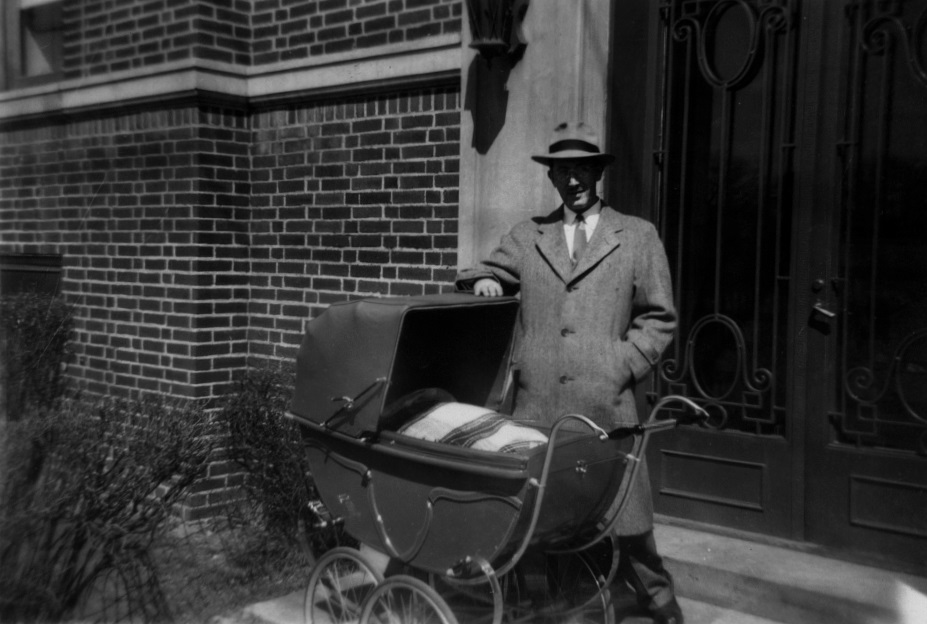
Dad worked for my grandfather, Philip Rosenthal, in his haberdashery store in Newark. For those unfamiliar with old-fashioned men’s couture, haberdashery consists of things like dress shirts, ties, cufflinks, handkerchiefs, socks, and the garters that used to hold up men’s socks before someone got the bright idea to weave elastic into the tops of the socks. My father would ride the bus every day to and from our third-floor walkup apartment in Irvington and my grandfather’s store in Newark, about 45 minutes each way. He always dressed impeccably in a suit, tie, and shiny leather shoes. I guess if you’re selling haberdashery it’s important to model your wares.

I remember being a small boy lying in bed. I would hear my father’s footsteps coming down the hallway outside our apartment, the key turning the lock and my father coming in. He’d take off his suit jacket and tie, placing them on a hanger that hung on a bracket over the bedroom door. After my father went into the kitchen to eat his dinner, I would sneak out of bed, take his tie off the hanger and put it around my neck, moving it back and forth to feel the coolness of the silk on my neck. If I moved it too fast, it would create friction and warm up instead of being cool. Then I’d put it back on the hanger and go to sleep.
I wanted to emulate my father. I wanted to eat the same food he was eating, even if it was too much for my little boy belly. I’d try on the ring he took off his finger and be amazed at how big it was on me. I wanted to be just like him, and I wanted to compete with him for Mom’s love. I felt I could win that competition because Dad was weak and not around all the time. But I wanted him around too.
There was an incident where my father made a commotion in the apartment building when he got home from work. He had become disoriented and tried to enter the apartment one floor below us. He couldn’t understand why they (we, in his mind) wouldn’t let him in, so he kept banging on the door. My mother and I heard the commotion, and went downstairs to guide him up to our apartment. He sometimes had a psychiatrist appointment after work. On this particular day, the psychiatrist had administered electroshock to my father during the appointment and then sent him on his way to navigate the bus ride home. He almost made it to the right place, which was amazing given the disorientation and short-term memory loss induced by electroshock.
My father had many many more electroshock sessions administered once he was placed in the state hospital, until his heart stopped after one session and he had to be revived. I guess after almost killing him they decided electroshock was now contraindicated.
My father’s mental illness seemed to be cyclical. He’d be okay for a few months and then start to have episodes of crying, pacing, and apparently experiencing visual hallucinations. I speculate about the visual hallucinations because he’d wave his hands in front of his eyes as if he were trying to figure out if what he was seeing was in his head or in the world.
Once when I was about five, dad was on a home visit from the hospital. Mom left me alone with him for about a half hour to go to the grocery store. This was a bad call. He had an episode while she was gone, crying, pacing, moaning, calling out to God and to his mother to help him, waving his hands in front of his eyes: the whole panoply of psychotic behaviors. Then he tried to hug me over and over, saying he’d never hurt me. I was not reassured. I was five and it was scary. Looking back, I get that there was a part of him that had some awareness of how he was coming across and wanted to reassure me, but he just couldn’t stop the psychotic behaviors.
My uncles Sydney and Norman had started an insurance agency in the back room of the haberdashery store. It grew to be so successful that they moved into a large office in Downtown Newark. I remember that the logo for Rosenthal Insurance was a map of the United States, implying that they had branches all over the country (which they didn’t). In any case, they were successful enough to buy beautiful homes in the suburbs in which to raise their families, complete with maids and even drivers. I remember a kind Black man named Sam in the employ of my uncle, who occasionally drove my mother and me to visit my father in the mental hospital.
When my father was having a very hard time, he’d go into a private mental hospital called “Fair Oaks” for four to six weeks. Whatever they did for him there, he’d be able to come home and hold it together for about six months until his condition deteriorated again. These hospital stays were financed by my uncles. This must have been very draining on their finances because eventually they declared that the next time my father needed to be hospitalized, he’d have to go to the state mental hospital in Cedar Grove, New Jersey.
This final hospitalization took place when I was about seven years old. My father never came out of “Cedar Grove” for the rest of his life, passing away at the age of 59. The cause of death was listed as head trauma from falling out of bed.
I didn’t see my father from the age of eight to the age of 18. My mother felt it was too much to keep visiting him in the state hospital and in the state he was in. We had to take three busses to get there. When we saw him, he’d rant and rave, displaying lots of paranoid ideation. Over and over he’d chant, “They’re going to take me downstairs. Don’t let them take me downstairs.” Apparently the morgue was in the basement of the mental hospital. Speculation was that someone had scared my dad by threatening to take him “downstairs.”
I remember the polished linoleum floors in the state hospital. I remember orderlies walking around dressed all in white, and patients roaming the hallways in various states of undress and decompensation, making noises nobody wanted to hear. There was a cafeteria where we were able to take my dad for a snack. On one visit we were able to take Dad out for a couple of hours. We went out for a meal. My dad was upset. We had to stop the car on the way back because my dad had to throw up.
Mom was mad at my uncles for abandoning their brother to the “snake pit” of the state hospital and upset about her situation in general as a single parent with a sick husband, so she decided to cut off that side of the family permanently. Not only did I lose contact with my dad for those years but also my paternal uncles, aunts and cousins. In addition, my grandfather Philip passed away at the age of 89 when I was about eight.
Mom’s story about the state hospital was that she had begged Dad’s psychiatrist to give him psychotherapy, but their policy was that if hospitalization extended beyond six months without clear improvement they would only provide custodial care, drugs, and electroshock.
I was a freshman in college when my mother and I visited him for the last time. The year was 1965. I was eighteen years old. We walked into the visiting area. My dad came out, took a look at us, and asked my mom, “Who is this man?” She said, “This is your son, Arthur. Don’t you recognize him?” My dad said, “Oh yeah, I think I see the resemblance now.” Then he turned to me and asked, “Why don’t you cut your hair?” In 1965 I had grown long hair and a beard like a lot of young guys of my generation. This was the first time I remember feeling angry at my dad. I was thinking, “After 10 years, this is your response to me? Look where your haircuts and fancy suits got you!” I guess this was the closest I got to an adolescent rebellion with my dad.
My dad passed away four years later, in 1969. I was 22 years old. I had graduated from college and was spending a lot of time hiking and backpacking in the mountains of Northern California. I only got to town about once a week to check my post office box, so by the time I got the telegram about his passing I had already missed Dad’s burial and service.
I flew back to New Jersey to visit my mom and visit the cemetery where my father was buried. It was a tiny Jewish cemetery sandwiched between industrial buildings in Newark. The Pabst Blue Ribbon brewery with its gigantic sign visible from the highway was adjacent to the cemetery. We visited the grave. My mom cried. I didn’t. I put my arm around her, feeling protective. Then we got in the car and drove away.











Arthur, Thank you for sharing your memories of your family and father. I am so sorry for all of your hard times. This is important to remember and to understand. It is very hard for people to comprehend what institutional life was like with both and or developmental disabilities and emotional crisis. It is also hard for folks to conceptualize the buildings and that sort of so called community. So also important in understanding the entire person in crisis history. Many old buildings have been used as haunted ruins which is a great disservice to those who worked or lived in them when they were functioning. I also wonder about cemeteries and if efforts like in Tuam Ireland or the Canadian and United Stated indigenous boarding school cemetery archeological and hopefully truth and reconciliation efforts should be considered as a viable option. In my own family and across my life I have heard whispered stories and on more than not shame on the faces of people talk of a family member who has had the schizophrenic( that label! ) identity put on and had times in hospitals or institutions. Just by reading a bit about his family so much immigration and ism history under the surface. Some folks seem to carry the historical and intergenerational trauma more than others. We all those of us who were or are behind the desks, those of who were or are in front of the desk, and those family members part of the invisible area encompassing the spaces outside the desk need to share history, gather information, and work together for a true supportive system somehow.
Report comment
Mary, thanks for your insights. Yes, there is so much historical and intergenerational trauma that’s usually invisible to us in our current generations unless we dig for it. As the youngest son, my speculation is that my father was carrying his mother’s unexpressed grief and depression from losing two children. I don’t know anything about what happened to my grandparents before leaving Russia, but I know historically it wasn’t pretty. That’s why they emigrated in the first place.
Report comment
Here’s a little informational addendum to my article:
The facility known as Overbrook Asylum, or the Essex County Hospital Center, was a psychiatric hospital located in Cedar Grove, New Jersey, that operated from 1898 until its closure in 2007. It was established to relieve overcrowding at the Newark Hospital and eventually grew into a self-sufficient campus of 34 buildings on 325 acres, housing thousands of patients during its peak.
The original site was demolished between 2015 and 2018, with the land subsequently converted into Hilltop Reservation (a county park) and a residential development of townhomes
Report comment
Well that is a good thing. One institution fell to ruins near a public university and used to be a place for seeing what ghosts there were. Equal Justice Initiative has soil from lynchings sites they have collected. A plaque would be a nice thing to do. Historical markers another option. In every county there is the Probate Court. This is wherevthe commitment orders were created. For one summer I worked micro-fishing the papers. It was beyond stunning. Sometimes what we saw caused us to stop cold in our tracks. It is an important though mostly forgotten archive of legal history. Similar things are happening in sone ways with the indigenous boarding schools. Something should be done. Germany and its stumbling stones. In Dublin they now after over 100 years a famine memorial art sculpture. It is so evocative and the generational issues created from those years staggering. The UN and its Human Rights Commission finally starting to come out with the disability universe. And is trauma a disability? It certainly changes one and sometimes hard to repair and for done folks an always ongoing process. So not sure ( it certainly created issues for me for a long time ) but good to see and for awhile there seemed to be hope for more international rights actions but who knows? Glad you found this location recent history.
Report comment
As a former New Yorker, I felt I knew your dad as I was growing up, as I read this. I knew I loved him. Thanks for sharing this story about your father, Arthur, I loved it.
Report comment
Someone Else: I can feel the love in your comment. It touches me.
Report comment
My father had a couple of breaks. However he went to Veterans hospital. In the 1950s Veterans hospitals were much better run than state hospitals I found sh believe. We never put my dad in a state hospital thank God. He was a very good dad to me nonetheless. Thanks for sharing.
Report comment
Sharilyn, I’m glad you got to have your dad in your life, and that he got better treatment.
Report comment
Thanks for this story about your father. It is so evocative of the time, particularly with the photos included. Your description of your early relationship with your father highlights the loss you experienced later.
You document many of the issues of psychiatric care, which even today is compromised in understanding and management of emotional distress. The account of him returning home alone and confused after electroshock demonstrates a failure of clinical judgment by his treating doctor.
It is so sad that your whole family was impacted so much by ineffective care.
The cyclical nature of his illness did make me wonder whether he had an affective psychosis rather than schizophrenia. Unfortunately the care he received did not enable him to live the life he deserved.
Report comment
I don’t think it reflects a lack of clinical judgement. I think it reflects an utter lack of empathy and the moral bankruptcy of any system that thinks electrocuting someone to induce a grand male seizure could possibly be “therapeutic!”
Report comment
Steve- I agree with your comment and Phil’s comment. It was totally reprehensible on the part of the shrink, lacking both empathy and professional judgement.
Report comment
Phil, I’m uncertain what you mean by the term “affective psychosis”; what distinguishes it from the vague term “schizophrenia?” Are there any objective tests that conclusively prove the existence of either of these states of mind, which constitute an extremely wide spectrum of behaviors, thoughts, and emotions?
Report comment
Diagnosis/labelling of people with mental distress remains an unresolved issue and in the absence of any consensus is likely to remain so for a while yet. Many of the diagnoses are vague and contested. There is probably no answer to your question.
Schizophrenia is understandably one of many debated diagnoses. There are no objective tests that confirm a diagnosis for depression, mania, schizoaffective disorder or schizophrenia.
Many years ago, particularly in the USA, anyone who experienced hallucinations was often diagnosed with schizophrenia. Some of those people may have been suffering from an affective psychosis – severe depression or mania or schizoaffective disorder.
Report comment
Thanks, Phil, for your kind and astute comment. I think back in the 50s most “crazy” people got labelled with schizophrenia. You are observant to note that my dad was cyclical and super emotional. He was sensitive and had a lot of anxiety and possibly panic attacks. I remember him getting up very early, getting fully dressed, and pacing up and down our hallway in an agitated state. Today he might be labelled with schizo-affective disorder or anxiety with panic disorder. Who knows. And, yes, sending him out to the bus stop after electroshock was totally inhumane and , IMO, malpractice even for those times.
Report comment
Even a therapist needs a story, a narrative, that they can live with.
What was omitted:
Two world wars, the great depression.
The likelihood of misdiagnosis based on trends, fads, zeitgeist.
The minimisation and minimal understanding of the side effects, adverse effects of psychoactive and similar drugs (plural), even at therapeutic doses, and their combined and cumulative effects, topped off with barbaric ECT (which was likely unregulated and operated unchecked).
It is doubtful that schizophrenia was a valid diagnosis. It is doubtful that the drugs and treatments given were warranted and necessary.
Psychosis has many causes – some as simple as nutritional. An other known cause are infection/s of various kinds.
This story, is a modern day warning to be discerning, astute, healthily sceptic, and seek other opinions (without telling previous stories from previous practitioners) – simply state current signs and symptoms plainly (no mention of medications, treatments, and so on), just seek a plain straightforward opinion, as though it was the first time of addressing issues.
Harms that needn’t have been.
Watching people line up for ECT, because the doctor said so, (1980s – 2020s), and witnessing the immediate detrimental impact as well as the longer term negative impacts, along with the doctors’ and industries’ and institutions’ and services’ propaganda narratives of illness, ongoing illness without treatments, disease, disorder, was the equivalent of witnessing criminality being fed to the public as being perfectly okay. “The banality of evil” might apply.? All ages, all demographics, all backgrounds, all education levels, … .
These already medicated people, given licit psychoactive drugs, cannot possibly give fully informed consent. The drugs and treatments “ALTER their normal mental functions” and behaviours.
Today, still, there is no fully informed consent.
A doctor’s visit, will end with a prescription in hand, for what? We don’t know – we haven’t been told. Taking hold of the prescription implies consent. Consent to what? Consent to side effects, adverse effects, that were never communicated.?
Do you have schizophrenia? Do your children have schizophrenia? Did your uncles (your father’s brothers) have schizophrenia? Rhetorical questions – but see where the questioning is headed!
Maybe you could also share your story from a different perspective and through a different lens?
Report comment
Vee, thanks for your broad, systemic overview. I agree with everything you say about the inhumane, fraudulent, and unscientific approach of the mental health system, from its earliest days to the present, as well as the effects of historical and intergenerational trauma. In writing my memoir, I took a first person narrative perspective based on my own lived experience as a child, teenager and young adult. I therefore touched tangentially on the macro issues you bring up, without going into a polemic from my current vantage point. My intent was to bring to light the macro issues you so clearly highlight, through my micro experiences. Could I have shared my story “from a different perspective and through a different lens?” Sure, I guess, but it would have been my old man thinking lens instead of the feeling lens of my younger lived experiences.
Report comment