When I was 25, and the world still seemed full of promise for me, a very unfortunate thing happened. I went ‘crazy’. Or, at least, I fully believed I was losing my mind, that I had inherited a dreadful and debilitating illness, which was beginning to manifest itself, and which would steadily progress until it ultimately robbed me of all the positive attributes I possessed: intelligence, creativity and musical talent, athleticism, and even my ability to simply function autonomously as a healthy, independent human being.
The reason I felt the clock ticking was primarily because my older sister had suffered a very significant mental breakdown at roughly the same age, and had been heavily medicated ever since, never regaining her pre-crisis personality and abilities. So I had always secretly wondered, and feared, was the same horrible fate in store for me?
And now, on the verge of a tumultuous breakup with a partner who I loved deeply, I feared that the answer was a resounding ‘YES’. I was becoming increasingly convinced that the extreme levels of anxiety I was experiencing, combined with insomnia, decreased appetite, and most frighteningly, a noticeable deterioration in my ability to process information, were manifestations of a condition that would soon extinguish the life and person I had always been. I felt I was experiencing the equivalent of a psychological cancer, a malignant and rapidly accelerating condition that was disintegrating my very personality, my identity, from the inside, and from which there would be no returning. It was, in my mind, unstoppable.
Quite apart from any underlying depression or acute anxiety I was actually suffering from at the time, my conviction that this impending psychological apocalypse was inevitable resulted in a level of fear, stress and sadness that I had never before experienced. I have described it to people I know as a waking nightmare, the unfiltered and primal scream of the reptilian brain devoid of any self-soothing or other placating mechanisms. Little did I know, nor could I have believed, that things were about to get several orders of magnitude worse, thanks to my fateful decision to visit the emergency department of my local hospital out of fear that I might otherwise take my own life.
My local hospital had a ‘prestigious’ psych unit, one of the best in the country according to its reputation, I would later discover. Unfortunately for me and my soon-to-be fellow inmates in the acute psych ward, this reputation would not translate into anything resembling a sense of care, or competence, let alone efficacy of treatment.
I want to be fair here before I continue: when people are presenting at hospitals because they are experiencing extreme psychological distress (regardless of the particulars involved, such as delusions, hallucinations, cognitive impairment, etc), one might expect their ‘stay’ at a hospital to be a stressful and generally unpleasant experience. However, what I witnessed, and the ‘treatment’ I personally received during my three months in that facility’s acute ward, have left permanent and completely unnecessary scars on my psyche and soul.
The first thing that concerned me, which I noticed upon my admission and which became a running theme over the ensuing months, was the reluctance of staff, particularly the higher-ups (the psychiatrists and psychologists), to simply BELIEVE anything I had to say: about my condition, my past, anything. There was an immediate skepticism, overtly expressed, and a reluctance to accept what I said at face value. Even in my heightened state of anxiety and impaired cognitive function, I found this extremely odd and perplexing. Here I was, voluntarily presenting to a mental health clinic because I was afraid I would self-harm, here I was actively seeking help and being as open and transparent as possible, and I was immediately hit with a wall of distrust and cynicism by the very doctors I was trusting to help me. This did not bode well.
It turned out, and I would later learn that this is unfortunately endemic to the field as a whole, that the lack of trust I perceived was representative of a general and broader disdain and disrespect with which doctors, and to a lesser extent staff, viewed and treated patients in the ward. The subtext seemed to be: “You’re crazy, we’re sane, and much smarter than you, so don’t expect to be treated as one of us, because you’re not!” It should go without saying that acute ward patients constitute a population suffering some of the most extreme levels of mental anguish possible, thus these people need and deserve to be treated with the utmost respect and care. It was therefore astonishing to me to see, and experience, the callousness with which staff treated some of the most fragile people in society.
This ranged from open displays of anger and impatience, to mocking and laughing at patients. I recall one incident where an aggressive patient had been locked in an isolation room and was violently pounding on the door to be let out, and a clearly frightened patient asked one of the nurses, “What should I DO?” To which the nurse glared at the patient and replied in a deliberately cold and sadistic manner, “There’s nothing you CAN do.” There was no offer to help or comfort the patient, simply a harsh rebuff, and the patient began to cry. Such indignities were a constant, and the power divide within the ward felt both oppressive and dehumanizing.
Another thing that was disturbing about the ‘culture’ in the ward was the lack of oversight and control that the staff on duty exercised over it. For example, I remember that on the first day I was admitted, a woman who I shared a room with (all the rooms were co-ed) took a liking to me and began making overtly sexual advances towards me. I was extremely uncomfortable about this, and mentioned it to one of the staff on duty. He responded by snickering and then ignoring the issue entirely. The situation became further complicated when I discovered that one of the male patients had a crush on this particular woman, so there was immediate conflict and tension within the first day of my admission. And this was indicative of the chaotic and unsupervised nature of the ward. Given the number of unstable and heavily drugged people in that small space, the environment was often hostile and tense, and certainly not conducive to recovery.
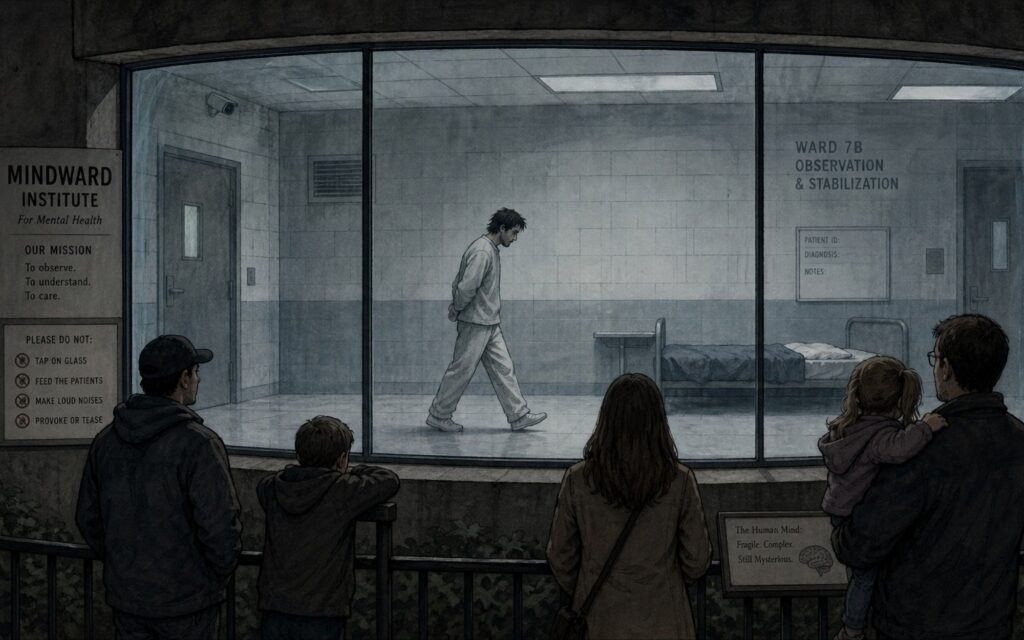
I recall one of the most upsetting side effects of being institutionalized, and I’m not sure how much of this was the result of the medication versus simply the experience of being locked up day after day. But most people, myself included, developed the habit of pacing. And we would just pace and walk back and forth in the small spaces that existed there. It was a kind of torture, but preferable to being still. It’s like you had this abundance of nervous energy, with no outlet, you couldn’t do puzzles or play games because you didn’t have the cognitive ability to focus, you couldn’t sit still because it was excruciating not just mentally but physically. And so, you paced.
I had befriended a fellow patient and he and I would make requests to be able to go out for short walks, and we would walk through the local shops and streets, not conversing, just walking robotically, nervously. I’ll never forget how foreign I felt in my own body during those times. I didn’t recognize what I was doing or why, I acted out of a compulsion that I didn’t understand and it was horrifying. I can never visit a zoo again after my experience in the acute ward. I could never watch an animal pace back and forth.
Far worse, and more lasting, however, was the critical aspect of diagnosing and medically treating my ‘condition’. To say that I was administered an inconsistent and illogical cocktail of psychotropics would be like saying the use of thalidomide by pregnant women in the 1950s was a little “ill-advised.” Rather than admit that they did not understand what I was suffering from or how to treat it, the standard psychiatric playbook of ‘prescribe now, prescribe more later’ was quickly adopted. By the time I left the ward, I was on a combination of antipsychotics such as Clozapine (even though I never experienced a single psychotic episode), strong sedatives such as Lorazepam, and Lithium because hey, why not. It took more than half a year for a psychiatrist I saw post-hospital to wean me off ALL the medications I had been on, and start me on a dose of Prozac (a story for another time, perhaps). He was stunned at the combination of psych drugs I had been on, calling it an example of “very bad medicine.”
Similarly “very bad” was just how inept my ‘diagnosis’ and corresponding prognosis were. The fact is, I never received a definitive diagnosis at all (or if I did, no one ever told me what it was). I was left to basically infer what my condition was based on the ridiculous combination of drugs I was given. The main thing I wanted when I presented at hospital was reassurance that someone could figure out what was wrong with me. That to me was just as important as the “cure,” if such a thing even existed.
It became terrifyingly clear soon after I was admitted that all my assumptions about the field of psychiatry had been misplaced. Like so many people, I had assumed that psychiatry was akin to other areas of medical science; that it had been founded on rigorous studies, which resulted in a neat, and of course valid, list of illnesses, each with a discreet set of symptoms, and corresponding medications to ‘treat’ said illnesses. All that was required was for a competent doctor to diagnose me by ticking ‘X’ number of boxes in some symptoms catalogue and presto, I would be given some pills and feel better. Except, no. It turns out none of that is true.
In reality, there are significant issues at every junction of that hypothetical treatment map, starting with the constructs of the illnesses themselves. Rather than being discreet and easily measurable and identifiable pathologies, many of the ‘disorders’ are so nebulously defined and/or poorly researched that their very existence is entirely uncertain. Many of the criteria and symptoms are similarly unreliable and/or arbitrary. And needless to say, if the illnesses themselves are less than valid, it is not surprising that there is a high level of discordant diagnoses (i.e., where the same individual can receive entirely different diagnoses from different doctors), and, in turn, a slew of inappropriate medications being prescribed and taken by unsuspecting patients.
Returning to my own frustrating story, even after spending three months being ‘observed and studied’ as it were, I was no closer to understanding what was wrong with me than the day I entered the hospital, and clearly, neither were the doctors. I was on medications that suggested I suffered from everything from bipolar disorder to schizophrenia, as well as major cognitive/affective disorders. It was a complete farce. I distinctly recall the head doctor of the ward having a meeting with my girlfriend (who had, miraculously, stuck with me throughout this ordeal) at my request, and confidently telling me that there was a “90% chance that you will be readmitted to hospital within the next two years.” That was more than three decades ago, so, I’m okay with those odds.
Needless to say, the fears I had at the time that I was on the brink of a devastating breakdown that would permanently alter my sanity and cognitive abilities were totally unfounded. I experienced a depressive episode with heightened anxiety (largely BASED on the false expectation I had that ‘the end was nigh’). As relatively mild as my underlying condition may have been, my stay in hospital resulted in SIGNIFICANT iatrogenic harm, from the institutionalization, the misdiagnoses and the self-fullfilling prophecy that ensues from such labelling (for years afterwards, I lived in the shadow of fear that it was “only a matter of time” before I would wind up back in the horrific confines of an acute ward), to the ‘dirty’ drugs I had been prescribed there, NONE of which addressed what I was experiencing, and ALL of which caused unwanted side effects ranging from the unpleasant to the debilitating.
One of the things I found most disturbing about my experience being hospitalized was the lack of informed consent about the many drugs that were shoved down my throat. In particular, the side effects of some of the stronger antipsychotic drugs were devastating to me, both physically and mentally. I will never forget the day they took us out to play basketball in the courtyard. I’ve been an avid basketball player all my life, and when I went to take a free throw, not only could I not make a single one, I couldn’t make the 15 ft distance to the hoop. I tried with all my strength and the ball traveled maybe 8 to 10 ft. It was an extremely traumatic moment, and obviously completely unexpected since no one had explained to me that this was a ‘normal’ side effect of the Clozapine.
Again, all someone, anyone, had to do was explain to me that my motor skills and strength were going to be significantly impacted by the combination of medications I was on. I wouldn’t have liked that, of course, but at least I wouldn’t have been terrified to see and experience these effects without any forewarning. Like the depression and anxiety weren’t bad enough, now suddenly I can’t MOVE MY ARMS normally!? It was sickening.
It took many years for me to recover; not from whatever was actually ailing me, but from the very experiences I had in that institution. I left there significantly more harmed than when I entered. I am not exaggerating when I say I literally had to learn how to function again in even the most rudimentary ways.
Consider my story a word of caution. I would strongly encourage anyone reading it to carefully weigh the risks and do your own research before seeking ‘help’ at any psych clinic or hospital. Depending on the severity and nature of what you’re experiencing, there is a good chance that avoiding such institutions altogether would be the safer, smarter choice. I can say with absolute certainty that, had I known then what I know now, I would never have set foot in that place.













Remarkably well written, thanks!
Report comment
Thank you Stefan! I hope my story was helpful to you in some way.
Report comment
I’m really sorry that psychiatry made you end up worse than you were to begin with. What a terrible experience you went through. Thanks for sharing your story. I wish you continued healing and peace in your life.
Report comment
Thank you so much, I appreciate your compassion and understanding about that horrible ordeal. It was honestly touch and go for quite a while both during and after that ‘treatment’. I’m not sure if what doesn’t destroy us makes us stronger in every instance, but I have certainly done my best to use what happened to me in order to grow and prosper.
Report comment
Hi G.T.O.,
Thank you so much for sharing your story. I honestly teared up reading this, it is just ghastly the way patients are treated by those who are meant to be CARING for them! You describe the ostracization and dehumanizing feelings so well. If you don’t mind me asking, how long did it take you to feel strong and healthy again after leaving the hospital, and did you regain your skills at things like basketball?
Take care,
Angela
Report comment
Hi Angela,
Thank you so much for your kind words! And while I’m sorry my story made you emotional, your empathy and compassion are so very much appreciated by me. Thank you. If only there had been some people like yourself among the staff at that hospital…
And no, I don’t mind you asking questions at all! 🙂 I’m happy to say that, from my own self-perception including/as well as all objective measures, yes, all my cognitive and athletic abilities seemed to EVENTUALLY return to their pre-hospitalization levels. As a matter of fact, I played a couple of hours of basketball just yesterday, and as has become tradition for me, finished my workout by making 10 straight free throws, as a nod to the time when I couldn’t hope to make a single one.
All the best Angela,
G
Report comment
Hi G.T.O ,
OMG, thank you for sharing this very well written piece. It is riveting and captures everything that is SO egregious and harmful about the mental health system – from the bogus psych labels, to the toxic drugs to the stigma, disdain and dehumanization that is shown to people who simply needed some compassion. It is SO shocking and appalling it’s incomprehensible and I am so sorry you endured this.
What makes it even more appalling is most often the person/patient was in a temporary state of distress or sadness due to life stressors and simply needed a little ‘help’ in the form of compassion and support to get through the difficult time. Instead they are left severely harmed, traumatized, stigmatized and way worse than when they tried to get ‘help’.
I live in Canada and in some of our provinces things are really out of control. As you noted many people think highly of psychiatry until they realize how farcical and damaging the whole system really is.
Report comment
Hi Rosalee,
Such a thoughtful comment, one that resonates so deeply with me, thank you! As horrific as my experience was, simply hearing from people like yourself who can echoe my very same concerns and criticisms of the mental ‘health’ system, is both a deeply moving and encouraging experience.
You parse out a very critical, and haunting point; that a significant proportion, quite possibly the vast majority, of the poor souls who voluntarily enroll in the macabre experiment which is modern psychiatric care, are suffering what would OTHERWISE be a transient, episodic period of extreme stress and low affect. However, thanks to the ‘help’ they receive, many of these people end up enduring prolonged or even permanent suffering, due to the baneful factors you mentioned above – bogus psych labels, harmful drugs, and the general contempt with which they are treated by these ‘care providers’. The harsh reality is that, daily, thousands of the most vulnerable people in society are fed into a system which is all but guaranteed to make their existing condition WORSE. And, the beat goes on…
I too hail from Canada! And yes, along with my general complaints about our once-great now-3rd world healthcare system, the mental health field is especially frightening. The problems run deep, not just here of course but globally, and I’m sad to say I still don’t see a light at the end of the tunnel, in terms of governments and health administrators even acknowledging, let alone trying to fix, what has been clearly broken for decades. 🙁
Here’s to a light emerging somehow, someday!
All the Best,
G
Report comment
I was once told by a psychiatrist whom I really liked and respected that most of the people who become psychiatrists have mental illness themselves or in their family and that is why they choose psychiatry as their work. I have seen this is true.
Report comment
Hi Molly,
Yes, I studied Psychology at university and can certainly attest to that tendency, and I am pretty sure it runs true across all the mental health disciplines. A way of working through personal issues perhaps, while also trying to help those whose suffering they can strongly relate to.
All the Best,
G
Report comment
I recently wrote regarding this issue on this article. My comment was:
I’ve also noticed that the client-to-professional pipeline is very big in the mental health industry the world over. Many people who were formerly clientele end up becoming psychologists, social workers, peer workers etc. because they were so traumatised by the system or what their families did to them that they want to “reform the system”. The other thing that happens is that they keep getting told “you are not a doctor or a healthcare professional”, “you don’t understand” etc. over and over again so they just end up doing degrees in the damn profession so that they finally get to have some say over their own life. Others just directly call them “mental”, “crack”, “psycho”, “you sound schizophrenic” etc. as slurs when they do something the opposite party does not agree with. It doesn’t have to be something irrational or wrong. Just something the opposite party does not agree with, cannot prove wrong or when a person shows them the irrationality of their own thinking. Also, their ordinary education ends up getting affected due to whatever they go through and their “education” ends up being about learning all the nuances of Psychiatry and the mental health field to protect themselves from the system, their families etc. It’s really abhorrent.
Report comment
Molly, I have suspected that as well. I recall watching a documentary several years ago created by a psychiatrist. He went into psychiatry because his sister has some kind of breakdown. This was in the early 1970s. The sister had gone through a divorce (no stigma there in the early 1970s — I am being facetious — there was a lot of stigma around divorce then.) And I believe his family, especially his parents, were staunch Catholics.
Report comment
GTO,
This piece is so succinct and beautifully written. May it help someone escape the “help” of Psychiatry.
All the best to you.
Report comment
Hi AnnieOakley,
Thanks very much for the feedback. I sure hope it helps at least one person escape, or better still, avoid being hospitalized in the first place. I can’t think of any condition a person could be in, other than perhaps being in very imminent danger of harming themselves or others, where an experience even resembling my own could be considered net beneficial for them.
All the best,
G
Report comment
Thank you for this account. The thing that bugs me is this: there have now been multitudes of articles like this published on this website. But that’s what it mostly is. There are still multitudes of Psychiatry graduates (and those of allied fields) making YouTube videos on every damn DSM/ICD psychiatric categorisation in every damn language in every major country: “what is schizophrenia? – signs and symptoms”, “obsessions of a borderline person”, “bipolar disorder explained”, “why ADHD makes everything harder”, “understanding avoidant personality disorder”, “the neurobiology of ADHD”, “the genetics of mental illness”.
Almost none of them outright talk about the damage from the very concept of “mental illness”, the damage from the very categorisations they sell as “diagnoses”, the fact that their “diagnoses” are very often used to shut people up and gaslight them, the damage from institutionalisation in wards, the damage from chronic revolving door syndrome, and the fact that all of this itself (and not the original suffering a person had entering into the system) can drive a person towards suicide or destroy years of their life.
Just recently, in May-26, I was talking (online) to an American man in his 40s about some of the damage from Psychiatry and his mind straight went to “you would have made a great Scientologist”. Then he went into “psychiatry has helped millions”.
Many people have been indoctrinated into not being able to consider the harm of this profession and its concepts at all. They do not bother to understand nuance, cannot understand that their experience is not universal and that the same profession that has helped them has ended up harming someone else (can be indirect harm also) depending on their social situation, family context, the nature of their suffering etc.
Report comment
Hi,
Yes, I agree very strongly with what you’ve written here. The problem, ONE of the problems anyway, is that the mental health field has been at pains to PROVE itself a ‘hard science’ for decades. Rather than acknowledging the data which clearly indicates that the very constructs of ‘mental disorders’ are just that – approximations made be people with titles to identify SUPPOSED existing illnesses, rather than valid descriptions of actual cognitive or affective conditions which exist in the wild – the field as a whole has been at pains to minimize said findings (such as the notoriously poor inter-rater reliability for MOST of the DSM disorders). The financial and reputational incentives to keep such data hidden from the public are painfully obvious.
And as your anecdote points out, the general public has been so successfully hoodwinked by this propaganda, that merely questioning the accepted wisdom that “psychiatry is a net positive” can often result in sarcastic and smug dismissal, of the type you received from the person you were conversing with. I’m sorry you experienced that, but alas, don’t take it personally. Once people believe believe in something, they will defend that belief even in the face of contradictory evidence and logic, to their own detriment.
Best,
G
Report comment
In case no one else mentioned it, some of what the author describes early in the article appeared to be akathisia. I experienced it briefly while hospitalized from a medication I was given for just a few days. It causes one to peace endlessly, not because there is nothing else to do, but because there is a painful inner feeling of intensely painful restlessness and discomfort. I first noticed it when a previously comfortable chair in the day room became impossible to sit in. I couldn’t sit at all. Had to constantly move.
Report comment
Hi Nancy,
You are quite right, I was undoubtedly suffering from akathisia. However, I’m not convinced that that itself explains the endless need to specifically pace while I was in hospital. One reason I question this is that, after my release, and despite being on the same levels of medication for the first few weeks, that constant need to WALK evaporated the day I left hospital. So I definitely think there was a psychological component to it, above and beyond the motor impulses resulting from the psychotropics themselves. Simply being in that hellhole, made one want to move, relentlessly.
I’m sorry for your own experience with this condition. It is extremely distressing.
Best,
G
Report comment
Great article. So many pieces in there to reference to other people — including the general public. I need to reread it and pull some out. The “prescribe now, prescribe more later.” And also that as a member of the general public, you were led to believe that the labels and treatments are all based on science, which of course, they are not. If you haven’t read James Davies’s book “Cracked: Why Psychiatry is Doing More Harm Than Good,” I highly recommend it.
It’s a horrifying thing to be traumatized worse by the system than by the very frightening experiences that lead a person to seek help from that system. As hellish as my own experiences were back in 1998, I was lucky in that I didn’t end up going to a hospital and having to deal with the drugs.
While reading this, I thought of the “crime against humanity” in how people dealing with difficult experiences are treated. From what you describe, you were not initially anywhere near what gets called “psychosis” or “schizophrenia” and yet you were likely pushed to those horrific states of consciousness.
In my own experiences, I remember thinking after a few months of being traumatized by the system, “If they only dealt with the trauma of the initial experience (severe stress breakdown), I would be in a much better place now. Your story echoes that and even magnifies that.
I am so sorry for the excessive trauma you endured from the system. Thanks for sharing your story.
Report comment
Hi Penni,
Thank you so much for your thoughtful and revealing comment. I’m sorry it took me this long to reply. I’ve been going through the comments in order, and it has taken me more time than I expected 🙂
It sounds like you went through a similarly horrible experience, and I am VERY glad for your sake that you at least avoided the additional ‘care’ of being hospitalized and drugged to a nearly catatonic state. I’ve lived through some fairly awful periods in my life, but the surreal nightmare that I experienced during those three months, is without peer. I do hope you have been able to put your own dark chapter behind you, as much as one can.
And yes, you are spot on. I WAS treated, both chemically and behaviorally, like I was indeed suffering from severe psychosis and/or schizophrenia, despite never having a psychotic break. Referring to the tendency by the profession to overprescribe and misdiagnose as a “crime against humanity” is not an overstatement, and I consider myself quite fortunate to have recovered as thoroughly and rapidly as I did, from both the stigma and harmful psychotropics I was given.
I’m not sure to what extent your own perceptions echo my own, but one of the fascinating, and yes troubling, aspects of my ordeal was the sense that the individuals involved (doctors, therapists, admin and general staff, etc) were not ‘evil’ people. They weren’t malicious (for the most part, there was one notable exception), and didn’t mean to be doing harm. Quite the opposite, in fact. I think that everyone there BELIEVED they were doing ‘good work’, helping the unfortunate souls who had lost their way. And while that may sound like ‘good news’ on the surface of it, it actually reflects the true magnitude and immutable nature of the problem, i.e., this is truly a systemic failure, a fictional science informing iatrogenic practices, which are themselves supported by governments, a billion dollar psychotropic industry, and the widespread acceptance of the general public. It will take a LOT to move the needle here.
And thank you for recommending James Davies’s book, I have not read it but will make a point of it. I am sure I will find it both aggravating, and also liberating, much as I find most discussions on these topics. Hard not to; when there is so much needless harm being done to people, being aware of it is both a blessing and a curse.
Thank you for your understanding and compassion Penni, I really appreciate it.
All the best,
G
Report comment
I meant to comment on this last week but failed to do so. Your comment about people not intentionally being “evil” is of interest. It reminds me of M. Scott Peck’s book “People of the Lie” — there is a chapter on systemic evil related to the My Lai massacre in Vietnam. You don’t have to be evil to be caught up in a system of evil is my take.
I finally self-published a book — Musings From a Kintsukouried Mind — where kintsukouri is the Japanese art form of taking a piece of pottery and breaking it into pieces. Then the pieces are put back together with gold or silver lacquer — and most importantly, the piece is more valuable for having gone through the process. I am still working on setting up book signings — but I am also working on a sequel book along with a couple of other writing projects.
I have a master’s degree in statistics and the biomedical model is easily one of the most ridiculous models out there — and I am talking about statistical models. The harm it has caused is truly criminal.
Best wishes to you.
Report comment
Hi Penni,
No worries, I actually only looked in today to see if there were any new comments.
Yes, the phenomenon – ‘nice’ people doing abhorrent things due to systemic or simply peer group pressure – is extremely eerie and pervasive. I’ll go slightly tangential here and say that it’s one of the main reasons, or at least symptoms, which makes me eternally pessimistic about our species. We each of us need to be philosopher kings and queens – able to reason at a high level, and determine right and wrong from first principles, not doctrine – in order for the barbarically cruel ‘sheep’ behavior humans have always and continue to be guilty of, to finally cease. And alas… perhaps one in a hundred, maybe one in a thousand, possess the intelligence, compassion, and strength of will, to achieve that goal.
Your book sounds intriguing. I had never heard of kintsukouri, but I love the metaphor. I’m assuming you can’t elaborate on it here since the site probably frowns on anything that can be construed as self-promotion, but I will look for the title online and see if I can find it.
I actually tutored stats at university, loved the subject most hated lol. And yes, once I started looking at the primary texts and ‘foundational’ studies in psychology a little more closely during my graduate studies, I was SHOCKED and appalled at the sophistry which was being rubber stamped and published in ‘prestigious’ journals, thereby influencing countless other asinine studies and grants in the process. The blind leading the stupid. And the end result – poor souls receiving ‘treatment’ more damaging than the presenting problems.
Best of luck with your current and future books! I hope to read some of them.
G
Report comment
Excellent work! So much of what you experienced matches my own encounters with mental health “treatment.” Fortunately my condition was milder and much shorter but I lost an entire year of my life. I’m heartened to hear that you survived and now appear to be thriving.
Report comment
Hi Gregory,
Thank you so much for the feedback, and for sharing your own unfortunate experience with the mental health field! It is shocking, isn’t it, how so many of us have had similarly nightmarish experiences, and yet the public remains blissfully unaware of the bedlam that exists within the confines of mental health clinics, or even the harm that is done by individual practitioners on a daily basis. I am glad that your condition was milder, and that you have likewise survived and moved on! It is a shame we lost what valuable time we did from our lives but, given what happens to many unfortunate souls, I suppose we should consider ourselves fortunate…
Take care,
G
Report comment
You know there was a real Bedlam in England. Shakespeare and his fool in King Lear references that and a whole Histiry of more bad then good and sonetines a good but it never lasts abd throughout history. Thanks for your story yep you got it. The concept of therapeutic milieu worth researching abd those units post 2000 or so more prison than not. Sone units in the eighties had pianos abd swimming and basketball ops along with passes and art therapy. There used to be a field of Recreational Therapy and post WWII has several alternative therapies used on the units for vets.
A lot was squashed and erased though every know and then stuff bubbles up. Jon Krauhsauer of the Everest Tragedy has a good interview out now on his processsing of the events. This should be standard for every employee every employee working with humans in crisis everywhere. Thanks much and take care.
Report comment
Hi Mary,
Thanks for your kind comment, and yes, unfortunately I know of the actual Bedlam hospital in London. Amazing that in some fundamental, scary ways, not THAT much has changed in how patients are treated, and harmed, in almost 1000 years! I will try to find the Jon Krauhsauer interview.
All the best,
G
Report comment
I am from India. In my country there have been a bunch of Psychiatry graduates who joined “Cochrane Collaboration”, an organisation that purports to restore honesty and ethics to medical research. There are psychiatry graduates from other countries in it too. They publish systematic reviews to answer the question of whether a particular treatment works.
It is utterly ridiculous to me that psychiatry graduates are allowed to join such a place and even give speeches on “ethics in research” when in real life clinical practice, their profession is one of the dirtiest and most unethical professions in all of medicine. It is routinely weaponised against people, not necessarily by professionals, but even family members and others. Even its language and nosology is a weapon.
It has ended up causing so much mental hell to so many people and instead of doing any ground level work to fix those issues, they’re bothered about “ethics in research”.
There are people whose lives end up getting damaged when they’re branded as “schizophrenics” and Cochrane has an entire group called “Cochrane Schizophrenia Group”. So out of touch with ground level realities.
In my country, psychiatry departments/hospitals are still officially called “mental hospitals” in many places. That verbiage itself destroys the reputation of any person who has the misfortune of ending up in those places (or being coerced into it). If such a person ends up in court during a serious family dispute, the perpetrator’s lawyer can ask the victim “did you go to a mental hospital? Did anyone in your family go to a mental hospital?” to humiliate and discredit the victim.
As you know, it’s not always “mad people” that end up in these places. Sometimes, they’re just victims of other people’s abusive and irrational behaviour. The consequences of these places do sometimes end up turning people “mad” though.
There needs to be some official law passed to rename them all to mental health centres wherever they’re called “mental hospitals” in the world. Psychiatry graduates should be barred from organisations regarding “ethics in research” and must be forced to confront the damage, not from mental illness, but from that very concept and all that their profession does.
There are Psychiatry graduates here and there that try to do a little bit of that, but 1 out of 150 Psychiatry graduates admitting some harms is not enough.
For example, when I’d tell the ex-director of the South Asian Cochrane Collaboration here that psychiatric categorisations are damaging and stigmatising, he’d retort with “even HIV patients face stigma”. Now of course HIV patients do face stigma, partly because of ignorance, but partly because they have a virus in their body which people are scared to contract, even if their fears are irrational in many cases. The stigma from psychiatric “diagnoses” is a consequence of what the psychiatry graduate does to his client. Not what the person he’s doing it to is or has. Big difference.
We need to come to a stage where nonsensical deflections and attitudes like this are eliminated from the field (and if people refuse to change, such people are eliminated from the field).
In public, they can be all about “ethics in research”. In private, if you call out any damage, it becomes “if you don’t like it, don’t go to psychiatrists” (in a profession which is not even properly voluntary and where children as young as 4.5 are admitted by their parents into departments), “go kill yourself if you want to, no one can stop you” (even if you’ve never mentioned wanting to). I just want them to be honest about what their profession actually is and remove the contrived facade of kindness that they can put up. I want them to also honestly speak about the fact that other people try to use their field to gaslight and subjugate also: families using psychiatric terms as slurs, threatening people with wards etc.
Report comment
Registeredforthissite, I have read your comments with great interest, they are very insightful and thought-provoking. You put it so well – “mad” people can be indeed simply victims of other people’s abusive and irrational behaviour.
Report comment
Yup. It’s also very problematic that once branded with psychiatric “diagnoses”, the medical system considers you to be a family history to all your relatives (what happened to the original person, their circumstances etc., all usually goes down the drain; just the “diagnosis”/label remains). Due to that fact, the descendants and future relatives of such “diagnosed” people could end up experiencing medical Psychiatry harassment from their spouses, parents etc. (growing up being told that them feeling bad about any maltreatment towards them is because they have “bad genes”, “a family history of mental problems” etc.) or end up as patients in Psychiatry themselves.
Psychiatry may not directly intend to be eugenicist. It ends up having that effect in some cases anyway because some people who end up being “diagnosed” with psychiatric pseudo-diagnoses would simply choose to stop having children because they wouldn’t want to be considered a “family history” to their kids and any children they have do not have to go through the indignity of what they had to go through.
You’re effectively tidying away the crime of maltreatment and irrational behaviour towards a human being by completely wiping out the maltreated and all traces of them. Intended or not, that’s the effect it has anyway.
I roll my eyes when I visit the YouTube pages of medical Psychiatry departments and people talk about “taking care of the mentally ill with compassion”. Not much about medical Psychiatry is compassionate: not its “diagnoses”, not its family history concepts, not its involuntary holds nor its drugs – when you think of it, while people do suffer, even the concept of “mental illness” is an incredibly uncompassionate and invalidating concept.
Psychiatry is a really nasty weapon inside medicine. Any compassion that is found inside tends to be contrived compassion that exists as long as the person follows the authority of the medico. Cross that boundary and even that goes flying out of the window.
Report comment
Oh so familiar. I began my journey(s) through the House of Horrors known as “psychiatric intervention” in my mid 30’s. It wasn’t long till I lost my prime job at a world-renown medical center in Dallas, was divorced, lost my brand new house to foreclosure, became unable to take care of myself, and had to live with my aging parents for 12 years. I put this all down to “mood stabilizers” and antipsychotics. I was always given the highest possible doses meaning I had the highest risk of unwanted effects. And boy, did I. The first antipsychotic paralyzed half my face, with the first dose. Welcome to psychiatric help. Only when I weaned myself off of Olanzapine and other psych meds 18 years later was I able to re-establish my independence and have a life. In the last 30 years I have been prescribed 26 harsh psychiatric medications. My psychiatrist (whom I was to see for 20 years) would say things like, “Better fat and sane than thin and insane.” This was when my weight doubled in a few months on the drugs. And when I finally insisted on tapering off of them, he warned me that if I did NOT continue to take them as prescribed, I would immediately relapse and end up in the state hospital. With someone else taking care of me, because I would not be able to take care of myself. I did it anyway, and here I am 13 years later with no relapse, no further hospitalizations, no harsh drugs, and no psychiatrists. Yay for me!
Report comment
Good for you, Donna! And FU*K THEM!
Report comment
Hi Donna,
Wow, what a great (but also terrifying and frustrating) story you have too! So many similarities to my own, unfortunately. And I REALLY resonated with the smug, self-assured confidence with which ‘God’ (your ex psychiatrist) proclaimed “thee shall be forced to return to an institution IMMEDIATELY if thou’st are foolish enough to stop ingesting all these ‘helpful’ medications…”, only for your own experience to completely confute said profit. As a side note, I truly wonder HOW MANY times these gurus’ predictions are shown, to THEM, to be completely misguided, and whether that ends up having even the slightest impact on their hubris and willingness to pontificate and predict the next time. My guess is, a LOT, and not at all, in that order…
Anyway, I am very sorry you experienced all that iatrogenic suffering and loss, of finances, time, and irony of ironies, mental health. But I am thrilled for you that you have survived and thrived, and are now free of the hazards you once, reasonably, saw as aids.
All the best, and well done for believing in yourself, and doubting the psychiatric ‘gods’.
G
Report comment
Exquisitely written GTO! I know the level of clarity and wisdom you gained from your psychiatric capture was much more hard won than the ease and flow of your story’s narrative! But your clarity of all the dynamics and unresponsive care, are invaluable to anyone whose traveled this absurd road!
First off, the mere prospect of a genetic caused scenario like that of your sister, is in itself, a huge psychic weight! FWIW, there’s a pretty good movie with Anthony Hopkins and Gwyneth Paltrow that dramatizes this psycho-dynamic (Proof, the movie). Anyway, I couldn’t help but wonder while reading your story, if anyone dialogued with you-during those 3 months!-on this dynamic and the several others that weighed on you at the time, or if you had to figure all this out while having to put your self back together after being psychiatrically gaslighted (what word here? So many choices!) Somehow I suspect the level of dialogue you received from your professional clinicians, was subpar to the dialogue on offer from your local bartender? But I would be grateful to know if your received substantive psychologically based dialogue during your three months as an inpatient!
Report comment
Hi Kevin!
Thanks for the very flattering feedback, and my apologies for the delay in responding. I stopped checking to see if there were new comments after the first week or so, my bad.
And yes, while I can’t deny that it has been a relief to share my story publicly, and to see that it has resonated with so many people, the latter fact is of course deeply troubling,even if it’s not surprising. When I sit back and consider the number of lives which have been significantly damaged and/or shortened as a result of the greed and incompetence which CONTINUES to masquerade as ‘science’ in the field of mental ‘health’, I begin to suspect that I’m actually living in a B-grade sci-fi horror film. Oops, I probably shouldn’t be saying such ‘crazy’ things! Or I’ll wind up back in the therapeutic lounge 😛 …
You are TOO right, in that my sister’s condition weighed heavily on me, and very nearly became a self-fulfilling prophecy. As to your question, a big resounding NO, not one of those brilliant professionals who ‘looked after me’ discussed that core issue, or any of the other elephants in the grungy padded room, during those agonizing months. Needless to say, this LACK of intelligent, open dialogue and exploration, or even a drop of curiosity, significantly added to the fear and intense isolation I experienced. The unspoken message, as has been echoed in many of the ‘stories’ I’ve read on this site and elsewhere, seems to be, “you are now a deeply sick individual, and whatever native intelligence, knowledge or insights you thought you possessed, these are of no interest to us, given that we are far more intelligent, rational and of course KNOWLEDGABLE about what ails you than you could ever hope to be. So take these pills and STFU, mental case!” Something along those lines. Thank God I went through all that ‘help’ when I was a young man. Don’t think I would have survived, let alone bounced back, otherwise… 🙂
Cheers,
G
Report comment
Oh, and thank you for mentioning the movie Proof; had never heard of it, despite being a big Anthony Hopkins fan, so it’s been added to my must-watch list!
Report comment