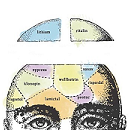
Cult dynamics operate on a precise psychological blueprint: the monopolization of power and control. By deliberately isolating the individual, enforcing rigid binaries, and pathologizing any form of boundary-setting, the structure reframes submission as safety and dissent as a defect. This isn’t just a religious phenomenon; it is a coercive psychological trap. It mirrors the same power dynamics that larger, oppressive societal systems use to keep people compliant, demanding that we surrender our autonomy to maintain the institution’s authority.
I think I was in a cult. Actually, I’ll clarify: I’ve concluded that I was absolutely in a cult. And I willingly put myself there.
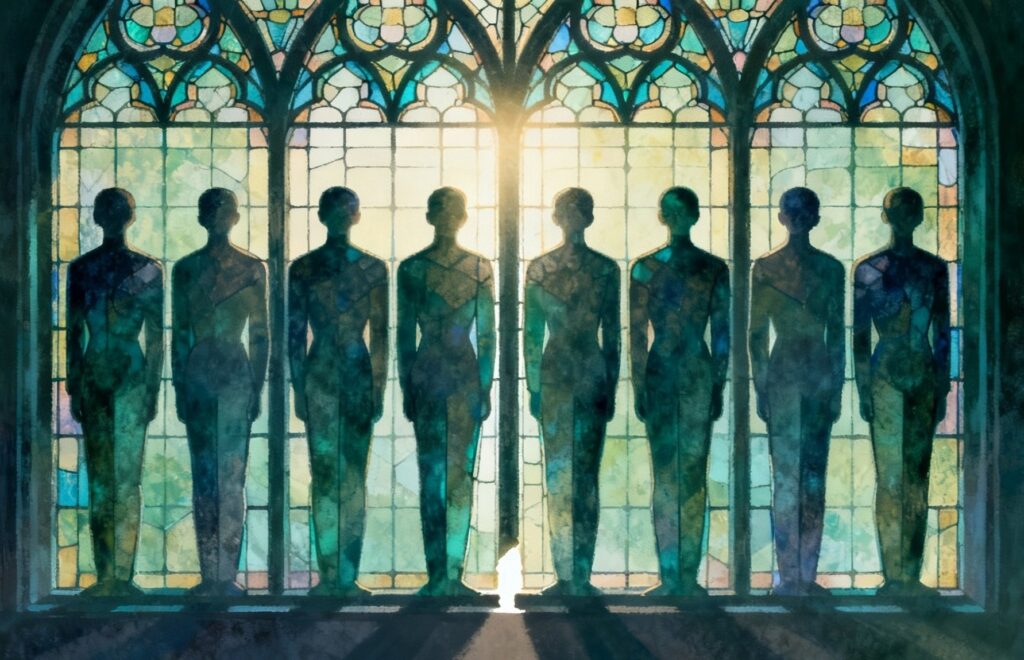
A cult is generally defined as a small, often secretive religious or quasi-religious group with extreme, unorthodox beliefs and an authoritarian structure, frequently centered on a charismatic leader. The only criterion my cult did not meet in this definition is “secretive.” This cult is far from a secret. Nor is it small. As a matter of fact, the country and culture I live in openly embraces and inherits the beliefs of this cult. I work as a therapist, a Social Worker specifically, assisting others in their navigation of broken systems, yet here I was trapped in this ideology myself. If the word cult seems too extreme, then I’ll just say it this way:
I was gaslit by the Christian church.
It’s Easter weekend as I write this, and I’m having some significant flashbacks. For reader context, when I refer to the “church,” I am referring to a group of people. Not a building, or a social construct. People. Raised in the Catholic church, we were known as Creasters, or church members who only attended on Easter and Christmas. Even then, there were so many bizarre rules. Of course, I also had to attend Sunday School throughout my elementary school years. But my parents weren’t in Mass during that time; they were at home in bed. My dad would drop us off in his robe and PJs while my mother slept. Do I sound resentful? That’s okay, because I am. But I also recognize that they were only doing what they thought was right. They were raising us to have a home base: somewhere to turn to when life got tough. Unfortunately, it worked.
The cult, it turns out, wasn’t an isolated anomaly—it was a mirror. It grew in the spaces where a fractured healthcare system had abandoned the people it was meant to heal. Both the authoritarian church and the rigid medical model operated on the exact same premise: they isolated the individual as the problem to be “fixed” or “cleansed,” demanding compliance and the eradication of symptoms like unhappiness or dissent. By framing your struggles as personal spiritual failures or internal chemical imbalances, both systems neatly absolved themselves of responsibility. Realizing this connected the dots for me: the church isn’t just a toxic anomaly, but a symptom of a broader societal failure that pathologizes the pain caused by a broken, indifferent environment rather than actually fixing the environment itself.
When I got to college, I sought out Christian groups to be a part of on campus. Not necessarily because I wanted to, but because it was familiar. I knew the rules even if I didn’t agree with them. It’s nice to feel a part of something, of course. In the field of psychology, Evolutionary Psychology (not at all supported by the church, obviously) and Social Attachment Theory suggest that humans, like all other mammals, have evolved to live in packs. Biologically, herd mentality and the deeply ingrained urge to belong, connect, and cooperate with others are thought to be necessary for survival. This striving for evolutionary survival advantages is often referred to as social affiliation. I have come to realize that the church knows this science and preys upon it.
As I made my way through early adulthood, I took note of how I did not feel safe in the church settings and environments. There were many teachings of the church that not only did I disagree with, but were harmful to me. I was being told that there is only one God, one higher power, and that being a good person didn’t matter as long as you claimed Jesus was God. I was told that if I didn’t believe this and claim it publicly, I would go to Hell. While I wasn’t sure what that meant exactly, I knew it was bad, and that any thoughts outside of what the Scriptures said were not allowed. I was taught to believe that God loved me, and that anything that happened in my life was “His Plan.” My physical disability made me a “special child” of God’s, sent with a message.
My childhood sexual and psychological abuse was part of his plan for me? My disability was a message for others to know him better? Bullshit.
Yet that herd mentality has a strong influence, and being accepted by others, even through the lens of a god’s plan for the world, left me feeling like I mattered. So I stayed. No matter how often I drifted, I’d be brought back in (like an abusive relationship). I thought, “I need this in order to be okay, even if I don’t like it.”
I married in the Catholic church, following all of the pre-marital traditions and protocols the church had for us. None of it felt good to me. It was all to check the boxes. Do the right thing. Stay in the herd. When I became a new mother, and my world felt upside down, I found myself back in the church again under what were false promises of “support” and a safe place to bring my family. I was so unhappy, and rather than acknowledging this, I instead walked further into an environment that challenged everything I knew I believed in.
I continued to learn things from the church: men hold more power than women, because of their gender. Women have very little power, especially when it comes to their bodies, which are used by God to carry out “His Will.” Marriage is a required covenant in order to do things with your own body, and once you’re there, you’re stuck there. Happiness and safety are not as important as being faithful and obedient. Science has proved many things, but if faith tells us otherwise, science is wrong. Anything can be achieved if you pray enough, and if it’s not, then it’s not God’s Will for you. That was only Lesson #1. There were many more.
If you’re part of the church, there is no room for self-love. They want us to think otherwise, by telling us we are “made in His image.” Why is He a He at all? And how am I, a woman, made in a man’s image? “He’s not a man, He’s God,” I was told. So again, why does God get to be a “He”? But I’ve digressed. Self-love is a no-no. We work hard for God, and we are to pray to do all things “in His name.” And then, if we’re successful, “all glory goes to God.” There is little celebration for an individual’s efforts when we’re told to give an invisible force all the credit.
As a parent, I wanted to offer my children experiences that would help them to thrive, enjoy life, and be all-around good human beings. The church not only promised this, but led me to believe that without their involvement, harm would come to my children. This created an urgency in me to invest years and thousands of dollars into starting them off in a private Christian education. The decision led to the complete opposite outcome for me. Sharing my children with this community caused me to believe there was something wrong with us anytime we had a challenge. My marriage was far from “wonderful” and “godly,” which put me immediately outside the fold. Furthermore, my kiddos had their struggles, and there was little to no room for creativity, acceptance, or pluralism for my children at this school. Their differences were seen as behaviors to fix and disobedience to God. In general, none of us felt great about our time at that school, and I found myself again white-knuckling my life to stay in the fold.
It got worse from there. As I progressed through my career, I found myself weaving this cult mentality into my clinical work. As a new therapist, I fell into step with a professional pack that viewed mental health through the lens of this bogus belief system. We held prayer meetings and gave a deity all the credit for any positive clinical outcome, but now, we had added a sinister invisible force to our diagnostic formulation. The Enemy, as he was referred to, had his grip on humankind. Within this framework, anything deemed problematic or non-compliant wasn’t viewed as a systemic trauma response; it was spiritual warfare.
In a disturbing way, this mirrored standard psychiatry protocol in the United States, which relies on rigid manuals to reduce complex human suffering to a list of pathology to be suppressed. We were effectively merging religious paranoia with clinical practice—using spiritual warfare the exact same way American institutional psychiatry uses diagnostic labeling: as a tool to police behavior, enforce conformity, and frame deep existential distress as an individual defect rather than a sane response to a broken world.
There were many things throughout my seven years with this group that were harmful to me. I felt yucky, a lot. Something about all of it did not sit right with me. Early in my experience, I participated in an after-hours meeting at a colleague’s home for the specific purpose of deciding as a group, “How will we handle folks requesting counseling for their same-sex relationship?” It was determined for me, as a member of this group, that we as Christian clinicians would not support or endorse same-sex relationships. We were told to see gay, lesbian, or bisexual people as a mental health problem to be solved. I remember raising the concern that this was unethical in my line of work, which I believe was the reason for this private after-hours gathering. The gaslighting continued, and we all found a way to see eye to eye on the issue, once I had conceded. Stay in the fold, this is your pack.
I went on to try to remain accepted. Attending church, leading small groups, being the group’s Golden Child. I strived for their approval; rather than developing my own thoughts and beliefs, I just took theirs, all while they took my money. We called our work our “ministry,” which made everything that did not feel right harder and harder to question. This eventually began to shape my practice and pigeonhole me into a certain population of clients. Marketing myself as a “Christian” therapist and being part of a group known to hold tight to these “values” is a real turn-off for a lot of the people I really wanted to serve. It positioned me to receive requests from parents to provide “conversion therapy” for their children (I never did this). When I supported the child instead of upholding the status quo, I would get major blowback from my clients’ family members. I was fired from certain cases for “encouraging unhealthy behaviors.”
It was jarring to realize that the rigid protocols in the church were mirrored in the clinical settings where I began my career. Whether through religious moralizing or the medical model’s obsession with labeling, the outcome was identical: human suffering was pigeonholed into tidy, compliant boxes. When I was taught that mental health treatment was simply about erasing “symptoms” so a person could return to their expected function in society, I recognized it as another mechanism for ongoing suppression. We were trained to “fix” the individual—treating their distress as a failure to adapt—rather than questioning the toxic environment they were navigating. In doing so, we were effectively protecting the status quo, demanding the same eradication of dissent that the church had forced upon me for years.
Throughout my time at the Christian therapy practice, my marriage got worse. I was miserable and felt very unsafe at home, yet I was hesitant to do anything about it for fear of being “pushed out” of the pack. There is little or no excuse for divorce in the Bible, and when someone considers such a sin as divorcing their spouse, the problem must be them, and not the reasons that would cause them to even consider such a bold life move in the first place. I remember a friend in the group also divorcing her husband just before I experienced my divorce, and she was very much pushed out by the group as a result. I was simultaneously inspired and scared to death. When I finally had the nerve to separate from my husband, the gaslighting continued: “You call yourself a Christian?” he spat at me. I hate that it worked, and that I felt shame and infantilized.
I did leave that marriage, eventually, and made my way out of that group of Christian therapists. I was judged by them for many things throughout my time there, yet still, my departure sent a shockwave through the owner, who proclaimed he had seen me as potentially “taking over” his practice one day. He wanted this to appear to be a compliment, but it wasn’t. What he was saying was that he almost had me conditioned to be who he wanted me to be to carry on his legacy, rather than believing that I had the capacity to create one of my own. I have experienced a lot of anger about this over the years, and it has taken me a long time to find a way to put these words on paper.
Outside of my cases at work, I continued to mask in a major way. On my social media, the way I talked to people, the associations I carried, were all in an attempt to remain in good standing in my church. My family of origin—despite the Catholic background—was much more liberal, cultured, and “worldly” as the church would call it (a negative connotation). This made me feel like I was living a double life: I was portraying myself as someone I was ashamed of. I had a cousin come out as lesbian, and I was so happy for her, proud to be her cousin deep down while I was compelled to be judgmental on the surface. I remember being fearful of bringing my kids to her wedding. The cognitive dissonance I was experiencing made me sick, and I am still recovering from the moral injury this caused. I realized that I was living inauthentically, yet I was a coward and saw no way out.
I left that company in 2021. I held on to some relationships briefly for a period of time afterward: we had monthly gatherings for birthdays and life celebrations with a group of what I called “friends.” But I noticed very quickly that as I grew, I was further judged. The last time I saw these friends was two years ago on a lunch outing not long after I became a vegetarian. Our entire lunch conversation consisted of their proclamation that not eating meat is against God and not “Biblical.”
Wait… what? I was offended and deeply hurt by these people whom I considered to be friends for the judgment they were passing upon me for something I knew to my core was a good thing for me, and for the planet. I wasn’t suggesting they had to be vegetarians also. I’m not that vegetarian (I literally cook meat for my meat-eating family members). Yet they passed judgment on me, and again I found myself pushed out of the fold. Change who you are, and you can earn your way back in.
Not this time. This time, I had the courage to remain true to myself. I started to take a closer look and be more honest with myself about what I was feeling. Prayer felt weird. Worship felt cult-like. And whoever my higher power is, I know for a fact it does not ask me to carry this ideology that the church has tried to impose on me. Sometimes I miss those friends and what I thought we had. Not unlike how I sometimes miss other aspects about what I had hoped Christianity was going to be for me. My personal growth had taken a back seat to concession, and it was killing me. I could not let it continue.
Walking away wasn’t just a change of faith; it was a refusal to comply with a system designed to keep me manageable. For years, I watched how both the church and the psychiatric system tag-teamed to pathologize the very real, heavy impact that systemic oppression has on marginalized communities. They want us to believe the pain is entirely inside us—a defect in our souls or our brain chemistry—rather than a direct consequence of the world around us. Healing meant completely de-centering those institutions and stripping them of their authority to define my reality. Leaving that group was my first act of professional rebellion. I stopped participating in the systemic gaslighting that labels the valid distress of marginalized people as ‘symptoms’ or ‘pathology,’ and started seeing it for what it is: an entirely sane response to a broken, oppressive world.
My journey moving away from the church is ongoing. My grandmother, who was my dear friend and confidant, was strong in the Irish heritage, culture, and Catholic faith, but also very liberal and progressive. She was an advocate for many things that the church usually passes judgment upon. I am so grateful for her and feel her presence with me always. She wasn’t perfect, but she taught me to think for myself and stand up for what I believe is right. I will continue to do as she taught me with every ounce I have to give. I have found new folds to move into, and packs where I belong. I have taken the lessons I have learned from living inauthentically and used them to better shape myself into the woman I am meant to be. I am now able to be openly accepting of lifestyles I had once been “taught” to condemn, without fear of my own condemnation.
Faith is a beautiful power to hold. Spirituality is the healthiest guide for living an authentic life. Unfortunately, the Christian church has exploited these gifts of humanity, and the exploitation isn’t confined to religious spaces; American psychiatry has historically engaged in the same weaponization of power and control. Both institutions prey on our innate desire for healing, community, and belonging, only to twist those vulnerabilities into tools for submission. Where the church uses spiritual guilt to demand compliance, the dominant medical model uses diagnostic labels to enforce it. Ultimately, both function as arbiters of normalcy, taking the deeply human search for meaning and pathologizing anything—or anyone—that threatens the authority of the status quo.










I agree, there still is a major paternalism problem within the mainstream religions, and with their psych “partners.” My entire family had to leave our childhood religion, since a psychologist thought it was his right to steal more than everything from my mom and I, via the most appalling thievery contract I’ve ever read, and refused to sign.
Report comment
Thank you for sharing your experience! The shame carried from this abuse keeps too many people quiet. We need to get louder about it.
Report comment
I’ve done nothing wrong, so am not ashamed, but the mental health lunatics who want to steal more than everything from the innocent women within their religions, should be ashamed.
Report comment
The Cult of Compliance is so real and pervasive in many of our institutions and societal structures. You have highlighted some of the most important and influential institutions (religious and psychiatric) cults which claim to heal and help but quite deliberately cause harm in order to protect the system.
These are tough realities to grapple with, especially when acknowledging this truth then requires us to re-examine everything we were taught from an institutional perspective and the nature of all other institutions.
Is this inherent to human nature, to all systems? What does a healthy system look like that operates within its designed framework but does not gaslight and invalidate when participants see flaws or offer improvements to blind spots and incongruence?
This article hints at a deeper question of how many of the traits expressed in narcissism infiltrate and define our human made systems within society at all levels and scales. From the individual, to the family, to the church, to education, psychiatry, medical, political, governmental, etc.
Fascinating things to mull over and consider what we choose to believe and have define us and at what costs. There are trade offs for everything and nothing is black and white. This is the challenge of the human experience and navigating this strange world we inhabit.
Report comment
Thank you for your deep read of my thoughts and your response. You ask some very important questions here.
Report comment
I found this article fascinating. My journey to find a therapist who looked at me as a whole person rather than a collection of flaws to be fixed was frustrating enough, but the abuse I suffered at the hands of the Catholic members of my family was horrific. When you are attacked by people who have the authority of “The Church” to back them up, you are defined as not just a problem, but evil. A young child has no defense at all, and even a young adult ends up in an impossible situation where any attempt to maintain their integrity is seen as dangerous. My spiritual life is important to me, but I now see nothing but red flags when I consider joining a church again.
Report comment
Thank you for the read, Roxane, and for the time you took to reply. You raise a great point about the shift in dynamics and power within families under the authority of the Church.
Report comment
I know the Catholic religion bought into the same psych fraud, as my too paternalistic ex-religion. Thanks for sharing your insight and truth, Roxane.
Report comment
Your words are brave, true, and inspiring! I’m sure many like-minded souls have also experienced similar emotions based on contradictory messages from patriarchal-based and institution-serving control tactics within the church and the often God-like position of psychiatry. The irony is that neither field typically even considers, let alone understands, the nature of human beings encompassing the nuance, beauty, complexity, and the innate goodness within us all. Thank you for your poignant account of what living authentically really involves.
Report comment
Thank you for reading and for your response. The validation is empowering.
Report comment
the metaphor continues
psychiatry and Christianity are both based on questionable source material
and historically both run by men
no recognition of sexism in the dsm not by accident
Report comment
A very important point, thank you for this insight.
Report comment
Thank you Carolyn.
Report comment