Attention Deficit Hyperactivity Disorder was invented in America and appeared in the American Psychiatric Association’s 1980 DSM-III diagnosis manual. But what is it?
At an NIH 1998 consensus conference, the chairman asked a leading ADHD expert, Mark Vonnegut, but he couldn’t explain what ADHD is:1,2 “They cannot sit still … they are difficult and they aggravate their parents … the diagnosis is a mess … I think, you know, we, uhm, I, I do, I think, part of the problem is that the profession keeps changing the diagnoses.”
Today, ADHD is a contagious, fashionable diagnosis.3 When youngsters look up descriptions of people who say they “have” ADHD on social media, they may be convinced they “have” it too and may even self-diagnose.
The diagnostic criteria for ADHD are so vague that when I lecture and ask people to try the adult ADHD test4,5 on themselves, it never fails that one quarter to half the audience test positive. Dr Iona Heath, Former President of the UK Royal College of General Practitioners, said in August that “if you want the diagnosis, you will be able to get it.”6 Many people are proud of their diagnosis and a British comedian said he needed to try the test five times before he passed.
Those who are too quiet can get the diagnosis of “predominantly inattentive” ADHD. So, what about those in the middle? It is so absurd that I invented a disorder for healthy people, Adult Symptom Deficiency Disorder (ASDD), with a 10-item test that guarantees that no matter what your score is, there is a treatment for you.7
ADHD is one of the oddest creatures in the psychiatric (be)wilderness. I do not dispute that some people suffer from their symptoms, but if you examine the central tenets of ADHD scientifically and logically, you’ll see that the diagnosis falls apart.5
The latest misinformation, the Fogany review
On 9 October 2026, a so-called independent review of ADHD and autism was published. It took up 599 pages plus a 230-pages technical annex.8 The Acknowledgements on page 463 show that a huge amount of people had contributed to the report but there are no declarations of conflicts of interest for anyone.
The review noted that the current system is not working but the authors were sitting on the fence and didn’t dare tackle the biggest problem of all: overdiagnosis. This is remarkable considering that the report stated that, by the end of 2025, open referrals in England for ADHD assessment exceeded 560,000, more than 17 times the number recorded in 2019.
In 2011, Allen Frances, chairman for the DSM-IV task force, said that the responsibility for defining psychiatric conditions needs to be taken away from the American Psychiatric Association because new diagnoses are as dangerous as new drugs:9
“We have remarkably casual procedures for defining the nature of conditions, yet they can lead to tens of millions being treated with drugs they may not need, and that may harm them.” Frances noted that DSM-IV created three false epidemics because the diagnostic criteria were too wide: ADHD, autism and childhood bipolar disorder.
As I shall explain below, the summary in the Fogany review presented highly misleading statements. It called ADHD a strongly genetically influenced neurodevelopmental disorder, which influences attention, communication, behaviour, learning and how people experience the world; the patients are neurodivergent; and the diagnosis can help explain difficulties that significantly impair a person’s functioning, participation and quality of life.
The Fogany review recommended banning direct-to-public advertising of NHS-funded ADHD and autism assessments. But when the BMJ published a news item about the review,10 it was accompanied by an ad for methylphenidate:
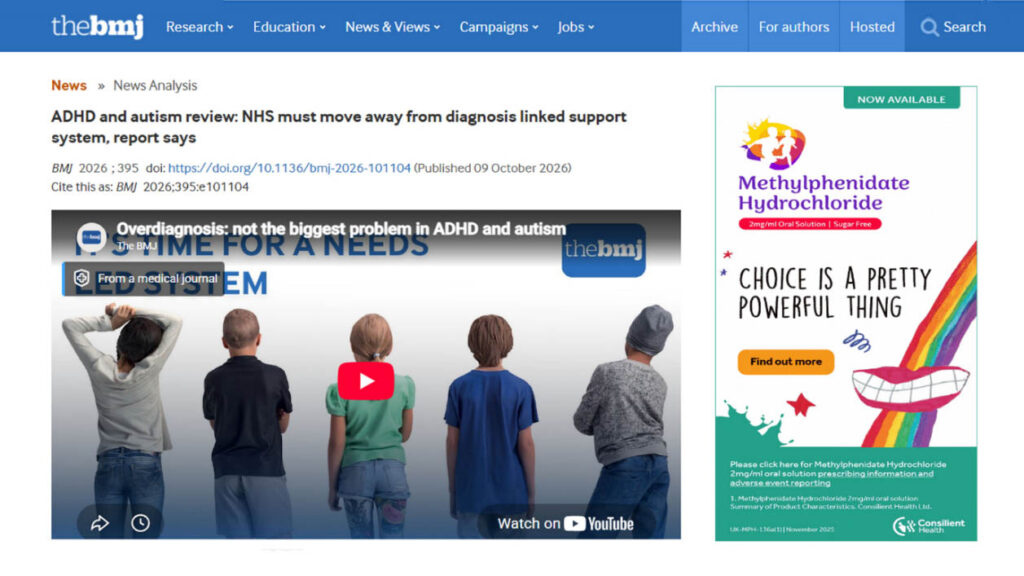
Methylphenidate is a narcotic on prescription used against ADHD. In the US, Ritalin, Adderall, and methamphetamine, all used against ADHD, are Schedule II controlled substances, which cocaine, oxycodone, and fentanyl also are.
Respectable medical journals avoid placing drug ads close to an article describing that type of drug or disease. But the BMJ is no longer a respectable journal. This summer, the editor, Kamran Abbasi, refused to publish criticisms in print of its highly misleading suicide prevention articles 11 even though he could have contributed to reducing the meaningless suicides caused by antidepressants by telling their readers that antidepressants do not protect against suicide. They double suicides in adults,12 and very likely also in children.5
The photo of the children has a link to an interview Abbasi conducted with Sir Simon Wessely, professor of psychiatry and vice-chair for the Fogany review. The headline shows BMJ’s stance on the issue: “Overdiagnosis is not the biggest problem in ADHD and autism.”
Wessely says that he finds neurodiversity an incredibly useful term and that 20% of school children and young adults identify as neurodiverse (see below why this is bullshit). Eight years ago, Wessely rejected any link between antidepressants and suicide and stated, categorically, that the pills are “not addictive,” both of which are false.5
The latest brouhaha, the Channel 4 documentary
On 18 August, Channel 4 in the UK showed the documentary, “The great ADHD myth?”13 which sought to determine whether ADHD is a genuine neurodevelopmental disorder or a social construct.14 The press release from 29 July acknowledged that, while the traits of ADHD undeniably exist, it asked if we should be giving children powerful, mind-altering drugs to treat it.14
Child and adolescent psychiatrist Sami Timimi said that we have replaced corporal punishment with giving children a pill and Iona Heath said that ADHD is not a medical condition.14
Heath’s former organisation, Royal College of General Practitioners, immediately denounced her. They made it clear that the quote attributed to a former College President was not made on behalf of the College and recognised ADHD as a neurodevelopmental condition.15
Many people on social media were so outraged that they called for censorship even before they had seen the documentary.16 Most critics interpreted it as denying that ”ADHD exists,” yet none of the experts in the film denied that some people diagnosed with ADHD have serious problems.17 As I shall discuss next, asking pertinent questions in the public arena about one of psychiatry’s holy cows was too much for influential organisations.
Condemnations by ADHD UK
Two weeks before the programme aired, ADHD UK warned Channel 4 that it would cause harm in an open letter that was so misleading that it could have been written by a drug firm.18 The charity has a commercial relationship with ADHD 360, a private company whose business depends upon people being assessed, diagnosed and treated for ADHD.19
In response to concerns from anonymous whistleblowers, external stakeholders, and people using the service, England’s healthcare regulator inspected ADHD 360 in 2020 and 2023 and found that improvement was needed.20
A week before the documentary aired, ADHD UK’s CEO Henry Shelford, who offers paid ADHD coaching, called it “sensationalist nonsense” and urged ”the charity’s members (potentially over 10,000 people) to lodge complaints.”19,20 There was even a complaint form.
ADHD UK used a similar strategy in 2023 in relation to BBC’s Panorama investigation about private ADHD clinics, again complaining to the broadcaster before the programme aired.19 After the broadcast, ADHD UK announced they would complain to the BBC and ask as many people as possible to join in that complaint. It published a detailed step-by-step complaints guide and noted that “It is fine to copy/paste.”
There were 1,639 complaints, and ADHD UK declared that it was the most complained-about Panorama programme. They might as well have sent the same complaint 1,639 times.
ADHD UK claimed that ADHD is not a social construct but a neurodevelopmental disorder.18 This claim is everywhere, also in psychiatric textbooks21 and in messages from the UK National Health Service and the US Centers for Disease Control and Prevention.22 It gives people the impression that science has found out that there is something objectively wrong with the brains of people with an ADHD diagnosis.
This is totally false,21 but if you repeat something often enough, people come to believe it to be true. Psychiatrists use impressive, scientific-looking words to obscure their ignorance and to deceive people, just like quacks do. We call it scientism.23 Abnormal development of the nervous system involves structural and functional disruptions during embryonic and foetal growth, leading to congenital central nervous system anomalies, e.g. neural tube defects such as spina bifida. To claim that ADHD is a neurodevelopmental condition is plain bullshit.
There is no evidence of a specific neurological state or process that gives rise to or is associated with ADHD.17 There are no biomarkers, it is not a dopamine deficiency disorder, and the brains are no different from those of people without the label.5,24,25 But Lancet Psychiatry nonetheless called it a disorder of the brain.25
ADHD UK called Channel 4’s press release “materially misleading” because it noted that boys aged 10-14 comprise the largest group being medicated.18 Channel 4 referred to NHS data showing that its statement is correct.18
ADHD UK called the ”chronic underdiagnosis of girls” a national scandal and claimed that the real story was not one of overmedication. This is what we always hear. Even though psychiatric drugs are the third leading cause of death,26 and harm people seriously in numerous other ways,1,5,21,27,28 we are always told that the problem is undertreatment.
ADHD UK noted that the programme put lives at risk; that ADHD drugs reduce the suicide risk; and that ”adults with diagnosed ADHD die on average around seven years earlier for men and nearly nine years earlier for women.”
This is extreme disinformation. ADHD drugs increase the risk of suicide and violence.25,29,30 and they don’t improve survival. ADHD UK didn’t provide a reference but I found the study, which is fatally flawed.31 People with an ADHD diagnosis had much higher rates of smoking, alcohol use, severe mental illness, and physical illnesses, which the authors of the study glossed over. I could equally well say that old people die earlier than young people but that would not make us wiser either.
ADHD UK claimed that ADHD is a lifelong condition, but many studies have documented that the symptoms that define ADHD can disappear when children grow up. A Canadian study showed that the prevalence of school children in treatment in the same class increased pretty much linearly over the months from January to December,32 with 50% more of those born in December being on drugs. This relative age effect was confirmed in a systematic review of 31 studies.33 If we allowed children to grow up and mature, fewer would receive an ADHD label and drugs.
A study spanning four decades showed that 90% of adult cases had no history of childhood ADHD.34 To circumvent this problem, psychiatrists have said that ADHD presents differently in adults, or in women and girls, but as psychiatrist professor Joanna Moncrieff noted, this is nonsensical, because how it presents is what it is, and if it is different, it is not the same.17
About medication, ADHD UK noted that ”133 randomised, double-blind controlled trials, covering around 18,000 people, underpin its use, and its measured benefit is among the largest in psychiatry … research links treatment with better school performance, fewer accidents and injuries.”
The short-term benefit of the drugs is that children may sit still in class, but this effect disappears quickly. The package inserts, e.g. for Adderall, reveal that the harms include sudden death, mania, delusional thinking, aggression, hostility, tics, vasculopathy, and a high potential for drug abuse. There is no improvement in school performance and no reduction in accidents and injuries.5
ADHD UK spoke about having ADHD and to live with ADHD,18 and the Fogany review noted that ADHD can influence attention and behaviour, but this is how the disorder is defined. A name cannot cause anything. ADHD is just a name for a collection of symptoms at one end of a normal behavioural spectrum where people are more energetic, impatient, and irritating than others. When we give a certain behaviour a name, we cannot say that a person behaves this way because he has ADHD. This reification, which is harmful,22 is circular evidence, a tautology. You can have a dog but you cannot have ADHD or live with ADHD, which just means to live with yourself, which we all do. When patients believe that a name can explain anything, they have been fooled.
Condemnations from the Global ADHD Network
The Global ADHD Network also condemned the film before they had seen it.35 They claimed that science had already answered the question if ADHD is a neurodevelopmental disorder and lamented that the question was reopened before a prime-time audience of hundreds of thousands of worried parents, undiagnosed adults, and vulnerable children.
The network claimed that ADHD is one of the most robustly evidenced conditions in psychiatry. If so, it says a lot about the rest of psychiatry!
We are told that genome-wide association studies have identified specific common genetic variants linked to ADHD, confirming a polygenic architecture, and that a condition that is roughly three-quarters heritable is not a “social construct.” However, the genetic emperor is naked. In one study, which claimed ADHD was related to genetic abnormalities, combining two tables shows that 99.7% of the patients don’t have genetic abnormalities.36 I have heard a professor say at a meeting that there is 80% agreement for identical twins.5 So, people who are identical behave similarly. Surprise, surprise.
The network claimed that people with ADHD have small brains, with reduced volumes in five regions. They referred to a 2017 review in Lancet Psychiatry with 58 authors,37 which has been debunked. The journal devoted an entire issue to criticisms of the study, and a re-analysis of the data, also in Lancet Psychiatry, found no brain differences.38 It is scientific misconduct to quote the original results 9 years later as if they were true.
Like ADHD UK and the drug industry, the network tried to convince their readers by using big numbers. We are told that every major medical body has already answered the “myth” question and that more than 10,000 clinical and scientific publications on ADHD exist. This is amusing. PubMed lists 2,107 entries with homeopathy or homoeopathy in the title, but that cannot remove the fact that homoeopathy is bogus.39 There is nothing in it.
The network claimed that ADHD is underdiagnosed, especially in women, girls and adults. When we are done with that, we should perhaps turn our attention to underdiagnosed ADHD in dogs. Many of them are impatient, cannot sit still, and bark too much.
The network mentioned “the landmark NIMH Multimodal Treatment Study of ADHD (the MTA), showing that properly prescribed, monitored medication reduces core symptoms and impairment.” This study is fraudulent. A lot has been written about how the investigators manipulated their results or drowned them in incomprehensible statistics to conceal how disappointing the long-term results were.5 One of the investigators broke ranks and stated in an interview:40 “The children had a substantial decrease in their rate of growth … there were no beneficial effects – none … that information should be made very clear to parents.”
It wasn’t. The public was lied to. An NIMH press release stated that the improvement was sustained in most children and one of the authors, Peter Jensen, said that the investigators were struck by the remarkable improvement in symptoms and functioning across all treatment groups.41 And rather than saying that the growth of children on drug treatment was stunted, the press release said that children who were not on medication “grew somewhat larger.”
After 16 years, those who consistently took their pills were 5 cm shorter than those who took very little.42 I consider it likely that these drugs also harm the developing brain. And methylphenidate doesn’t protect against delinquency and substance abuse, which people usually claim; if anything, it causes them.43
The network said they fight misinformation and that “evidence is our strongest weapon.”35 They distorted the science beyond belief and claimed that Channel 4 presented the views “of a small number of cherry-picked medical professionals as though they constitute fair and balanced representation of the science.” Thou shalt not criticise the Lord’s precious drugs.
The BMJ published sheer rubbish
As so often before,44-46 the BMJ published a misleading article in support of a failed psychiatry.47 The BMJ editor must have thought it was important because it was commissioned, not externally peer reviewed, and published with record speed.
The article had the declarative title, “The Great ADHD Myth documentary is misleading and misinformed.” The authors postulated that a wealth of robust research supports the view that ADHD is a well established, extensively evidenced neurodevelopmental condition; that the disorder is associated with serious adverse outcomes, including substance misuse, suicide, and premature mortality (reification again); and that substantial evidence from randomised trials shows that ADHD responds to treatment.
The key reference is to a consensus report48 with 80 so-called authors. All top ADHD experts take drug company money,49 and the most interesting part of the consensus report is the financial disclosures. The first author, Stephen V. Faraone from the USA, declared that he, in the past year, had received support from 13 companies and in previous years from 13 other named companies. During a 10-year period, he had put his name on an article every 11 days.49 One of my colleagues once remarked that if a doctor had lent Shakespeare a pencil, he would have become co-author of Macbeth.
Two of the three authors of the BMJ article work at departments of clinical neuroscience, even though ADHD has nothing to do with neuroscience. The third author is from the British Association for Neurodiversity and she declared under competing interests that she is neurodivergent.
This is bullshit. Neurodivergent is a nonmedical term coined in 1998 to recognise that everyone’s brain develops in a unique way.50 Thus, apart from identical twins, we are all neurodivergent, which renders the notion meaningless.
The authors accused the documentary of having “made the scientifically inaccurate claim that brain imaging studies have shown that ADHD is not a condition of the brain or development,” quoting the consensus report. However, the statement is accurate.5 ADHD is not a brain disease. A brain tumour is a brain disease.
The authors said that the “disorder is associated with serious adverse outcomes.” These tautological reifications are everywhere. People don’t realise that such statements are empty.
As usual, the authors also made sacrifices to the industry gods. They rejected that there was overdiagnosis and emphasised that “there is clear evidence of underdiagnosis.” They also claimed that drug effects are clinically meaningful, with significant reductions in adverse outcomes.
Like other authors, these authors opined that the implication that ADHD is a myth is “unhelpful and risks perpetuating stigma and prejudice. It speaks to an ongoing lack of parity between physical health and mental health/neurodevelopmental conditions.”
Mental health issues cannot be compared to physical health issues. If you have a broken leg, you want to have it fixed, not just to get an aspirin to lessen the pain. But in psychiatry, this is exactly what is offered.5 A drug that doesn’t really help the patient’s emotional pain5 is not a causal treatment like bone surgery is, and it doesn’t stigmatise the patients if their doctors were a little honest about the issues, for a change.
The Guardian got it right
The Guardian’s reviewer of the documentary noted that the presenter, psychiatrist Max Pemberton, answered the questions he posed convincingly, and that the proposed redresses, which included making drugs the last resort, seemed neither radical nor uncompassionate.6
A former president of the Royal College of Psychiatrists (Professor Dinesh Bhugra) said that “The industry around ADHD is about making money at the cost of the misery of others,” and child and adolescent psychiatrist Sami Timimi reminded people that the drugs most often involve amphetamines, which are controlled substances, and that there is a good reason why the rest of the population are warned about them.6
When Pemberton took a dose of the amphetamine he was prescribed for his spurious ADHD diagnosis, he reported feeling subdued and antisocial.17 He didn’t want to talk to the people in his local shop as he normally would and wanted the film crew to leave him alone.
Other comments on what ADHD is
Many psychiatrists, psychologists, neurologists and others have documented how false the statements about AHDH offered by mainstream psychiatry are.17,21-25, 51,52 But the day after the documentary aired, the President of the Royal College of Psychiatrists wrote that we should not question ”the legitimacy of a well-established neurodevelopmental disorder.”53
Critics of drug focused psychiatry noted that the institutional response to the film illustrated the confused thinking that underpins the mainstream understanding of ADHD.24 Most importantly, the claim that “ADHD is real” has multiple meanings. The experiential reality of the difficulties classified as ADHD are real, but the claim that ADHD is an established neurological disorder that explains those difficulties is not.
A consensus statement claimed52,54 that there is no disagreement; that numerous studies link ADHD to several specific areas of the brain; that the genetic contribution to the disorder is the highest for any psychiatric disorder, with one specific gene being reliably associated with ADHD; that the propaganda of ”fringe doctors” with a political agenda want the public to believe there is no real disorder; and that publishing stories that ADHD is a fictitious disorder “is tantamount to declaring the earth flat, the laws of gravity debatable, and the periodic table in chemistry a fraud.”
This is the talk of people who are desperately short of arguments. They tried to impress their readers by using big numbers: 86 people were co-signatories and there were 547 references, the largest number I have seen for any article. The first author, Russell A. Barkley, organised the statement and is a strong supporter of narcotics on prescription—amphetamine and amphetamine-like substances—for ADHD.
What should we do?
Some studies have shown that one child in five meets the diagnostic criteria.25 But calling ADHD a common disorder is false. It cannot be pathological that so many children behave rather normally. I can recommend Martin Whitely’s hilarious little video, “ADHD is BS”55 that mocks the ADHD pseudoscience. It is a good antidote against hubris and grandiosity.
The difficulties people experience should be understood and supported, without the need to apply a diagnostic label that implies a lifelong underlying neurological disorder. NHS England’s ADHD Taskforce recommends that support should be needs-led and should not require a clinical diagnosis which can be self-fulfilling and life-limiting.24
My views, supported by the best evidence we have, are that the ADHD diagnosis is fake and should be buried in the graveyard of psychiatry’s many failures;5 ADHD drugs should be removed from the market because they are harmful; people with symptoms that qualify for an ADHD diagnosis should receive psychosocial interventions; triggers, such as poor parenting or poor schoolteachers, should be addressed; and the social structures that constrain parents and teachers from doing better and having the time and freedom to do so should be addressed.
***
References
1 Gøtzsche PC. Deadly psychiatry and organised denial. Copenhagen: People’s Press; 2015.
2 ADHD, epidemic or fraud? Voices and faces from the 1998 NIH consensus conference. Video.
3 Gøtzsche PC. The pandemic of fake psychiatric diagnoses. Brownstone Journal 2025;Sept 17.
4 Adult ADHD Self-Report Scale-V1.1 (ASRS-V1.1) Symptoms Checklist from WHO Composite International Diagnostic Interview; 2003.
5 Gøtzsche PC. Is psychiatry a crime against humanity? Copenhagen: Institute for Scientific Freedom 2024 (freely available).
6 Mangan L. The Great ADHD Myth? review – the most controversial show of the year is here. The Guardian 2026;Aug 18.
7 Gøtzsche PC. Self-test for Adult Symptom Deficiency Disorder (ASDD). Mad in America 2023;April 26.
8 Independent review into mental health conditions, ADHD and autism: final report. UK Department of Health and Social Care 2026;Oct 9.
9 Moynihan R. A new deal on disease definition. BMJ 2011;342:d2548.
10 Furneaux R. ADHD and autism review: NHS must move away from diagnosis linked support system, report says. BMJ 2026;Oct 9.
11 Gøtzsche PC. The BMJ refused to publish criticisms in print of its highly misleading suicide prevention articles. Mad in America 2026;Sept 22.
12 Hengartner MP, Plöderl M. Newer-generation antidepressants and suicide risk in randomized controlled trials: a re-analysis of the FDA database. Psychother Psychosom 2019;88:247-8 and Hengartner MP, Plöderl M. Reply to the Letter to the Editor: “Newer-Generation Antidepressants and Suicide Risk: Thoughts on Hengartner and Plöderl’s Re-Analysis.” Psychother Psychosom 2019;88:373-4.
13 The great ADHD myth? Channel 4 2026;Aug 18.
14 New Channel 4 documentary, The Great ADHD Myth?, seeks to determine whether ADHD is a genuine neurodevelopmental disorder, or a social construct. Channel 4 Press Release 2026;July 29.
15 Statement on Channel 4 documentary. Royal College of General Practitioners 2026;July 31.
16 BONUS: The Great ADHD Myth? with Lucy Johnstone. Let’s Talk Neurosense 2026;Aug 20.
17 How to think about ADHD. Joanna Moncrieff’s blog 2026;Aug 21.
18 Challenging Channel 4’s “The great ADHD myth?” ADHD UK 2026;Aug 4.
19 Whitely M. The money behind the group behind the 9,656 complaints about Channel 4’s ‘The Great ADHD Myth’. ADHD is BS 2026;Aug 31.
20 AOL: Channel 4’s The Great ADHD Myth? to spark Ofcom storm as backlash grows. Press release 2026;Aug.
21 Gøtzsche PC. Critical Psychiatry Textbook: a new psychiatry is needed. Institute for Scientific Freedom 2023;May 17.
22 Gøtzsche PC. Psychiatric diagnoses cannot attack people, but the reification of mental health issues is harmful. Mad in America 2026;March 11.
23 Timimi S. Insane medicine: How the mental health industry creates damaging treatment traps and how you can escape them. Seattle: Kindle Direct Publishing; 2021.
24 Barnes J, Moncrieff J, Davies J, Johnstone L. Beyond ‘ADHD is real’: what does the evidence actually establish? BMJ 2026;Aug 25.
25 Ophir Y. ADHD UK cannot hide the flawed science behind the diagnosis and its treatment. Mad in America 2026;Sept 5.
26 Gøtzsche PC. Prescription drugs are the leading cause of death. And psychiatric drugs are the third leading cause of death. Mad in America 2024;April 16.
27 Whitaker R. Mad in America: bad science, bad medicine, and the enduring mistreatment of the mentally ill. Cambridge: Perseus Books Group; 2002.
28 Whitaker R. Anatomy of an epidemic, 2nd edition. New York: Broadway Paperbacks; 2015
29 Ophir Y. Life expectancy and years of life lost for adults with diagnosed ADHD in the UK: Matched cohort study: commentary, Ophir. Br J Psychiatry 2025;227:648–9.
30 Moore TJ, Glenmullen J, Furberg CD. Prescription drugs associated with reports of violence towards others. PLoS One 2010;5:e15337.
31 O’Nions E, El Baou C, John A, et al. Life expectancy and years of life lost for adults with diagnosed ADHD in the UK: matched cohort study. Br J Psychiatry 2025;226:261-8.
32 Morrow RL, Garland EJ, Wright JM, et al. Influence of relative age on diagnosis and treatment of attention-deficit/hyperactivity disorder in children. CMAJ 2012;184:755-62.
33 Frisira E, Holland J, Sayal K. Systematic review and meta-analysis: relative age in attention-deficit/ hyperactivity disorder and autism spectrum disorder. Eur Child Adolesc Psychiatry 2025;34:381-401.
34 Moffitt TE, Houts R, Asherson et al. Is adult ADHD a childhood-onset neurodevelopmental disorder? Evidence from a four-decade longitudinal cohort study. Am J Psychiatry 2015;172:967-77.
35 Global ADHD Network Statement on Channel 4’s “The Great ADHD Myth?” Documentary. 2026;Aug 4.
36 Glessner JT, Li J, Wang D, et al. Copy number variation meta-analysis reveals a novel duplication at 9p24 associated with multiple neurodevelopmental disorders. Genome Med 2017;9:106.
37 Hoogman M, Bralten J, Hibar DP, et al. Subcortical brain volume differences in participants with attention deficit hyperactivity disorder in children and adults: a cross-sectional mega-analysis. Lancet Psychiatry 2017;4:310-9.
38 Batstra L, Te Meerman S, Conners K, et al. Subcortical brain volume differences in participants with attention deficit hyperactivity disorder in children and adults. Lancet Psychiatry 2017;4:439.
39 Gøtzsche PC. None of the most popular alternative remedies are effective. And it can be deadly to believe that they work. Gøtzsche’s Perspective 2026;Feb 22.
40 Miranda C. ADHD drugs could stunt growth. Daily Telegraph 2007;Nov 12.
41 Improvement following ADHD treatment sustained in most children. National Institute of Mental Health Press Release 2007;June 20.
42 Swanson JM, Arnold LE, Molina BSG, et al. Young adult outcomes in the follow-up of the multimodal treatment study of attention-deficit/hyperactivity disorder: symptom persistence, source discrepancy, and height suppression. J Child Psychol Psychiatry 2017;58:663-78.
43 Molina BS, Flory K, Hinshaw SP, et al. Delinquent behavior and emerging substance use in the MTA at 36 months: prevalence, course, and treatment effects. J Am Acad Child Adolesc Psychiatry 2007;46:1028-40.
44 Gøtzsche PC. So-called suicide experts recommend antidepressants, which increase suicides. Mad in America 2024;Oct 24.
45 Gøtzsche PC. Antidepressants are major drivers of suicides. But authors of suicide prevention articles ignore this. Mad in America 2026;Sept 12.
46 Gøtzsche PC. The BMJ refused to publish criticisms in print of its highly misleading suicide prevention articles. Mad in America 2026;Sept 22.
47 Eccles J, Phillips H, Thapar A. The Great ADHD Myth documentary is misleading and misinformed. BMJ 2026;394:e100727.
48 Faraone SV, Banaschewski T, Coghill D, et al. The World Federation of ADHD International Consensus Statement: 208 Evidence-based conclusions about the disorder. Neurosci Biobehav Rev 2021;128:789-818.
49 Whitely M. Top ‘ADHD Experts’ all take drug company money. ADHD is BS 2021;Nov 16.
50 Neurodivergent. Cleveland Clinic 2022;June 2.
51 Timimi S, Moncrieff J, Jureidini J, et al. A critique of the international consensus statement on ADHD. Clin Child Fam Psychol Rev 2004;7:59–63.
52 Mills S. The scientific integrity of ADHD: A critical examination of the underpinning theoretical constructs. Front Psychiatry 2022;13:1062484.
53 RCPsych statement on Channel 4 ADHD documentary. Royal College of Psychiatrists 2026;Aug 19.
54 Barkley RA. International consensus statement on ADHD. January 2002. Clin Child Fam Psychol Rev 2002;5:89-111.
55 Whitely M. ADHD is BS. Video.











This is from NHS England
“From this week, almost 50,000 eligible adults living with bipolar, schizophrenia, psychosis or major depression in England and Wales are being invited to join the study, known as GlobalMinds.
NHS England’s DigiTrials service will identify eligible patients and contact them to see if they would like to take part to help find new treatments.
Patients will be provided with at-home sampling kits as well as with targeted support from the NHS for those who are more severely ill or face barriers to using technology.
The study will combine genetic data from blood or saliva samples given by volunteers with online questionnaire responses and information from their NHS medical records – linking genes, background, biology and mental health.”
This week I received a letter asking if I wanted to join the ‘study’.
Emailed back stating I’ve never had serious mental illness and that, in fact, had a serious adverse drug reaction twice which was akathisia first from sertraline prescribed for a minor bout of anxiety/ insomnia followed by an onslaught of polypharmacy then two years later tardive akathisia none of it diagnosed as such. It’s been eight years since I’ve managed to keep myself from akathisia.
I have asked that they take me off their data base as it puts me at risk of more forced ‘medication’ if I suffer tardive akathisia again. I doubt the NHS will take my name off their data base.
This has bothered me a lot this week I’ve had reoccurring flashbacks of the serious abuse I was subject to for a good number of years.
People who want to tell everyone they have ADHD with a hint of lovely jubbly, have no concept how horrific it can get if they end up with a serious adverse drug reaction.
optogenetics no thanks.
Report comment
Give them BS answers. Supply them with dog saliva and blood samples. And let them work it out.
You can find novel ways to keep yourself protected and safe.
What is the NHS going to do?
Report comment
I always find Peter Goetzsche’s arguments and conclusions to be sound. The great majority of the other grossly inflated DSM diagnostic categories are likewise pseudo-scientific “unicorns” whose existence is hypothesized by the psychiatric establishment for the self-serving purpose of making profits and maintaining an image of professional legitimacy and competence at all costs.
Report comment
“how it presents is what it is and if it is different, it is not the same”, Joanna Moncrieff. How distorted is the thinking of the people she is talking to, that she has to point this out? And why is anybody wasting their time arguing with them…. Ah yes, because they have power over people noone else in society has. At least, the citation makes for a very good laugh.
Report comment
Young adults and even their families want ADHD – it gives them accommodations and privileges while studying in tertiary settings including Universities.
Children don’t get a say. But their parent/s also seek financial and other gains from an ADHD diagnosis label put onto the child, children.
Report comment
This is one of the best takedowns of ADHD I have ever seen.
Gotzche deserves a Nobel prize. Or maybe even just a noble prize for deconstructing the ADHD industry. Very noble work indeed
Report comment
Young adults and even their families want ADHD – it gives them accommodations and privileges while studying in tertiary settings including Universities.
Children don’t get a say. But their parent/s also seek financial and other gains from an ADHD diagnosis label put onto the child, children.
Report comment
In high conflict custody battles, court-appointed experts (psychiatrists) will side with a parent, agree with a parent that the child should be prescribed ADHD medications. This diagnosis and recommendation becomes the official report presented to the judge, authority in proceedings.
What is interesting is that the observations made of the child, children by the expert are done within an hour of time that is spent with the child/ren in the presence of the parent who claims the other parent to be incompetent. Is this not bizarre in more ways than one?
Report comment
I am now retired after working for over 25 years as an NHS psychiatrist in Scotland. My role was with older adults and mainly in dementia assessments. I have had a lifelong interest in medical ethics and particularly in relation to transparency in science, academia and healthcare. In relation to the Fonagy Review I have put together this short summary of my concerns. I should make clear that I am retired, I have not worked with younger adults and children and have no research record. Nor am I an epidemiologist. I have, though, had longstanding awareness of determined ‘narrative control’. The Fonagy review seems to be a clear example of this and it leaves me troubled. Particularly, how can we all learn, when important aspects of the narrative seem to be deliberately left out?
The Fonagy Review, as far as I can see, provides only one brief consideration on overmedicalisation. It is in this passage which considers system failures:
“Thus the same system may fail to recognise some people whose needs are substantial while diagnosing others whose difficulties lie close to current thresholds. Margaret McCartney described this as the ‘patient paradox’: overtreatment of some occurring alongside undertreatment of others, influenced by wider factors including unequal access to care and, at times, commercial pressures. Such pressures may stem, for example, from the pharmaceutical industry [85,86], but may also be the consequence of private healthcare.”
References, as given in the Fonagy Review:
[85] McCartney M. The patient paradox: why sexed up medicine is bad for your health’ Montag & Martin, 2013
[86] Hart JT. ‘The inverse care law’ Lancet 1971: volume 297, pages 405-412.
The Fonagy review, by focussing on private healthcare as a driver for overmedicalisation, has side-stepped discussion of the role of the pharmaceutical industry. In addition to this, the review process itself is compromised by failing to discuss in any depth potential competing interests. The review process also lacked public transparency as the working groups did not publish their meeting minutes or any conflict of interest declarations. This stands in stark contrast to the Cass Review. It is thus impossible to determine if the Fonagy Review, itself, has sought to control the narrative by preventing wider consideration of the role of vested interests [financial, political and other].
The independent review into ADHD and autism involved a large group of over 150 contributors, including doctors, teachers, and families who openly disagreed with one another during the process, as indicated in this section from the Foreword by Professor Fonagy:
“Behind the four of them stand over 120 colleagues: clinicians, researchers, teachers, commissioners, people who work in the voluntary sector, and people who came to this because of what they or their children have been through. They did not agree with one another. That was the point, and it is the reason I trust what follows. Some of the sharpest disagreements are recorded in these pages rather than smoothed away.”
This statement admits that the full range of disagreements does not feature in the final published report.
When publishing a one-hour interview with one of the co-chairs of the review, the headline given by the BMJ was “overdiagnosis is not the biggest problem.” At the same time, the BMJ, a high impact medical journal ranked 4th among the general medical journals in the world, has in its side-by-side marketing space and through a direct link to ‘hosted content’, advertisements for ADHD drugs.
Report comment
You said:
“There is no evidence of a specific neurological state or process that gives rise to or is associated with ADHD.17”
This is a bogus statement because one cannot objectively define ADHD. Without a solid scientific definition of the term, the question is moot.
Report comment
Parenting assistance would be the most beneficial first-line intervention. Direct assistance, hands-on interventions in the home, not just a parenting course.
Teacher/Educator supports – an extra fully qualified relevantly knowledgeable adult in assistance with the teacher would be priceless for the child, children, family, families.
Put these two early interventions together and the decline in so-called problematic behaviours would come close to vanishing. If they can be consistently sustained and implemented for one year, the brain would be re-wired towards healthier patterns and habits, meaning that the nervous systems could learn to be more calm and able to rest when rest is needed.
DSM -1980, might have been influenced by post WWII rapid expansions of pharma drugs, the proliferation of junk foods, highly processed foods, artificial colours, artificial flavours, artificial preservatives. To that can be added synthetics, mimics, xenobiotics and other non-human, non-natural fabrications used in medicine and diagnostics and elsewhere.
What the parents, both, ingest will be passed on.
It is an additional thought that if a child is conceived in less than favourable circumstances (sex for the sake of sex, forced intercourse, even if supposedly consensual) the act would prime that little embryo with a nervous system of worry, anxiety, guilt, shame, stress, no matter how calm the mother tries to remain. Maybe this priming can be overridden if what follows is consistent warmth and responsiveness and attunement for the first couple of years of life.
As for those infants who attend outsourced commercial care from six weeks of age – are they the ones that parents are having problems with, that teachers are having problems with??
Is insecure attachment possibly another piece to ADHD, ADD? The mind boggles as to what drugs can be formulated for that mental insecure, disorganised attachment disturbance.! Is it the parent/s? Is it outsourced commercial child care? Does outsourced commercial child care impact infants’ nervous systems, which grow without loving attunement? Does this then influence the way a parent might interact in the one hour upon waking and the one hour in the evening when the majority of interactions are meals, baths, bed functions? Peak hours and possibly stressful after a day’s work. Day after day.
When is there time for rest and calm and soothing and peaceful co-regulation?
Before holding parents incompetent and incapable and uneducated and poor, and usually the sole source of problems (schools per se point the finger at parenting. It is NEVER the school teacher, school climate, school environment) –
Is it these children who are being diagnosed with ADHD?
By posing a parent problem, all other contributors to the ADHD presentation, are absolved.
Report comment
Legislation is required to provide extra staff to any class including preschool and outsourced commercial child care, where a child is showing problematic behaviours. The commercial child care providers, public, private, religious education systems should be held responsible for providing that additional support person onsite at all times during the hours that child/children attend. It ought to be a mandatory necessity that has a formal framework that can be implemented promptly and without the current requirements of assessments (which could take months, or years), diagnoses, reports, which all too often lead to drug treatments per se.
Why is this pathway not being followed??
Report comment
In relation to marketing of ADHD drugs, readers may be interested to see some of the promotional material at the 2024 Royal College of Psychiatrists International Congress. The College proudly announced that the International Congress had ‘SOLD OUT’:
https://holeousia.com/2024/09/18/sold-out-rcpsych/
Report comment
‘New Information Resource: ADHD in adults resource for patients and carers’ published by the Royal College of Psychiatrists, 2023:
Unfortunately the College missed out information in this ‘new resource’. No competing interests were declared. Yet again, that the Royal College of Psychiatrists has failed to follow its own advice on transparency.
New ADHD resource [missing information]: https://holeousia.com/2023/06/07/new-adhd-resource-missing-information/
Report comment
The BMJ has a long history of publishing marketing material by makers of drugs for ADHD.
Here, is an example, a full-page advert on the back cover of the BMJ, 12 October 2019: https://holeousia.com/2019/10/12/front-page-back-page-3/
Report comment
Like the BMJ, the British Journal of Psychiatry has a long track-record of marketing ADHD drugs. Financial transactions lie behind this. Surely these financial transactions [competing interests] need to be made fully transparent and recorded in an open database. Without this, how can readers be sure that scientific/academic Journals are not influenced or biased in what they publish?
“Authenticity”: The British Journal of Psychiatry: https://holeousia.com/2015/09/03/authenticity-the-british-journal-of-psychiatry/
Report comment
I watched the BBC documentary.
They warned the NHS that they would interview them for a documentary, and saw the private sector services under cover. Then, surprise surprise, the NHS who were informed that the reporter didn’t really feel he had ADHD, gave an extra long appointment (which is difficult for UK adults to get via the NHS) and drew conclusions in line with what he had admitted to them prior.
I understand the controversy surrounding children being given ADHD drugs when they may be suited to different learning environments or have domestic issues impacting their attention, but let’s not imply ADHD drugs are on par with Fentanyl, nor pretend that the BBC documentary was more scientific than sensationalist.
You say people with ADHD should receive psychosocial interventions, yet give examples specifically relating to children, when the topic requires a distinct analysis for adults versus children when children are supposed to be the responsibility of schools and parents, whilst adults have to take responsibility for themselves, and ADHD is deemed as you say to be regarded as different in adults.
Likewise, you cite the ADHD coaching provided by a proponent of ADHD provisions as if to imply this is a conflict of interest, yet you also advocate for psychosocial interventions, which would include coaching (and there is a shortage of coaches).
I’m all for free speech and a critical debate, but user reviews, academia and death rates from ADHD medications are more overall positive than antidepressants, neuroleptics and painkillers, at least based on what I’ve read.
There are larger issues than promoting the idea based one one case study that it’s apparently easy to deceive a psychiatrist into providing a prescription (which doesn’t exactly prove that demonstrating this would reduce the instances of that happening, nor do I see why someone who wanted to misuse drugs would go through the hassle and expense when street drugs are rampant, including in schools).
If you’re going to advocate for psychosocial interventions, you really ought to specify what these are. Exercise, trauma therapies and ADHD coaching have very positive results for some people.
Regarding the major issues I’m referring to, I mean the poor state of sectioning people in the name of ‘mental health’, the failed prison systems, the suicide rates that are not decreasing, and the addressing of social determinants of trauma, such as housing instability, domestic abuse, street crime, bullying, high divorce rates, etc.
Yes, ADHD is associated with higher suicide rates, which is often with comorbid depression, so I’d love to see an analysis on that.
Report comment
I was disappointed not to read the fact that none of the supposed “adverse outcomes” attributed to ADHD have been shown to be improved by stimulant “treatment.” It’s pretty disingenuous to claim that “untreated ADHD” leads to delinquency, school dropouts, and low self esteem when “treated” ADHD has exactly the same outcomes!
Report comment