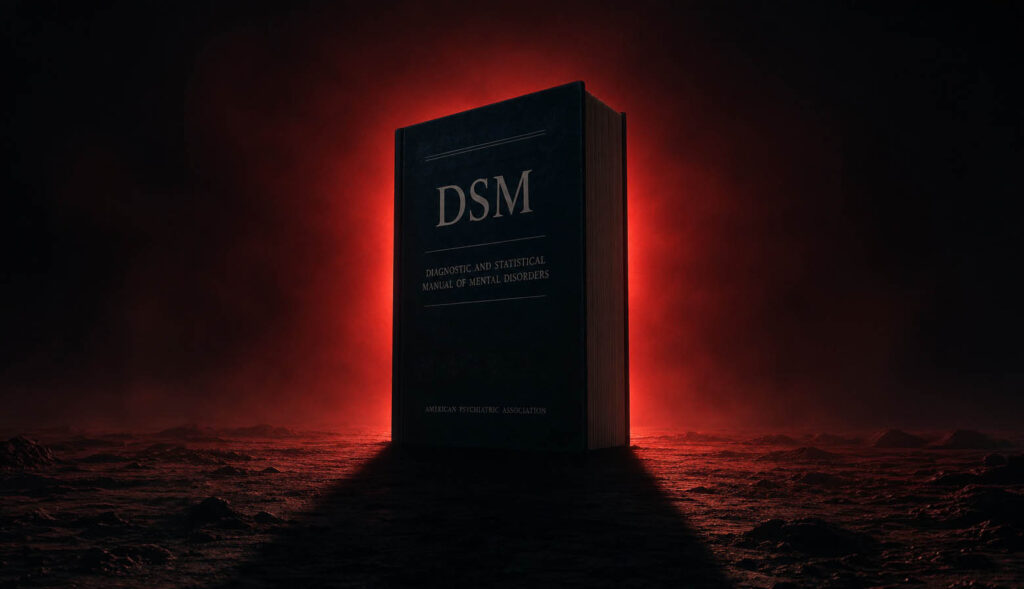
For all the years I have spent studying the DSM, the diagnostic manual so often called “the bible of psychiatry,” I never really stopped to think about that nickname. I assumed it referred to authority: the canonical text that tells clinicians what counts as a mental disorder and how it should be diagnosed.
But while writing my recent Feature for the British Journal of Psychiatry1 (a prominent journal within mainstream academic psychiatry), the metaphor suddenly struck me differently. Perhaps the DSM resembles a bible for another reason too. Its words have something of a “Let there be light” quality.
This is hardly a discovery of mine. Many of psychiatry’s most important critics were thinking along these lines long before I was. But working closely with the changing language of successive DSM editions2 made the idea strikingly concrete for me.
Psychiatric diagnoses, as Mad in America readers know all too well, are unusual things. They are largely classificatory constructs built around patterns of experience and behavior. We do not diagnose them through blood tests, brain scans, or other biomarkers that can independently confirm the diagnosis.
And that is what makes the wording so unusually powerful. Change a small thing in the definition, and watch what happens. Who meets the diagnosis changes. Which treatments are offered changes. What researchers study changes. How schools and families respond changes. Sometimes even how people understand themselves changes. Of course, suffering, difficulties, and human traits are not created by the DSM. But a psychiatric label can create a new clinical reality around them.
The DSM, therefore, resembles the Bible in its power to shape reality. But unlike the Bible, its words are rewritten again and again. One particularly consequential rewriting came in 1980, with the publication of the third edition of the DSM.3 DSM-III is widely remembered as a turning point in modern psychiatry.4 It was meant to address serious problems in the existing classificatory system and make psychiatric diagnosis more consistent and more reliable. It was, in many ways, psychiatry’s scientific revolution. The DSM had undergone a major facelift. Psychiatry’s “bible” now carried the aura of science. If a diagnosis appeared in its pages, it could feel all the more real. Science, after all, had put it there.
Let There Be ADHD
One of the diagnoses born in this new “scientific” edition was Attention Deficit Disorder, the diagnostic construct that would later become ADHD. DSM-III brought several earlier childhood labels (e.g., Hyperkinetic Reaction of Childhood, Minimal Brain Dysfunction) together under a single diagnostic construct, on the grounds that attentional difficulties were prominent across them. Of course, children had struggled with attention, activity, and behavior long before 1980. But now those difficulties had a new name. And once that name entered the DSM, it began to take on a clinical life of its own (for a broader discussion, see our review of the philosophical foundations of narrative therapy for ADHD).5
Of course, that fact alone does not mean that the original formulation was unjustified. But ADHD would go on to become an unusually revealing case study of psychiatric classification itself. Our systematic analysis of every ADHD-related passage across successive DSM editions2 revealed a pattern of changes that touched almost every major fault line in psychiatric classification, from the boundary between normality and pathology to the tension between nature and nurture. Across just four decades, six major shifts stand out:
- ADHD has shifted from a primarily behavioral disorder to a neurodevelopmental condition emphasizing biological and cognitive underpinnings.
- Initially conceptualized as a disorder of young boys, ADHD has evolved into a lifespan condition spanning ages and genders. Reported prevalence in children increased from 3% to 7.2%, while the male-to-female ratio declined from 10:1 to 2:1. DSM-5 recognized adult ADHD (2.5% prevalence), lowered symptom thresholds for older individuals, and extended the age-of-onset criterion from 7 to 12 years.
- The definition of impairment has broadened beyond academic difficulties to include occupational, social, and emotional domains. Later editions also lowered the threshold for impairment, allowing diagnosis even in cases of relatively minor functional difficulties.
- Diagnostic criteria have become more flexible, moving beyond rigid subtypes to accommodate changing presentations and subthreshold cases (e.g., Unspecified ADHD).
- The scope of comorbidities and differential diagnoses has expanded significantly; DSM-5-TR lists 17 differential diagnoses, while normal behavioral variation no longer appears among them.
- Alongside its neurodevelopmental framing, later DSM editions also include cultural and environmental factors shaping symptom expression.
Taken together, these six shifts amount to a remarkable transformation. By 2022, the diagnosis had traveled a long way from the construct introduced in 1980. And all of this happened in just four decades. That is an extraordinarily short time in evolutionary terms. Human biology does not evolve that quickly. Diagnostic language, however, can. And in psychiatry, that language has the power to shape clinical reality, even when the clinical reality it helps create begins to conflict with psychiatry’s own basic assumptions about what should count as disorder.
Let There Be a Better Diagnosis?
Many would argue that the changes behind these six shifts were necessary to address scientific or clinical problems. That may well be true. But as Karl Popper famously warned, attempts to accommodate troublesome observations may “rescue a theory from refutation only at the price of destroying, or at least lowering, its scientific status.”6 When a theory is repeatedly adjusted to accommodate observations that do not quite fit, each solution may preserve the theory while creating new problems of its own. At some point, changes meant to improve a diagnosis can make it broader, more flexible, and harder to know exactly what it means.
That is the basic logic of my British Journal of Psychiatry Feature.1 Using ADHD as a case study, I ask: what happens to psychiatric diagnoses when successive attempts to improve them generate new tensions in the very construct they are meant to refine?
In the paper, I trace five such tensions: (1) prevalence and the threshold of deviance, (2) gender and diagnostic heterogeneity, (3) etiological framing and explanatory coherence, (4) comorbidity and discriminant validity, and (5) medical framing and diagnostic boundaries. I discussed the first of these, the prevalence problem, in some detail in my recent Mad in America response to ADHD UK.7 Here, I want to focus on the last, because it takes us closest to an even more basic question: what makes a human difficulty a medical disorder in the first place?
Let There Be a Medical Disorder
To see how this happens, consider what became of ADHD over those four decades. As the diagnosis expanded, its conceptual home moved steadily inward. A behavioral diagnosis became a neurodevelopmental disorder, increasingly described in biological terms. Yet the more firmly the disorder was located inside the individual, the more the DSM itself acknowledged the importance of what happens outside the individual. Culture, environment, and context all shape symptom expression; in some situations, the signs may even become minimal or disappear.8 And there is still no biological marker that can independently tell us who “has ADHD.”
So what, exactly, makes this a medical disorder located inside the person?
This is where medicalization enters the picture. Over time, ADHD’s boundaries widened, thresholds were lowered, milder and unspecified presentations were added, and the language surrounding the diagnosis became increasingly neurodevelopmental. DSM descriptions also came to emphasize associations with serious outcomes such as substance use, suicidal behavior, and premature mortality. Such associations clearly matter when there is good evidence that ADHD itself causes them (rather than, for example, other conditions or common ADHD medications9-11). When causality remains uncertain, however, surrounding an increasingly broad diagnosis with the language of severe medical risk can make it appear more dangerous, more “medical,” and more in need of pharmacological intervention than the evidence necessarily justifies.
And here Popper returns.
The medical framing can make the diagnosis sound more scientific. ADHD is no longer simply a pattern of behavior; it is presented as a “real” medical condition located inside the person, perhaps even rooted in the brain. But that apparent scientific gain lacks solid empirical support. The DSM itself acknowledges that “No biological marker is diagnostic for ADHD… meta-analysis of all neuroimaging studies do not show differences between individuals with ADHD and control subjects…”12 It also acknowledges that the signs can change dramatically, or even become minimal, depending on context. The medical theory, therefore, ends up resting on a surprisingly weak foundation (for a fuller discussion, see my book ADHD is Not an Illness and Ritalin is Not a Cure).
Furthermore, if ADHD truly reflects an internal medical disorder, the prevalence problem becomes especially difficult to ignore. Many medical conditions are common, of course. But in psychiatry, where there is no independent biological marker separating pathology from normal human variation, very high prevalence raises a more fundamental question: where exactly does the medical disorder end and ordinary human variation begin? That question brings us straight back to the first tension, “prevalence and the threshold of deviance”, which I discussed in detail in my previous Mad in America article.7
And finally, medical framing does something else: it helps create the clinical reality described at the beginning of this article. Once clinicians and patients understand the problem as an internal biological disorder, it becomes natural to assume that something is physically wrong and that the appropriate solution should also be medical. In practice, that can make pharmacological treatment feel like the obvious next step. Which brings us back to where we started: the words begin to shape the clinical reality they describe.
Let There Be a Biomarker
There is, of course, an apparent way out of this last tension: find the biology. Perhaps today’s diagnostic boundaries are fuzzy simply because psychiatry has not yet found the biology underneath them. The APA’s Future DSM Strategic Committee has indeed proposed moving toward more biologically grounded diagnoses.13
But here psychiatry runs into a remarkable paradox, acknowledged by the committee itself. If robust biological mechanisms are eventually identified, some conditions may cease to belong to psychiatry at all and move into other branches of medicine, as happened with Rett syndrome. The committee even warns that advances in neuroscience could lead to an “erosion, if not erasure, of the field.”14
Think about how strange that is. Psychiatry has spent decades looking to biology to validate its diagnostic categories. Yet the strongest possible biological validation may ultimately move those categories out of psychiatry.
For now, however, no such diagnostic biological anchor exists. Psychiatric diagnosis still rests primarily on clinical judgment applied to clusters of experiences and behaviors. Diagnoses can be useful classificatory tools for identifying and communicating recurring patterns of suffering. But the label itself does not explain what it describes. As Peter Gøtzsche recently put it in Mad in America, “A description cannot explain itself.”15 A diagnosis of major depressive disorder does not explain why a person is depressed. Calling a pattern of inattention and restlessness ADHD does not tell us why it exists.
Trouble begins when the description starts to function as an explanation, and the category as a concrete medical entity. Philosophers of psychiatry call this reification.16 Ian Hacking went further, arguing that classifications can even help “make up people.”17 Once that happens, diagnostic language can change how behavior is perceived, how difficulties are treated, and even how people understand themselves.
And so we return to where we started. The words do not create the suffering. But they can help create the clinical reality that grows around it. That is why these definitions deserve very careful scrutiny before psychiatry writes its next DSM. My hope is that the decision of a prominent journal within mainstream academic psychiatry to publish a Feature focused precisely on these major conceptual challenges is itself a glimmer of light on the horizon, suggesting that this rethinking may be underway.
Let there be light in psychiatry, too.
And let there be light for everyone struggling with mental distress and the difficulties of life.
***
Bibliography
- Ophir Y. Conceptual challenges in psychiatric nosology: ADHD across six editions of the DSM. The British Journal of Psychiatry. 2026:1–5. https://www.cambridge.org/core/journals/the-british-journal-of-psychiatry/article/conceptual-challenges-in-psychiatric-nosology-adhd-across-six-editions-of-the-dsm/310B3767F69610C19197A5B7EC0D172A. Accessed Sep 7, 2026. doi: 10.1192/bjp.2026.10768.
- Ophir Y, Shir-Raz Y, Tikochinski R. Four decades of ADHD: A systematic AI-assisted analysis of conceptual shifts across six DSM editions. Front Psychiatry. 2026;17. https://www.frontiersin.org/journals/psychiatry/articles/10.3389/fpsyt.2026.1792051/full. Accessed Mar 11, 2026. doi: 10.3389/fpsyt.2026.1792051.
- APA. Diagnostic and statistical manual of mental disorders – third edition (DSM-III). American Psychiatric Association (APA); 1980.
- Wilson M. DSM-III and the transformation of American psychiatry: A history. Am J Psychiatry. 1993;150:399.
- Ophir Y, Rosenberg H, Tikochinski R, Efrati Y. Health side story: Scoping review of literature on narrative therapy for ADHD. Healthcare. 2025;13(11):1247. https://www.mdpi.com/2227-9032/13/11/1247. Accessed Aug 9, 2025. doi: 10.3390/healthcare13111247.
- Popper K. Conjectures and refutations: The growth of scientific knowledge. routledge; 2014.
- Ophir Y. ADHD UK cannot hide the flawed science behind the diagnosis and its treatment. 2026. https://www.madinamerica.com/2026/09/adhd-uk-cannot-hide-the-flawed-science-behind-the-diagnosis-and-its-treatment/. Accessed Sep 15, 2026.
- Ophir Y. Reevaluating ADHD and its first-line treatment: Insights from DSM-5-TR and modern approaches. Clinical Neuropsychiatry. 2024;21(5):436–443. doi: 10.36131/cnfioritieditore20240507.
- Ophir Y. Life expectancy and years of life lost for adults with diagnosed ADHD in the UK: Matched cohort study: Commentary, ophir. The British Journal of Psychiatry. 2025;227(3):648–649. https://www.cambridge.org/core/journals/the-british-journal-of-psychiatry/article/abs/life-expectancy-and-years-of-life-lost-for-adults-with-diagnosed-adhd-in-the-uk-matched-cohort-study-commentary-ophir/2751A56CF0B5AEFD3AEF46F52F6FDF59. Accessed Sep 22, 2025. doi: 10.1192/bjp.2025.122.
- Ophir Y, Shir-Raz Y. Overlooked medication effects and editorial asymmetry in psychiatric research: A case study. Ethical Human Psychology and Psychiatry. 2026. https://connect.springerpub.com/content/sgrehpp/early/2026/04/21/EHPP-2025-0035. Accessed May 4, 2026. doi: 10.1891/EHPP-2025-0035.
- Ophir Y. ADHD and suicide risk: The overlooked roles of comorbid disorders and stimulant medications. Clinical Neuropsychiatry. 2025;22(3):253–258. https://www.clinicalneuropsychiatry.org/download/adhd-and-suicide-risk-the-overlooked-roles-of-comorbid-disorders-and-stimulant-medications/. Accessed Jul 1, 2025. doi: 10.36131/cnfioritieditore20250308.
- APA. Diagnostic and statistical manual of mental disorders, 5th edition, text revision (DSM-5-TR). 2022.
- APA. APA releases roadmap for the future of the DSM. American Psychiatric Association Web site. https://www.psychiatry.org:443/news-room/news-releases/apa-releases-roadmap-for-future-of-dsm. Updated 2026. Accessed Feb 19, 2026.
- Oquendo María A., Abi-Dargham Anissa, Alpert Jonathan E., et al. Initial strategy for the future of DSM. Am J Psychiatry. 2026;0:appi.ajp.20250878. https://doi.org/10.1176/appi.ajp.20250878. doi: 10.1176/appi.ajp.20250878.
- Gøtzsche PC. Psychiatric diagnoses cannot attack people, but the reification of mental health issues is harmful. 2026. https://www.madinamerica.com/2026/03/psychiatric-diagnoses-cannot-attack-people-but-the-reification-of-mental-health-issues-is-harmful/. Accessed Sep 15, 2026.
- Fried EI. Studying mental health problems as systems, not syndromes. Curr Dir Psychol Sci. 2022;31(6):500–508. https://doi.org/10.1177/09637214221114089. Accessed Mar 23, 2026. doi: 10.1177/09637214221114089.
- Hacking I. Making up people. In: Forms of desire. Routledge; 2013:69–88.