Editor’s note: Parts 1 and 2 of this series can be found here and here.
The first time ‘it’ happened — my first awakening — was on my 22nd birthday, just a few months after having quit psych drugs cold-turkey.
The day was unglamorously spent driving six hours back to campus from the beach where my sister-in-law-to-be had hosted her bachelorette party, which gave me plenty of time to think and talk to myself, uninterrupted. I’d begun to deconstruct the language we use, splitting linguistic hairs to discern truth from narrative.
Why do we use words like “good” and “bad” to mean so many things? Why are the same words that denote morality used to describe subjective states of pleasure or pain?
Same with words like “healthy” and “unhealthy.” Something can be healthy/unhealthy for you. But a person themselves can also be described as healthy/unhealthy.
So what does it mean to have “good mental health”? Does it mean you experience more pleasurable emotions? And “bad mental health” just means you experience more painful ones?
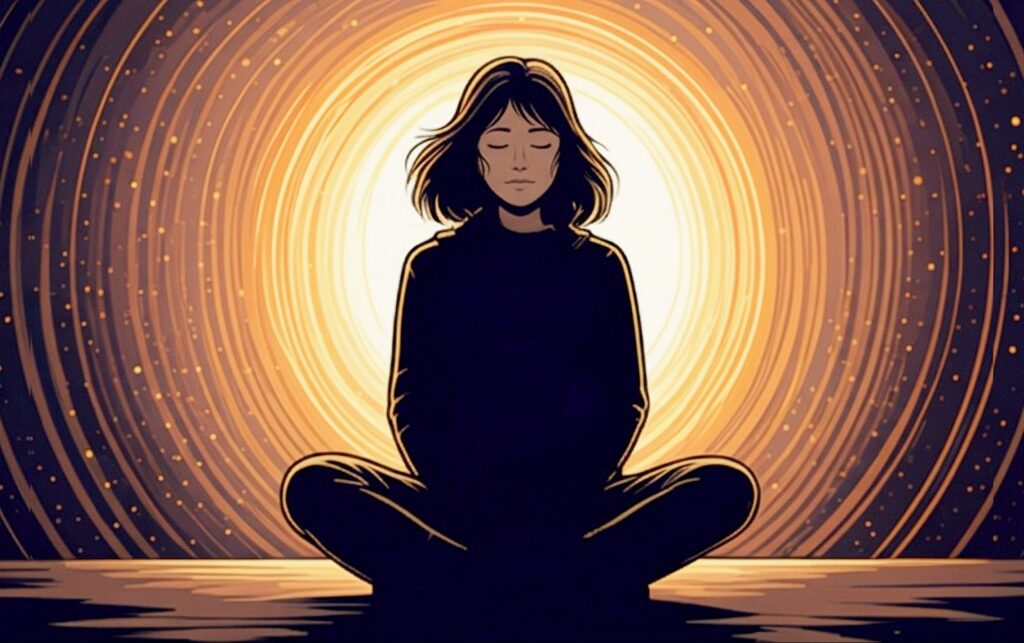
Why is “good mental health” equated with being a “good” person? Why is “bad mental health” equated with being a “bad” person — only redeemable if you’re actively working towards “better” mental health?
Why do we conflate health with morality at all?
Why do we conflate emotions with health?
Why do we pathologize or moralize some emotions and not others?
Pain isn’t morally bad. Pleasure isn’t morally good. Neither is the inverse true. They’re both morally neutral. They both simply… exist.
Zero-calorie energy drink in one hand, the other on the steering wheel, my mind felt light and free, working at lightning speed. What did this mean? I wasn’t quite sure. What a joy to be unsure! What a joy to be asking questions! I spent the rest of the drive continuing in this vein of existentialist pondering. I didn’t know what I was going to do with it yet, but I knew one thing was certain: I needed to write.
That night, I began writing a poem titled “Call of the Void.” I continued working on it over the next several days. I would work on it first thing in the morning when I woke up and first thing in the evening after I got back to the dorm from my classes. I would think of new lines in the middle of class — or in the shower or on a run — and scramble to write them down as soon as I could, or repeat them in my head until I was able to do so. Every time I got a chance, I would work on this poem, and any time I wasn’t working on it, I was thinking about working on it. By the end of the week, I had a 25-page epic narrative poem on my hands. I’d never written anything like it before.
That entire week I felt… amazing. A newfound energy was pulsing through me, like liquid starlight through my veins. It wasn’t mine; it belonged to the universe. Everything was so interconnected, I could see it clearly now! The morning after my birthday, I smiled at the construction workers and the birds and the squirrels outside my dorm as I walked by, music blasting through my earbuds, practically floating down to the campus Starbucks for a coffee on my way to class. I love you! I thought. You are beautiful! I wanted to dance! I wanted to sing! The world didn’t feel good or bad anymore, it simply… was. And what a beautiful thing to just exist!
But there was a small, yet present, voice of fear and hesitation in the back of my mind despite this overwhelming euphoria. I can’t let myself get too happy, it said, or I’ll become attached to life and give up my plans to die. This probably won’t last anyway. Just stick to the plan.
It was right about one thing: The feeling didn’t last.
By the end of the week, I crashed. I don’t remember what triggered it. It might’ve been an argument or a verbal insult from one of my “friends,” or it might’ve simply been the law that what goes up must generally come down. But whatever the catalyst, once again I was miserable. All of my new ideas I’d thought were “brilliant” just a few days before seemed stupid and pointless to me now.
Yet something in me was nonetheless changed. I now knew that it was possible for me to feel that way. If I was capable of it once, then that meant it was possible for me to feel like that again. And with the understanding that pain wasn’t inherently good or bad, my suffering had grown, somehow, easier to carry. It simply was.
I continued to write nonstop in my notes app, questioning everything:
Everyone’s all “talk about your feelings, it’s good for your mental health” until you actually do, and then they need to draw boundaries to protect their *own* mental health. How could I *not* feel like a burden?
It’s only okay to talk about mental health/mental illness if you’re actively in recovery. Otherwise you’re seen as just spreading negativity and promoting harm. It’s only okay to talk about the darkness in terms of finding the light. They only wanna hear stories of getting through it, rather than “it” itself.
They don’t care about the feelings, only about the behaviors. Psychiatrists don’t ask you “how has this new medication been making you feel?” They ask about your symptoms, more specifically, your behaviors. “How have your sleeping/eating habits been? How are your grades? Relationships? Are you exercising? Have you self-harmed lately?” The medication isn’t even meant to make you feel better, it’s only meant to make you more socially palatable and high-functioning. That’s why whenever you raise concerns of numbness and emotional flatness, it gets dismissed. You’re essentially gaslit into thinking that you don’t know your own emotions, and you don’t know how “normal” emotions are supposed to feel, since you’re so used to living on the extremes. Well, maybe I’d rather feel my emotions intensely than not be able to feel them at all.
Little did I know I was stumbling into the beginning of my critical psychiatry journey. I didn’t know such a movement already existed at the time; I thought I was the first one in the world to invent the proverbial wheel. However, I wasn’t trying to do anything profound, I was just venting my own frustrations. I honestly thought I was in the wrong most of the time. God forbid anyone found out about these ideas — they might think I was crazy!
In order to continue to evade suspicion about my mental state, eating disorder and suicidality, I paid hypervigilant attention to my appearance. I did my skincare routine twice daily and wore makeup almost every day. I tried to wear “cute” outfits while also trying to hide the size and shape of my body under baggy clothes. I made my bed every day and never skipped class, no matter how bad I was feeling. I kept a smile on my face, or at least tried not to cry. I contributed to class discussions, turned in my assignments (mostly) on time, and continued to get all A’s and B’s.
Fortunately, everyone’s continued obliviousness made my job surprisingly easy. But although my goal was to fly under the radar, I still felt hurt by how little others seemed to notice or care. These contradictory feelings confused even me. I wanted to be left alone, and yet the loneliness and desolation were crushing. I felt forgotten, unloved, invisible. Beyond that, as my weight and health plummeted, the compliments — and petty jealousy — kept pouring in, cutting like sugar-coated daggers. “OMG, Jasmine’s serving body goals!” my sister-in-law-to-be had gushed about me at her bachelorette party. “Skinny bitch over there didn’t even finish her sushi,” one of my “friends” scoffed towards me one time after we’d all gone out for dinner at a Japanese restaurant. “Have fun being healthy,” my roommate would grumble at me as I went out for a run, having eaten my usual starvation-diet portion of food that day.
My euphoria-like state from before had not returned. I began to doubt the realness of it. Maybe it was just a dream. Or maybe it was just another symptom of “mental illness.” Maybe it was mania. Just a chemical imbalance in my brain — nothing spiritual or meaningful about that. My psychiatrist had once suggested that I might be bipolar; maybe she was right. Maybe the medications had simply masked it up until now, and I had finally experienced my first manic episode.
In the midst of my suffering and solitude, however, there were glimmers. Rather than out-of-body experiences, I would describe these as in-body experiences. I often felt as though I was teetering on the edge of psychosis, about to slip at any moment. Though I never hallucinated, my sensory experiences and perceptions seemed intensified, augmented. I wasn’t sure if I was about to break from reality, or if I already had. Or if, on the other hand, I was actually discovering some truer, more intimate reality for the first time.
Once, for example, while crying in the shower, I took acute notice of the wall in front of me. It suddenly felt colossal, like an entire world of detail unto itself. I studied the wall intently: its texture, color, imperfections, the way the water droplets collected and rolled down it. I placed my hand out in front of me and ran my fingertips over it, feeling how the smoothness of the tiles contrasted with the grittiness of the grout. It was as though, for that moment, that beige shower wall had become my entire world. Then, my tears turned to self-aware laughter. How absurd is this? I thought. Maybe I really am going crazy. Maybe I’ve finally lost it.
Another time, I was on a run listening to a new album. Suddenly, it started raining hard and thundering as well. I used to be terrified to run during thunderstorms; even though the probability of being struck by lightning was realistically quite low, it was an irrational fear I’d always had. But now I didn’t care. What’s the worst that can happen? I die? I tucked my phone under my already-soaked t-shirt and let the tears streaming down my face mix with the rain. I felt like I was one with the storm.
The second awakening happened after an argument with a “friend.” Drunkenly, I had confessed my eating disorder “relapse” to them over text. They insisted that I needed to tell my parents, that I needed their “help.” I explained how, no, my parents always made things worse. I thought my friend would get that. I thought they would understand. Getting “better” in the short-term by being forced into performative “recovery” at the cost of my autonomy was not sustainable or healing. I had tried that before and look where it had gotten me. I felt that I would rather die of my eating disorder than spend the rest of my life cycling between quasi-recovery and relapse.
My friend also insisted — of course — that I needed to get back on medication. Unable to effectively counter my arguments or successfully undermine my self-determination, they eventually derailed the discussion about my personal mental health experiences into a broader debate about “mental illness” and medication in general. Attempting to defend myself against the accusation that my decision to not use medication myself was somehow an attack on those who do, I declared:
Because I don’t like having my colors muted, I like seeing them vividly. I find more meaning when I’m able to feel the good, the bad, and the ugly. I feel so intensely, and yes, it can be overwhelming, but it’s the way I am, and I don’t see it as wrong, not anymore. I don’t want to feel disconnected from my experiences, even when they’re painful. It’s not because I feel morally superior for any of this, it’s just a personal preference. You don’t have to feel the same way. You don’t even have to understand.
Though frustrating — much like playing chess with a pigeon — this conversation also reawakened something in me. The feeling was finally back.
In the following days, I came up with an idea for an album that I would name Booksmart and I wrote eight out of the ten songs within the next two weeks. As with the “Call of the Void” poem, my creative drive was insatiable. Once, I couldn’t stop thinking of new lyrics during my volunteer shift at the hospital, so I scribbled them down on the back of my patient sheet so I wouldn’t forget. Every chance I got, I went to the practice rooms in the basement of the music building to sit at a piano and write. Sometimes I would stay there until midnight, one or two in the morning. Like the song I had written over the summer (which would also end up on the album), these songs felt honest. I wasn’t trying to complete a narrative I thought others wanted to hear; the story they told was mine. My voice felt stronger than ever.
This time, I wasn’t afraid that the feeling would end. I knew it would, but that didn’t scare me. I want to be wherever I am, I wrote in my notes app. I am home. Not as in, I am at home, as in a place, as in a fixed destination point. But rather I am home, I am being the home, I am embodying it… I am a vessel for experience to flow through. To resist, to cling onto, or to force, are to create a blockage. Like running water through a dam, experience will eventually (inevitably) flood through. This is nature.
By now, my starvation-suicide method was starting to take its toll. Though my eating disorder — now half as old as I was — had been chipping away at my health for years, its effects were escalating at an unprecedented rate. My hair was falling out in clumps. The skin on my hands was constantly cracking and bleeding from dryness. Sometimes I had to lay down immediately after getting out of the shower because I felt so dizzy I thought I was going to pass out. Practically all the bones in my body were showing, as my weight was the lowest it had been since middle school.
During a visit to student health for an unrelated issue, I ended up getting “caught.” As soon as they had me step on the scale backwards, I knew what was going on, though I pretended to play along. When confronted about my weight loss, I communicated that I wasn’t interested in recovery at the moment, thank you very much. The doctor was understanding, but insisted that I at least come back for another appointment to run some labs and such. She expressed concern that I could be at a dangerous point.
I looked her dead in the eye and boldly professed, “I’ve been suicidal for most of my life. I’m not afraid of death.” I did, however, agree to come back for testing.
I left the appointment very pleased with myself. All day, I felt triumphant, yet a slight feeling of unease was creeping in. By evening, I broke down sobbing. Suddenly it hit me. I could die. Oh my god. I could really die. What if I don’t wanna die? What if it’s already too late? Of course I was scared of death. I was terrified. I was just a scared, sad, 22-year-old kid who’d tried to be too strong for too long. How could I not be scared?
Over the next week, my physical health hit a shock threshold. I felt nauseous almost constantly, was having heart palpitations, pain in my abdomen, and extreme exhaustion. I finally skipped classes for the first time all semester. I spent most nights tossing and turning, unable to sleep due to the myriad of physical symptoms I was experiencing. Sometimes I would simply stay up, or go on my phone, knowing I wouldn’t be able to sleep anyway.
One night as I lay awake in bed, I grabbed my phone and impulsively typed into the google search bar something like “mental illness isn’t real” or “depression isn’t a chemical imbalance.” I don’t remember my exact wording. I clicked on the first result. It was an interview with some guy named Robert Whitaker who’d apparently written a book. Wait a minute… this guy is saying all the same stuff I’ve been saying! I thought, in disbelief. He mentioned having a webzine called Mad in America. Rapidly, I went back to the search bar and looked it up. Oh my god.
I only ended up getting one hour of sleep that night. All night long, I read article after article. I couldn’t believe it! There was an entire community of people out there who thought just like me, who’d been through things just like me, who had already been saying these same things for years.
The next morning, on November 13, 2023, I started eating disorder recovery. This time, on my terms. I wanted to live.
This wasn’t, however, a happily-ever-after. It was only the beginning. The most difficult parts of my journey had yet to come. I soon discovered the gravity of my own psychiatric drug harm, including side effects I’d experienced that I hadn’t even recognized as side effects at the time due to the lack of informed consent. My protracted withdrawal lasted over a year since stopping the medications, and I am still in eating disorder recovery now over two years later. These experiences, for better or worse, have shown me who my real friends are. I’ve lost many relationships to sanism, and many more for the fact they were emotionally abusive and I finally realized I deserved better. I’ve had so much to grieve during this time, yet it has made room for so much new life as well.
My suicidality was right about one thing: Something had to die. It just didn’t have to be me.











I have read all three of your articles now and I loved them. Your narrative voice is so strong, and I feel deeply inspired. Thank you for being so articulate in how you’ve shared your journey.
Report comment
Thank you, Ruby, I really appreciate this comment. My purpose in writing this was not only to express these experiences for myself, but to reach others as well, so I’m glad I was able to do that for you.
Report comment
Jasmine, your story makes me believe in providence — in how the right turning point can arrive exactly when it’s needed.
Report comment
Thank you, Birdsong. Me too, honestly. Like I’d said in part 2, I’d lost all spiritual belief until this point, but going through this experience catalyzed a re-invention of myself & everything I believe in, including the divine.
Report comment
You might look into Buddhist teachings. They don’t see emotions as moral or spiritual tests, and the distinction between pain and suffering has been useful to me. YouTube has some introductory videos on Buddhism if you want to explore it.
Report comment
Funny you mention it, I actually did take an Intro to Buddhism class in college as an elective. Unfortunately, it did not resonate with the headspace I was in at the time, and even caused further distress. I think this may be in part due to some of the therapy & self-help I’d experienced co-opted Buddhist teachings to fit a Western, medicalized framework. So I’m a bit traumatized by it! But I always try to keep an open mind about different ways of seeing the world (including religion), so I’m open to revisiting it in the future! And there are definitely aspects of it that I remember learning about that I do resonate with & appreciate.
Report comment
I don’t see Buddhism as a religion because it doesn’t focus on sin, guilt, or martyrdom, none of which promote a healthy psychology in my book.
Buddhism emphasizes staying in the moment, not going off on spiritualized tangents.
Report comment
Buddhism is widely recognized as a religion, even if you don’t personally see it that way. I’m glad you found Buddhism helpful for you. I did not necessarily find it helpful for me, but I appreciate & respect your perspective!
Report comment
Jasmine, I wouldn’t call myself a Buddhist. I respond to its focus on direct self-awareness. It restores dignity in a way belief systems built around dependence on religious authority never did for me.
Therapy had a similar dynamic — the managed dependence that therapists subtly demand from clients, and the deliberately withheld honest reactions on the part of the therapist, were emotionally stunting, dignity-robbing, and frankly, insulting to my intelligence.
Buddhist thought puts the responsibility for how I feel back on me, which is where it belongs because in the end no one is coming to save me.
Nor is that what I want.
Report comment
Birdsong, I am glad you found a worldview that resonates with you, regardless of whether you choose to label it as a “religion” or not. I’m not trying to split hairs over semantics, and I hope it didn’t come across that way. I think this conversation may be getting a little off-topic anyways, so I’m gonna end it here, but I’m genuinely happy for you for finding what works for you, and I respect the differences between our beliefs.
Report comment
Alright, Jasmine.
I do find your reply a bit curious, given that your piece is titled “Spiritual Rebirth”.
Report comment
Birdsong, I do not understand what is “curious” about it at all. Having different spiritual beliefs than you does not negate the spirituality of my experience, nor does it contradict my title. My experiences, my beliefs, my narrative, and what I chose to title it, are not open to debate. I respect your beliefs, and I would appreciate it if you could respect mine. Let’s leave it at that.
Report comment
Jasmine, just to be clear, I wasn’t asking about your spiritual beliefs or debating them. I was commenting on the contrast between your title and the tone of your reply.
Report comment
“Contrast”…? “Tone of my reply”…? I’m totally lost. Did I offend you in some way? I thought the tone of my replies has been respectful & honest. I still don’t understand what it has to do with the title of my piece. Besides, I think the content of my work matters more than the title I have chosen for it.
I won’t be responding to any further replies on this thread (for real this time). I don’t think the conversation is going anywhere productive at this point. To reiterate: I respect your beliefs & appreciate your perspective. I hope you found some value in reading my story.
Report comment
Jasmine, really well done! Glad you found MIA!
Report comment
Thank you, Dan! Me too!
Report comment
You got me crying yet again! You are a warrior! I am so glad you found MIA and that WE found YOU!
Report comment
Aw, thank you, Steve!! I really appreciate it. This community means so much to me!
Report comment
Jasmine,
The manner you have described your precarious journey is so articulate and compelling. And bravo, you really took the bull by the horns and as Steve says, you are a “warrior”. I can relate to how you felt when you came across Mad in America. I felt the same way when I found Mad in America back in 2018. It was like walking out of the dehumanizing darkness and crazy-making nonsense of psychiatry into a place of insight, validation and humanity. I wish you continued success on your journey and remember always say goodbye to anyone who is being emotionally abusive. Take good care and best of wishes to you.
Report comment
Thank you for your kind & thoughtful comment, Rosalee. And I am really glad that you resonated with my story & found value in it (though I’m obviously not glad that you went through something similar with psychiatry!). That’s part of why I decided to write this — to connect with others with similar experiences — so it means a lot to read comments like this.
Report comment
I’m both jealous and so very happy & relieved you got yourself out of the insanity and grave harms of the mental ‘health’ system at such an early age.
I was trapped in it for 38 years. I was force drugged starting at 17 in an adolescent mental ward. I’m 59 yrs old & 3 years off all pharma now. I’m still suffering from an acquired brain injury from ECT and protracted withdrawal. But so so grateful to finally be able to discover & define who I am—for myself! Grateful that I’m not in the trap of being told who I am & who I will always be by a professional stranger who then gets paid to manage my inner & outer existence with drugs, psychological coercion & incarceration.
I also credit my escape to finding Robert Whitaker. Until I found him I truly believed I deserved all that. I also wrote a personal story here. I’m so grateful to him and everyone in the critical psychiatry world. Like YOU!
I am so grateful you did not die and so hopeful that you’re in this world unmedicated. We all need you! Congratulations for living as a human being!
Report comment
“My suicidality was right about one thing: Something had to die. It just didn’t have to be me.”
Thank you, Jasmine, Steve and MIA for a magnificent essay!
If there be Spirit, at all, of course, then what is not Spirit, and we must all be, and how could we, rather than our egos (or unobserved minds) possibly die, anyway..?
….and is not the essence of all spiritual teaching to “die before you die – and realize there is no death?”
Docile – Etymology, Origin & Meaning https://share.google/vUxrb9dLhG3tcVJl1
Doctor – Etymology, Origin & Meaning https://share.google/AIZ5AShu7lrIqQaIT
Quantum suicide and immortality – Wikipedia https://share.google/mLkbf7HZFm48Dp2Ae
Druid – Wikipedia https://share.google/vvsolaBmUtUb7oZ57 :
‘Caesar made similar observations:
With regard to their actual course of studies, the main object of all education is, in their opinion, to imbue their scholars with a firm belief in the indestructibility of the human soul, which, according to their belief, merely passes at death from one tenement to another; for by such doctrine alone, they say, which robs death of all its terrors, can the highest form of human courage be developed. Subsidiary to the teachings of this main principle, they hold various lectures and discussions on the stars and their movement, on the extent and geographical distribution of the earth, on the different branches of natural philosophy, and on many problems connected with religion.
— Julius Caesar, De Bello Gallico, VI, 14.’
THEEE only lesson worth teaching, having taught or caught, is, of course, the indestructible and immortality without end IR beginning of the spirit and/or soul:
We were never created: We ever INTER-ARE.
And did not Doctor, Teacher Jesus not so miserably fail to get this across, at least to his MALE followers before his crucifixion, that he tried a new, fun-and-on-a-full-tum approach with them after it?
THAT, rather than any “And, for my next trick, please, just watch it all pour out this hole in my side” is what I take from his relenting enough to ask if the boys had anything to eat before….
“Okay, now I am NOT going to go through all THAT again, so, just which part of ‘We are ALL immortal spirits, gods, divine children of God did we clearly not understand, please?”
Thank you, again!
Comfort and JOY!
Tom.
Report comment
I think many Christians believe Jesus to have said the ancient Aramaic or whatever he spoke equivalent of
“I am the way!”
If what he actually said was or was more like the the equivalent of
“The I-AM is the way,” then there might be no Christians but this, apparently, was not to be – or not yet.
If he told mere mortal men who would later repeatedly fall back to sleep when Jesus, in his angst and agony and most desperate need had implored them to stay awake and to pray with/for him then…if, in his “Sermon on the Mount,” he had previously told those same men that they were “the light of the world,” as well as telling Pharisees that “the Kingdom ” was within them, then it may seem reasonable to deduce that “the I-AM” or the Now or Life or Consciousness itself or Being rss or Being or what some Buddhists call “emptiness” or spaciousness no-mind is our indwelling “or presence” or the “I-AM presence?”
If the Dalai Lama said that his religion was kindness, or loving-kind, then perhaps he was acknowledging that he was not a Buddhist….and more than Jesus was a Christian?
If John 14:12 is at all accurate,
“Verily, verily, I say unto you, He that believeth on me, the works that I do shall he do also; and greater works than these shall he do; because I go unto the Father!”,
then perhaps we are all called to be Christ/s, Buddhas, awakened, enlightened, unconditionally loving and kind beings?
Much love and music and mirth!
Tom.
Report comment
Wonderful, Jasmine! You found a way out of the confusion of what Carl Jung calls “mass psychosis” or the “collective delusion” to the inner spiritual journey! That you did it alone is truly magnificent and I wish you well on your quest, wherever it may take you.
Report comment
Thank you for your kind words, Lynne!!
Report comment
How to Make Life Feel Easier Instantly | Eckhart Tolle
Can You Overcome Anxiety through Presence? | Eckhart Tolle
Navigating Life’s Challenges with Spiritual Awareness | Eckhart Tolle
Why Your Ego Needs An Enemy | Eckhart Tolle
Report comment
Jasmine, this is one of the most beautiful stories I have read in MIA! Thank you for putting it together.
I’d like to ask you something:
You tell how you were in therapy before reaching the psychiatrising point, and indicate that it wasn’t helpful.
Could you please elaborate on this?
What wasn’t helpful, why it wasn’t helpful, and how could therapy have been helpful to you?
In fact, I would be delighted to read a Part 4 of your story, discussing and dissecting therapy as you did so beautifully to psychiatric “care”.
I think that MIA is really good at systematic critique of psychiatry, but less superb at mapping the pitfalls of psychotherapy as a substantial alternative.
Report comment
Tamar, first of all, thank you for your kind words!
So actually, I already wrote about (some of) my therapy experiences in my first article on MIA, which was published last year. Specifically, it is about my experience with eating disorder therapy.
You can find that here: https://www.madinamerica.com/2025/03/sick-enough-paradox-eating-disorder-treatment/
I have not written about my therapy experiences pre-psychiatrization, or the other therapies I received while psychiatrized. I do not wish to elaborate at this time.
In the pieces I’ve written, I’ve shared what I felt comfortable with, and what I felt was relevant to that part of my story. None of them are comprehensive accounts of my experiences with the mental health system.
It is very emotionally difficult to write pieces like this, digging up some of my most painful traumas for all the world to see, while also trying to craft a coherent, compelling narrative. I hope you can understand & respect that.
If I do write & publish another personal story about my therapy experiences in the future, it will be on my own accord. It will not be a part 4 of this series. I intentionally wrote this as a 3-part series.
I do not work for MIA or represent them in any way, so I can’t speak to your last comment. But like I said above, I have written about my experiences/criticisms of therapy on here before.
You can also find my other 2 articles below:
https://www.madinamerica.com/2025/08/narrative-reclamation/
https://www.madinamerica.com/2025/10/eating-disorders-where-madness-meets-medicalization/
Report comment
Jasmine, thank you so much for taking the time and replying to me.
I had read your first article at the time, and now I re-read it again.
It made me enraged!
The control the treatment team was entitled to, the lack of autonomy, the hierarchy… I wouldn’t dare call it “therapy” at all.
As my dear therapist (a true healer) said to me lately, “trauma recovery is based on the right to say NO”.
How true!
I totally understand your reservations about what to share, when and where. I also resonate with the emotional demand such writing poses. While I have written my own recovery story on and off for the last 5 years or so (and haven’t got halfway yet!) – I know what you are talking about.
I still think, as a reader, that too many therapy stories are written by therapists, not by the people who have been there, done that. Which is sad and wrong. However, not being entitled to press anyone else to share their therapy story, I have no choice but to accomplish mine and bring it to publication!
I want to do it because I really want to demystify it for others. To break the code of a process that, for me, is almost magical. To show it to others and say: see? This is not necessarily how any therapy should look. But this is one version of how it COULD look when it works well. Or not so well. And here are the reasons why it worked well. And here is how it went wrong. And here is what I learned from it. Here are the principles I discovered by experimenting. This is therapy my way. What’s yours?
All the best in your further recovery
xxx
Report comment
Across contemplative traditions, spiritual insight is usually measured less by the intensity of an experience and more by what follows — the quiet return to ordinary life with steadiness, responsibility and presence. The “chop wood, carry water” teaching points to integration rather than narrative.
In my own practice, that grounded embodiment has carried far more weight than dramatic accounts of awakening.
Report comment
Hi Birdsong, thank you for sharing that insight! I actually do agree somewhat, though in my opinion, intense spiritual experiences can certainly be transformative by prompting us towards that kind of change. But it is up to us to then carry out these newfound values in our daily lives through slow, gradual, grueling implementation. This is, of course, the less ‘glamorous’ part of healing/transformation.
Though I am quite familiar with that aspect of the process, that is not what I chose to write this piece about, nor the 3-part series of which it is a part, which is specifically meant to be about my experiences going on & off of medication. I did mention at the end of this piece (if you recall) that this was “only the beginning” and “the most difficult parts of my journey had yet to come.”
Perhaps one day I will write another piece about that — including the painstaking, day-by-day, bite-by-bite process of nursing myself back to health from near-starvation, the heartwrenching grief of peeling myself free from multiple abusive relationships one-by-one, the existential horror at unlearning almost everything I’d believed to be true about life, relationships, the world, society, myself, etc, and the humbling labor of rebuilding my entire life & identity brick-by-brick after ‘burning it all down.’ However, as I am still actively going through this process, it may be a long time before I am 1) ‘finished’ with it, whatever that means, and 2) ready to write about it for a public audience.
Though I never claimed to be a ‘perfect,’ spiritually enlightened being (nor will I ever be), and I am very fallibly human & still learning every day, I do think I’ve acquired quite a bit of wisdom through this process so far, and I look forward to sharing it one day. In the meantime, I would invite you to share your own personal story on MIA, as you seem so passionate about this subject matter! I would love to hear how you carry out those values you mentioned in your own life! Here is the link to their submissions page: https://www.madinamerica.com/submitting-personal-stories/
In summary, though I disagree with the notion that the intensity of a spiritual experience means nothing, I do agree that the (transformative) value of my experience wasn’t inherent, but what I chose to make of it. Which makes it a testament to my character, not to the experience itself.
Report comment
I didn’t say the intensity of a spiritual experience means nothing. I was speaking to the contemplative distinction between experience and integration.
Report comment
Hi Jasmine. I finally had a chance to read all three parts of your memoir. Wow. Very articulate, insightful, heartfelt, and real – as others have said.
I was moved by your perseverance and courage to be true to yourself, to find your own way and live life on your own terms, not settling for what others, too often disingenuous, would have you think, feel, and do in betrayal of that. And I’m glad you’ve made, and continue to make, a home with yourself and others, like here at MIA.
I’m passing this memoir on to family and friends who I know will benefit from hearing your own voice as a reminder of their own and that they are not alone in finding their own way home. I hope you will continue to share your remarkable spirit. Much appreciated.
Report comment
John, thank you so much for these kind words! I really appreciate you taking the time to read my story & leave such a thoughtful comment.
Wow, it means a lot to me that you would pass along my work to your family & friends! I certainly hope I can help others feel less alone by giving voice to their experience; that is always one of my goals in sharing my writing & art. I hope to continue doing that for the rest of my life!
Report comment
An absolutely invaluable contribution to MIA and anyone who takes the time to reflect on this series, Jasmine. I had to read it a couple of times, highlight several passages, and then go back and do the same with your previous post (because so many passages added further clarification to my own experiences). I can say that I’m most impressed that someone so young could navigate and rise above so many difficult forces and dynamics, is truly “impressive”. It’s rather apparent to me that you have a high aptitude for “differentiated perception”, and are rather bright and “principled” on top of it; two qualities, that, combined, don’t translate well with MHIC clinicians, or not make for some serious shadow boxing. I can only wonder what my life might have been like had I had a hint of your self-awareness and educational foundation “when I was that young”!
I suspect “most” young adults today are faced with many of the “individuating” challenges you captured so well here, however otherwise they are unable to equally recognize and differentiate the onslaught of contradictions, double binds, emotional hooks, and other holes covered over with superficial social norms, of which you held your center and navigated. And it is not missed on me that young adults who are in these situations, are further taxed and burdened with having to carry added adult dysfunctions and power issues before they are developmentally ready. I mention this because any young adult who seeks the “counsel” of a psychiatrist-as you did, is all but certain to get the 10-minute head fake of having been listened to, followed by the comprehensive explanation and solution translation to diagnosis and pills, and thus, on the hook to perform and reconcile multiple forms of additional dysfunction, including psychotropic dysregulation/worse. Arendt’s banality of evil thesis (from her unpublished notes) is really getting some serious confirmation from today’s MHIC.
To this day I really don’t know if psychiatrist and other clinicians actually believe that their superficial listening and deafening dialogue bracketed by no curiosity, is because they are psychologically ignorant and intellectually challenged, or because they have, effectively, sold out to their institutional and professional obligations? Sadly, I’m now inclined to believe that the former is the foundation, the latter the means. All I know for sure is that, in these “extraordinary” times, the MHIC might as well be selling Indulgencies, because they collectively offer little more to the mental health of anyone, than the 12th century Catholic Church offered spiritual salvation.
I hope you keep writing Jasmine! I see a few books in your future, if not a calling along the way!
Report comment
Kevin, thank you for this lovely response! I really appreciate your kind words & will try to take their message to heart.
I certainly will keep writing! I have already written a full-length poetry collection, as yet unpublished. (Apparently most publishers aren’t terribly enthusiastic to invest in a work that openly discusses suicidality & psychiatric abolition — who knew?!) I’m also thinking of writing a memoir one day, and perhaps some other non-fiction works on the MH system and/or eating “disorders.” I’ve always wanted to write at least one novel, too, ever since I was a kid. So I definitely have some ambitious dreams in that area! It’ll probably be decades before I’m able to accomplish all that, though…
In the meantime, I plan to continue submitting my writing to MIA occasionally. I have a substack as well, so you can follow me there if you want (it’s free!): https://substack.com/@madradrecoverybaddie
Again, thank you for taking the time to read this series, and I really appreciate your thoughtful comment! I hope it made a (positive) impact on you!
Report comment
Jasmine, my friend! I am so glad you have continued to contribute here and so proud to know you have so much to offer because you are still so YOUNG!
I am finally retired now, so let’s grab coffee again soon!
I love this series of articles because they fill many niches and have obviously impacted so many!
Report comment
Hi Laurie!
Oh my gosh, I was just talking about you today! What a coincidence!
Thank you for taking the time to read my series. And yes, I’d love to get coffee soon — let’s get in touch!
-Jasmine
Report comment