About a quarter of “healthy” young adults already think they have ADHD (28%), according to new research. But that number jumped to more than half (58%) after they received an ADHD awareness campaign based on popular ADHD advocacy groups’ material.
Again, this was a study in “healthy” young adults. None of them actually met criteria for ADHD, and they had no other psychiatric diagnoses or medication use.
“Being exposed to ADHD awareness reliably increases false self-diagnosis among healthy young adults for at least one week,” the researchers write.
The researchers also tested a 10-minute educational session to mitigate this effect. The session was a “nocebo” message, or information on how “negative expectations may cause symptom misattribution and worsening.” It was somewhat successful: after the intervention, 41% believed they had ADHD (compared to 58% in the group that did not receive the nocebo intervention). At one week, this was down to 35%.
The researchers consider this a success, but this does mean that about a third of healthy young adults still believed they had ADHD despite not meeting criteria for the disorder, even after the “nocebo” intervention.
The study was led by Dasha Sandra at the University of Toronto, Canada, and was published in Psychological Medicine.
A Controversial Diagnosis
The diagnosis of ADHD and the prescription of stimulants to treat it have received major criticism from prominent figures in psychiatry.
For instance, take Allen Frances, the man who spearheaded the creation of the fourth edition of psychiatry’s bible as Chair of the DSM-IV Task Force. He argues that the diagnosis is overly broad and medicalizes normal aspects of childhood, such as being unable to sit still for eight hours of school lectures. Supporting this notion, dozens of studies have found that younger children in the classroom are much more likely to receive a diagnosis of ADHD and take stimulant drugs. And take Keith Conners—the namesake of the primary measure for diagnosing ADHD, and prominent early Ritalin proponent—who also argued that the current ADHD diagnosis was based on “shoddy science.”
Worse, the diagnosis and treatment of ADHD is not leading to better outcomes. In fact, in one study comparing kids with the same symptoms, those who received the ADHD diagnosis ended up with worse quality of life, not better—and were more than twice as likely to self-harm—than kids with the same symptoms who went undiagnosed.
The large, NIMH-funded MTA study is often cited as evidence that stimulant drugs work. Indeed, the short-term results appeared positive. However, by the 22-month mark, the benefit of stimulant drugs vanished. The authors wrote that “the MTA medication algorithm was associated with deterioration rather than a further benefit.” Ultimately, they added, “extended use of medication was associated with suppression of adult height but not with reduction of symptom severity.”
Other studies have contradicted the notion that stimulants can improve academic performance and even support the notion that kids are more likely to drop out of school after taking the drugs. One study noted that Ritalin was associated with an 18-fold increase in depression, which returned to baseline once kids stopped taking the drug.
And despite claims to the contrary, researchers have been unable to find a single biomarker, nor any brain differences, to define the supposed neurobiological condition of ADHD.
The Current Study
In the current study, the researchers sought to test the effect of their “nocebo” intervention to mitigate the rate of false self-diagnoses of ADHD in young adults. They recruited 215 young adults (18-25 years old; 77% women) who scored less than 18 on the World Health Organization adult ADHD self-report scale (ASRS), did not have any psychiatric diagnoses, and were not taking any psychiatric drugs. The participants were told that they were assessing the quality of health workshops. They were randomized into three groups:
- ADHD awareness workshop
- ADHD awareness workshop + nocebo education
- Control (workshop on sleep and dreams)
The participants were assessed just after the program and also at one week. Self-diagnosis was measured on a scale of 1-5 indicating how much they agreed with the statement “I believe I have ADHD.” Scoring a 3 or higher was considered agreement.
Before the intervention, more than a quarter of the participants already believed they had ADHD: 28% in group 1, 26% in group 2, and 29% in group 3.
After the intervention, the number who believed they had ADHD increased to 58% in group 1 and 41% in group 2. The number in the control group decreased slightly to 27%.
One week later, the number was still 52% in group 1, but had decreased to 35% in group 2. It had increased slightly to 30% in the control group.
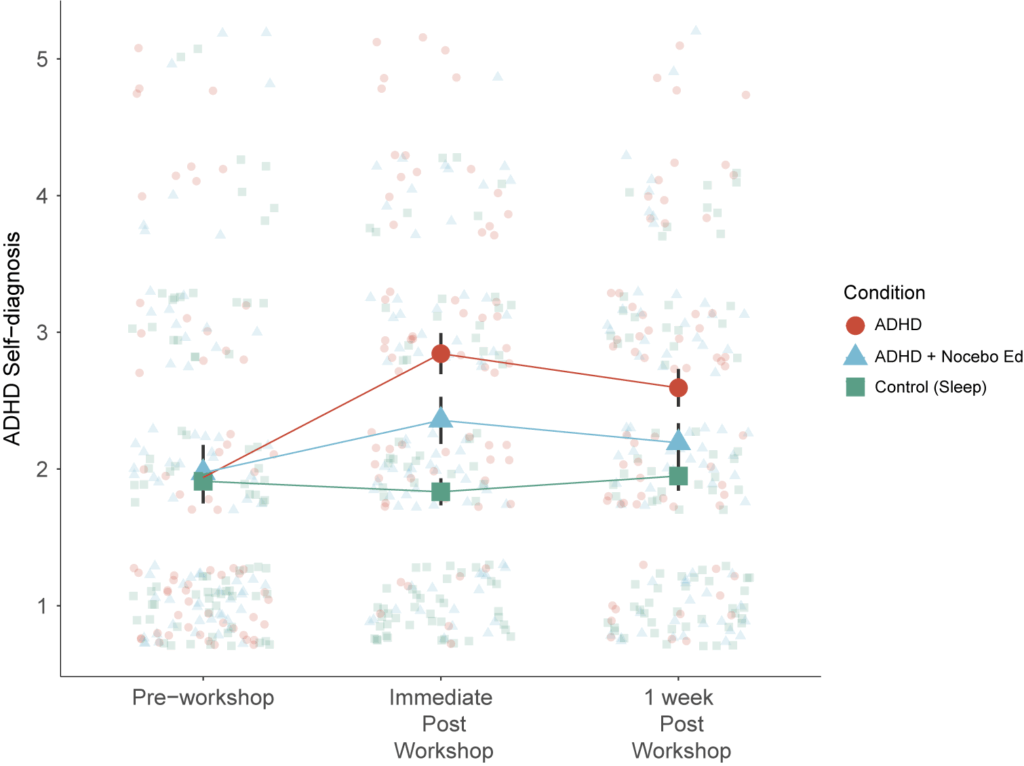
One explanation is that the increase in self-diagnosis could be due to people with subclinical symptoms realizing that although they may not meet the cutoff point, the symptoms do reflect true ADHD. However, the researchers write that this is not a plausible explanation: higher ADHD symptom scores were not associated with the increased self-diagnosis, and symptom ratings did not change after the intervention.
The researchers also conclude that unblinding did not affect their results, since statistical exclusion of the 12 individuals who guessed the purpose of the study did not change the findings.
What is the harm of a false self-diagnosis? The researchers write that while it can be comforting to explain confusing parts of young adult life, doing so by wrongly labeling it an “illness” can interfere with healthy identity development and lead to increased mental health problems, overdiagnosis, and overmedication.
“Young adulthood is a critical time for developing a stable and coherent identity; being offered a clear label and explanation for otherwise confusing experiences of this period could be particularly seductive but potentially cause long-lasting negative consequences such as maladaptive coping or formal help-seeking behaviors,” the researchers write.
They add that “awareness efforts can clearly cause false self-diagnosis across a range of conditions. This, in turn, may contribute to the rise in self-reported mental health problems among youth, overdiagnosis, overuse of services, and maladaptive coping.”
They thus conclude that nocebo education should be integrated into mental health awareness efforts, particularly in settings such as schools that focus on adolescents and young adults.
****
Sandra, D. A., Segal, Z., Majoo, S., Sistanis, A., Burke, M. J., & Inzlicht, M. (2025). Inform and do no harm: Nocebo education reduces false self-diagnosis caused by mental health awareness. Psychological Medicine, 55, e330. (Full text)











If no reliable method exists for determining whether the hypothetical syndrome known as ADHD stems from a chemical imbalance, defective genes, or faulty brain circuits, all this tiresome stereotypical talk of its “symptoms” is just another instance of attaching a pejorative medicalized label on behavior arbitrarily defined as dysfunctional. Quite a source of authority and profit for consultants, therapists, special education teachers, and other “experts” has developed on the basis of unsubstantiated conjectures regarding this supposed learning disability–which in fact may well be an understandable, natural response to a poor diet, a stultifying school environment, or to physical and/or emotional abuse in the home.
Report comment
I never hesitate to point out that there is no “Hypoactivity Disorder.” I wonder why not?
Report comment
Your comment made me smile :>)
But don’t give psychiatrists any ideas, they might very well concoct such a disorder one day! The opportunities for profit are unlimited.
Report comment
Actually, Joel, as I understand it, Russell Barkley has lobbied rather hard to for the diagnosis of “Sluggish Cognitive Tempo Disorder”, otherwise known as “Concentration Deficit Disorder”; effectively the Hypoactivity Disorder Steve cleverly referred to. There were a couple articles about this in MIA back in 2014, one by the ever-venerable Philip Hickey. I remember reading about this a couple years ago and feeling rather infuriated by the sense of Barkley’s sense of presumptive credibility. One of the real tragedies, to my mind, is that the ADHD diagnosis is such a specious and lacking/wanting construct, and yet an authoritatively viral narrative, that real world causes and individual challenges with ‘attention’ (most of which are temporary, context dependent, mild, potentially advantageous, etc.) can scarcely be addressed.
This passage, From Nat Dyer’s timely book, “Ricardo’s Dream”, really sums up for me the problem with ADHD in particular, and psychiatry and neuroscience in general:
When model and world have failed to align, too many have concluded that it was real-world humans who had misbehaved. This tends to not happen with physics. If a planet fails to arrive when predicted, the astronomer cannot reprimand it of change its orbit. “The only option is to change its theory or model. But people are more pliable than planets. Humans have been seen as faulty machines and goaded and prodded into acting correctly. Great has been the effort to hammer out our irrationality in order to make the crooked timber of humanity straight. Efforts to close the gap between the ideal and the real sometimes involve, as Max Weber saw, ‘violence to reality in order to prove the real validity of the construct. This violence might only intensify in our age of surveillance, artificial intelligence, and synthetic biology”.
Report comment
Kevin, your citation from Max Weber reminds me of a recent frustrating MIA thread in which a certain individual confidently predicted the advent of genetic engineering technology whereby a caste of super-intelligent adepts of transhumanism would be able to remodel the world in such a way as to eliminate misfits on the so-called schizoid spectrum.
Report comment
Well, Kevin, in certain circumstances I myself have exhibited unmistakable “symptoms” of concentration deficit, especially in my high school geometry class, which I absolutely detested, or whenever I hear or read political newspeak in the media.
I doubt there is any kind of psychiatric hammer that could straighten the “crooked timber” of my errant mind.
Report comment
VERY beautifully put, thank you, Kevin!
Anyone who thinks they may have “ADD/ADHD” might read “DAILY RITUALS” by Mason Currey with joy.
“Not for me!”
Pages 218-219, re William Gass (b. 1924):
“Gass is an early riser. In a typical 1998 interview, he said that he works mostly in the morning, finishing his serious writing by noon. Afternoons are spent on his academic duties – in addition to writing fiction, he is taught philosophy for much of his career – and “other kinds of work which is more mechanical.” A colleague once asked Gass if he had any unusual writing habits:
‘No, sorry to be so boring,’ he sighed…“How does your day begin?’’Oh, I go out and photograph for a couple of hours,’ he said. ‘What do you photograph?’ ‘The rusty, derelict, overlooked, down-trodden parts of the city. Filth and decay mainly,’ he said in a nothing-much-to-it tone of voice, as casually dismissive as the wave of a hand. ‘You do this every day, photograph filth and decay?’ ‘Most days.’ ‘And then you write?’ ‘Yes.’ ‘And you don’t think that’s unusual?’ ‘Not for me.’
Not for me!
Polite Americans sometimes ask me if they detect an accent.
Not for me!
The same benevolent God who obviously invented alcohol so that we Irish would not conquer the globe, and a sense of humor so that the English would, obviously gave us England’s King George III and the USA so that we can all witness the nonsense of “ADHD” diagnoses achieve what even the insertion into DSM’s and the subsequent removal from DSM’s of homosexuality failed to achieve – the complete debunking of the myths of “mental” and “personality disorders.”
Obviously, everybody has ADHD, for how anyone not – even if perhaps Bucky Fuller achieved some occasional, temporary relief from his while practising his dymaxion sleep, as we all do while we sleep, probably – apart from the diagnosticians, who do it all the time, of course.
https://content.time.com/time/subscriber/article/0,33009,774680,00.html
“…when his attention to his work began to wander…”
Even Jesus of Nazareth himself, poor guy, seems to have been unable to resist the endless temptations to dig deep and to keep going when giving into his need for rest might have prevented his burn-out, with its (arguably) career-ending results.
If he failed to protect himself adequately, perhaps it was (from a divine, cosmic point of view) in order to prompt us all to try to do better, and, when we, too, find ourselves having to dig deeper than we wish, to be encouraged by the struggles that others (among them Bucky and Jesus) faced, and came through.
Please read under “Depression and Epiphany (and, if you haven’t already, and ask yourself, too, please, if maybe (a) Bucky died that day?):
https://en.wikipedia.org/wiki/Buckminster_Fuller
Isn’t it intriguing that we can actually read any version of The Canaanite Woman story, at all – and read of…well, interpret it any way you like!
https://www.goodnews.ie/canaanite.shtml
“Very truly I tell you, whoever believes in me will do the works I have been doing, and they will do even greater things than these, because I am going to the Father.” – Gospel of John, 14:12.
“Major depression,” “generalized anxiety disorder,” “prolonged grief disorder,” “ODD,” “ADHD”…where can anyone possibly draw any meaningfully defining line?
Isn’t it just like our accents, and the supposed lack of them?
I am and I speak 100% normal – for me!
And, like everyone, I guess, I struggle to see the blindingly obvious, but find myself amply rewarded when the blinkers are removed.
I have asked lots of folks, perfect strangers, mostly (that’s not unusual – for me), if Liz was Queen of the United Kingdom etc. for seven decades, what should Chuck be king of? Only with tremendous coaching did one lady finally, finally, finally tell me, at last, “The united Queendom?”
https://www.youtube.com/watch?v=NT_3HUp3ZlU
Wishing you all much more focus in your focus, as needed,
Tom.
Report comment
There is – Inattentive ADHD, and recently Cognitive Disengagement Syndrome. The latter I reserve my opinion on, and it is not DSM’d (yet) but info is info.
That we still believe ADHD is only Hyperactivity is why awareness is necessary…
Report comment
You clearly miss my point entirely.
Report comment
Since my comments are finally available, thanx Steve 🙂
Obviously, since I still do, but then I don’t have the benefit of your previous assertions.
Report comment
My point is that the “disorder” of ADHD exists primarily because such kids are annoying for adults to have to deal with, hence the lack of “hypoactivity disorder.” Of course, now they need new markets, so “Sluggish Cognitive Whatever” is being developed to sell yet more drugs. But none of these “disorders” have any actual objective way to be “diagnosed.” They are social constructs, not “neurocognitive disorders.”
Report comment
I can’t reply on a reply?
Come on Steve, we agree (in part) here. I have done a piece on ODD specifically because I have similar feelings about its intention.
If we could take the meds out of the equation, would you ever see the possibility that some frameworks are useful for understanding how we engage with the world?
Everything around us is a social construct – that’s never a useful backdoor, but if we accept it as a social construct we can accept that it comes with a social contract – and, as we have seen with the gender wars, the social contract is owned by those with the loudest voices.
Let’s just say we agree on half of the answer but will diagree on the rest.
Report comment
Shane, I’m beginning to suspect that I’ve developed a severe case of “cognitive disengagement syndrome” after reading some recent MIA articles about psychoanalytic theory and practice, including one that expatiates on the unique benefits of “existential phenomenology” in correcting dysfunctional emotions and patterns of thought. You see, my cognitive faculties disengage (black out) in futile efforts to hack through dense thickets of overwrought verbiage. Do psychotherapists really converse with their clients in this kind of affected language, or is it meant solely for publication in psychiatric journals?
Report comment
Unfortunately, I am a moth to a flame when overwrought verbiage is in play, because it’s often meant to indicate academic superiority intended to fend off the average trendee of, say, ADHD. Nobody has to believe in it, but we do have to believe that critical psychiatry is the only discipline that is authentic in motivation.
Report comment
I have LCD, Lazy Cow Disorder, self diagnosed obvs.
I get defriended on Facebook for saying ADHD is marketing masking a medicine. Folk are so guillible!
Report comment
FACT: The power of suggestion happens a lot to medical students.
Report comment
I’m 72 now but I was told that I was born hyperactive and I’m still very fidgety and very active and still skinny. When I see this surge of energy in children I explain to the parents that it doesn’t mean that they are ADHD. It just means they have an abundance of energy, just like soccer players, football players, cross country bicyclists, track and field runners. And you wouldn’t diagnose any of them as ADHD. Think of attention deficit as somebody who cannot prioritize, cannot finish what they start, who often lose focus on what they are talking about. And hyper is a good thing as opposed to sitting around like a clump of dough and having no energy to burn off all that junk food you ingest everyday. ADHD children have been known to interrupt people when they’re sitting around quietly or to jump up from the table and run around in a circle instead of acting like everyone else in the room. I say that if you tell a child that sit still long enough their battery is going to overcharge and they’re going to have to expel that energy more than usual. When I was a child my mom had a simple answer, when I came home from school she told me to go outside and play for a couple hours. That burned off the excess energy from sitting around all day and then I could sit down and do my homework without any mental or physical interruptions. Over the years I’ve helped many children burn off energy by taking them to the park and running around and when they got home their parents said I don’t know what you did to them but they are so peaceful and fell asleep early. So don’t label people medically, and in these comments, stop using long intricate words to make yourself look intelligent. Keep it short and simple. Abraham Lincoln once said that when he was a small child he used to listen to his father talk to important people and he couldn’t much understand what they were talking about. So he decided that as he got older to speak so simply that the smallest child could understand him yet so intelligently that the most important person will vote for him. Think of this when you talk next. By the way, I’m a psychologist since 1978 and a medical hypnotist since 2000.
Report comment
I was a play worker in the 80’s and I did what you did, chuck the troublesome children, mainly boys, outside. They managed each other, didnt get under our feet or cause mayhem andvwere just fine.
Report comment
There is nothing inherently wrong about long intricate words per se; it’s the particular context in which and the purpose for which they are used that make them more or less meaningful and pertinent.
If experimental writers like James Joyce, Henry Miller, William Burroughs, or the beat era authors for example, indulge in rambling, obscure, stream-of-consciousness wordplay to reflect a character’s mental state, this type of prose can open up new vistas for vivid creative expression.
Opaque psychobabble, on the other hand, has nothing fresh and inspirational to offer. To me, it only reflects a pretentious claim to superior knowledge and higher wisdom that cannot be conveyed in the language of the common man.
The writings of Erich Fromm are a rare exception to the mind-numbing jargon that litters the pages of psychoanalytic texts in general.
Report comment
Your words are confusing. If you were to take everything you just said and condense it into three sentences so that a 10-year-old child would understand it, what then would you say?
Report comment
I think it’s quite reasonable to assume that the overwhelming majority of MIA readers and contributors are mature intelligent adults, NOT 10-year-old children, so why should it be necessary for me to dumb down my comments to a level of vocabulary that a preteen can easily grasp?
But in keeping with your request, let me condense my previous remark into three sentences:
Gifted writers know how to use long words for a good purpose.
Psychiatrists often use long words to show off.
The psychiatrist Erich Fromm is easy to understand.
Now, does that satisfy you?
Report comment
When you say it’s best to speak at a level that would be comprehensible to “the smallest child,” do you mean a two-year-old toddler who is just starting to babble in fragmentary ungrammatical sentences?
Can all concepts, no matter how complex, be reduced to the meager vocabulary of a typical child (I’m not referring to an infant prodigy). For example, if a university lecturer wants to explain Hegelian philosophy, quantum physics, or economic cycles, should he keep the image of preschoolers in mind when addressing the audience?
Report comment
Once again MIA goes full in by confusing the study and the outcomes, and then extends their thought beyond the study.
The premise of the study is “self-diagnosis” NOT diagnosis so shift to medicating normal (besides being the authors bias) is anathema to the discussion. You don’t medicate a self-diagnosis – a clinician needs to diagnose before any consideration for medication can even begin.
And we should also wonder why little attention is paid to the non-neutral nocebo education. By suggesting a negative association you’re doing exactly what is being claimed in the first group – priming young minds to accept a position, in this case that you would not want to be diagnosed with ADHD.
Here’s a better approach for nocebo – as part of any awareness drive one should include “If you relate to this, it could be worth discussing with a doctor to rule out other causes or confirm a diagnosis.”. A self diagnosis is not a diagnosis – and the responsibility for diagnosis is the professional class. They cannot abrogate their responsibilities by complaining that “everybody wants a diagnosis”, they are trained to manage their patients expectations – it is THEIR responsibility.
That young people look for identity/belonging is the nature of being young – whether that is self-identifying as ADHD/neurodivergent or an incel (why aren’t we talking more about this far more dangerous identity) – but it doesn’t mean that we stop awareness.
The real damage over time for someone not being diagnosed is far more impactful on their life’s path – the maladaptive coping mechanisms suggested forget that this applies to the developmental paths of those not diagnosed appropriately.
As part of my process, this conclusion sums it up:
A more balanced and clinically useful conclusion would be:
Improve Awareness Campaigns: They should be designed to encourage professional evaluation, not replace it. They should include caveats like, “If you relate to this, it could be worth discussing with a doctor to rule out other causes or confirm a diagnosis.”
Empower Clinicians, Don’t Blame Patients: The focus should be on strengthening diagnostic training for clinicians, ensuring they have the time and tools to perform thorough assessments, and teaching them how to navigate conversations with patients who come in with self-researched hypotheses.
Reframe the “Harm”: The harm isn’t necessarily self-diagnosis itself. The harm is a healthcare and public information ecosystem that leaves self-diagnosis as a dead end, without clear pathways to qualified help and nuanced professional guidance.
The study’s intervention, while clever, is a workaround for a deeper problem: it tries to “fix” the patient’s thinking to reduce pressure on the clinical system, rather than asking how the clinical system can better serve a more informed and actively engaged public.
Report comment
I don’t agree with the comment largely because of the number of presuppositions you introduce without ascertaining their factuality;
“The real damage over time for someone not being diagnosed is far more impactful on their life’s path – the maladaptive coping mechanisms suggested forget that this applies to the developmental paths of those not diagnosed appropriately.”
That, however, already implies several things that haven’t been conclusively shown to be true or that are, ultimately, ideologically charged statements;
1. That the act of diagnosing someone with a DSM/ICD label in itself already constitutes a form of intervention.
2. That the intervention given to those with a diagnosis actually improves outcomes or developmental pathways.
3. Whether or not the subject actually wants an improved “outcome”.
4. Closely related to the two points above; the question whether improved outcomes are measured by anything other than labor participation and fiscal politics.
“By suggesting a negative association you’re doing exactly what is being claimed in the first group – priming young minds to accept a position, in this case that you would not want to be diagnosed with ADHD.”
The negation of which implies that one wants to be diagnosed with ADHD which is just as much a problematic statement if not more.
“If you relate to this, it could be worth discussing with a doctor to rule out other causes or confirm a diagnosis.”
Yes, but considering that the diagnoses are little more than a checklist, and frankly a vague one that allows for significant “lateral” movement within any evaluation process, we’re again back at where we started from. The act of labelling behavior and issues without any deeper understanding of what is actually going on.
“whether that is self-identifying as ADHD/neurodivergent or an incel (why aren’t we talking more about this far more dangerous identity) – but it doesn’t mean that we stop awareness.”
Considering that the treatment plans, e.g. for ADHD, haven’t been shown to consistently alleviate or ease distress, the prime question here is who actually gets to benefit of more awareness. Because framing any form of inattentive or hyperactive behavior as “pathological” adverently or not propagates what I call a disease culture and this is not helpful to those who do not identify as disordered.
“The focus should be on strengthening diagnostic training for clinicians, ensuring they have the time and tools to perform thorough assessments”
This is what I often hear and it strikes me that this is effectively about shifting blame from the institution to individual (anonymous) clinicians and because no one knows who or where these faulty clinicians are, the problem is forgotten. And anyway, if a more thorough evaluation is meant to more accurately differentiate between cases, would this not effectively suspend a catchall or suitcase term like ADHD. We’re already dealing with the fallout of that problem in the case of autism and schizophrenia where the heterogeneity has rendered such diagnoses meaningless for scientific purposes because there is no quality inherent to them. Both autism and schizophrenia are largely formulated in what amounts to formulating the negative of something. “They are either hypo- or hypersensitive”, “They talk too much or too little” etc.
“The harm is a healthcare and public information ecosystem that leaves self-diagnosis as a dead end, without clear pathways to qualified help and nuanced professional guidance”
But more diagnoses and more diagnostics can’t be the answer either. It simply makes no sense when awareness groups proclaim that the act of diagnosing someone with ADHD is a civil rights issue when such people have arguably existed for thousands of years without requiring any such “enabling”. And as many MIA/MIUK etc. readers will know, a diagnosis of ADHD doesn’t confer improved outcomes nor more happiness.
Report comment
I am going to assume that you’re responding to my comment since you quote it prodigiously but its not nested as a reply.
And to do everyone here a favor, I’ll regulate my need to counter each point at length because it will deviate from the intended commentary on the original author’s insistence that this study is saying something useful when in fact its flawed. That’s not unique to critical psychiatry, as a lay reader of studies I’ve long despaired that what we’re really seeing is ideological premises posing as innocent theories and then the data is panelbeat into a conclusion that supports the premise (or the study does not see the light of day – it would be nice to find studies that say “hey we positted this theory, the data disproves it, so we were wrong”).
When I read studies, and yes, as a lay person I now parse them through AI to help dumb it down to SMOG 11/12 as I am more interested in the content that the statistics, I go through a process. Parse once, no critique, just lay it out there. Read, look for patterns that may link it to previous work, and then start the questioning process. I do limit for confirmation bias – and lately I’ve experimented with using alternate AI, at least in the first 2 stages, to ensure that my preferred one (ChatGPT) is not introducing bias based on my history with it. In fact, this particular one I ran through Deepseek. To avoid “advertising” I did unpack this on a popular platform as a counter narrative.
Here’s what I will say though, after already oversharing, I have ADHD (shock), I was only diagnosed at 45 (in a country where it was not (yet) fashionable and trendy). My trajectory has dealt with some of the nuances you talk to, and for some I don’t yet have an answer, and on others I am still processing the contradictions that are inherent in any new movement that has competing interests.
Yet my baseline starts with “ADHD exists” – could I call a framework that defines my challenges anything else – perhaps, but why when we already have a working theory. My own work recognizes that genetics does play a role, as does nurture and environment. Again, I can get carried away here but I’d really encourage people to not limit their understanding of any “hot topic” to a narrow window of studies that confirms their own ideological viewpoint.
Here’s where I can agree, and where I struggle daily when running through social media, neurodiversity has become a broad camp but lacks coherence. On one hand we embrace “disorder”, excuse behaviours, and lean into disability, while on the other hand we talk about differing cognitions, “superpowers” and finding acceptance. Both sides have some contextual validity but the real answer is far more nuanced and lies somewhere messily in between. And contradictions tie my brain up into knots because it really messes with patterns.
But this is where critical psychiatry also lacks coherence – to either talk of no disorder but simply a personal struggle to respond adequately to life’s challenges, or to accept at some level that there is a systemic solution but never actively advocate for it, then they too fail in their own mission other than to dismiss a reality for some.
Since people like the DSM I have often defined “normal” as a statistical bell curve – 80% of society are cognitively “normal” on the bell, and 20% are outliers or “ab-normal”. That’s statistics – right – the S in DSM? But in our world the 80% define how the environment is built and shaped, and the 20% have to somehow operate in an environment that is not really aligned to their needs. This is where I stand on neurodiversity and a movement for equity – which I realise is a dirty word in the new world.
That it is a “civil rights” issue is an entire topic on its own simply because you assume that the world we live in now is the same world that we have always lived in, that the 80% has always had full control of the systems – ironically those that are now shaping the new systems to come may well sit on the spectrum of sorts, it is the normies that may in a few decades time start needing support and diagnosis.
Rambled a bit but there are some discussions that are not served by a two dimensional discussion format.
Report comment
If “ADHD” is simply a different end of a neurological spectrum, the idea that it is a MEDICAL PROBLEM is not legitimate. That such behavior EXISTS is undeniable, but I think you’re on a much better track to start talking about creating a system that is flexible to the needs of all of its participants.
BTW, I find the term “normies” to be highly problematic, and in fact kind of insulting. It assumes that just because certain people are able to swallow their own needs and forcibly adapt to the inappropriate expectations that school and society puts on them, it means they are OK with it or not harmed by it. This is observably not the case. Maybe we can call them “adapters” in order to acknowledge that there is no one whose brain/body/personality can really be called “normal.”
Report comment
Normies is meant to insult, but in an ironic sense. And you’re framing it wrong against my 80:20 principle – neurotypicals don’t “swallow their needs and adapt”, the environment is built for them.
But I’ve been open about my tension towards the contradictions that exist, until all sides are open to a fair and nuanced discussion rather that simply denying one’s existence I will continue to be outspoken. It helps me resolve my position on the inherent contradictions.
If you really want to go down a garden path I could introduce you to why psychopaths belong on a part of the ND continuum 😉 and, in Dr Sapolsky’s view are not (entirely) responsible for their actions – but let’s leave that for another article.
Report comment
You are quite wrong about that, IMHO. So-called “neurotypicals” do not “easily fit” into an environment that is “built for them.” The environment is built for those in charge – teachers, bosses, psychiatrists, business owners, politicians. Your so-called “normies” are simply those able to fly under that radar. It might actually work for a few of them, but for the most part, they are also suffering, and are just better at fronting than those labeled as “neurodivergent” are able to be. My own example is telling. I HATED school, hated every minute of elementary school, was bored, anxious, depressed for years. When I graduated high school, I felt like the allied troops had freed me from the POW camp! But I knew how to give the teachers what they wanted. They left me alone because I was quiet and mostly compliant. That’s all. My school experiences were EXTREMELY traumatic to me from day one (which I quite literally remember as if it were yesterday). Of course, you can then claim that I’m NOT “neurotypical” after all, because if I were the system would somehow magically work for me. But the truth is, the system doesn’t work for much of anyone. The idea that there is some giant class of “normies” who find going to a typical school or having to work at a job they hate to be agreeable is a ludicrous fantasy.
You don’t want others to tell you what your experience is like. Why are you so willing to tell me (and others like me) what my experience is like rather than listening to what I say?
Report comment
Steve made some really great points above. I second all of that.
The idea that our current human-made environment is “built for” the majority of the population is demonstrably false. First of all, which one? There is no single “environment” across culture, time, and place. Human society is not one static monolith. And it evolves far faster than the human genome, so if ADHD is truly a genetic brain abnormality, then how do you explain that?
Furthermore, the assumption that any given human trait or experience always follows a normal distribution pattern is unfounded. First of all, I think we need to unpack that word & the idea of statistical averages. If you google the word “normal”, you will be able to see that the word usage over time ramps up heavily in the late 1800s/early 1900s and peaks around mid-20th century. This was largely due to the eugenics movement. In 1943 — around peak usage — eugenicist Robert Latou Dickinson designed statues named “Normman” and “Norma” based on the statistical averages of 15,000 men and women (respectively), all aged 21-25 years and racially white. According to the eugenics movement, it was believed that being closer to statistical averages (based on samples of exclusively young, white people) inherently meant being closer to ideal health.
The first edition of the DSM was published 11 years later, in 1952.
I think it’s worth noting that a large part of this obsession with “normal” originates from eugenicism, and therefore, bigotry. It’s also worth noting that industrial-capitalist society is not natural or “built for” 99% of humans. In fact, I would argue that society’s not built by/for the 80%, it’s built by/for the 1%. And I think we all know which 1% I’m talking about.
Report comment
*Sorry, I meant 9 years, not 11 years in my comment above.
Btw, this is a great video on the topic if you have 30 minutes to spare: https://youtu.be/S2OjueAZGFo?si=SbNj2ZQlfbmdewfi
Report comment
@Steve Do replies lose their thread?
Steve, there is a unique online method for debate that I find frustrating – and while its particularly rampant on X, it seems to be an outcome of the US culture wars.
Not only do you strip my response of the possible common areas we may share, but you personalise where I have not 😉 that you took on the mantle of the normie was your own.
I use nuance because I can never presume to know anyone’s own experience, and I’d never presume to suggest where you are on any continuum without having a conversation with you, and, unlike those who’d like me not to take on (any) identity, that’s surely a personal choice? As I stated somewhere earlier on, this is a 2D medium, and flawed since my replies are not connected to the author, I make no proclamations other than my own position.
Report comment
Again, I think you miss my point here. The use of the term “normie” assumes no nuance, it assumes that there are those who are good with the current system and those for whom it does not work. I’m saying that this assumption is patently false. The very use of that term is insulting because it decontextualizes the suffering of anyone who doesn’t fit the “neurodiverse” label. You explicitly stated that the system was “designed for” those who don’t fit that label. This is what I’m disagreeing about, not “where I am on any continuum.” That system sure as shit wasn’t designed for me, even though I was more successful in it than most.
I do think there’s a lot we agree about, as I indicated in your other post. I just want you to stop dividing the world into the “normal” and the “neurodiverse”. There’s nothing “normal” about being able to adapt to the idiocy that is expected in the average school classroom, for instance. It’s just more convenient for the Overseers. So perhaps we should coin a new spectrum – the “convenients” vs. the “unadaptables.” This would bring us to a less divisive and more accurate view of the current social reality in the Western world.
Report comment
@Jasmine
In a “normal” world we would recognize that every facet of humanity is simply a continuum, and that fundamentally different does not mean superior/inferior. But we don’t – we live in a world where people are measure by ideological metrics – the challenge, however, is always when a “marginalised” different challenges the predominant status quo.
I live in that reality here in SA – as a white person I have to listen to our white right take pleasure in the US’ swing to the right, where DEI is seen as a threat to the old system. Then suddenly we all want to be equal – that we’re sorry we were terrible people but surely we should all be measured on merit* (yet in my many attempts I have yet to get a measurable definition). That in the neurodiversity paradigm there is a concerted effort to dismiss a reality of existence, and then an insistence that we are all equal, no-one is better than the other. BTW, we both know that in a eugenics world those who cling to their identities in the ND space would be the first eradicated, its hardly looking to legitimise it by using its metrics as routinely used in these discussions.
As to the 1%’s this too is why I ask why those most critical are not attacking the system – my position holds that if there are systemic problems then we need to target those, but its far easier to target identities, far safer.
Let’s also remember that the 1% are kept in power by a majority, they enjoy watching the minions fight about arbitrary issues because it keeps us distracted. And I would point out that the new 1% are in fact mostly neurodivergent, but their positions insulate them where they prefer, even need, the old systems to realize their future.
BTW, don’t use google, use AI. My use of normal is reflective of precisely how I laid it out. Eugenics co-opts the term to add valence and as such polluted a pretty useful word in a medical context.
https://chat.deepseek.com/share/b62r57rcbsj1mosjuu (not sure if shared links are allowed – remove if not)
*Meritocracy itself has a shady origin story.
Report comment
Agree with all you have said above.
Report comment
Since the emoji doesn’t come through – ditto 🙂 o7
Report comment
I’ve come back to note that the commentor has refused to meaningfully engage with my post and hasn’t actually answered any of the questions.
Report comment
Commenting as moderator:
Commenters are not required to engage with later posters, and we are not to assume anything by their lack of participation. Sometimes people just post once and don’t come back. That’s their right.
Report comment
Bites tongue.
Don’t worry you don’t have to release this from moderation 🙂
But just in case you do:
https://adhdreimagined.substack.com/p/is-adhd-identity-harmful-or-are-we
Report comment
The Internet is saturated with mental ill health industry tools to lure in and mint another neurodupe, neurocapitalism is now completely out of control.
Once the algorithm sniffs an interest in utter nonsense like ‘adhd’ etc it feeds and reinforces it and people can become utterly convinced they have this or that disorder and are then caught in the neurocapitalists web utterly entangled in endless reinforcements and echo chambers.
Truly dystopian and dangerous how even so called mental disorders can be turned into profitable and desirable consumer products/identities.
Substack is riddled with neurodupes using the prefix ‘neuro’ to write under. Ian Hackings looping effect is now loopy.
Report comment