
The pharmaceutical industry has a well documented history of corruption and placing profit above public health. A new research letter published in JAMA Open finds that US revenues from drugs involved in kickback settlements far surpassed the penalties. This research, led by Tobias Liu from Yale University, also reports many major pharmaceutical companies, including Pfizer, GSK, Johnson & Johnson, Merk, Purdue, and AstraZeneca, have settled anti-kickback statute cases out of court, meaning they were likely illegally paying physicians to increase prescriptions of their products. The authors write:
“This cross-sectional study found that pharmaceutical manufacturers penalized for kickbacks paid only 2.2% of US revenue accrued from selling implicated drugs during years of alleged violations … Moreover, all cases were resolved through negotiated settlements, likely due to resource constraints and uncertainty of judicial judgment, which also makes settlement more predictable for manufacturers. Thus, our findings suggest that AKS [anti-kickback statute] settlements may be economically tolerable for some pharmaceutical manufacturers and function as a cost of doing business.”
In other words, these companies have likely determined that the fines and settlements paid as a result of illegal kickback investigations are worth the profits these practices bring, which means the penalties for engaging in illegal kickback schemes are not enough to deter pharmaceutical companies from breaking the law.

Harms Linked to Industry Payments
Media has reported on the pharmaceutical industry paying illegal kickbacks to people in many different roles, including psychiatrists, physicians, and patient advocates, most typically to increase prescriptions of industry drugs. This results in biased actors making healthcare decisions based on maximizing profit rather than patient need.
Even legal payments from pharmaceutical companies to physicians and psychiatrists can negatively affect public health. Research has found that two thirds of US adults see physicians that have accepted payments from pharma companies, but only 5% knew their doctors were taking industry money. Studies have found that these kinds of payments influence prescribing decisions and are linked to increased prescriptions and Medicare costs. Research has also found doctors that accept industry money get more patient complaints and disclosure is not enough to affect pharma influence over prescribing practices.
This is a widespread issue, with open payments reporting that physicians legally accepted $13.14 billion of industry money in 2024. One study found that psychiatrists accepted nearly $100 million between 2015 to 2022 in research payments alone. This figure does not account for speaking fees, consulting fees, travel, and other payments made to psychiatrists. A 2021 Mad in America investigation revealed that psychiatrists accepted more than $340 million between 2014 to 2020. Neither of these figures accounts for industry payments to psychiatric nurse practitioners.
Study Details
The goal of the current work was to examine anti-kickback settlement resolutions and penalties. The authors also investigated the revenue from drugs involved in anti-kickback settlements during the time period in which the manufacturer was allegedly violating the AKS.
To achieve this aim, the researchers conducted a search of Department of Justice press releases between January 1, 2000 and June 1, 2025 related to resolved “drug kickbacks” investigations involving pharmaceutical manufacturers. Reports without dates, those that involved medical devices, and those where price fixing was the only violation were excluded from the current study. The authors extracted company names, alleged duration of kickback schemes, implicated drugs, drug characteristics, settlement characteristics, and the penalties paid as a result of kickbacks from the press releases. When kickback specific penalties could not be determined, the authors used the entire penalty amount detailed in the report.
The researchers used SEC reports from each implicated company to determine the revenue generated by drugs involved in kickback schemes. For years that were missing revenue information, an average was calculated using available data. Cases for which the authors could not locate relevant revenue data were excluded from the current work.
In total, the researchers examined 64 cases of alleged AKS violations. Fifty-three cases (82.8%) ended with a civil settlement. Nine cases (14.1%) involved both a criminal and civil settlement, with another two (3.1%) cases resolved with only a criminal settlement. All examined cases were settled out of court and none resulted in a judicial judgment of liability. Novartis was implicated in the most cases with four settlements. Ten other companies had multiple settlements between January 1, 2000 and June 1, 2025. Thirty settlements (46.9%) involved corporate integrity agreements. On average, it took 3.8 years from the time misconduct was alleged for companies to settle out of court.
In total, included cases involved 142 drugs. The authors were able to locate revenue data for 105 of these drugs (73.9%). US revenue for these drugs during the period when manufacturers were allegedly violating the AKS ranged between $674,693,333 to $4,827,508,333, with an average of $2,091,773,260. Forty-nine of 105 (46.7%) implicated drugs with revenue data were considered “blockbusters,” meaning they had a global annual revenue that exceeded $1 billion for at least one year.
Complete revenue and settlement data was available for 46 of 64 included cases (71.9%). Between January 1, 2000 and June 1, 2025, pharmaceutical companies paid $10,248,496,852 to settle alleged ASK cases. Settlements ranged between $37,700,000 to $271,900,000 with an average of $70,000,000 per case.
Including only the cases for which complete revenue and settlement data exists, pharmaceutical companies had a total US revenue of $458,586,424,016 from implicated drugs during the time period when ASK violations were alleged. US revenue for these drugs ranged between $1,214,878,911 to $15,564,596,384, with an average of $4,026,006,970. This means the penalties these companies paid for alleged AKS violations averaged just 2.2% of US revenue.
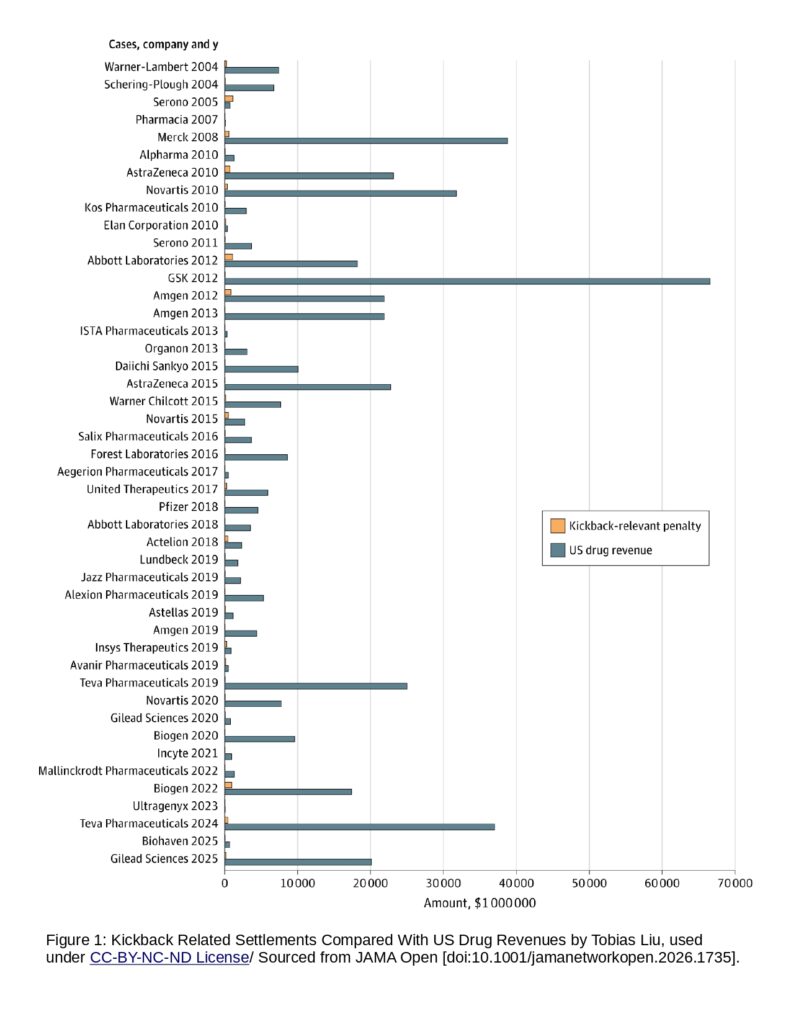
Settlements were varied based on settlement type and whether or not the company had multiple alleged AKS violations. Four settlements were more than 25% of US revenue, including 3 that involved criminal settlements. Cases involving only civil settlements averaged 1.9% of US revenue, while cases involving both civil and criminal settlements averaged 6.6%. Settlements involving companies that had multiple alleged AKS violations averaged 1.1% of US revenue compared to 3.5% for single violation settlements.
The authors acknowledge several limitations to the current study. The findings relied on revenue rather than profit. Some kickback penalty amounts were not reported. Some cases had incomplete US revenue data. Long-term revenue generated by altering prescription patterns through kickback schemes could not be accounted for.
The authors conclude: “To further deter AKS violations, increasing penalties to the statutory maximum or instituting stronger sanctions targeted at individuals involved may be needed.”
Industry Payments Likely Influence Psychiatry at Every Level
In addition to illegal kickbacks, and legal payments to physicians that some experts argue could actually violate the AKS, industry uses its considerable resources to bias medical professionals at every level. Research has found that most psychopharmacology textbook authors have received industry payments. This means the materials used to educate aspiring psychiatrists are, to some extent, biased by industry money. Pharmaceutical companies also commonly make payments to authors in academic journals, as well as peer reviewers, biasing evidenced based medicine and clinical indications that rely on that research. Industry payments to FDA advisers create conflicts of interest for regulators while payments to DSM panel members call into question the entire basis of the biomedical model of mental “illness.” Studies have found that industry pays doctors and patients to market drugs on social media. Patient advocacy groups are also commonly funded by industry money, raising the question of whether they are acting in the best interest of patients or pharma’s bottom line.
****
Liu, T., Ross, J. S., Morten, C. J., & Ramachandran, R. (2026). Pharmaceutical Manufacturer Kickback Resolutions and Associated Financial Penalties, 2000-2025. JAMA Network Open, 9(3). (Link)











Two things are needed to result in change. First, industry payments to Congress have to be curtailed. Second, pharmaceutical executives have to receive prison sentences.
Neither of these things are going to happen. So, it’s hopeless in my opinion.
Report comment
The situation will remain hopeless as long as the current economic system and corporatist political establishment, with the complicity of the venal compliant mainstream media and various institutions of social control (of which the mental health field is an integral part), are able to manipulate public perception. Severe external and internal crises such as war and financial collapse may alter mass attitudes, but the outcome of this shift will by no means be certain. The fall of the Weimar Republic exemplifies one possible scenario.
Report comment
I am a former healthcare worker- I believe 100% of this article. Completely corrupt system including dentists. I am now retired with serious health issues from being on my feet all my life and almost all they do is gaslight and push pills $$$$$ (treat symptoms only)
Report comment
Love your reporting, Richard. Keep it coming!
Report comment
Thank you for reporting on this important issue in American Corporate Health. No need to add “Care” to the equation. We have taken a giant leap away from that model.
Report comment