
I have been aware of patient rights since I began working as a Certified Peer Specialist in 2006. I had the privilege of serving as emcee at an M-POWERed event at the statehouse in 2009, and participated in testimony related to Massachusetts’ Restraint and Seclusion Initiative around the same time. I worked for a year at The Transformation Center, a wing of M-POWER, the now-defunct grassroots political organization that secured Massachusetts mental health patients their six fundamental rights on psych units. I knew each of the six fundamental rights by heart (humane environment, daily private visitors, professional communications, uncensored mail, phone access, and outdoor access), but after becoming a peer specialist, I rarely experienced psychiatric hospitalization myself and had little opportunity to see how well those rights were upheld.
During a manic episode in late 2025, I felt little fear about voluntarily admitting myself to my local psych hospital because I assumed my rights would be respected. After a single weekend, I was astonished by the poor implementation of the six fundamental rights, and my mental state deteriorated as a direct result of the psych unit’s inability to uphold even the most basic of those rights.
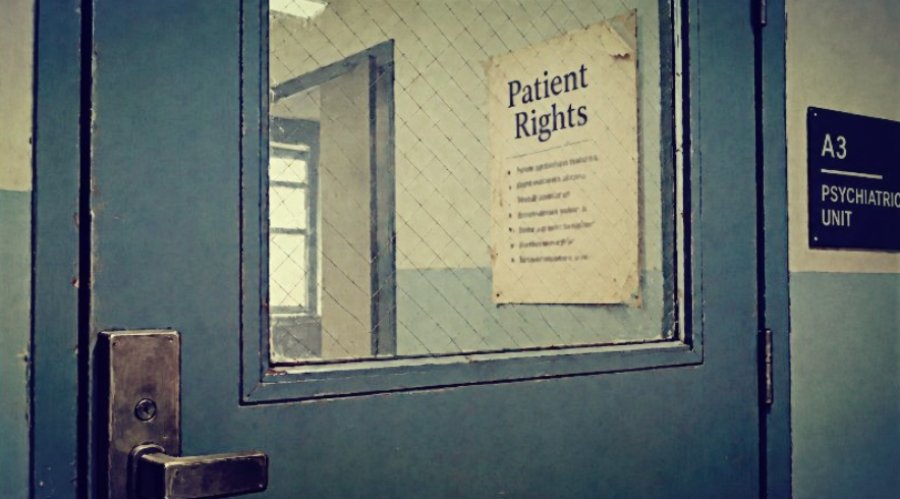
Feeling sure that I could manage my mania and medication on my own, I asked for an immediate discharge, which was not granted (I signed a three-day but was told I would be taken before a judge — recalling my commitment in 2002 where the judge took one look at me and committed me without asking me a single question or providing me an opportunity for defense, I was hesitant to trust the local courts). Reviewing the rights board in the hallway, I vocally indicated to the staff where their policy deviated from state law, and I was met with disregard that devolved to disdain. Trapped and contemplating how to either exercise my rights or win my freedom to return to the community, I took comfort in the fact that at least the newest of the six fundamental rights, the right to fresh air, was being honored (though without access to cigarettes, which continually annoyed the other patients).
My first effort towards garnering assistance was to speak privately with my parents about my concerns, including the psych doctor’s stubborn refusal to discuss my discharge, but I was met with deprivation as my right to receive daily visitors of my own choosing, in private and at reasonable times, was immediately trampled. My elderly parents, who have vision problems and live over an hour away from the hospital, politely requested an earlier visiting time, in the early afternoon. The established visiting hours were 6pm-8pm (after the sun has set in late-autumn New England) which prevented my parents from ever having an extended visit with me during my entire psych ward stay considering they could not drive at night. They merely dropped off clothes, my phone, and a book and then left.
My next attempt was to have a private conversation with my mother about how I might secure a discharge, but I was met with another right denied when I was told I needed a “prescription” from the psych doctor for a private phone call (which she did not grant). I was told that even if I did get the “prescription phone call,” a staff member might be required to stand in the room (no one explained how the conversation could remain private with a staff member in the room). My mother insisted on having this phone conversation, being as upset as I was that they would not let me leave. I was left with two options: I could either call my mother from the crowded cafeteria during my allotted 30 minutes of daily cell phone access (with another staff member sitting five feet away with a sign-in sheet pretending not to listen as I whispered over the other 15 local phone conversations), or I could call my mother from one of the two “very private” payphones, each about seven feet from the staff office in the “secluded” hallway that everyone needed to walk through to arrive at the cafeteria or the TV room.
Reading the patients’ rights board, I noticed an unnumbered set of rights including the “right to know why you are being held on the psych unit and the stipulations for your discharge.” Waiting the entire evening, I knew I could question my assigned psych doctor the next day. Working with this doctor became a chore. She would devote barely two minutes to speaking with me regardless of my concerns, and refused to meet with me at all one day even though another staff member assured me she was required by state law to see me every day of the regular week (Monday through Friday). When I found myself sitting across from her on the mass-produced pleather chair and explained how I would manage my condition and why I believed I would benefit from being discharged to the community, she offered only a vague refusal. When I referenced the rights board and my right to know why I was being held and what the stipulations were for my discharge, the response was cagey and ambiguous. Examining my incarceration, I could find no escape. The walls felt five feet closer the second I stood up.
The following day, a holiday, I was assigned a random doctor as my obstinate psychiatrist enjoyed her celebration at her home in freedom. I explained the entire situation to this other doctor, who offered me the dignity of meeting with me for a full 30 minutes and addressing every individual concern. This doctor completely agreed with me and said she would immediately put in the paperwork for me to switch to the other unit psych doctor: 10 days later. I felt forlorn waiting 10 more days held against my will on a psych ward as I hoped with my entire being that the other psych doctor on the unit would be more reasonable than the one who denied me at every turn. The following morning, when I awoke, nothing had changed.
I participated in all the usual unit activities while contemplating a way out. Mid-day, the nurse said she needed me at the medication window, which perplexed me considering I was only prescribed nighttime medications. Arriving at the window, she handed me a small plastic cup with a single unidentifiable pill and instructed me to swallow. I reminded her I wasn’t prescribed any noontime medications and she informed me that the psych doctor (who I was already drastically disagreeing with) had written an order for me to take a PRN anxiety medication if necessary. I informed her that I did not consent, I was not anxious and I would be exercising my right to decline medications I did not wish to take. Indifferent to my decision, she insisted, in response to which I simply walked away.
I spent the next two minutes energetically walking away from the med nurse as she followed me around the unit demanding I take the anxiety medication, endeavoring to convince me that she was more aware of my anxiety than I was. I became alarmed when the single nagging nurse swelled to a crowd of eight staff members cornering me in my room, demanding I take the pill. I stood silently surrounded with the little plastic cup in my hand. A lone loose pill. Four short women stood in a row in front of four tall men, the middle two men being uniformed security guards (possibly armed somehow). They prevented me from exiting my room, silently staring me down as I held their demand in my hand: a lone unnamed pill.
“What is the criteria for forced drugging?” I asked. The hollowness of the room resounded. “What is the criteria for forced drugging,” I repeated. Nothing. No response. Quickly considering the situation, I calculated the odds and decided that eight adult staff members versus one cornered mental patient was a losing proposition, and voiced “I do not willingly consent to take this pill” before swallowing the pill and handing the staff the small plastic cup.
I awoke the next day convinced I could not spend another second in this psych prison. I scoured the patients’ rights board for any possibility of assistance. Written in bold black letters there was a triune hope: the human rights officer; the patient’s rights advocate; the disability law center. I wrote down their phone numbers and spent the next three days calling them all multiple times, leaving multiple messages concerning my situation and the method for reaching me. I heard nothing back.
My next effort was to write my grievances on a small slip of scrap paper and insert the summary into the complaints box. I was met with the resistance of a mass of compacted paper as the complaints box was so full that I had to jam my complaint in with a book. When I questioned the staff about when the complaint box is actually checked, they smiled, simply saying, “Never. I don’t think I have ever seen anyone check the complaint box once.” This was typical of my entire experience on the psych ward.
Desperate, the next day I decided to write a list of every right denied to me while I stayed on this psych unit. I used my limited 30 minutes with my cell phone acquiring the mailing addresses of local newspapers to send them physical mail concerning the rights abuses on this unit. After I wrote my simple appeal, I went to the staff office stating that I needed to use their photocopier and I planned on sending some mail (per my patient’s right) that I did not want them reviewing. They informed me they would photocopy my letter, they would place my letters in the respective envelopes and write the addresses and add the postage themselves (away from my vicinity): I am not sure this was a denial of my right to send uncensored mail but I in no way trusted the staff on the unit to honor their offer.
By this point, I was dejected. Hopeless for any release, I decided I would document every rights abuse occurring on the psych unit so I could take action once free in the community. The breaches of the right to a humane environment were too numerous to list here. My psych doctor still refused to be honest with me in relation to the stipulations for my discharge and I spent every day in a state of unknowing. My mental health was deteriorating as a result of my confinement on the psychiatric unit. The manic symptoms that originally led me to seek the psych unit’s help had subsided, but I felt that the unit itself was now crushing my soul. I meandered through the day in a state of hopelessness, unable to see any way out.
On my last night on the unit, oblivious of fate, I approached the medication window hesitant and drained. I took my medications and drank the cup of water and was surprised when the nurse called after me to turn around. She handed me a second cup, saying: “You forgot your Clozaril.” I looked in the cup and noticed two 50 mg pills and a third smaller pill. “This isn’t the right dose,” I said (I was prescribed 150 mg at the time).
“No, it is,” she insisted.
“No,” I showed her the cup. “That third pill isn’t a 50 mg,” I said, pointing.
Attending to other nurse duties in the medication room, she said, “No, it’s the right dose,” while not even looking in my direction.
I raised my intonation to assure her I was right about my assessment of my medications and she shot me down, simply telling me to just take my pills. I had been clashing with the staff on the unit for days, being fairly forward about the rights they were denying me and other patients, and by this point the staff had no empathy for me. “Just take your pills, please,” she said, organizing the next client’s medications and not even looking towards me.
My entire will withered and I took the pills, beaten and without hope. I walked to the TV room and sat down to be quiet by myself. I felt this unit crushed the human soul and I had lost: period.
A friend came and sat down next to me as my entire body began to tingle and I quickly thought of the rogue pill. I realized I had no idea what that pill actually was, and as I stood up, feeling ripples all over my body, I feared that the nurse purposely gave me the wrong pill as a lark. I told my friend, “I think they dosed me” and got up and walked to the nurse’s station quickly. I told the nurse I didn’t feel well and she grabbed the blood pressure cuff and brought it to me to test my blood pressure. I collapsed on the floor. For several seconds I felt dizzy and lacking strength flattened me to the tiles. I had no strength, and the hallway I could see from my position on the floor was rocking as if on an ocean. I suddenly gained the strength to stand again but my breathing became labored. The hyperventilating manifested dizziness as I walked in any direction away from the nurse who was trying to calm me as I felt a deep distrust in her. A code was called and I was rushed to the ER in the same building.
I was attached to an oxygen machine and given IV drugs to assist my circulatory system. Nurses stood next to my ER bed and asked me which limbs I could feel and which limbs I could not as the sensation in my extremities retreated and recovered in waves for over one hour. Eventually I completely lost the ability to move as my entire back felt the pain of extra sensation: the ER nurse was tasked with rolling me back and forth into different angles and putting pillows under me to assuage the pain as I lost the ability to move of my own strength. I found the ER staff’s insistence on lifting my eyelids and shining flashlights into my pupils irritating but I did not have the volition to verbally or physically protest. Eventually, I lost my entire connection to my physical being and temporarily inhabited the empty space of my nebulous intellect. My thoughts echoed in the profound blackness and every other bodily sense became a memory. I resided in a hollow void for an unestablished amount of time.
The next morning, while being interviewed by the ER doctor, I vehemently voiced that I refused to go back on that psych ward because the med nurse was inept: she either purposely bungled my pills or the error was due to incompetence! Either way, I refused to take another dose of medication from that psychiatric unit staff. I was sent to another psych hospital, which was a breath of fresh air, where the doctors were transparent and I was discharged quickly. Apparently, the conditions for my release, which my psych doctor neglected to inform me of, were that my lungs needed to stop working and my cardiovascular system had to collapse.
Immediately upon arriving home I submitted a seven-page complaint. I assure you there is much I had to leave out of this story considering word count stipulations. When I received the judgment about a month later, my hopes for justice dissolved to dejection as I became aware that the accused psych unit was allowed to investigate themselves! No neutral third party was involved!
As I read the findings of the “investigation” a pattern appeared: the accused psych unit’s defense consisted of either ignoring specific accusations completely or fabricating information entirely. The doctor who would only ignore me in two-minute increments asserted she set aside 45 minutes to see me every day (which I assume she billed for), and the human rights officer who never responded to my messages had documented that she met with me on multiple occasions. No mention was made of the forced drugging. You can only imagine the myriad of falsehoods that filled the file.
I promptly typed up a two-page appeal highlighting the fabrications. The response to my appeal did not address my claim that false statements had concealed what really happened on the unit, but did agree with my accusation in relation to the “investigation” that I, personally, was never interviewed during the entire inquiry. The hospital would be forced to interview all complainants in the future but that change would not apply to my case. When I spoke with a DMH human rights officer and asserted the psych unit’s lies, he responded simply: “It’s a matter of ‘he said, she said’,” and said there was nothing they could do. When I talked to the DMH human rights officer a second time he hinted, “Well, considering you are the psych patient, they’ll probably just assume you are the one lying.”
Looking back on the entire experience, I find myself gazing into the void that is patients’ rights on psych units. I am comforted that at least the rights exist on paper, somewhere proudly displayed in the hallway, framed and in bold script, as the staff and clients walk by them every day. Perhaps some state legislators have even heard that these rights were passed into law sometime in the not-so-distant past. Indication and implementation are two entirely different acts. Maybe someday the complaint process for psychiatric patients’ rights will actually have teeth. For now, patient rights remain a phantom that haunts the halls as patients scream about their rights being violated, only to be judged by the very staff who are culpable. Staff who are concerned only with volume as they ensure routine control on psych units across the Commonwealth. I will manage my symptoms in the community from this point forward.