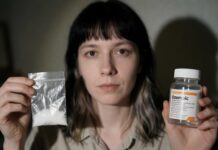
Marketing GLP-1 Drugs for Addiction: Why Critics Are Skeptical
The question surrounding GLP-1RAs is not simply whether they can change the brain, but whether that is enough to change the life around it.

Mad in the World at the Mad in Norway International Film Festival
Mad in the World Liaison Karin Jervert reflects on the powerful experiences of helping to organize and attending the Mad in Norway International Film Festival in Lillehammer, Norway.

Don’t Let Barbie Out of the Glovebox – An OCD Account
It’s easy to cling to my diagnosis for comfort. In fact, externalizing obsessions the way you would an alien invasion or a metastasized tumor is a foundational part of OCD’s gold standard of treatment.

Psychiatric Drugs and Violence: What Can Genetics Tell Us? A Conversation With Selma Eikelenboom
Brooke Siem speaks with Selma Eikelenboom, together they explore what questions her research raises about the relationship between psychoactive drugs, genetic variation, and violence.

Lillehammer’s “Other” Olympics: The Mad in Norway International Film Festival
This was a weekend of movies, art, conversation, and camaraderie. But more than that, it was an infusion of strength.

Didn’t Anyone Tell You It Is Okay to Be Different?
At the Mad in Norway film festival, it struck me that people agreed that mental health needs to be systematically reformed, with more emphasis on psychosocial interventions.

The New York Times Fails Our Veterans
Yet another New York Times article on psychiatry misses the mark

Getting Rid of the Pain Before Answering Its Questions: Psychiatry’s Damage to Self and...
By answering questions that pain asks, one can rediscover one’s true self. If you get rid of pain before you have answered its questions, you get rid of the self along with it.

Meeting Persephone: A Katabasis of Bipolar Night
One doctor advised, “Do not listen to the voices!” Yet I yearned for them—the dreams, the poetic signs, the strange illuminations where the streets shed their names.

From Efficacy to Non-Efficacy: Lessons from Pediatric Fluoxetine Trials
Modern studies find that fluoxetine has lost its efficacy for children and can now be considered clinically equivalent to placebo.

The VA’s New Prescribing Safety Reforms Are a Start – Here’s What’s Still Missing
On Monday, September 28, U.S. Department of Veterans Affairs (VA) Secretary Doug Collins announced actions the VA will take to address mental health prescribing...

My $100,000 Life Sentence
One word turned my entire life upside down and nearly convinced me to end it. What was that one word? Borderline.

The BMJ Refused to Publish Criticisms in Print of its Highly Misleading Suicide Prevention...
Journal editors should change their practices profoundly. They should welcome academic debate instead of censoring it.

Soteria Model Linked to Lower Psychiatric Readmission Rates, Study Finds
The Soteria care model is an alternative to restrictive inpatient psychiatric care for people experiencing psychosis in which patients and service users stay in...

The ODDESSI: Open Dialogue, The Lancet, and a Trojan Horse
DESSI trial results provide a beginning for rethinking psychiatric care

Open Dialogue and ODDESSI: What Have We Learned?
I found Open Dialogue to be a compelling and deeply humane way of working but I also learned how hard it is to implement and sustain.

The Abyss and Beyond
Psilocybin seemed less interested in helping me avoid the abyss than in showing me that there was an entire landscape beyond it.

When Stopping Prescription Drugs Is Hard: Alicia Martin and the TaperMate Story
Alicia Martin is an Australian community pharmacist and the creator of an ingenious mobile app, TaperMate, which aims to help people with hyperbolic drug tapering and prescribed drug withdrawal.

Clancy’s Lawyer Blew the Chance for Lindsay to Go Free
If there is a second trial for Lindsay, I hope her lawyer puts a psychopharmacologist or neurotoxicologist on the stand.

Pharmaceutical Industry Corruption Is Structural, Systemic, and Profitable, New Review Finds
A new empirical review published in the Journal of Law, Medicine & Ethics reports that pharmaceutical industry corruption is a structural, industry-wide problem. Author...

Open Dialogue Approach Cuts Psychiatric Hospital Use in Major Trial
The ODDESSI trial found that people’s reported recovery, quality of life and satisfaction with services improved with Open Dialogue.

Antidepressants Are Major Drivers of Suicides
For almost 40 years, psychiatric leaders have denied that antidepressants increase suicides despite overwhelming evidence.

A Call for a Paradigm Shift in Schizophrenia Treatment: Reassessing Long-Term Antipsychotic Use and...
The cumulative evidence challenges the assumption that lifelong antipsychotic treatment is necessary or beneficial for most individuals with schizophrenia.

What I Learned After Losing My Partner to Polypharmacy
I am left with questions that cannot be resolved retrospectively. Why were medications added without clear longitudinal review of cumulative exposure?

Remembering Dory Previn: An Interview by Peter Sterling in 1974
Dory Previn was an American lyricist, singer-songwriter, and poet whose deeply personal work explored her struggles with mental health, including experiences of psychosis. In October 1974, she met with neuroscientist Peter Sterling for a candid conversation about her psychiatric treatment.